
Medical Marijuana Market Size, Share and Trends 2026 to 2035
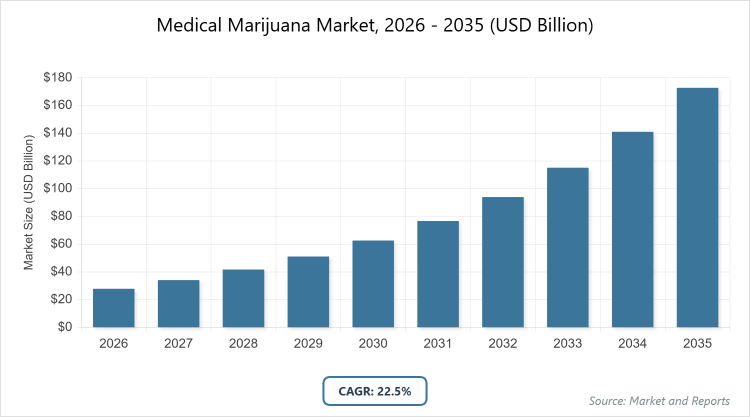
According to MarketnReports, the global Medical Marijuana market size was estimated at USD 27.81 billion in 2025 and is expected to reach USD 211.54 billion by 2035, growing at a CAGR of 22.5% from 2026 to 2035. Medical Marijuana Market is driven by increasing legalization and growing acceptance of cannabis for therapeutic applications.
What is the Industry Overview of Medical Marijuana?
The medical marijuana market involves the regulated use of cannabis and its derivatives for therapeutic purposes, addressing conditions like chronic pain, epilepsy, and anxiety through products such as oils, edibles, and flowers prescribed or recommended by healthcare professionals. This market is influenced by evolving legal frameworks that permit controlled access for medical use, focusing on quality, safety, and efficacy. Market definition refers to the lawful production, distribution, and consumption of cannabis-based products intended for medical treatment, driven by clinical research, patient demand, and shifts away from traditional pharmaceuticals toward natural alternatives.
What are the Key Insights into Medical Marijuana?
- The global Medical Marijuana market size was estimated at USD 27.81 billion in 2025 and is expected to reach USD 211.54 billion by 2035.
- The market is expected to grow at a CAGR of 22.5% during the forecast period from 2026 to 2035.
- The market is driven by expanding legalization, rising prevalence of chronic diseases, and increasing awareness of cannabis therapeutic benefits.
- In the product type segment, dried flowers dominate with a 45% share due to their direct use and high potency for immediate relief.
- In the application segment, pain management holds the largest share at 85% because of its effectiveness in treating chronic and neuropathic pain.
- In the end-user segment, pharmacies dominate with 50% share owing to regulated distribution and patient access through prescriptions.
- North America dominates the market with a 76% share, attributed to widespread legalization and advanced healthcare infrastructure in the United States.
What are the Market Dynamics in Medical Marijuana?
Growth Drivers
Growth drivers for the medical marijuana market include progressive legalization in numerous countries, enabling broader access and reducing stigma around cannabis use for health purposes. Increasing clinical evidence supporting its efficacy for conditions like chronic pain and epilepsy encourages physician prescriptions and patient adoption. Rising prevalence of chronic illnesses, coupled with preferences for natural remedies over opioids, further accelerates demand, while investments in research and product development enhance formulation safety and variety.
Restraints
Restraints encompass varying regulatory environments across regions, creating barriers to market entry and interstate commerce. High production costs and quality control requirements for pharmaceutical-grade cannabis strain smaller operators. Limited insurance coverage and ongoing federal restrictions in key markets like the U.S. hinder accessibility, while public misconceptions and lack of standardized dosing protocols slow mainstream integration.
Opportunities
Opportunities arise from potential federal rescheduling and international trade agreements, which could streamline operations and expand markets. Advancements in cannabinoid isolation and synthetic alternatives offer new therapeutic applications, targeting underserved conditions. Emerging economies in Asia-Pacific and Latin America present growth through initial medical legalization, while partnerships with pharmaceuticals for drug development promise innovative, patented treatments.
Challenges
Challenges include navigating complex compliance with diverse regulations, risking legal penalties and operational disruptions. Supply chain vulnerabilities, from cultivation to distribution, affect product consistency amid weather and pest issues. Competition from black markets undercuts pricing, while insufficient long-term clinical data limits broader medical acceptance and reimbursement.
Medical Marijuana Market: Report Scope
| Report Attributes | Report Details |
| Report Name | Medical Marijuana Market |
| Market Size 2025 | USD 27.81 Billion |
| Market Forecast 2035 | USD 211.54 Billion |
| Growth Rate | CAGR of 22.5% |
| Report Pages | 220 |
| Key Companies Covered |
Curaleaf Holdings Inc., Trulieve Cannabis Corp, Green Thumb Industries Inc., Cresco Labs Inc., Tilray Brands Inc., Canopy Growth Corporation, Aurora Cannabis Inc., Organigram Holdings Inc., Cronos Group Inc., MedMen Enterprises Inc., and Others |
| Segments Covered | By Product Type, By Application, By End-User, and By Region |
| Regions Covered | North America, Europe, Asia Pacific (APAC), Latin America, and The Middle East and Africa (MEA) |
| Base Year | 2025 |
| Historical Year | 2020 – 2024 |
| Forecast Year | 2026 – 2035 |
| Customization Scope | Avail customized purchase options to meet your exact research needs. |
The Medical Marijuana market is segmented by product type, application, end-user, and region.
Based on Product Type Segment, dried flowers is the most dominant subsegment, holding approximately 45% market share, followed by oils & tinctures as the second most dominant. Dried flowers dominate due to their versatility in consumption methods and high bioavailability for rapid symptom relief, driving the market by catering to patient preferences for traditional forms and supporting diverse medical applications; oils & tinctures follow, providing precise dosing and discreet use, contributing to growth through integration in pharmaceuticals and edibles.
Based on Application Segment, pain management is the most dominant subsegment with around 85% share, while neurological disorders ranks second. Pain management leads because of cannabis’s analgesic properties proven effective for chronic conditions, driving market growth via reduced opioid reliance and regulatory approvals; neurological disorders follows, addressing epilepsy and multiple sclerosis, expanding the market through specialized treatments and research advancements.
Based on End-User Segment, pharmacies dominate with about 50% share, with hospitals as the second dominant. Pharmacies’ dominance stems from their role in regulated dispensing and patient education, propelling the market through accessible distribution channels; hospitals follow, utilizing cannabis for inpatient care, sustaining growth via clinical integrations.
What are the Recent Developments in Medical Marijuana?
- In October 2025, Tilray Brands expanded its medical cannabis portfolio with new high-CBD strains approved for epilepsy treatment in Europe.
- In November 2025, Curaleaf Holdings acquired a research firm to advance cannabinoid-based therapies for mental health disorders.
- In December 2025, Canopy Growth Corporation launched a new line of medical edibles in Canada, focusing on pain management.
- In January 2026, Aurora Cannabis partnered with a pharmaceutical company for clinical trials on cannabis for Alzheimer’s.
- In early 2026, Green Thumb Industries received FDA approval for a cannabis-derived drug for chronic pain.
How Does Regional Analysis Impact Medical Marijuana?
- North America to dominate the global market.
North America holds the largest share, propelled by extensive legalization in the U.S. and Canada, robust R&D, and high patient adoption for therapeutic use. The United States dominates the region with over 30 states permitting medical cannabis, supported by federal rescheduling efforts, significant investments in clinical studies, and a mature dispensary network ensuring accessibility and innovation in treatments.
Europe ranks second, driven by progressive policies in Germany and the UK, emphasizing medical research and pharmaceutical integrations. Germany leads with its comprehensive insurance coverage for cannabis prescriptions, fostering a regulated market that encourages exports and collaborations for standardized products.
Asia-Pacific emerges rapidly, fueled by medical legalization in Thailand and Australia, addressing regional health needs. Thailand dominates through government-backed cultivation and tourism-integrated medical programs, promoting affordable access and research into traditional applications.
Latin America grows steadily, with Uruguay and Mexico pioneering reforms for medical access. Mexico leads via recent legalization, leveraging agricultural strengths for domestic supply and potential exports to North America.
The Middle East and Africa show nascent development, primarily in Israel and South Africa for research-driven markets. Israel dominates with its advanced R&D ecosystem, exporting medical cannabis globally and influencing therapeutic standards.
Who are the Key Market Players in Medical Marijuana?
Curaleaf Holdings Inc. focuses on acquisitions and R&D for high-potency medical strains, expanding U.S. dispensaries.
Trulieve Cannabis Corp. emphasizes vertical integration for quality control in medical products, targeting pain management.
Green Thumb Industries Inc. invests in pharmaceutical partnerships for cannabinoid drugs, enhancing mental health offerings.
Cresco Labs Inc. pursues innovation in edibles and topicals for targeted therapies, strengthening European presence.
Tilray Brands Inc. leverages global mergers for diversified medical portfolios, focusing on epilepsy treatments.
Canopy Growth Corporation adopts sustainability in cultivation, developing CBD-focused medical lines.
Aurora Cannabis Inc. concentrates on clinical trials for neurological disorders, optimizing production costs.
Organigram Holdings Inc. innovates in dissolvable powders for precise dosing in medical applications.
Cronos Group Inc. invests in synthetic cannabinoids for patented therapeutics, targeting emerging markets.
MedMen Enterprises Inc. focuses on retail expansions for accessible medical distribution.
What are the Market Trends Shaping Medical Marijuana?
- Increasing adoption of CBD-dominant products for non-psychoactive therapies.
- Expansion of clinical trials for new applications like Alzheimer’s and PTSD.
- Shift toward sustainable and organic cultivation practices.
- Growth in online and pharmacy distribution channels.
- Integration of cannabis in pharmaceutical drug development.
- Rise in personalized medicine with strain-specific treatments.
- Focus on child-resistant and tamper-proof packaging.
- Emergence of transdermal and sublingual delivery methods.
- Collaborations between cannabis firms and healthcare providers.
- Emphasis on regulatory compliance and quality standardization.
By Product Type
-
- Dried Flowers
- Oils & Tinctures
- Capsules & Tablets
- Concentrates
- Edibles & Beverages
- Topicals
- Powders & Dissolvables
- Vapes
- Transdermal Patches
- Suppositories
- Others
By Application
-
- Pain Management
- Neurological Disorders
- Mental Health
- Cancer
- Arthritis
- Epilepsy
- Multiple Sclerosis
- Nausea and Vomiting
- Sleep Disorders
- Muscle Spasms
- Others
By End-User
-
- Pharmaceutical Industry
- Research and Development Centres
- Hospitals
- Rehabilitation Centers
- Pharmacies
- Patients
- Clinics
- Online Platforms
- Dispensaries
- Homecare Settings
- Others
By Region
-
- North America
- U.S.
- Canada
- Europe
- UK
- Germany
- France
- Rest of Europe
- Asia Pacific
- China
- India
- Japan
- Rest of Asia Pacific
- Latin America
- Brazil
- Mexico
- Rest of Latin America
- Middle East & Africa
- UAE
- South Africa
- Rest of Middle East & Africa
- North America
Chapter 1. Preface
Chapter 2. Executive Summary
Chapter 3. Global Medical Marijuana Market - Industry Analysis
Chapter 4. Global Medical Marijuana Market- Competitive Landscape
Chapter 5. Global Medical Marijuana Market - Product Type Analysis
Chapter 6. Global Medical Marijuana Market - Application Analysis
Chapter 7. Global Medical Marijuana Market - End-User Analysis
Chapter 8. Medical Marijuana Market - Regional Analysis
Chapter 9. Company Profiles
Frequently Asked Questions
Medical marijuana refers to cannabis and its derivatives used for therapeutic purposes to treat conditions like pain, epilepsy, and anxiety under regulated medical supervision.
Key factors include legalization expansions, clinical research advancements, rising chronic disease prevalence, and shifts toward natural therapies.
The market value is projected to grow from USD 27.81 billion in 2025 to USD 211.54 billion by 2035.
The market is expected to grow at a CAGR of 22.5% during the forecast period from 2026 to 2035.
North America will contribute notably, holding the largest share due to extensive legalization and infrastructure.
Major players include Curaleaf Holdings Inc., Trulieve Cannabis Corp, Green Thumb Industries Inc., Cresco Labs Inc., and Tilray Brands Inc.
The report provides comprehensive analysis including size, trends, segmentation, regional insights, key players, and forecasts.
Stages include cultivation, extraction, formulation, testing, distribution, and prescription to patients.
Trends favor CBD products and personalized treatments, with preferences shifting to discreet, non-smoking forms like edibles and oils.
Legalization reforms and sustainability mandates are boosting growth, while varying regulations pose challenges.