
Mechanical Face Seals Market Size, Share and Trends 2026 to 2035
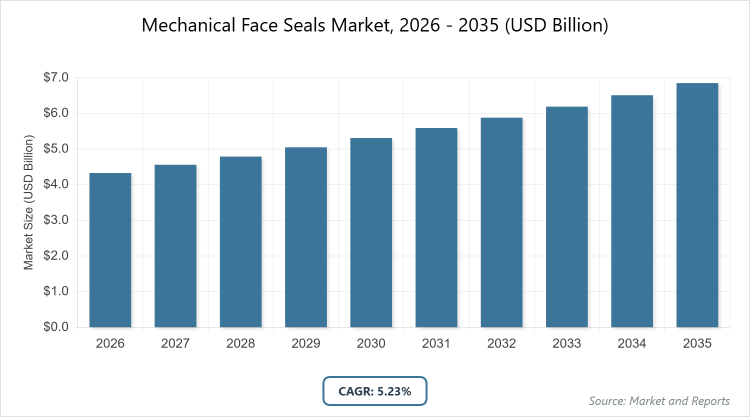
According to MarketnReports, the global Mechanical Face Seals market size was estimated at USD 4.33 billion in 2025 and is expected to reach USD 7.21 billion by 2035, growing at a CAGR of 5.23% from 2026 to 2035. Mechanical Face Seals Market is driven by rising industrial automation and the increasing need for reliable, energy-efficient sealing solutions in rotating equipment.
What are the Key Insights for Mechanical Face Seals Market?
- The global mechanical face seals market was valued at USD 4.33 billion in 2025 and is projected to reach USD 7.21 billion by 2035.
- The market is expected to grow at a CAGR of 5.23% during the forecast period 2026-2035.
- The market is driven by increasing industrial automation, stringent emission regulations, and growing demand for energy-efficient sealing solutions.
- Single mechanical face seals dominate the product type segment with approximately 48% share due to their simplicity, cost-effectiveness, and suitability for standard applications.
- Balanced seals lead the seal design segment with around 55% share because of their ability to handle higher pressures and reduce wear.
- Pumps dominate the application segment with over 40% share owing to their widespread use in fluid handling across industries.
- Chemical industry holds the largest end-user segment share at approximately 35% due to extensive processing requirements involving corrosive fluids.
- North America dominates the regional market with around 40% share owing to established industrial infrastructure, strong automotive sector, and high regulatory compliance.
What is the Mechanical Face Seals Market Overview?
Mechanical face seals, also known as end-face mechanical seals, are precision-engineered devices designed to prevent leakage of fluids or gases between a rotating shaft and a stationary housing in equipment such as pumps, compressors, agitators, and mixers.
These seals operate by maintaining close contact between two highly flat surfaces—one rotating and one stationary—typically lubricated by a thin film of the process fluid or a barrier fluid.
They are critical components in ensuring operational safety, environmental compliance, and energy efficiency across industries handling hazardous, corrosive, or high-pressure media.
The market encompasses a wide range of seal configurations and materials tailored to specific operating conditions, including high temperatures, aggressive chemicals, and abrasive environments.
Market definition: Mechanical face seals refer to dynamic sealing devices that use opposing faces under controlled loading to create a leak-proof barrier in rotating machinery.
What are the Market Dynamics for Mechanical Face Seals Market?
Growth Drivers
The primary growth drivers include rising demand from the automotive and industrial sectors for leakage prevention and operational efficiency, coupled with strict environmental regulations mandating reduced emissions and fluid loss.
Expansion in oil & gas exploration, chemical processing, and pharmaceutical manufacturing further accelerates adoption.
Technological advancements in seal materials and designs that enhance durability and performance under extreme conditions, along with the global push for energy efficiency in rotating equipment, significantly boost market growth.
Increasing industrialization in emerging economies and the replacement of traditional packing seals with superior mechanical face seals also contribute substantially.
Restraints
High initial costs of advanced mechanical face seals, particularly cartridge and double seals, limit adoption in cost-sensitive markets.
Complex installation and maintenance requirements demand skilled personnel, increasing operational expenses.
Vulnerability to damage from dry running or improper handling can lead to premature failure, deterring some end-users.
Availability of alternative sealing technologies such as labyrinth or magnetic seals in specific applications poses competition.
Opportunities
Growing emphasis on sustainability opens avenues for eco-friendly, low-friction seals using advanced materials like diamond-like carbon coatings.
Integration of IoT and sensor-enabled smart seals for predictive maintenance presents significant potential.
Expansion in renewable energy sectors, water treatment, and food processing industries offers new application areas.
Rising demand for high-performance seals in electric vehicles and hydrogen applications creates lucrative opportunities.
Challenges
Volatility in raw material prices, especially for specialized alloys and ceramics, impacts manufacturing costs.
Intense competition among players leads to pricing pressures.
Counterfeit products in developing regions affect brand reliability.
Achieving zero-leakage performance in ultra-high-pressure or highly abrasive environments remains technically challenging.
Mechanical Face Seals Market: Report Scope
| Report Attributes | Report Details |
| Report Name | Mechanical Face Seals Market |
| Market Size 2025 | USD 4.33 Billion |
| Market Forecast 2035 | USD 7.21 Billion |
| Growth Rate | CAGR of 5.23% |
| Report Pages | 220 |
| Key Companies Covered |
John Crane, EagleBurgmann, Flowserve Corporation, AESSEAL, Parker Hannifin, Schaeffler, and Others |
| Segments Covered | By Product Type, By Seal Design, By Material, By Application, By End-User Industry, and By Region |
| Regions Covered | North America, Europe, Asia Pacific (APAC), Latin America, and The Middle East and Africa (MEA) |
| Base Year | 2025 |
| Historical Year | 2020 – 2024 |
| Forecast Year | 2026 – 2035 |
| Customization Scope | Avail customized purchase options to meet your exact research needs. |
How is the Mechanical Face Seals Market Segmented?
The Mechanical Face Seals market is segmented by product type, seal design, material, application, end-user industry, and region.
Based on Product Type Segment
Single mechanical face seals are the most dominant subsegment due to their simple design, lower cost, ease of installation, and suitability for a wide range of standard-pressure and non-hazardous applications, making them the preferred choice for pumps and general industrial machinery.
They drive market growth by serving as the entry-level solution that meets the needs of a majority of end-users while offering reliable performance and minimal maintenance.
Cartridge mechanical face seals rank as the second most dominant, gaining traction rapidly because of their pre-assembled nature that reduces installation errors and downtime, particularly in critical processes where reliability is paramount, thus driving market expansion in high-value industries.
Based on Seal Design Segment
Balanced seals dominate this segment as they can handle higher pressures with reduced heat generation and wear, making them ideal for demanding applications involving volatile or high-temperature fluids.
Their ability to maintain sealing integrity under varying conditions significantly drives overall market growth by enabling use in challenging environments.
Unbalanced seals are the second most dominant, favored in low-to-medium pressure scenarios due to lower cost and simpler construction, supporting market penetration in budget-constrained applications.
Based on Material Segment
Carbon remains the most dominant material owing to its excellent self-lubricating properties, chemical resistance, and favorable tribological characteristics that ensure long service life and minimal leakage.
It drives the market by being the standard material pairing (carbon vs. ceramic or metal) in most seals.
Ceramic is the second most dominant and fastest-growing due to superior hardness, corrosion resistance, and performance in abrasive or pure water applications, expanding adoption in pharmaceutical and food sectors.
Based on Application Segment
Pumps represent the most dominant application because they are the primary equipment requiring face seals across all industries for fluid transfer, with mechanical seals preventing leakage and ensuring process efficiency.
This subsegment drives market growth through sheer volume demand.
Compressors are the second most dominant, experiencing rapid growth due to increasing use in oil & gas, refrigeration, and air separation units where high-pressure sealing is critical.
Based on End-User Industry Segment
The chemical industry is the most dominant end-user due to extensive use of seals in handling corrosive, toxic, and volatile substances in reactors, pumps, and agitators, where failure is not an option.
It drives market growth through stringent safety and environmental requirements.
The pharmaceutical industry ranks second and is the fastest-growing owing to demand for contamination-free, high-purity sealing in sterile processes and compliance with GMP standards.
What are Recent Developments in Mechanical Face Seals Market?
- In January 2025, John Crane launched a new series of high-temperature mechanical face seals incorporating silicon carbide variants capable of operating above 300°C, targeting oil & gas downstream applications.
- EagleBurgmann introduced diamond-coated face seals in November 2024, offering 5x longer life in abrasive slurry pumping, gaining rapid adoption in mining and wastewater sectors.
- Flowserve Corporation expanded its cartridge seal portfolio in March 2025 with modular designs that reduce installation time by 60%, receiving strong orders from chemical processors.
- AESSEAL invested USD 25 million in a new UK manufacturing facility in 2025 focused on sustainable seal production using recycled materials and low-emission processes.
- Parker Hannifin acquired a specialized ceramic seal manufacturer in Q4 2024, strengthening its position in high-purity pharmaceutical sealing solutions.
Which Region Dominates the Mechanical Face Seals Market?
North America to dominate the global market.
North America holds the largest share in the mechanical face seals market due to its mature industrial base, presence of leading seal manufacturers, and high concentration of oil & gas, chemical, and automotive industries.
The United States is the dominating country, driven by substantial investments in shale gas extraction, refinery upgrades, and strict EPA regulations on fugitive emissions that mandate advanced sealing technologies.
Strong R&D capabilities and early adoption of innovative seal designs further solidify its leadership.
Europe maintains the second-largest share with Germany, the UK, and France leading due to robust engineering standards, booming pharmaceutical sector, and transition toward green energy requiring reliable seals in hydrogen and carbon capture applications.
Stringent EU environmental directives continue to drive replacement of older sealing systems.
Asia-Pacific is the fastest-growing region, led by China and India, fueled by rapid industrialization, expanding manufacturing capacity, and massive infrastructure projects requiring pumps and compressors.
Government initiatives in clean energy and water treatment accelerate seal demand.
Latin America shows moderate growth, primarily driven by Brazil’s oil & gas and mining sectors, while Middle East & Africa grows steadily through UAE and Saudi Arabia’s petrochemical investments and water desalination projects.
Who are the Key Market Players in Mechanical Face Seals Market?
- John Crane (Smiths Group) is the global leader with comprehensive portfolio strength, extensive service network, and focus on digital monitoring solutions; its strategy emphasizes innovation in dry-gas and high-pressure seals while expanding in emerging markets through acquisitions.
- EagleBurgmann (Freudenberg & Schaeffler joint venture) excels in engineered custom solutions for extreme conditions, pursuing growth through sustainability-focused products and strategic partnerships in oil & gas sectors.
- Flowserve Corporation maintains strong position through integrated pump-seal offerings and global service centers, with strategies centered on aftermarket services and expansion in water infrastructure projects.
- AESSEAL plc focuses on cost-effective, reliable cartridge seals and environmental solutions, achieving growth through patented water-management technology and aggressive expansion in Asia-Pacific.
- Parker Hannifin leverages material science expertise for high-performance seals, emphasizing R&D in smart seals and acquisitions to broaden industry coverage.
- Schaeffler Group combines bearing and seal technologies for integrated solutions, targeting automotive and industrial sectors with emphasis on electrification-compatible seals.
What are the Emerging Trends in Mechanical Face Seals Market?
- Rapid adoption of sensor-integrated smart seals enabling predictive maintenance and Industry 4.0 compatibility
- Shift toward dry-running and gas-lubricated seals to eliminate barrier fluid systems and reduce environmental impact
- Increasing use of advanced surface coatings (DLC, nanocrystalline diamond) for extended seal life in abrasive applications
- Development of seals compatible with hydrogen and carbon capture processes supporting energy transition
- Growing preference for modular and cartridge designs that minimize installation time and human error
- Rising demand for API 682 qualified seals ensuring compliance in oil & gas applications
- Integration of 3D-printed components for rapid prototyping and customized seal geometries
- Focus on biodegradable or low-friction materials to meet sustainability goals
What Market Segments and their Subsegments are Covered in the Mechanical Face Seals Report?
By Product Type
- Single Mechanical Face Seals
- Double Mechanical Face Seals
- Cartridge Mechanical Face Seals
- Others
By Seal Design
- Balanced Seals
- Unbalanced Seals
- Tandem Seals
- Others
By Material
- Carbon
- Ceramic
- Metal
- Elastomers
- Others
By Application
- Pumps
- Compressors
- Agitators
- Mixers
- Others
By End-User Industry
- Chemical
- Oil & Gas
- Pharmaceutical
- Food & Beverage
- Water & Wastewater
- Power Generation
- Others
By Region
- North America
- U.S.
- Canada
- Europe
- UK
- Germany
- France
- Rest of Europe
- Asia Pacific
- China
- India
- Japan
- Rest of Asia Pacific
- Latin America
- Brazil
- Mexico
- Rest of Latin America
- Middle East & Africa
- UAE
- South Africa
- Rest of Middle East & Africa
Frequently Asked Questions
Mechanical face seals are dynamic sealing devices that prevent fluid or gas leakage in rotating equipment by maintaining contact between a rotating and a stationary flat face under controlled loading, typically using spring or bellows mechanisms.
Industrial automation, emission regulations, energy efficiency requirements, technological advancements in materials, and expansion in chemical, oil & gas, and pharmaceutical sectors.
The market is projected to grow from USD 4.33 billion in 2025 to USD 7.21 billion by 2035.
The market will grow at a CAGR of 5.23% during 2026-2035.
North America will continue to contribute the largest share, while Asia-Pacific will show the highest growth rate.
John Crane, EagleBurgmann, Flowserve Corporation, AESSEAL, Parker Hannifin, and Schaeffler are the key players driving innovation and market expansion.
Comprehensive analysis of market size, trends, segmentation, competitive landscape, growth drivers, regional insights, and strategic recommendations for stakeholders.
Raw material suppliers (carbon, ceramics, metals), component manufacturers, seal assemblers, distributors, system integrators (pump/compressor OEMs), end-users, and aftermarket service providers.
Trends are shifting toward sustainable, smart, and low-maintenance seals with preferences for longer life, zero-emission performance, easy installation, and digital monitoring capabilities.
EPA fugitive emission standards, EU REACH regulations, API 682/683 qualifications, and global net-zero targets drive demand for high-performance, low-leakage sealing solutions.