
Marine Insurance Market Size, Share and Trends 2026 to 2035
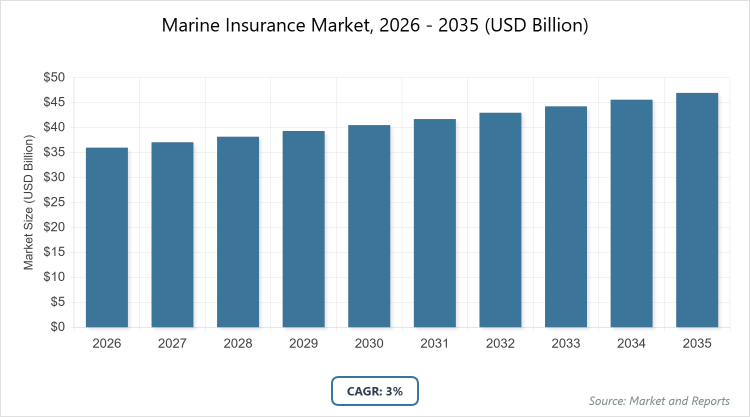
According to MarketnReports, the global Marine Insurance market size was estimated at USD 36 billion in 2025 and is expected to reach USD 48 billion by 2035, growing at a CAGR of 3% from 2026 to 2035. Marine Insurance Market is driven by rising global trade volumes, expanding maritime networks, and increasing risks from natural disasters, piracy, geopolitical tensions, and cyber threats.
What are the Key Insights in the Marine Insurance Market?
- The global Marine Insurance market was valued at approximately USD 36 billion in 2025 and is projected to reach USD 48 billion by 2035.
- The market is expected to grow at a CAGR of 3.0% during the forecast period from 2026 to 2035.
- The market is driven by escalating global trade, higher cargo volumes, regulatory compliance requirements, and heightened exposure to perils including natural disasters, piracy, geopolitical conflicts, and cyber risks.
- Cargo Insurance dominates the type segment with a 57.9% share as it covers a wide range of goods against theft, damage, accidents, and natural catastrophes in international supply chains.
- Wholesalers dominate the distribution channel segment with a 60.0% share because they manage large-scale, high-value shipments such as electronics and machinery that require comprehensive risk mitigation.
- Traders dominate the end-user segment due to their extensive involvement in global supply chains, high cargo risk exposure, and need for tailored policies including war risk and liability coverage.
- Europe dominates the global market with over 48.7% share owing to its long-standing maritime heritage, extensive shipping routes, advanced port infrastructure, stringent regulatory frameworks, and high trade volumes.
What is the Industry Overview of the Marine Insurance Market?
Marine insurance is a specialized form of insurance that protects against losses and liabilities arising from maritime activities. It covers vessels, cargo, freight, and related interests during sea transit, as well as liabilities to third parties. The market provides financial protection from perils of the sea such as collisions, grounding, fire, theft, jettison, piracy, and other risks including natural disasters and geopolitical events. It supports global trade by enabling ship owners, cargo owners, traders, and logistics providers to mitigate financial exposure in an industry vital to international commerce and supply chains.
What are the Market Dynamics of the Marine Insurance Market?
Growth Drivers
The Marine Insurance market experiences strong growth from surging global trade and cargo volumes, which increase the need for coverage against transit risks. Expanding maritime networks, including new shipping routes and port developments, further amplify demand. Regulatory mandates such as IMO conventions and liability laws compel operators to secure insurance. Advancements in digital tools like AI, blockchain, and IoT enhance risk assessment, underwriting, and claims processing. The rise of e-commerce drives more frequent shipments, while emerging sectors like offshore wind and LNG transportation create new coverage needs.
Restraints
Higher claim payouts from major incidents, such as ship accidents and infrastructure damage, lead to elevated premiums and potential financial strain on insurers. Geopolitical conflicts and piracy in key routes disrupt operations and increase risk perceptions, making coverage more expensive or limited in certain areas.
Opportunities
Opportunities arise from growth in offshore energy projects, port modernization, and e-commerce logistics in emerging regions. Digitalization enables innovative products like cyber marine insurance. Sustainability initiatives around decarbonization and green shipping introduce specialized coverage requirements. Strategic alliances and expansions in high-growth markets offer avenues for insurers to capture new business.
Challenges
Challenges include managing increased claims from climate-related events, ship accidents, and cyberattacks on ports and vessels. Geopolitical tensions raise war risk premiums and disrupt traditional routes. Insurers must adapt to evolving risks while maintaining profitability amid fluctuating fuel prices and regulatory changes.
Marine Insurance Market: Report Scope
| Report Attributes | Report Details |
| Report Name | Marine Insurance Market |
| Market Size 2025 | USD 36 Billion |
| Market Forecast 2035 | USD 48 Billion |
| Growth Rate | CAGR of 3% |
| Report Pages | 216 |
| Key Companies Covered | Allianz SE, American International Group Inc. (AIG), Aon plc, AXA S.A., Chubb Group Holdings Inc., Lloyd’s of London, Marsh & McLennan Companies Inc., Swiss Re Ltd, Zurich Insurance Group Ltd., and Others |
| Segments Covered | By Type, By Distribution Channel, By End User, and By Region |
| Regions Covered | North America, Europe, Asia Pacific (APAC), Latin America, and The Middle East and Africa (MEA) |
| Base Year | 2025 |
| Historical Year | 2020 – 2024 |
| Forecast Year | 2026 – 2035 |
| Customization Scope | Avail customized purchase options to meet your exact research needs. |
What is the Market Segmentation of the Marine Insurance Market?
The Marine Insurance market is segmented by type, distribution channel, end user, and region.
Based on Type Segment, Cargo Insurance is the most dominant segment with a 57.9% share because it addresses the broadest risks to goods in transit, including perishables, high-value items, and raw materials exposed to theft, damage, accidents, and natural disasters in global trade. Hull and Machinery Insurance ranks as the second most dominant segment as it protects vessel structures and equipment against physical damage, supporting fleet operators in maintaining operational continuity and is essential for ship owners facing high repair costs from maritime perils.
Based on Distribution Channel Segment, Wholesalers represent the most dominant channel with a 60.0% share since they handle bulk high-value consignments like electronics, machinery, and luxury goods that demand extensive coverage to protect against substantial financial losses. Retail Brokers are the second most dominant channel by offering personalized services and access to specialized policies for smaller clients, facilitating wider market penetration through tailored risk solutions.
Based on End User Segment, Traders are the most dominant end-user group due to their central role in global supply chains, high volume of shipments, significant exposure to cargo risks, and requirement for customized policies covering liability, war risks, and comprehensive transit protection. Ship Owners are the second most dominant segment as they require hull, machinery, and liability coverage to safeguard capital-intensive assets against operational and third-party risks.
What are the Recent Developments in the Marine Insurance Market?
- In January 2025, Policybazaar For Business introduced Enroute, a digital platform for marine and transit insurance that automates certificate generation and declarations to streamline processes for businesses.
- In September 2024, Sompo launched its national marine insurance offering in the UK, providing all-risks cargo and transport/logistics policies to meet growing demand in the region.
- In May 2024, Allianz Commercial and Rokstone unveiled a USD 10 million marine cargo facility to support global underwriting capabilities.
- In April 2023, Chubb expanded its marine business in Asia by appointing a Head of Marine in Malaysia and launching new products across 10 Asian nations including the Philippines.
- In March 2024, Marsh McLennan expanded its Unity facility in collaboration with the Ukrainian government and Lloyd’s to provide war risk insurance for non-military goods.
Which Region Dominates the Marine Insurance Market?
- Europe to dominate the global market.
Europe holds the leading position with over 48.7% share due to its centuries-old maritime tradition, dense network of major ports, high-volume international trade routes, presence of prominent insurers and brokers, and rigorous regulatory environment that enforces comprehensive coverage requirements.
North America shows strong growth particularly in the United States which commands over 86.8% of the regional market thanks to massive cargo throughput, advanced port infrastructure, e-commerce expansion, environmental regulations, climate vulnerabilities, offshore wind and LNG projects, port automation, and rising cybersecurity needs.
Asia Pacific benefits from rapid industrialization in countries like China, India, Japan, and South Korea, surging maritime traffic, port expansions, and explosive e-commerce growth especially in Southeast Asia where the sector is projected to expand significantly.
Latin America gains momentum through rising agricultural, mining, and energy exports, improving maritime infrastructure, and logistics enhancements in key countries like Brazil and Mexico.
Middle East and Africa leverages strategic shipping lanes, substantial oil exports, ongoing port investments, and regional trade growth despite challenges from political instability and piracy risks.
Who are the Key Market Players in the Marine Insurance Market?
- Allianz SE focuses on customized coverage, digital risk assessment tools, and global expansion in high-growth areas including Asia and offshore energy.
- American International Group Inc. (AIG) emphasizes comprehensive marine liability and cargo solutions with advanced claims processing and technology integration.
- Aon plc provides brokerage services with specialized risk management and analytics for maritime clients worldwide.
- AXA S.A. pursues alliances for marine liability and cyber coverage while expanding in emerging markets.
- Chubb Group Holdings Inc. strengthens its Asia presence through leadership appointments and product launches tailored to regional needs.
- Lloyd’s of London leads in specialty underwriting, war risk facilities, and innovative syndicates for complex marine exposures.
- Marsh & McLennan Companies Inc. develops facilities like Unity for war risk and supports clients with risk consulting and brokerage expertise.
- Swiss Re Ltd offers reinsurance support and focuses on emerging risks such as cyber and climate impacts in marine portfolios.
- Zurich Insurance Group Ltd. invests in digitalization and sustainable shipping coverage to address evolving industry demands.
What are the Market Trends in the Marine Insurance Market?
- Increasing frequency and severity of ship accidents driving higher claims and premiums.
- E-commerce growth leading to more frequent, smaller shipments and elevated transit risks.
- Geopolitical tensions disrupting routes and boosting demand for war risk and piracy coverage.
- Rising cybersecurity threats prompting specialized cyber marine insurance products.
- Adoption of AI, blockchain, and IoT for improved underwriting, tracking, and claims efficiency.
- Sustainability push toward green shipping and decarbonization creating new coverage requirements.
What Market Segments and Subsegments are Covered in the Report?
By Type
- Cargo Insurance
- Hull and Machinery Insurance
- Marine Liability Insurance
- Offshore/Energy Insurance
- Others
By Distribution Channel
- Wholesalers
- Retail Brokers
- Others
By End User
- Ship Owners
- Traders
- Others
By Region
- North America
- U.S.
- Canada
- Europe
- UK
- Germany
- France
- Rest of Europe
- Asia Pacific
- China
- India
- Japan
- Rest of Asia Pacific
- Latin America
- Brazil
- Mexico
- Rest of Latin America
- Middle East & Africa
- UAE
- South Africa
- Rest of Middle East & Africa
Chapter 1. Preface
1.1 Report Description and Scope1.2 Research Scope1.3 Research Methodology1.3.1 Market Research Type1.3.2 Market Research MethodologyChapter 2. Executive Summary
2.1 Global Marine Insurance Market, (2026 - 2035) (USD Billion)2.2 Global Marine Insurance Market: SnapshotChapter 3. Global Marine Insurance Market - Industry Analysis
3.1 Marine Insurance Market: Market Dynamics3.2 Market Drivers3.2.1 The marine insurance market is driven by rising global trade, expanding shipping networks, regulatory mandates, digital risk technologies, e-commerce growth, and emerging sectors like offshore wind and LNG transport.3.3 Market Restraints3.3.1 The market is restrained by high claim payouts, rising premiums, geopolitical conflicts, piracy risks, and increased operational uncertainty in key shipping routes.3.4 Market Opportunities3.4.1 Opportunities arise from offshore energy growth, port modernization, e-commerce logistics, digital insurance innovations, green shipping initiatives, and expansion in emerging markets.3.5 Market Challenges3.5.1 The market faces challenges from climate-related losses, cyberattacks, geopolitical tensions, war risk premiums, volatile fuel prices, and evolving regulatory pressures.3.6 Porter’s Five Forces Analysis3.7 Market Attractiveness Analysis3.7.1 Market Attractiveness Analysis By Type3.7.2 Market Attractiveness Analysis By Distribution Channel3.7.3 Market Attractiveness Analysis By End UserChapter 4. Global Marine Insurance Market- Competitive Landscape
4.1 Company Market Share Analysis4.1.1 Global Marine Insurance Market: Company Market Share, 20254.2 Strategic Development4.2.1 Acquisitions & mergers4.2.2 New Product launches4.2.3 Agreements, partnerships, collaborations, and joint ventures4.2.4 Research and development and regional expansion4.3 Price Trend AnalysisChapter 5. Global Marine Insurance Market - Type Analysis
5.1 Global Marine Insurance Market Overview: Type5.1.1 Global Marine Insurance Market share, By Type, 2025 and 20355.2 Cargo Insurance5.2.1 Global Marine Insurance Market by Cargo Insurance, 2026 - 2035 (USD Billion)5.3 Hull and Machinery Insurance5.3.1 Global Marine Insurance Market by Hull and Machinery Insurance, 2026 - 2035 (USD Billion)5.4 Marine Liability Insurance5.4.1 Global Marine Insurance Market by Marine Liability Insurance, 2026 - 2035 (USD Billion)5.5 Offshore/Energy Insurance5.5.1 Global Marine Insurance Market by Offshore/Energy Insurance, 2026 - 2035 (USD Billion)5.6 Others5.6.1 Global Marine Insurance Market by Others, 2026 - 2035 (USD Billion)Chapter 6. Global Marine Insurance Market - Distribution Channel Analysis
6.1 Global Marine Insurance Market Overview: Distribution Channel6.1.1 Global Marine Insurance Market Share, By Distribution Channel, 2025 and 20356.2 Wholesalers6.2.1 Global Marine Insurance Market by Wholesalers, 2026 - 2035 (USD Billion)6.3 Retail Brokers6.3.1 Global Marine Insurance Market by Retail Brokers, 2026 - 2035 (USD Billion)6.4 Others6.4.1 Global Marine Insurance Market by Others, 2026 - 2035 (USD Billion)Chapter 7. Global Marine Insurance Market - End User Analysis
7.1 Global Marine Insurance Market Overview: End User7.1.1 Global Marine Insurance Market Share, By End User, 2025 and 20357.2 Ship Owners7.2.1 Global Marine Insurance Market by Ship Owners, 2026 - 2035 (USD Billion)7.3 Traders7.3.1 Global Marine Insurance Market by Traders, 2026 - 2035 (USD Billion)7.4 Others7.4.1 Global Marine Insurance Market by Others, 2026 - 2035 (USD Billion)Chapter 8. Marine Insurance Market - Regional Analysis
8.1 Global Marine Insurance Market Regional Overview8.2 Global Marine Insurance Market Share, by Region, 2025 & 2035 (USD Billion)8.3 North America8.3.1 North America Marine Insurance Market, 2026 - 2035 (USD Billion)8.3.1.1 North America Marine Insurance Market, by Country, 2026 - 2035 (USD Billion)8.3.2 North America Marine Insurance Market, by Type, 2026 - 20358.3.2.1 North America Marine Insurance Market, by Type, 2026 - 2035 (USD Billion)8.3.3 North America Marine Insurance Market, by Distribution Channel, 2026 - 20358.3.3.1 North America Marine Insurance Market, by Distribution Channel, 2026 - 2035 (USD Billion)8.3.4 North America Marine Insurance Market, by End User, 2026 - 20358.3.4.1 North America Marine Insurance Market, by End User, 2026 - 2035 (USD Billion)8.4 Europe8.4.1 Europe Marine Insurance Market, 2026 - 2035 (USD Billion)8.4.1.1 Europe Marine Insurance Market, by Country, 2026 - 2035 (USD Billion)8.4.2 Europe Marine Insurance Market, by Type, 2026 - 20358.4.2.1 Europe Marine Insurance Market, by Type, 2026 - 2035 (USD Billion)8.4.3 Europe Marine Insurance Market, by Distribution Channel, 2026 - 20358.4.3.1 Europe Marine Insurance Market, by Distribution Channel, 2026 - 2035 (USD Billion)8.4.4 Europe Marine Insurance Market, by End User, 2026 - 20358.4.4.1 Europe Marine Insurance Market, by End User, 2026 - 2035 (USD Billion)8.5 Asia Pacific8.5.1 Asia Pacific Marine Insurance Market, 2026 - 2035 (USD Billion)8.5.1.1 Asia Pacific Marine Insurance Market, by Country, 2026 - 2035 (USD Billion)8.5.2 Asia Pacific Marine Insurance Market, by Type, 2026 - 20358.5.2.1 Asia Pacific Marine Insurance Market, by Type, 2026 - 2035 (USD Billion)8.5.3 Asia Pacific Marine Insurance Market, by Distribution Channel, 2026 - 20358.5.3.1 Asia Pacific Marine Insurance Market, by Distribution Channel, 2026 - 2035 (USD Billion)8.5.4 Asia Pacific Marine Insurance Market, by End User, 2026 - 20358.5.4.1 Asia Pacific Marine Insurance Market, by End User, 2026 - 2035 (USD Billion)8.6 Latin America8.6.1 Latin America Marine Insurance Market, 2026 - 2035 (USD Billion)8.6.1.1 Latin America Marine Insurance Market, by Country, 2026 - 2035 (USD Billion)8.6.2 Latin America Marine Insurance Market, by Type, 2026 - 20358.6.2.1 Latin America Marine Insurance Market, by Type, 2026 - 2035 (USD Billion)8.6.3 Latin America Marine Insurance Market, by Distribution Channel, 2026 - 20358.6.3.1 Latin America Marine Insurance Market, by Distribution Channel, 2026 - 2035 (USD Billion)8.6.4 Latin America Marine Insurance Market, by End User, 2026 - 20358.6.4.1 Latin America Marine Insurance Market, by End User, 2026 - 2035 (USD Billion)8.7 The Middle-East and Africa8.7.1 The Middle-East and Africa Marine Insurance Market, 2026 - 2035 (USD Billion)8.7.1.1 The Middle-East and Africa Marine Insurance Market, by Country, 2026 - 2035 (USD Billion)8.7.2 The Middle-East and Africa Marine Insurance Market, by Type, 2026 - 20358.7.2.1 The Middle-East and Africa Marine Insurance Market, by Type, 2026 - 2035 (USD Billion)8.7.3 The Middle-East and Africa Marine Insurance Market, by Distribution Channel, 2026 - 20358.7.3.1 The Middle-East and Africa Marine Insurance Market, by Distribution Channel, 2026 - 2035 (USD Billion)8.7.4 The Middle-East and Africa Marine Insurance Market, by End User, 2026 - 20358.7.4.1 The Middle-East and Africa Marine Insurance Market, by End User, 2026 - 2035 (USD Billion)Chapter 9. Company Profiles
9.1 Allianz SE9.1.1 Overview9.1.2 Financials9.1.3 Product Portfolio9.1.4 Business Strategy9.1.5 Recent Developments9.2 American International Group Inc. (AIG)9.2.1 Overview9.2.2 Financials9.2.3 Product Portfolio9.2.4 Business Strategy9.2.5 Recent Developments9.3 Aon plc9.3.1 Overview9.3.2 Financials9.3.3 Product Portfolio9.3.4 Business Strategy9.3.5 Recent Developments9.4 AXA S.A.9.4.1 Overview9.4.2 Financials9.4.3 Product Portfolio9.4.4 Business Strategy9.4.5 Recent Developments9.5 Chubb Group Holdings Inc.9.5.1 Overview9.5.2 Financials9.5.3 Product Portfolio9.5.4 Business Strategy9.5.5 Recent Developments9.6 Lloyd's of London9.6.1 Overview9.6.2 Financials9.6.3 Product Portfolio9.6.4 Business Strategy9.6.5 Recent Developments9.7 Marsh & McLennan Companies Inc.9.7.1 Overview9.7.2 Financials9.7.3 Product Portfolio9.7.4 Business Strategy9.7.5 Recent Developments9.8 Swiss Re Ltd9.8.1 Overview9.8.2 Financials9.8.3 Product Portfolio9.8.4 Business Strategy9.8.5 Recent Developments9.9 Zurich Insurance Group Ltd.9.9.1 Overview9.9.2 Financials9.9.3 Product Portfolio9.9.4 Business Strategy9.9.5 Recent Developments
Frequently Asked Questions
Marine Insurance refers to insurance coverage that protects against losses or damages related to maritime activities, including vessels, cargo, freight, and liabilities during sea transport.
Key factors include rising global trade and cargo volumes, regulatory compliance, advancements in digital technologies, e-commerce expansion, offshore energy projects, and increasing exposure to climate, geopolitical, piracy, and cyber risks.
The market is projected to grow from approximately USD 36 billion in 2025 to USD 48 billion by 2035, reflecting steady expansion over the period.
The market is expected to grow at a CAGR of 3.0% from 2026 to 2035.
Europe will contribute notably as the dominant region with over 48.7% share, followed by North America and Asia Pacific.
Major players include Allianz SE, American International Group Inc. (AIG), Aon plc, AXA S.A., Chubb Group Holdings Inc., Lloyd's of London, Marsh & McLennan Companies Inc., Swiss Re Ltd, and Zurich Insurance Group Ltd.
The report provides quantitative analysis of market size and forecasts, insights into trends and dynamics, regional and segmentation breakdowns, competitive landscape, and strategic recommendations.
The value chain includes risk assessment and underwriting by insurers, distribution through brokers and wholesalers, policy issuance to ship owners and traders, reinsurance support, claims processing, and technology integration for efficiency.
Trends show preferences shifting toward digital platforms, customized policies for cyber and sustainability risks, comprehensive coverage amid geopolitical instability, and technology-driven solutions for faster claims and better risk management.
Regulatory factors include IMO conventions and liability laws mandating coverage, while environmental factors involve climate risks, decarbonization initiatives, and sustainability requirements driving new policy demands.