
Marine Battery Market Size, Share and Trends 2026 to 2035
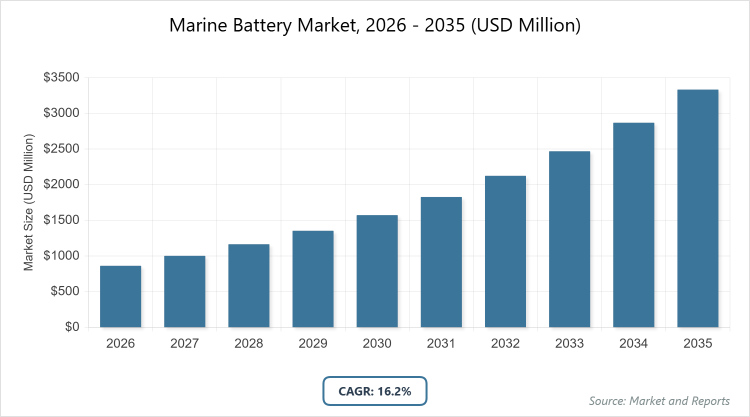
The global Marine Battery Market size was estimated at USD 863.25 Million in 2025 and is expected to reach USD 3874.34 Million by 2035, growing at a CAGR of 16.20% from 2026 to 2035. The marine battery market is primarily driven by the increasing adoption of electric and hybrid propulsion systems as the maritime industry shifts toward decarbonization to meet stringent environmental regulations and rising fuel costs.
Marine Battery Market- Key Insights
- Global Marine Battery Market value in 2025: USD 863.25 Million
- Projected Global Marine Battery Market value by 2035: USD 3874.34 Million
- CAGR during 2026-2035: 16.20%
- Dominated subsegment in battery type: Lithium-ion, accounting for over 62% market share due to its high energy density and suitability for hybrid propulsion.
- Dominated subsegment in propulsion type: Hybrid, holding approximately 64% share as it balances efficiency with range for commercial applications.
- Dominated subsegment in application: Commercial vessels, representing around 60% of the market driven by freight and passenger shipping demands.
- Dominated region: Europe, with about 42% market share owing to stringent emission regulations and strong adoption in countries like Norway.
Industry Overview
The Marine Battery Market encompasses the development, production, and distribution of specialized energy storage systems designed for maritime applications, including powering propulsion systems, auxiliary equipment, and onboard electronics in vessels such as commercial ships, defense fleets, recreational boats, and unmanned maritime vehicles. These batteries are engineered to withstand harsh marine environments, including exposure to saltwater, vibrations, and extreme temperatures, while providing reliable power for hybrid, fully electric, or conventional setups. The market integrates advancements in electrochemistry to support the maritime industry’s shift toward sustainable and efficient energy solutions, addressing needs from short-range ferries to long-haul cargo ships, and playing a pivotal role in reducing emissions and enhancing operational resilience in global shipping and leisure activities.
What Drives the Growth of the Marine Battery Market?
Growth Drivers
The primary growth drivers in the Marine Battery Market include stringent environmental regulations imposed by organizations like the International Maritime Organization, which mandate reductions in greenhouse gas emissions from vessels, pushing shipbuilders and operators toward hybrid and electric propulsion systems that rely on advanced batteries for cleaner operations. Rising fuel costs and the need for operational efficiency further accelerate adoption, as marine batteries enable fuel savings through peak shaving and energy regeneration in hybrid setups. Additionally, technological advancements in battery chemistries, such as lithium-ion and emerging solid-state options, offer higher energy density and longer lifespans, making them attractive for diverse applications from commercial shipping to recreational boating, while government incentives and subsidies for green maritime technologies bolster market expansion worldwide.
What Restrains the Marine Battery Market?
Restraints
Key restraints in the Marine Battery Market stem from the high initial capital costs associated with advanced battery systems, including lithium-ion variants, which require substantial upfront investments for installation, integration, and safety certifications, often deterring smaller operators or budget-constrained fleets from transitioning away from traditional diesel-powered setups. Limited charging infrastructure at ports and marinas poses another significant barrier, as it restricts the practicality of fully electric vessels for long-distance voyages, leading to range anxiety and operational inefficiencies. Furthermore, the complexity of maintaining and protecting batteries in corrosive marine environments adds to ongoing costs, with issues like thermal management and degradation accelerating under harsh conditions, thereby slowing widespread adoption despite the push for sustainability.
What Opportunities Exist in the Marine Battery Market?
Opportunities
Opportunities in the Marine Battery Market are abundant with the expanding electrification of short-range vessels, such as ferries, tugs, and offshore support crafts, where batteries can fully replace or augment diesel engines, capitalizing on urban coastal routes that prioritize low-emission operations and benefit from frequent recharging access. The integration of renewable energy sources, like solar and wind-assisted charging on ships, presents avenues for hybrid systems that enhance energy independence and reduce operational costs over time. Moreover, advancements in next-generation technologies, including sodium-ion and fuel cell hybrids, open doors for cost-effective alternatives to lithium-based solutions, particularly in emerging markets where raw material availability and recycling infrastructure can be leveraged to meet growing demand from defense and unmanned applications.
What Challenges Face the Marine Battery Market?
Challenges
Challenges in the Marine Battery Market revolve around the technical limitations of current battery technologies, such as insufficient energy density for long-haul applications, which confines fully electric vessels to shorter routes and necessitates hybrid compromises that add system complexity and weight. Supply chain vulnerabilities for critical materials like lithium and cobalt exacerbate price volatility and availability issues, compounded by geopolitical tensions that disrupt global sourcing. Regulatory inconsistencies across regions also pose hurdles, as varying safety standards and certification processes delay market entry for new innovations, while the need for skilled workforce training in battery maintenance and emergency response further strains adoption in an industry traditionally reliant on conventional power sources.
Marine Battery Market: Report Scope
| Report Attributes | Report Details |
| Report Name | Marine Battery Market |
| Market Size 2025 | USD 863.25 Million |
| Market Forecast 2035 | USD 3874.34 Million |
| Growth Rate | CAGR of 16.20% |
| Report Pages | 215 |
| Key Companies Covered |
Corvus Energy, Leclanché SA, Siemens Energy, Saft, EnerSys, Toshiba Corporation, Shift Clean Energy,Echandia Marine AB,EST Floattech, and Sensata Technologies Inc. |
| Segments Covered | By Battery Type, By Propulsion Type, By Nominal Capacity, By Design, By Function, By Energy Density, By Application, By Sales Channel, By Region |
| Regions Covered | Asia Pacific, North America, Europe, Latin America, The Middle East and Africa |
| Base Year | 2025 |
| Historical Year | 2020 – 2024 |
| Forecast Year | 2026 – 2035 |
| Customization Scope | Avail customized purchase options to meet your exact research needs. |
How is the Marine Battery Market Segmented?
Marine Battery Market Segmentation
By battery type, where lithium-ion emerges as the most dominant segment, capturing over 62% of the market share, followed by lead-acid as the second most dominant at around 20%. Lithium-ion’s dominance stems from its superior energy density, lighter weight, and longer cycle life compared to alternatives, which significantly enhances fuel efficiency and reduces emissions in hybrid and electric vessels, driving overall market growth by enabling longer operational ranges and lower maintenance costs for commercial and defense applications. Lead-acid, while cost-effective and reliable for starting functions, supports the market by providing a transitional option for operators upgrading from traditional systems, contributing to broader adoption in budget-sensitive segments like recreational boating.
In terms of propulsion type, hybrid propulsion is the most dominant segment with about 64% share, while fully electric follows as the second most dominant at roughly 25%. Hybrid systems lead due to their flexibility in combining batteries with diesel engines, allowing for optimized fuel consumption and compliance with emission standards without sacrificing range, which propels market expansion by appealing to large-scale shipping operations seeking gradual electrification. Fully electric propulsion, gaining traction in short-range applications like ferries, aids market growth through zero-emission capabilities that align with urban and coastal sustainability goals, fostering innovation in battery integration.
By application, commercial vessels dominate with around 60% market share, and defense applications are the second most dominant at about 30%. Commercial dominance is driven by the high volume of freight and passenger ships requiring reliable power for propulsion and auxiliaries, boosting the market through economies of scale and regulatory pressures for greener fleets. Defense applications contribute by demanding rugged, high-performance batteries for submarines and unmanned vehicles, enhancing market dynamics through investments in advanced technologies that spill over to civilian uses.
Regionally, Europe leads as the most dominant with 42% share, followed by Asia-Pacific as the second most dominant at approximately 35%. Europe’s position is fueled by proactive policies like the EU’s Green Deal, promoting battery adoption in maritime hubs, which accelerates market growth via subsidies and infrastructure development. Asia-Pacific supports expansion through rapid industrialization and shipbuilding in countries like China, driving demand for cost-effective batteries in export-oriented shipping.
What are the Recent Developments in the Marine Battery Market?
Recent Developments
- In December 2024, Corvus Energy unveiled its Blue Whale NxtGen battery system, an advanced addition to its NxtGen family, featuring enhanced energy density and modular design tailored for large-scale marine applications, aiming to support the electrification of offshore vessels and reduce operational emissions through improved efficiency and scalability.
- In November 2024, AYK Energy supplied Brittany Ferries with a 12 MWh Orion+ battery system, marking one of the world’s largest marine battery installations, designed to enable hybrid propulsion on passenger ferries, enhancing fuel savings and compliance with European emission standards while demonstrating the feasibility of large-capacity batteries in commercial operations.
- In September 2024, Leclanché SA launched the XN50 lithium-ion battery cell incorporating niobium-based anode material from Echion Technologies, offering faster charging and higher safety for marine use, positioning it as a breakthrough for hybrid ships by addressing thermal runaway risks and extending service life in demanding environments.
- In August 2024, Corvus Energy and Wärtsilä collaborated on a 40 MWh battery system for a 130-meter electric ferry capable of carrying 2,100 passengers, set for delivery by late 2024, highlighting advancements in high-capacity energy storage that facilitate zero-emission urban transport and set new benchmarks for passenger vessel electrification.
- In May 2024, Rolls-Royce supplied a 12 MW output, 24 MWh capacity mtu-based battery energy storage system to Encavis AG, intended for marine hybrid applications, emphasizing grid-like stability and renewable integration to lower costs and emissions in offshore wind support vessels.
- In April 2024, Med Marine launched a battery-electric tugboat, incorporating advanced lithium-ion systems for zero-emission harbor operations, underscoring the trend toward sustainable port activities and providing a model for reducing noise and pollution in coastal areas.
- In March 2024, Corvus Energy secured a contract for the Magellan Discoverer’s battery energy storage system, featuring modular high-density cells for enhanced performance in exploration vessels, advancing the market by enabling reliable power in remote marine expeditions.
- In February 2024, EST-Floattech received a USD 4.49 million investment to expand marine battery production, focusing on innovative floating designs that improve safety and buoyancy, supporting broader adoption in flood-prone or dynamic vessel environments.
- In January 2025, Vision Marine Technologies partnered with Calip to develop high-voltage marine battery packs, targeting recreational and small commercial boats with faster charging capabilities to accelerate the shift to electric leisure boating.
- In October 2024, Fortescue opened a marine battery manufacturing plant in the US, emphasizing scalable production of sodium-ion alternatives to lithium, aiming to address supply chain issues and lower costs for North American maritime operators.
How Does Regional Performance Vary in the Marine Battery Market?
Regional Analysis
Europe stands out as the leading region in the Marine Battery Market, driven by rigorous environmental policies such as the EU’s Fit for 55 package and substantial investments in green shipping infrastructure, with Norway dominating as the key country due to its pioneering adoption of electric ferries and hybrid offshore vessels, supported by government subsidies like the NOx Fund that incentivize over 50% of newbuilds to incorporate batteries, fostering innovation in cold-weather resilient systems and positioning the region as a global hub for maritime electrification.
Asia-Pacific exhibits rapid growth in the Marine Battery Market, fueled by expansive shipbuilding industries and increasing focus on export-oriented trade, where China dominates through its massive production capacity and state-backed initiatives like the Made in China 2025 plan, which has led to the deployment of over 100 hybrid vessels in domestic waters, emphasizing cost-effective lithium-ion integrations to meet rising demand from container shipping and reduce urban port pollution.
North America demonstrates steady advancement in the Marine Battery Market, supported by federal incentives under the Inflation Reduction Act and a growing emphasis on defense applications, with the United States leading as the dominant country via collaborations between companies like Corvus Energy and naval programs, resulting in widespread adoption in unmanned maritime vehicles and coastal ferries, enhancing energy security and operational efficiency in diverse climates.
Latin America shows emerging potential in the Marine Battery Market, driven by resource extraction and tourism sectors seeking sustainable solutions, where Brazil dominates through investments in hybrid river ferries and offshore support for oil platforms, leveraging local renewable energy to integrate batteries that cut fuel costs by up to 30% in Amazonian and coastal operations.
The Middle East and North Africa region experiences niche growth in the Marine Battery Market, influenced by oil-dependent economies transitioning to diversified energy, with the United Arab Emirates as the dominant country via projects like Dubai’s electric abra boats and hybrid yacht developments, capitalizing on solar-abundant conditions to pioneer battery systems that align with Vision 2030 sustainability goals.
Who are the Key Players in the Marine Battery Market?
Key Marine Battery Market Players and Strategies
Corvus Energy focuses on modular, high-capacity battery systems with an emphasis on safety certifications and partnerships for large-scale installations, such as collaborating with Wärtsilä on mega-ferries to expand its footprint in hybrid propulsion and secure type approvals for global compliance.
Leclanché SA prioritizes innovation in cell technology, like niobium-based anodes for faster charging, while pursuing joint ventures with shipbuilders to customize solutions for defense and commercial vessels, enhancing market penetration through R&D investments in energy density.
Siemens Energy leverages integrated propulsion packages that bundle batteries with automation systems, targeting efficiency gains in offshore and cargo ships via digital twins and predictive maintenance strategies to reduce downtime and operational costs.
Saft emphasizes rugged designs for extreme environments, particularly in defense submarines, with strategies centered on material advancements and supply chain localization to ensure reliability and meet stringent military standards.
EnerSys concentrates on lead-acid and lithium hybrids for auxiliary power, employing cost-optimization through scalable manufacturing and aftermarket services to appeal to budget-conscious recreational and small commercial operators.
Toshiba Corporation invests in solid-state battery R&D for longer lifespans, partnering with Asian shipyards to integrate systems in newbuilds, focusing on export markets to capitalize on regional growth.
Shift Clean Energy adopts a subscription-based model for battery leasing, reducing upfront costs for operators while emphasizing cloud-based monitoring to optimize performance in hybrid tugs and ferries.
Echandia Marine AB specializes in lightweight, high-power systems for fast vessels, with strategies involving modular scalability and collaborations with European regulators to accelerate certification processes.
EST Floattech innovates with floating battery designs for enhanced safety, securing investments to scale production and target flood-resilient applications in coastal regions.
Sensata Technologies Inc. focuses on sensor-integrated batteries for real-time health monitoring, partnering with OEMs to embed IoT capabilities that improve predictive analytics and extend system longevity.
What are the Current Trends in the Marine Battery Market?
Marine Battery Market Trends
- Increasing adoption of lithium-ion batteries with enhanced energy density for hybrid propulsion, reducing fuel consumption by up to 30% in commercial vessels.
- Rise in solid-state and sodium-ion alternatives to address lithium supply chain vulnerabilities and lower costs for emerging markets.
- Integration of AI-driven battery management systems for predictive maintenance and optimized charging in dynamic marine conditions.
- Growth in electrification of short-haul ferries and tugs, driven by urban sustainability initiatives and port emission controls.
- Expansion of modular battery designs allowing easy scalability and retrofitting in existing fleets without major overhauls.
- Emphasis on recycling and circular economy practices to manage end-of-life batteries and comply with global environmental standards.
- Partnerships between battery manufacturers and renewable energy firms for solar-wind hybrid charging on offshore vessels.
- Advancements in fast-charging infrastructure at key ports to support fully electric operations and reduce turnaround times.
What Segments are Covered in the Marine Battery Market Report?
Marine Battery Market Segments Covered in the Report
By Battery Type
- Lithium-ion
- Lead-acid
- Nickel Cadmium
- Sodium-ion
- Fuel Cells
By Propulsion Type
- Hybrid
- Fully Electric
- Conventional
By Nominal Capacity
- Up to 100 AH
- 100-250 AH
- More than 250 AH
By Design
- Solid
- Liquid or Gel-based
By Function
- Starting Batteries
- Deep-cycle Batteries
- Dual-purpose Batteries
By Energy Density
- Up to 100 WH/Kg
- 100-500 WH/Kg
- More than 500 WH/Kg
By Application
- Commercial
- Defense
By Sales Channel
- OEM
- Aftermarket
By Region
-
- North America
- U.S.
- Canada
- Europe
- UK
- Germany
- France
- Rest of Europe
- Asia Pacific
- China
- India
- Japan
- Rest of Asia Pacific
- Latin America
- Brazil
- Mexico
- Rest of Latin America
- Middle East & Africa
- UAE
- South Africa
- Rest of Middle East & Africa
- North America
Frequently Asked Questions
The Graphene Composites Marine Battery Market refers to the niche segment within the broader marine battery industry that incorporates graphene-enhanced composite materials into battery structures, improving conductivity, strength, and thermal management for maritime applications, enabling lighter, more durable energy storage solutions that enhance performance in harsh ocean environments while supporting electrification trends.
Key factors influencing growth include advancements in graphene integration for higher energy density and faster charging, rising demand for lightweight batteries in electric vessels to reduce overall ship weight, stringent maritime emission regulations driving adoption of efficient composites, and increasing R&D investments in composite materials to overcome traditional battery limitations like corrosion and cycle life.
The Graphene Composites Marine Battery Market is projected to grow from approximately USD 50 million in 2026 to over USD 800 million by 2035, reflecting the integration of graphene technologies into marine applications amid broader market expansion.
The CAGR for the Graphene Composites Marine Battery Market is expected to be around 33%, driven by rapid innovations in composite-enhanced batteries and their adoption in high-performance marine sectors.
Asia-Pacific will contribute notably, led by China's dominance in graphene production and shipbuilding, accounting for over 40% of the market value through scaled manufacturing and export-focused electrification initiatives.
Major players include Corvus Energy, Leclanché SA, and Saft, which are incorporating graphene composites to enhance battery efficiency, alongside emerging firms like Graphene Manufacturing Group focusing on specialized marine applications.
The report provides in-depth analysis of market size, segmentation by battery type and application, regional breakdowns, competitive landscapes, and forecasts, offering actionable insights for stakeholders on trends like enhanced durability and integration with hybrid systems.
The value chain includes raw material sourcing for graphene and composites, battery component manufacturing and assembly, system integration into vessels, distribution through OEMs and aftermarkets, and end-of-life recycling, with emphasis on R&D for material enhancements at early stages.
Trends are shifting toward lighter, corrosion-resistant batteries with graphene composites for extended range in electric boats, while consumers prefer sustainable options that offer faster charging and lower maintenance, aligning with eco-conscious preferences in recreational and commercial maritime sectors.
Regulatory factors include IMO emission targets pushing for low-carbon technologies, while environmental concerns over material sustainability drive graphene's appeal due to its potential for recyclable composites, though supply chain regulations on rare earths pose challenges to growth.