
Luxury Car Rental Market Size, Share and Trends 2026 to 2035
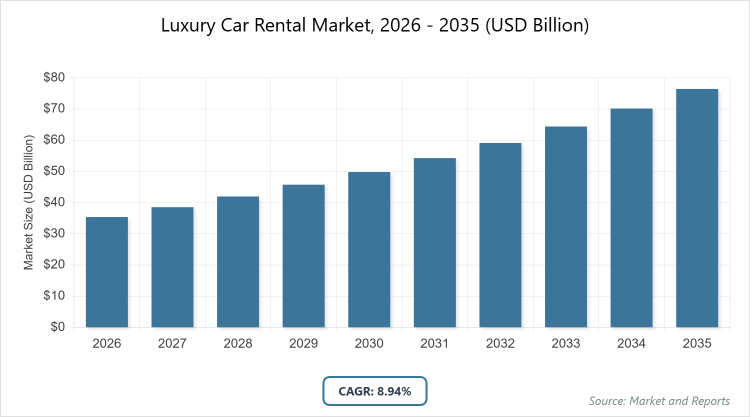
According to MarketnReports, the global luxury car rental market size was estimated at USD 35.36 billion in 2025 and is expected to reach USD 83.24 billion by 2035, growing at a CAGR of 8.94% from 2026 to 2035. Rising disposable incomes and increasing tourism activities.
What are the Key Insights into the luxury car rental market?
- The global luxury car rental market size was USD 35.36 billion in 2025 and is projected to reach USD 83.24 billion by 2035.
- The market is anticipated to grow at a CAGR of 8.94% from 2026 to 2035.
- The market is driven by increasing high-net-worth individuals, tourism growth, and digital booking platforms.
- The chauffeur-driven segment dominates the rental type with around 55% share, owing to its convenience for business travelers and events, providing professional service and safety.
- The leisure travel segment leads the application with approximately 45% market share, due to rising demand for experiential vacations and road trips in premium vehicles.
- The individual segment is dominant in end-users with about 50% share, as it caters to personal luxury experiences and status symbols for affluent consumers.
- North America dominates the regional market with around 35% share, driven by high disposable incomes, tourism, and corporate events in the United States.
What is the Luxury Car Rental?
Industry Overview
The luxury car rental market involves the provision of high-end vehicles, such as premium sedans, sports cars, SUVs, and exotic models from brands like Mercedes-Benz, BMW, Ferrari, and Lamborghini, on a short-term or long-term basis for personal, business, or leisure purposes, offering clients access to superior performance, comfort, and status without ownership costs, through self-driven or chauffeur services that include insurance, maintenance, and roadside assistance for seamless experiences in urban, airport, or event settings. This industry caters to affluent individuals, corporates, tourists, and event planners seeking flexible mobility solutions, integrating digital platforms for booking, customization, and tracking to enhance convenience and personalization.
Market definition encompasses all rental services for vehicles priced above a certain luxury threshold, excluding standard car rentals or leasing, and it reflects the growing emphasis on experiential consumption and sustainable options like electric luxury vehicles amid evolving travel preferences.
What are the Market Dynamics Affecting Luxury Car Rental?
Growth Drivers
The growth drivers in the luxury car rental market are primarily fueled by the surge in global tourism and experiential travel, where affluent travelers seek premium vehicles for unique road trips and events, leading to increased demand for exotic and high-performance rentals that enhance vacation memories, particularly in destinations like Europe and the Middle East with scenic routes and cultural attractions. This is supported by rising disposable incomes among high-net-worth individuals and millennials, enabling access to luxury without ownership burdens, while digital platforms facilitate easy bookings and customization. Furthermore, corporate expansions and events drive chauffeur services for executive transport, fostering market growth through partnerships with hotels and airlines for bundled packages that improve convenience and loyalty.
Restraints
Restraints in the luxury car rental market include high operational costs for fleet maintenance, insurance, and depreciation of premium vehicles, which elevate rental prices and limit accessibility for price-sensitive segments, particularly in economic downturns. Regulatory challenges, such as stringent emission standards and licensing requirements, increase compliance burdens for operators. Additionally, supply chain disruptions for luxury car parts and vehicles, exacerbated by global events, lead to fleet shortages and higher acquisition costs, hindering expansion in competitive markets.
Opportunities
Opportunities in the luxury car rental market arise from the integration of electric and hybrid luxury vehicles, as sustainability-conscious consumers prefer eco-friendly options like Tesla or Porsche EVs, enabling operators to differentiate with green fleets and attract premium pricing in urban areas with charging infrastructure. The rise of subscription models offers flexible, long-term access without commitment, appealing to urban professionals. Moreover, untapped markets in the Asia-Pacific present avenues for digital-first services through apps, capitalizing on rising affluence and tourism for localized expansions.
Challenges
Challenges in the luxury car rental market involve vehicle security and theft risks, requiring advanced tracking and insurance that increase costs, particularly in high-crime areas. Competition from ride-hailing services like Uber Lux fragments demand for short trips, necessitating innovation in personalized experiences. Additionally, fluctuating fuel prices and economic uncertainties affect consumer spending on discretionary rentals, impacting profitability in volatile regions.
Luxury Car Rental Market: Report Scope
| Report Attributes | Report Details |
| Report Name | Luxury Car Rental Market |
| Market Size 2025 | USD 35.36 Billion |
| Market Forecast 2035 | USD 83.24 Billion |
| Growth Rate | CAGR of 8.94% |
| Report Pages | 220 |
| Key Companies Covered |
Sixt, Hertz, Avis Budget Group, Enterprise, Europcar, and Others |
| Segments Covered | By Rental Type, By Application, By End-User, and By Region |
| Regions Covered | North America, Europe, Asia Pacific (APAC), Latin America, and The Middle East and Africa (MEA) |
| Base Year | 2025 |
| Historical Year | 2020 – 2024 |
| Forecast Year | 2026 – 2035 |
| Customization Scope | Avail customized purchase options to meet your exact research needs. |
How is the Luxury Car Rental Market Segmented?
The Luxury Car Rental market is segmented by rental type, application, end-user, and region.
Based on Rental Type Segment, the chauffeur-driven subsegment is the most dominant, holding around 55% share, due to its appeal for safety, convenience, and professionalism in business and events, which drives the market by catering to high-end clients seeking hassle-free experiences and boosting repeat business. The self-driven subsegment is the second most dominant, with approximately 35% share, as it offers freedom for leisure travelers, contributing to market growth by attracting adventure seekers and reducing operational costs for providers.
Based on Application Segment, the leisure travel subsegment is the most dominant, capturing about 45% share, attributed to tourism growth and demand for premium road trips, which propels the market by enhancing vacation experiences and encouraging partnerships with travel agencies. The business travel subsegment is the second most dominant, with around 30% share, owing to corporate needs for executive transport, helping to drive the market through long-term contracts and loyalty programs.
Based on the end-user segment, the individuals subsegment is the most dominant, with roughly 50% share, facilitated by personal luxury aspirations and events, driving the market by increasing demand for exotic rentals and digital bookings. The corporates subsegment is the second most dominant, holding about 30% share, propelled by business requirements, which contribute to market expansion through fleet management services.
What are the Recent Developments in Luxury Car Rental Market?
- In 2025, Sixt expanded its luxury fleet with electric vehicles like the Porsche Taycan, partnering with hotels for sustainable travel packages in Europe.
- In 2024, Hertz launched a subscription model for luxury cars, allowing monthly access to models like BMW and Mercedes for urban professionals in the US.
- In 2023, Avis Budget Group acquired a digital platform for seamless bookings, enhancing AI-driven recommendations for personalized rentals.
- In 2022, Enterprise introduced chauffeur services in Asia, targeting corporate clients with Mercedes S-Class vehicles.
How Does Regional Analysis Impact Luxury Car Rental Market?
- North America to dominate the global market.
North America leads the luxury car rental market with a significant share, driven by high disposable incomes and corporate events; the United States dominates this region, where tourism hotspots like Las Vegas and Miami fuel demand for exotic rentals, contributing to growth through digital platforms and celebrity endorsements.
Europe follows closely, benefiting from scenic destinations and cultural tourism; Germany stands out as the dominating country, leveraging brands like BMW for domestic rentals, supporting market progress via efficient infrastructure.
Asia Pacific emerges as the fastest-growing region, propelled by rising affluence; China dominates here, with urban elites seeking luxury for status, driving expansion through e-commerce integrations.
Latin America shows steady progress, influenced by beach tourism; Brazil is the dominating country, where events like Carnival boost rentals, aiding growth via seasonal packages.
The Middle East and Africa represent emerging opportunities, boosted by luxury tourism; the UAE dominates, with Dubai’s extravagance attracting high-end rentals, propelling growth through airport services.
Who are the Key Market Players in Luxury Car Rental?
- Sixt focuses on premium fleet expansions with EVs, employing digital apps for bookings and sustainability initiatives to attract eco-conscious clients.
- Hertz specializes in subscription models, utilizing partnerships for corporate fleets and AI for personalized recommendations to enhance loyalty.
- Avis Budget Group offers global networks, adopting acquisitions for tech enhancements and chauffeur services for business segments.
- Enterprise targets airport rentals, with strategies involving diverse luxury options and customer service focus for repeat business.
- Europcar emphasizes European tourism, employing green vehicles and event packages to differentiate in leisure markets.
What are the Market Trends Shaping Luxury Car Rental?
- Rise of electric and hybrid luxury vehicles for sustainable rentals.
- Growth in subscription and flexible long-term models.
- Integration of digital apps for seamless bookings and tracking.
- Expansion of chauffeur services for business and events.
- Focus on personalized experiences with customization options.
- Increase in partnerships with hotels and airlines for packages.
- Adoption of AI for demand forecasting and pricing.
What Market Segments and Subsegments are Covered in the Luxury Car Rental Report?
By Rental Type
- Self-Driven
- Chauffeur-Driven
- Subscription-Based
- Short-Term Rental
- Long-Term Rental
- Airport Rental
- Corporate Fleet
- Exotic Car Rental
- Vintage Car Rental
- Sports Car Rental
- Others
By Application
- Business Travel
- Leisure Travel
- Events & Weddings
- Airport Transfers
- VIP Services
- Film & Media Production
- Test Drives
- Corporate Events
- Tourism Packages
- Promotional Activities
- Others
By End-User
- Individuals
- Corporates
- Tour Operators
- Event Planners
- Government
- Hospitality Sector
- Entertainment Industry
- Automotive Dealers
- Travel Agencies
- High-Net-Worth Individuals
- Others
By Region
- North America
- U.S.
- Canada
- Europe
- UK
- Germany
- France
- Rest of Europe
- Asia Pacific
- China
- India
- Japan
- Rest of Asia Pacific
- Latin America
- Brazil
- Mexico
- Rest of Latin America
- Middle East & Africa
- UAE
- South Africa
- Rest of Middle East & Africa
Chapter 1. Preface
Chapter 2. Executive Summary
Chapter 3. Global Luxury Car Rental Market - Industry Analysis
Chapter 4. Global Luxury Car Rental Market- Competitive Landscape
Chapter 5. Global Luxury Car Rental Market - Rental Type Analysis
Chapter 6. Global Luxury Car Rental Market - Application Analysis
Chapter 7. Global Luxury Car Rental Market - End-User Analysis
Chapter 8. Luxury Car Rental Market - Regional Analysis
Chapter 9. Company Profiles
Frequently Asked Questions
Luxury car rental involves providing high-end vehicles like sports cars or premium sedans on a temporary basis for personal or business use, often with added services like chauffeurs.
Key factors include rising tourism, increasing disposable incomes, digital booking platforms, and sustainable vehicle options.
The luxury car rental market is projected to grow from approximately USD 38.2 billion in 2026 to USD 83.24 billion by 2035.
The CAGR value is expected to be 8.94% during 2026-2035.
North America will contribute notably, driven by tourism and corporate demand.
Major players include Sixt, Hertz, Avis Budget Group, Enterprise, and Europcar.
The report provides comprehensive insights on size, trends, segments, regions, players, and forecasts from 2026 to 2035.
Stages include vehicle acquisition, fleet management, booking platforms, rental operations, maintenance, and customer service.
Trends are shifting toward sustainable EVs and digital subscriptions, with preferences for personalized, flexible experiences.
Regulatory factors include emission standards, while environmental factors involve demands for green fleets and sustainability.