
Litigation Funding Investment Market Size, Share and Trends 2026 to 2035
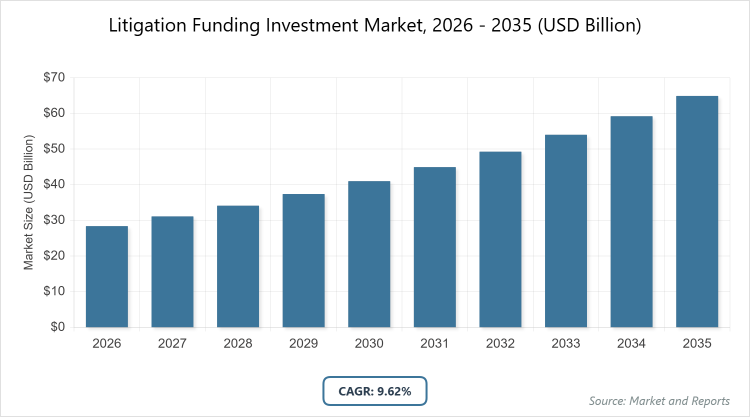
The global Litigation Funding Investment Market size was estimated at USD 28.4 Billion in 2025 and is expected to reach USD 64.8 Billion by 2035, growing at a CAGR of 9.62% from 2026 to 2035. The litigation funding investment market is primarily driven by the demand for high-yield, non-correlated returns and the rising financial costs of complex commercial litigation.
What are the Key Insights?
- The global Litigation Funding Investment Market is projected to grow from approximately USD 28.4 billion in 2026 to USD 64.8 billion by 2035.
- The market is anticipated to register a compound annual growth rate (CAGR) of 9.62% during the forecast period from 2026 to 2035.
- The commercial litigation subsegment dominates the type segment, accounting for over 41% market share due to high-value corporate disputes.
- The BFSI (Banking, Financial Services, and Insurance) subsegment leads the end-user segment with a significant revenue share, driven by complex financial litigations.
- North America dominates regionally, holding around 37-60% of the global market share, led by advanced legal systems and high litigation volumes.
What is the Industry Overview?
The Litigation Funding Investment Market refers to the financial ecosystem where third-party investors provide capital to litigants or law firms to cover legal expenses in exchange for a share of the potential settlement, award, or judgment from the case. This market operates as an alternative investment avenue, enabling plaintiffs who lack resources to pursue meritorious claims against well-funded defendants, while offering investors uncorrelated returns independent of traditional market fluctuations. It encompasses various funding models, from single-case investments to portfolio financing, and is increasingly viewed as a tool for risk management in high-stakes disputes across commercial, consumer, and international arbitration domains. By democratizing access to justice, this market bridges the gap between legal rights and financial capabilities, fostering a symbiotic relationship between capital providers and the legal sector, where funders assess case merits through due diligence similar to venture capital evaluations, ultimately transforming litigation into an investable asset class.
What are the Market Dynamics?
Growth Drivers
The Litigation Funding Investment Market is propelled by escalating legal costs and the growing complexity of disputes, which make it challenging for individuals and businesses to afford prolonged litigation without external support, thereby increasing demand for third-party financing as a means to level the playing field against deep-pocketed opponents. Additionally, heightened awareness among corporations and law firms about using funding to manage cash flow and offload risk encourages adoption, particularly in sectors like banking and manufacturing where high-value claims are common. Technological advancements in case assessment tools, such as AI-driven analytics, further enhance funders’ ability to evaluate merits accurately, boosting investor confidence and market expansion. Favorable regulatory shifts in key jurisdictions, including clearer guidelines on disclosure and ethics, also contribute by reducing barriers and attracting institutional investors seeking diversified, high-yield opportunities uncorrelated with stock market volatility.
Restraints
Despite its potential, the Litigation Funding Investment Market faces significant hurdles from regulatory uncertainties and varying legal frameworks across regions, which can lead to restrictions on funding practices or mandatory disclosures that deter investors wary of compliance risks and potential litigation over funding agreements. Ethical concerns, such as the perception that third-party funding may encourage frivolous lawsuits or influence case strategies unduly, also restrain growth by prompting scrutiny from courts and bar associations, potentially limiting market penetration in conservative jurisdictions. Moreover, the inherent high-risk nature of litigation outcomes, where funders may lose their entire investment if cases fail, combined with long resolution timelines that tie up capital, acts as a deterrent for risk-averse investors and hampers broader institutional participation.
Opportunities
Emerging opportunities in the Litigation Funding Investment Market arise from the expansion into untapped regions like Asia-Pacific, where legal modernization and rising commercial disputes create demand for funding solutions, allowing established players to partner with local firms and capture new market share. The integration of technology, such as blockchain for transparent funding contracts and big data for predictive case outcomes, presents avenues to streamline operations and attract tech-savvy investors looking for innovative asset classes. Additionally, the growing trend of portfolio funding, where investors back multiple cases to spread risk, opens doors for law firms to secure larger capital infusions, fostering strategic alliances and enabling scalability in high-growth sectors like intellectual property and class actions.
Challenges
The Litigation Funding Investment Market grapples with challenges stemming from prolonged case durations and unpredictable judicial outcomes, which can delay returns and increase opportunity costs for investors accustomed to quicker liquidity in other asset classes. Heightened calls for transparency and regulation pose operational difficulties, as funders must navigate evolving disclosure requirements that could expose sensitive case details and invite opposition from defendants seeking to challenge funding validity. Furthermore, competition from alternative financing options, such as insurance products or self-funding by large corporations, intensifies pressure on funders to offer competitive terms, while economic downturns may reduce the volume of viable cases, straining market growth and requiring adaptive strategies to maintain investor interest.
Litigation Funding Investment Market: Report Scope
| Report Attributes | Report Details |
| Report Name | Litigation Funding Investment Market |
| Market Size 2025 | USD 28.4 Billion |
| Market Forecast 2035 | USD 64.8 Billion |
| Growth Rate | CAGR of 9.62% |
| Report Pages | 215 |
| Key Companies Covered |
Burford Capital, Omni Bridgeway, Therium Capital Management, Apex Litigation Finance, Deminor, and Fortress Investment Group. |
| Segments Covered | By Type, By End-User, By Region |
| Regions Covered | Asia Pacific, North America, Europe, Latin America, The Middle East and Africa |
| Base Year | 2025 |
| Historical Year | 2020 – 2024 |
| Forecast Year | 2026 – 2035 |
| Customization Scope | Avail customized purchase options to meet your exact research needs. |
What is the Market Segmentation?
By Type, including commercial litigation, international arbitration, class actions, insolvency, and others, with commercial litigation emerging as the most dominant segment due to its prevalence in high-stakes corporate disputes that require substantial capital outlays, often involving intellectual property or contract breaches where funding enables smaller entities to challenge larger corporations effectively. This dominance stems from the segment’s ability to generate higher returns through larger settlements, driving overall market growth by attracting institutional investors seeking diversified portfolios; the second most dominant is international arbitration, which benefits from cross-border complexities and neutral forums, allowing funders to mitigate risks through enforceable awards under international treaties, thereby supporting market expansion in global trade disputes.
In terms of end-user segmentation, the market includes BFSI, manufacturing, IT and telecom, media and entertainment, healthcare, and others, where BFSI stands out as the most dominant due to the sector’s frequent involvement in regulatory compliance issues, fraud claims, and financial product disputes that demand expert legal navigation and significant funding to cover expert witnesses and discovery costs. This leadership helps propel the market by providing a steady stream of fundable cases with predictable outcomes based on precedent; manufacturing follows as the second most dominant, fueled by product liability and supply chain litigations that often involve class actions or mass torts, enabling funders to capitalize on economies of scale and drive innovation in risk assessment models for industrial claims.
Regional segmentation divides the market into North America, Europe, Asia-Pacific, Latin America, and Middle East & Africa, with North America being the most dominant owing to its litigious culture, supportive case law on third-party funding, and concentration of major funders, which facilitates rapid adoption and high investment volumes. This position accelerates market development through precedents set in U.S. courts that influence global practices; Europe ranks second, bolstered by progressive regulations in countries like the UK and Germany that encourage funding in commercial and arbitration cases, contributing to market maturation by integrating funding into standard legal strategies.
What are the Recent Developments?
- In recent years, the Litigation Funding Investment Market has seen a surge in portfolio funding models, where investors back bundles of cases from law firms to diversify risk, exemplified by major players like Burford Capital expanding their offerings to include multi-case financing, which enhances capital efficiency and appeals to institutional investors seeking stable returns amid economic volatility.
- Regulatory advancements have marked another key development, with jurisdictions like Singapore and Hong Kong refining frameworks to allow third-party funding in arbitration, fostering market growth by reducing legal barriers and attracting international capital, though this has also sparked debates on disclosure requirements to ensure fairness in proceedings.
- The integration of technology, such as AI for case prediction and blockchain for contract transparency, represents a pivotal shift, as firms like Omni Bridgeway adopt these tools to streamline due diligence, improving investment accuracy and opening new avenues for data-driven funding decisions in complex litigations. Increased scrutiny on ethical practices has led to industry self-regulation initiatives, including voluntary codes of conduct by associations, aimed at addressing concerns over influence on case strategies, thereby building trust and paving the way for broader acceptance among courts and litigants.
- Finally, mergers and acquisitions among funders, such as potential consolidations to achieve scale, have emerged as a trend, enabling smaller players to combine resources for larger commitments, which strengthens market competitiveness and supports expansion into emerging regions with untapped potential.
What is the Regional Analysis?
North America dominates the Litigation Funding Investment Market, holding approximately 37-60% of the global share, primarily driven by the United States as the leading country with its highly litigious environment, extensive case volumes in federal and state courts, and established funders who leverage sophisticated risk assessment to fund commercial and class action disputes. This region’s strength lies in favorable judicial precedents that uphold funding agreements, coupled with high legal costs that necessitate external capital, enabling businesses to pursue claims without straining balance sheets, while Canada’s growing adoption in arbitration adds to the momentum, though the U.S. remains the core driver through innovations like portfolio funding that attract hedge funds and private equity. Europe follows as a mature market, with the United Kingdom leading due to its progressive regulations post-Jackson Reforms that explicitly permit third-party funding, facilitating growth in London as a hub for international arbitration and commercial litigation where funders support high-value disputes in sectors like finance and energy. Germany’s robust legal system and increasing acceptance in insolvency cases contribute significantly, while France’s evolving framework encourages funding in class actions, collectively driving regional expansion through EU-wide harmonization efforts that reduce barriers and enhance cross-border investments, making Europe a stable yet innovative landscape for funders.
Asia-Pacific emerges as the fastest-growing region, led by Australia with its long-standing acceptance of litigation funding since the 1990s, where firms fund mass torts and shareholder actions amid rising corporate governance issues, supported by Singapore’s recent legal amendments allowing funding in arbitration to position it as an Asian dispute resolution center. China’s gradual opening to foreign investment in legal finance and India’s potential in commercial disputes further fuel growth, as economic development increases litigation complexity, presenting opportunities for funders to enter via partnerships and capitalize on underserved markets with high return potential.
Latin America shows nascent but promising development, with Brazil at the forefront due to its complex judicial system and high-volume class actions in consumer and environmental law, where funding helps navigate lengthy proceedings and corruption-related claims, though regulatory ambiguities pose hurdles. Mexico’s reforms to encourage alternative dispute resolution add traction, enabling the region to attract international funders seeking diversification, albeit challenged by political instability that affects case predictability.
The Middle East & Africa region lags but holds potential, dominated by South Africa with its advanced legal infrastructure allowing funding in mining and commercial disputes, while the UAE’s Dubai International Financial Centre promotes arbitration funding to align with global standards. This area’s growth is tempered by varying Sharia compliance issues and limited awareness, yet increasing foreign direct investment in infrastructure projects creates demand for funding in contract litigations, positioning it for future expansion through targeted regulatory improvements.
Who are the Key Market Players and Their Strategies?
Burford Capital employs a strategy focused on portfolio financing and monetization of legal assets, leveraging its public listing to raise capital for large-scale investments in commercial litigation and arbitration, emphasizing data analytics for case selection to maximize returns and expand globally through strategic acquisitions.
Omni Bridgeway pursues diversification by funding a mix of single cases and portfolios across regions, with a strong emphasis on international arbitration and class actions, utilizing partnerships with law firms to access high-merit opportunities and incorporating ESG criteria to appeal to socially conscious investors.
Therium Capital Management adopts a risk-managed approach by investing in high-value disputes with thorough due diligence, specializing in European and U.S. markets while expanding into Asia, and using co-funding arrangements to share risks and enhance deal flow.
Apex Litigation Finance concentrates on UK-based funding for SMEs in commercial claims, with a strategy centered on quick approvals and flexible terms to build a loyal client base, while advocating for regulatory clarity to foster market growth.
Deminor targets recovery of investments through funding shareholder actions and antitrust claims, employing a no-win-no-fee model combined with expert legal networks to minimize risks and maximize recoveries in European jurisdictions.
Fortress Investment Group integrates litigation funding into its broader alternative assets portfolio, focusing on U.S. mass torts and insolvency cases, using its financial expertise to structure deals that provide liquidity to distressed assets and attract institutional capital.
What are the Market Trends?
- Increasing adoption of portfolio funding models to diversify risks across multiple cases, appealing to law firms seeking stable capital.
- Growing integration of AI and predictive analytics for more accurate case merit assessments and investment decisions.
- Rising regulatory scrutiny leading to calls for mandatory disclosure of funding agreements in courts.
- Expansion into emerging markets like Asia-Pacific, driven by legal reforms and increasing commercial disputes.
- Shift towards ESG-focused funding, where investors prioritize cases with social or environmental impact.
- Collaboration between funders and insurers to offer hybrid products like judgment preservation insurance.
- Heightened focus on transparency to address ethical concerns and build trust with stakeholders.
What Market Segments are Covered in the Report?
- By Type
- Commercial Litigation
- International Arbitration
- Class Actions
- Insolvency
- Others
- By End-User
- BFSI
- Manufacturing
- IT and Telecom
- Media and Entertainment
- Healthcare
- Others
By Region
-
- North America
- U.S.
- Canada
- Europe
- UK
- Germany
- France
- Rest of Europe
- Asia Pacific
- China
- India
- Japan
- Rest of Asia Pacific
- Latin America
- Brazil
- Mexico
- Rest of Latin America
- Middle East & Africa
- UAE
- South Africa
- Rest of Middle East & Africa
- North America
Chapter 1. Preface
Chapter 2. Executive Summary
Chapter 3. Global Litigation Funding Investment Market - Industry Analysis
Chapter 4. Global Litigation Funding Investment Market- Competitive Landscape
Chapter 5. Global Litigation Funding Investment Market - Type Analysis
Chapter 6. Global Litigation Funding Investment Market - End-User Analysis
Chapter 7. Litigation Funding Investment Market - Regional Analysis
Chapter 8. Company Profiles
Frequently Asked Questions
The Litigation Funding Investment Market involves third-party investors providing capital to cover legal costs in disputes, in return for a portion of any successful outcome, serving as an alternative asset class for risk diversification.
Key factors include rising legal expenses, regulatory advancements, technological integration for case evaluation, expansion into new regions, and increasing corporate adoption for risk management.
The market is expected to grow from approximately USD 28.4 billion in 2026 to USD 64.8 billion by 2035.
The CAGR is projected to be 9.62% over the forecast period.
North America will contribute notably, driven by high litigation volumes and supportive legal frameworks in the United States.
Major players include Burford Capital, Omni Bridgeway, Therium Capital Management, Apex Litigation Finance, Deminor, and Fortress Investment Group.
The report provides comprehensive insights into market size, growth drivers, segmentation, regional analysis, key players, trends, and future projections.
The value chain includes case sourcing and due diligence, funding agreement structuring, legal proceedings monitoring, settlement or award collection, and return distribution to investors.
Trends are shifting towards portfolio funding and tech-driven assessments, while preferences favor transparent, ethical funders offering flexible terms for diverse case types.
Regulatory factors include varying disclosure requirements and ethical guidelines, while environmental factors involve ESG integration in funding decisions, influencing growth by promoting sustainable practices.