
Lingerie Market Size, Share, Trends and Forecast 2026 to 2035
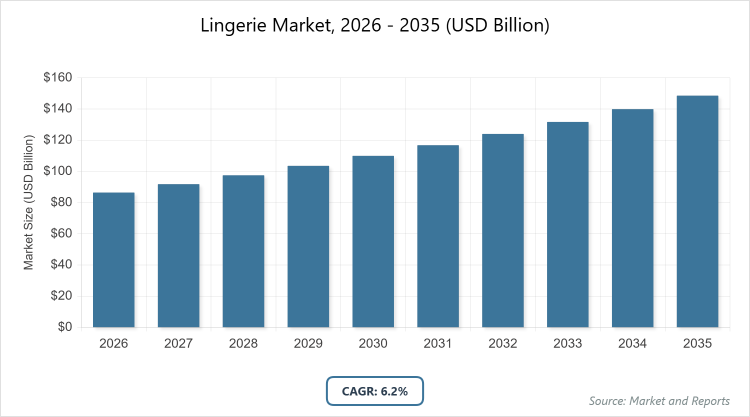
According to our latest research, the global lingerie market is projected to grow from approximately USD 86.44 billion in 2026 to USD 149.41 billion by 2035, growing at a CAGR of 6.2% from 2026 to 2035. The Lingerie Market is primarily driven by rising body positivity and inclusivity movements, which have shifted consumer demand toward diverse sizing, high-performance comfort, and “clean” sustainable fabrics.
What are the Key Insights into the Lingerie Market?
- The global lingerie market is valued at approximately USD 86.44 billion in 2026 and is projected to reach USD 149.41 billion by 2035.
- The market is expected to grow at a compound annual growth rate (CAGR) of 6.2% from 2026 to 2035.
- Among product types, the briefs segment dominates due to its everyday comfort and versatility.
- In distribution channels, the online segment is the leading subsegment, driven by e-commerce growth.
- Asia Pacific is the dominated region, supported by rising disposable incomes and manufacturing hubs.
What is the Lingerie Market?
Industry Overview
The lingerie market encompasses the design, manufacturing, distribution, and retail of intimate apparel primarily for women, including items such as bras, briefs, shapewear, and loungewear that provide support, comfort, and aesthetic appeal while addressing functional needs like hygiene, posture maintenance, and confidence enhancement. It integrates fashion trends with practical innovations, offering a range of materials from cotton for everyday wear to silk or lace for premium styles, catering to diverse body types, occasions, and preferences through inclusive sizing and sustainable options. This market supports consumer self-expression and wellness by blending traditional undergarments with modern multifunctional designs, influenced by cultural shifts toward body positivity and e-commerce accessibility, while fostering brand loyalty via personalized experiences and marketing strategies in a competitive global landscape.
What Drives the Lingerie Market?
Growth Drivers
The lingerie market is driven by the increasing number of working women and rising disposable incomes, which boost demand for comfortable, fashionable, and premium intimate apparel, supported by advancements in fabric technology like breathable and sustainable materials that enhance product appeal and functionality. Social media and influencer marketing amplify trends in body-positive and inclusive designs, while the expansion of e-commerce platforms facilitates global access, enabling brands to reach diverse demographics and capitalize on personalized shopping experiences for sustained growth.
Restraints
Significant restraints in the lingerie market include fluctuating raw material prices and high production costs, which limit affordability for budget-conscious consumers and strain profit margins for manufacturers, particularly in emerging regions with economic volatility. Rapid changes in fashion preferences and competition from alternative clothing options like athleisure further challenge market stability, as consumers shift toward multifunctional garments, reducing demand for traditional lingerie items.
Opportunities
Opportunities in the lingerie market stem from the growing preference for eco-friendly and sustainable products, allowing brands to innovate with organic fabrics and biodegradable materials that attract environmentally aware consumers and enable premium pricing through green certifications. The surge in online retail and digital tools like AI-powered virtual fitting rooms presents avenues for expansion into untapped markets, fostering partnerships with e-commerce giants to enhance accessibility and personalization for global audiences.
Challenges
Key challenges in the lingerie market involve addressing size inclusivity and fit inconsistencies, which require substantial investments in R&D for diverse body types amid varying cultural standards, complicating product development and increasing return rates. Regulatory hurdles related to material safety and labor practices in supply chains, combined with geopolitical disruptions affecting textile imports, demand resilient strategies to maintain quality and ethical standards without escalating costs.
Lingerie Market: Report Scope
| Report Attributes | Report Details |
| Report Name | Lingerie Market |
| Market Size 2025 | USD 86.44 Billion |
| Market Forecast 2035 | USD 149.41 Billion |
| Growth Rate | CAGR of 6.2% |
| Report Pages | 220 |
| Key Companies Covered | Jockey International Inc., Victoria’s Secret, Zivame, Hanesbrands Inc., Triumph International Ltd., Gap, Inc., PVH Corporation, MAS Holdings, Calvin Klein, and Hunkemoller. |
| Segments Covered | By Product Type, By Distribution Channel, By Region |
| Regions Covered | North America, Europe, Asia Pacific (APAC), Latin America, The Middle East and Africa (MEA) |
| Base Year | 2025 |
| Historical Year | 2020 – 2024 |
| Forecast Year | 2026 – 2035 |
| Customization Scope | Avail customized purchase options to meet your exact research needs. |
How is the Lingerie Market Segmented?
The lingerie market is segmented by product Type, distribution channel, and region.
By Product Type, The product type segmentation in the lingerie market is dominated by briefs, which lead due to their essential role in daily hygiene and comfort with versatile designs like seamless or period-proof options that cater to a broad consumer base, driving market growth by encouraging frequent purchases and loyalty through affordable, functional innovations that align with active lifestyles. Bras rank as the second most dominant, providing support and style variations such as sports or nursing types, but they trail briefs because the latter’s lower cost and higher replacement frequency generate more volume sales, thereby accelerating overall market expansion via mass-market accessibility.
By Distribution Channel, In distribution channel segmentation, online channels emerge as the most dominant in the lingerie market, attributed to convenience, wide variety, and features like virtual fitting that reduce barriers for discreet purchases, propelling growth by leveraging digital platforms to reach global audiences and lower overhead costs for brands. Offline channels follow as the second most dominant, offering tactile experiences and personalized fittings in stores, yet they lag behind online due to the latter’s faster growth in emerging markets, contributing to market advancement through hybrid retail strategies.
What are the Recent Developments in the Lingerie Market?
- In September 2025, Adore Me launched the Soft Touch loungewear collection alongside its first men’s underwear line, featuring over 100 styles priced under USD 50 for VIP members, expanding availability through online platforms and retail partners like Macy’s, Nordstrom, and Target to broaden market reach.
- In August 2025, Wacoal unveiled its Autumn/Winter 2025 Lingerie Collection, emphasizing seasonal elegance with luxurious lace, rich tones, and sustainable fabrics to blend practicality and style, targeting consumers seeking premium, eco-conscious options.
- In August 2024, Wacoal introduced the Wacoal Basics collection in India, including cotton bras, push-up, and t-shirt styles, aiming to enhance accessibility in emerging markets through affordable essentials.
- In July 2025, Victoria’s Secret launched the Body by Victoria FlexFactor Bra with flexible titanium underwire and adaptive memory foam, offering inclusive sizes to prioritize comfort and support for diverse body types.
- In August 2024, Marks & Spencer released knickers designed for stoma individuals, available both in stores and online, promoting inclusivity in functional lingerie.
- In July 2024, Ann Summers planned the Knickerbox online platform for women’s underwear, focusing on digital expansion to capture e-commerce growth.
How Does the Lingerie Market Vary by Region? (Regional Analysis)
- Asia Pacific to dominate the market
Asia Pacific dominates the lingerie market with over 46% share by 2035, propelled by a large female population, rising disposable incomes, and booming textile industries that enable affordable production and innovation; China and India are the dominating countries, with China leading through massive exports and e-commerce platforms like Tmall, while India contributes via low-cost manufacturing and growing urban demand, together driving exponential growth by addressing cultural shifts toward modern styles.
North America holds a significant position in the lingerie market, supported by high workforce participation among women and demand for comfort-focused designs; the United States dominates, leveraging brands like Victoria’s Secret for inclusive sizing and online innovations, though economic factors influence spending, fostering steady expansion through premium and sustainable trends.
Europe exhibits robust growth in the lingerie market due to fashion-forward consumers and sustainable preferences; Germany and the United Kingdom are dominating countries, with Germany excelling in efficient supply chains for brands like Triumph, and the UK advancing via fast fashion and e-commerce, collectively enhancing market through eco-innovations and inclusivity.
Latin America is emerging in the lingerie market with cultural emphasis on body positivity and beachwear; Brazil dominates, utilizing vibrant trends and expansions like Victoria’s Secret stores to boost demand, navigating economic volatility to promote accessible, stylish options.
The Middle East & Africa region shows promising growth in the lingerie market through luxury and modest fashion integrations; the United Arab Emirates and South Africa are dominating countries, with UAE as a hub for premium brands like La Vie en Rose, and South Africa via diverse offerings, propelling the market despite conservative norms by focusing on comfort and e-commerce.
Who are the Key Market Players in the Lingerie Market
and What Are Their Strategies?
- Jockey International Inc.: Jockey focuses on global expansion through innovative fabrics and promotional strategies, emphasizing comfort and affordability to capture mass markets.
- Victoria’s Secret: Victoria’s Secret employs e-commerce expansions and inclusive sizing like the FlexFactor Bra, leveraging celebrity endorsements for brand visibility.
- Zivame: Zivame pursues AI-powered virtual fittings and D2C models, targeting emerging markets with personalized, affordable options.
- Hanesbrands Inc.: Hanesbrands prioritizes diversified designs and sales networks, focusing on sustainable materials to appeal to eco-conscious consumers.
- Triumph International Ltd.: Triumph emphasizes retail expansions like new stores in India, offering variety in supportive and stylish lingerie.
- Gap, Inc.: Gap collaborates with brands like DEON for floral-printed collections, integrating loungewear with fashion trends.
- PVH Corporation: PVH extends license agreements with partners like G-III for flexible transitions, focusing on premium branding.
- MAS Holdings: MAS innovates with leak-proof and lactating bras, targeting functional needs in global markets.
- Calvin Klein: Calvin Klein utilizes social media and endorsements for awareness, emphasizing luxury and style.
- Hunkemoller: Hunkemoller focuses on sustainable fabrics and digital marketing to attract young consumers.
What are the Current Market Trends in the Lingerie Market?
- Shift toward comfort-first designs like wire-free bras and seamless briefs, prioritizing breathability for daily wear.
- Rise in sustainable and eco-friendly materials such as organic cotton and recycled polyester amid environmental awareness.
- Growth in size-inclusive and body-positive options, expanding to plus-size and petite ranges.
- Integration of functional innovations like period-proof panties and nursing bras for practical needs.
- Expansion of online personalization with AI virtual fittings and augmented reality try-ons.
- Influence of social media on trends like floral prints and bright colors for aspirational buying.
- Premiumization through luxury fabrics like lace and silk for special occasions.
- Hybrid retail models combining in-store experiences with online convenience.
- Focus on men’s lingerie lines as male grooming expands.
- Emphasis on multifunctional loungewear blending comfort and style post-pandemic.
What Market Segments are Covered in the Lingerie Report?
By Product Type
- Briefs
- Bras
- Shapewear
- Others
By Distribution Channel
- Online
- Offline
By Region
- North America
- U.S.
- Canada
- Europe
- UK
- Germany
- France
- Rest of Europe
- Asia Pacific
- China
- India
- Japan
- Rest of Asia Pacific
- Latin America
- Brazil
- Mexico
- Rest of Latin America
- Middle East & Africa
- UAE
- South Africa
- Rest of Middle East & Africa
Chapter 1. Preface
Chapter 2. Executive Summary
Chapter 3. Global Lingerie Market - Industry Analysis
Chapter 4. Global Lingerie Market- Competitive Landscape
Chapter 5. Global Lingerie Market - Product Type Analysis
Chapter 6. Global Lingerie Market - Distribution Channel Analysis
Chapter 7. Lingerie Market - Regional Analysis
Chapter 8. Company Profiles
Frequently Asked Questions
Lingerie refers to intimate apparel, primarily for women, including bras, briefs, shapewear, and loungewear designed for comfort, support, and aesthetic appeal in daily or special occasions.
Key factors include rising disposable incomes among working women, demand for sustainable and comfortable designs, e-commerce expansion, and social media trends, while restraints like price fluctuations and changing preferences may moderate pace.
The lingerie market is projected to grow from approximately USD 86.44 billion in 2026 to USD 149.41 billion by 2035, reflecting global demand increases.
The compound annual growth rate (CAGR) for the lingerie market is expected to be 6.2% from 2026 to 2035.
Asia Pacific will contribute notably, holding over 46% share by 2035 due to population growth and manufacturing strengths, with China as the key driver.
Major players include Jockey International Inc., Victoria’s Secret, Zivame, Hanesbrands Inc., Triumph International Ltd., Gap, Inc., PVH Corporation, MAS Holdings, Calvin Klein, and Hunkemoller, driving growth through innovations and expansions.
The global lingerie market report provides comprehensive insights into size, forecasts, segmentation, drivers, restraints, opportunities, regional trends, key players, developments, and future strategies for stakeholders.
The value chain includes raw material sourcing (fabrics like cotton, nylon), product design and manufacturing, distribution through online/offline channels, marketing via social media, and consumer retail with feedback loops for improvements.
Market trends are evolving toward sustainable fabrics, AI personalization, and multifunctional designs, while consumer preferences favor comfort, inclusivity, and eco-friendly options over traditional styles.
Regulatory factors include material safety standards and labor compliance increasing costs but ensuring quality; environmental factors involve demands for sustainable sourcing to reduce impacts, promoting growth through green innovations.