
Lift Chair Market Size, Share and Trends 2026 to 2035
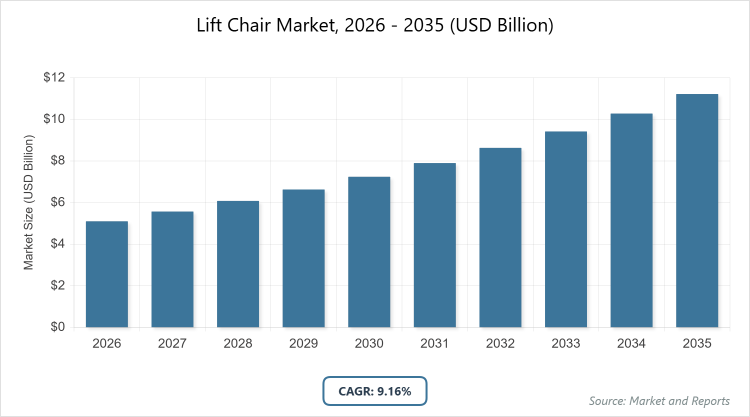
According to our latest research, the global lift chair market size reached USD 5.1 billion in 2025, demonstrating robust expansion. The market is poised to grow at a CAGR of 9.16% from 2026 to 2035, with the market projected to reach USD 11.2 billion by 2035. The lift chair market is primarily driven by a rapidly aging global population and the increasing prevalence of mobility-related chronic conditions like arthritis, which fuel the demand for assistive home healthcare solutions that promote independence.
What are the Key Insights into the Lift Chair Market?
- The global lift chair market is anticipated to expand from USD 5.1 billion in 2026 to USD 11.2 billion by 2035, achieving a CAGR of approximately 9.16%.
- In type segmentation, infinite position lift chairs lead, providing infinite adjustability for optimal user customization.
- Household applications dominate end-use, reflecting preferences for in-home aging solutions.
- Offline distribution prevails, emphasizing in-person trials for high-involvement purchases.
- North America commands the regional lead, bolstered by mature healthcare frameworks and demographic factors.
What is the Lift Chair Industry?
Industry Overview
The lift chair industry comprises mechanized recliners engineered to aid users with limited mobility, such as seniors, individuals with disabilities, or those recovering from injuries, by smoothly elevating the seat to facilitate standing or sitting with minimal effort. These chairs mimic standard recliners in appearance but incorporate powered lifting systems, often with adjustable positions, heat, massage, and ergonomic supports, serving both residential and institutional needs.
Positioned at the intersection of furniture and medical devices, the market emphasizes user independence, pain relief, and safety, driven by innovations in motor technology and materials that prioritize durability and comfort while addressing healthcare trends like home-based care and aging populations.
What are Market Dynamics in the Lift Chair Market?
Growth Drivers
The lift chair market is fueled by the surging global elderly demographic and escalating rates of mobility-impairing conditions like arthritis, obesity, and post-operative recovery, necessitating assistive furniture for daily autonomy and reduced caregiver dependency. Advancements in features such as remote operation, integrated therapeutics, and smart connectivity elevate product utility and appeal, expanding adoption in homes and facilities. Moreover, heightened healthcare expenditures, insurance inclusions for durable medical equipment, and policy support for disability aids amplify accessibility, propelling market penetration across income levels and regions.
Restraints
Elevated pricing of advanced lift chairs, stemming from premium components and technology, deters budget-conscious consumers, especially in emerging economies with limited reimbursement options. Insufficient product awareness in rural or low-literacy areas, alongside perceptions of stigma associated with mobility aids, curbs demand. Additionally, supply chain vulnerabilities and raw material cost fluctuations challenge manufacturer margins and consistent availability, impeding broader market proliferation.
Opportunities
The proliferation of digital retail platforms unlocks global reach, enabling customized offerings and virtual demonstrations to underserved demographics. Emerging smart integrations, including IoT for health tracking and voice commands, position lift chairs as wellness hubs, attracting tech-oriented buyers. Furthermore, burgeoning middle-class populations in developing nations, paired with healthcare infrastructure upgrades, create avenues for cost-effective, region-specific variants to capture untapped growth.
Challenges
Compliance with diverse international safety and medical device regulations complicates product development and escalates costs, potentially delaying innovations. Competition from substitutes like walkers or stairlifts, combined with counterfeit goods in lax markets, undermines brand integrity. Sustainability pressures regarding material recyclability and energy use in powered models demand R&D shifts toward eco-designs to align with evolving consumer and regulatory expectations.
Lift Chair Market: Report Scope
| Report Attributes | Report Details |
| Report Name | Lift Chair Market |
| Market Size 2025 | USD 5.1 Billion |
| Market Forecast 2035 | USD 11.2 Billion |
| Growth Rate | CAGR of 9.16% |
| Report Pages | 215 |
| Key Companies Covered | Pride Mobility, Golden Technologies, La-Z-Boy, Med-Lift, Franklin Corporation, Ashley Furniture, Mega Motion, Best Chairs, Seminar Components, and Jackson Furniture |
| Segments Covered | By Type, By End-User, Distribution Channel, By Region |
| Regions Covered | North America, Europe, Asia Pacific (APAC), Latin America, The Middle East and Africa (MEA) |
| Base Year | 2025 |
| Historical Year | 2020 – 2024 |
| Forecast Year | 2026 – 2035 |
| Customization Scope | Avail customized purchase options to meet your exact research needs. |
How is the Lift Chair Market Segmented?
The lift chair market is segmented by type, end-use, distribution channels, and region.
By type, into 2-position, 3-position, infinite position, and zero gravity variants, with infinite position as the predominant subcategory owing to its boundless reclining capabilities, independent controls for backrest and footrest, and add-ons like heat and vibration that deliver tailored therapeutic relief for chronic conditions; this leadership accelerates market momentum by commanding premium pricing and loyalty among users prioritizing versatility, whereas 3-position chairs hold second place through their cost-effective balance of upright, TV, and nap settings, appealing to entry-level buyers and sustaining volume-driven expansion.
By end-use, categorization includes household, commercial, and healthcare, where household reigns supreme by enabling aging-in-place strategies that minimize institutionalization, integrate discreetly into living spaces, and alleviate family caregiving loads, thus catalyzing widespread residential uptake; healthcare follows closely, endorsed for clinical rehabilitation and supported by procurements in facilities, reinforcing market credibility via professional validation and bulk acquisitions.
By distribution channels, split into offline and online, with offline dominant via specialty outlets and showrooms that afford sensory evaluations critical for trust in expensive, health-related investments, fueling sales through informed decisions; online ranks second, surging with e-commerce conveniences like comparisons and doorstep delivery, broadening access and invigorating growth in digital-native cohorts.
What are the Recent Developments in the Lift Chair Market?
- In early 2025, Golden Technologies unveiled a series of electric slab-inspired lift chairs with curved linkages for superior ergonomics and reduced ownership costs, targeting rental fleets and enhancing competitiveness in efficiency-focused segments.
- Pride Mobility rolled out IoT-connected models in mid-2025, incorporating app-based diagnostics and preset memory, appealing to smart home ecosystems and bolstering remote monitoring for caregivers.
- La-Z-Boy announced partnerships in late 2025 with e-tailers for augmented reality previews, streamlining virtual fittings and amplifying online conversions amid post-pandemic digital shifts.
How Does Regional Performance Vary in the Lift Chair Market?
- North America to dominate the market
North America dominates the lift chair market, anchored by an expansive senior cohort, sophisticated insurance ecosystems covering assistive devices, and entrenched manufacturers innovating rapidly; the United States leads regionally with pervasive Medicare integrations, high per-capita spending on home modifications, and retail networks facilitating trials, underpinning innovation diffusion and sustained demand. Additionally, the region’s advanced healthcare infrastructure and high awareness of mobility aids further solidify its leadership, while growing reimbursement policies encourage broader adoption among elderly and disabled populations.
Europe maintains robust growth through subsidized elderly programs and demographic pressures, with Germany at the forefront via precision engineering, universal coverage reimbursements, and export-oriented production that standardizes quality across borders. Strong regulatory frameworks ensuring product safety and the integration of lift chairs in home care initiatives contribute to steady expansion, supported by an increasing focus on aging-in-place solutions in countries like the UK and France.
Asia-Pacific emerges dynamically, propelled by urbanization and geriatric surges; China predominates with vast domestic manufacturing, policy-backed senior initiatives, and affordable adaptations incorporating local preferences, driving volume and technological localization. Japan follows closely due to its highly aged population and advanced tech integrations, while India’s rising middle class and healthcare investments accelerate market penetration in urban areas.
Latin America advances moderately amid rising middle-class healthcare priorities; Brazil excels with urban aging trends and import-reliant supply chains evolving toward regional assembly. Mexico supports growth through economic fluctuations and increasing affordability focus, with both countries benefiting from expanding awareness campaigns and private healthcare developments targeting mobility solutions.
Middle East & Africa lags but grows in premium niches; the UAE spearheads via expatriate affluence, luxury medical tourism, and investments in modern care facilities integrating high-end mobility solutions. Saudi Arabia and South Africa show emerging potential through government elderly care programs and gradual infrastructure improvements, though affordability and awareness remain key barriers in broader sub-Saharan regions.
Who are the Key Market Players in the Lift Chair Industry?
- Pride Mobility invests heavily in R&D for user-focused ergonomics and global partnerships with providers to dominate elderly segments.
- Golden Technologies prioritizes tech-infused sustainability, launching app-enabled eco-models and direct marketing for loyalty.
- La-Z-Boy merges lift tech with aesthetic recliners, acquiring distributors for premium expansion.
- Med-Lift stresses medical compliance, hospital tie-ups, and budget lines for emerging penetration.
- Franklin Corporation optimizes costs via efficient production and e-platforms for a wide reach.
- Ashley Furniture embeds lifts in mass lines, leveraging pricing and retail for volume.
- Mega Motion offers quick-assemble versatility, digital campaigns for swift entry.
- Best Chairs refines ergonomics from feedback and dealer networks for localization.
- Seminar Components supplies OEMs and B2B alliances for component dominance.
- Jackson Furniture diversifies multifunctional trade events for branding.
What are the Current Market Trends in Lift Chairs?
Market Trends
- Smart integrations like app controls, sensors, and voice activation for personalized health monitoring.
- Eco-materials and efficient motors amid sustainability pushes.
- Aesthetic customizations blending with decor for stigma reduction.
- E-commerce with AR tools is enhancing remote purchases.
- Multifunctional additions, including zero-gravity and therapeutics.
- Compact designs for urban spaces.
- Battery resilience for outages and portability.
What Market Segments are Covered in the Report?
By Type
- 2-Position Lift Chair
- 3-Position Lift Chair
- Infinite Position Lift Chair
- Zero Gravity Lift Chair
By End-Use
- Household
- Commercial
- Healthcare
By Distribution Channel
- Offline
- Online
By Region
-
- North America
- U.S.
- Canada
- Europe
- UK
- Germany
- France
- Rest of Europe
- Asia Pacific
- China
- India
- Japan
- Rest of Asia Pacific
- Latin America
- Brazil
- Mexico
- Rest of Latin America
- Middle East & Africa
- UAE
- South Africa
- Rest of Middle East & Africa
- North America
Frequently Asked Questions
Lift chairs are powered recliners that mechanically raise and tilt to help users with mobility issues stand or sit effortlessly, combining comfort features with assistive technology.
Aging populations, chronic disease prevalence, tech innovations, home care shifts, and e-commerce expansion will drive growth.
The market is projected to rise from USD 5.1 billion in 2026 to USD 11.2 billion by 2035.
The CAGR is expected to be around 9.16% from 2026 to 2035.
North America will lead, supported by healthcare infrastructure and demographics.
Pride Mobility, Golden Technologies, La-Z-Boy, Med-Lift, Franklin Corporation, Ashley Furniture, Mega Motion, Best Chairs, Seminar Components, and Jackson Furniture lead through innovation and distribution.
In-depth size, trends, segmentation, regional breakdowns, players, and projections for informed strategies.
Sourcing materials, assembly, wholesaling/retailing, sales/marketing, and post-sale support.
Toward smart, sustainable, stylish, and multifunctional designs prioritizing wellness and integration.
Safety certifications raise costs; eco-demands push recyclable, efficient models.