
Legal Marijuana Market Size, Share and Trends 2026 to 2035
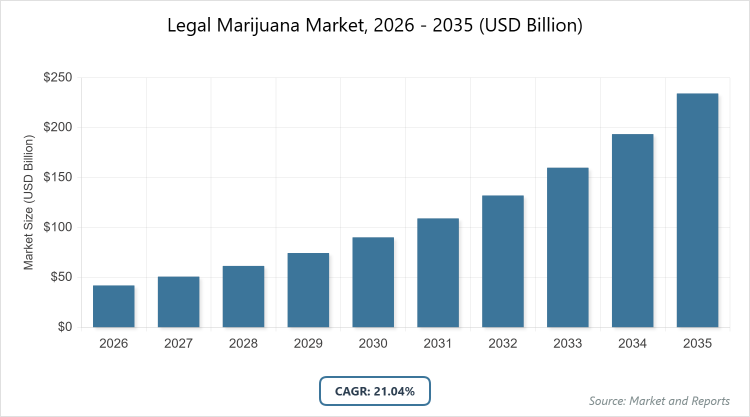
According to MarketnReports, the global Legal Marijuana market size was estimated at USD 42.02 billion in 2025 and is expected to reach USD 283.64 billion by 2035, growing at a CAGR of 21.04% from 2026 to 2035. Legal Marijuana Market is driven by increasing legalization for medical and recreational use coupled with growing awareness of therapeutic benefits.
What is the Industry Overview of Legal Marijuana?
The legal marijuana market involves the regulated cultivation, production, distribution, and consumption of cannabis products for medical, recreational, and industrial purposes, encompassing a wide array of formats from flowers to edibles and oils. This market is shaped by evolving regulatory frameworks that permit controlled access while addressing public health and safety concerns. Market definition pertains to the lawful trade of cannabis-derived goods under governmental oversight, driven by therapeutic applications, consumer demand for wellness alternatives, and economic opportunities in agriculture and retail sectors.
What are the Key Insights into Legal Marijuana?
- The global Legal Marijuana market size was estimated at USD 42.02 billion in 2025 and is expected to reach USD 283.64 billion by 2035.
- The market is expected to grow at a CAGR of 21.04% during the forecast period from 2026 to 2035.
- The market is driven by expanding legalization, rising medical applications, and increasing consumer acceptance of cannabis products.
- In the product type segment, flowers/buds dominate with a 51% share due to their traditional appeal and widespread use in both medical and recreational contexts.
- In the application segment, pain management holds the largest share at 28% because of cannabis’s efficacy in treating chronic pain conditions.
- In the end-use segment, medical use dominates with 63% share owing to regulatory approvals and growing prescriptions for therapeutic purposes.
- North America dominates the market with a 76% share, attributed to progressive legalization policies and established infrastructure in the United States and Canada.
What are the Market Dynamics in Legal Marijuana?
Growth Drivers
The growth drivers for the legal marijuana market include widespread legalization initiatives across regions, boosting accessibility and reducing black market activities, alongside increasing recognition of cannabis’s medical benefits for conditions like chronic pain and epilepsy. Rising consumer preferences for natural wellness products, coupled with innovations in product formats such as edibles and topicals, enhance market appeal and drive adoption. Economic incentives from tax revenues and job creation further encourage governmental support, while investments in research and development improve product quality and efficacy, fostering sustained expansion.
Restraints
Restraints in the legal marijuana market encompass stringent regulatory hurdles and varying legal frameworks across jurisdictions, which complicate interstate commerce and international trade. High taxation and compliance costs burden operators, potentially stifling small businesses and innovation. Public health concerns, including potential misuse and lack of standardized dosing, lead to cautious policy approaches and delayed approvals.
Opportunities
Opportunities in the legal marijuana market arise from potential federal rescheduling in key countries, which could alleviate banking restrictions and enable broader research funding. Expanding into emerging markets in Asia-Pacific and Latin America, where legalization trends are gaining momentum, offers untapped potential. Integration with wellness and pharmaceutical industries through CBD-infused products and clinical trials presents avenues for diversification and premium pricing.
Challenges
Challenges in the legal marijuana market involve navigating inconsistent regulations that create operational uncertainties and hinder scalability. Supply chain issues, including quality control and traceability, pose risks to product integrity and consumer trust. Competition from illicit markets undercuts pricing, while stigma and limited clinical data slow mainstream acceptance and insurance coverage.
Legal Marijuana Market: Report Scope
| Report Attributes | Report Details |
| Report Name | Legal Marijuana Market |
| Market Size 2025 | USD 42.02 Billion |
| Market Forecast 2035 | USD 283.64 Billion |
| Growth Rate | CAGR of 21.04% |
| Report Pages | 220 |
| Key Companies Covered |
Trulieve Cannabis Corp., Green Thumb Industries Inc., Curaleaf Holdings Inc., Verano Holdings Corp., Cresco Labs Inc., Tilray Brands Inc., Canopy Growth Corporation, Aurora Cannabis Inc., Cronos Group Inc., SNDL Inc., and Others |
| Segments Covered | By Product Type, By Application, By End-Use, and By Region |
| Regions Covered | North America, Europe, Asia Pacific (APAC), Latin America, and The Middle East and Africa (MEA) |
| Base Year | 2025 |
| Historical Year | 2020 – 2024 |
| Forecast Year | 2026 – 2035 |
| Customization Scope | Avail customized purchase options to meet your exact research needs. |
The Legal Marijuana market is segmented by product type, application, end-use, and region.
Based on Product Type Segment, flowers/buds is the most dominant subsegment, holding approximately 51% market share, followed by oils as the second most dominant. Flowers/buds dominate due to their familiarity, versatility in consumption methods, and high demand in both medical and recreational sectors, driving the market by serving as the foundational product that attracts new users and supports diverse applications; oils follow, offering concentrated forms for precise dosing, contributing to growth through medical precision and edible integrations.
Based on Application Segment, pain management is the most dominant subsegment with around 28% share, while anxiety and depression ranks second. Pain management leads because of cannabis’s proven analgesic properties, essential for chronic conditions, thereby driving market growth via increased prescriptions and patient reliance; anxiety and depression follows, addressing mental health needs with non-addictive alternatives, expanding market reach through wellness trends.
Based on End-Use Segment, medical use dominates with about 63% share, with recreational use as the second dominant. Medical use’s dominance stems from regulatory endorsements and therapeutic validations, propelling the market through healthcare integrations and research; recreational use follows, fueled by legalization, sustaining growth via consumer lifestyle products.
What are the Recent Developments in Legal Marijuana?
- In December 2025, President Trump signed an executive order directing federal agencies to expedite the rescheduling of marijuana from Schedule I to Schedule III, recognizing its medical uses and potentially easing tax burdens for businesses.
- In January 2026, Curaleaf Holdings expanded its operations through strategic acquisitions in emerging markets, enhancing its portfolio of medical cannabis products.
- In late 2025, Tilray partnered with major beverage companies to develop non-alcoholic cannabis-infused drinks, targeting the growing wellness segment.
- In 2025, New York State advanced its cannabis equity programs, issuing more licenses to social equity applicants and boosting market inclusivity.
- In early 2026, Aurora Cannabis announced innovations in high-CBD strains for medical applications, aimed at treating epilepsy and anxiety disorders.
How Does Regional Analysis Impact Legal Marijuana?
- North America to dominate the global market.
North America maintains the largest market share, driven by comprehensive legalization in the United States and Canada, robust infrastructure for cultivation and distribution, and high consumer demand for both medical and recreational products. The United States dominates within the region, with states like California and Colorado leading due to mature markets, significant tax revenues, and innovations in product development that set global standards.
Europe holds a growing position, supported by progressive policies in countries like Germany and the Netherlands, focusing on medical cannabis and pilot recreational programs. Germany leads the region with its large patient base, pharmaceutical integrations, and EU-aligned regulations that facilitate cross-border trade and research.
Asia-Pacific emerges as a high-potential region, with medical legalization in Thailand and Australia paving the way for expansion amid cultural shifts. Thailand dominates here, leveraging tourism and export opportunities, while investing in cultivation to meet regional demand.
Latin America shows steady advancement, with Uruguay and Mexico pioneering full legalization and emphasizing social equity. Mexico leads, capitalizing on its vast agricultural capabilities and proximity to North American markets for exports.
The Middle East and Africa exhibit nascent growth, primarily through medical programs in Israel and South Africa. Israel dominates with its advanced research ecosystem, exporting medical cannabis globally and influencing international standards.
Who are the Key Market Players in Legal Marijuana?
Trulieve Cannabis Corp. focuses on vertical integration and expansion in key U.S. states, emphasizing medical-grade products to capture therapeutic demand.
Green Thumb Industries Inc. pursues retail growth and product innovation, targeting premium edibles and wellness lines for recreational markets.
Curaleaf Holdings Inc. employs acquisitions to broaden its footprint, prioritizing international exports and CBD-focused pharmaceuticals.
Verano Holdings Corp. invests in cultivation efficiency and branded products, aiming for cost leadership in competitive regions.
Cresco Labs Inc. leverages partnerships for infused beverages, enhancing recreational appeal through diverse consumption methods.
Tilray Brands Inc. emphasizes global diversification, focusing on European medical markets and research collaborations.
Canopy Growth Corporation adopts sustainability initiatives and high-CBD strains, targeting wellness and export opportunities.
Aurora Cannabis Inc. concentrates on cost optimization and premium flower production for medical applications.
Cronos Group Inc. pursues R&D in novel derivatives, aiming for patented therapeutics in emerging markets.
SNDL Inc. focuses on value-chain efficiencies and e-commerce platforms to boost accessibility.
What are the Market Trends Shaping Legal Marijuana?
- Increasing focus on medical cannabis for chronic conditions like pain and anxiety.
- Growth in edible and beverage formats for discreet consumption.
- Expansion of CBD-dominant products for wellness applications.
- Rescheduling efforts reducing regulatory barriers and taxes.
- Rise in social equity licensing for inclusive market growth.
- Integration of technology in cultivation for higher yields.
- Surge in international trade and exports from leading regions.
- Development of low-THC options for new consumers.
- Emphasis on sustainable and organic farming practices.
- Partnerships with pharmaceuticals for clinical trials.
By Product Type
-
- Flowers/Buds
- Oils
- Tinctures
- Edibles
- Concentrates
- Topicals
- Beverages
- Capsules and Tablets
- Vapes
- Transdermal Patches
- Others
By Application
-
- Pain Management
- Anxiety and Depression
- Cancer
- Epilepsy
- Multiple Sclerosis
- Arthritis
- PTSD
- Alzheimer’s
- Nausea and Vomiting
- Sleep Disorders
- Others
By End-Use
-
- Medical Use
- Recreational Use
- Industrial Use
- Wellness and Personal Care
- Veterinary Use
- Pharmaceuticals
- Cosmetics
- Food and Beverages
- Others
By Region
-
- North America
- U.S.
- Canada
- Europe
- UK
- Germany
- France
- Rest of Europe
- Asia Pacific
- China
- India
- Japan
- Rest of Asia Pacific
- Latin America
- Brazil
- Mexico
- Rest of Latin America
- Middle East & Africa
- UAE
- South Africa
- Rest of Middle East & Africa
- North America
Chapter 1. Preface
Chapter 2. Executive Summary
Chapter 3. Global Legal Marijuana Market - Industry Analysis
Chapter 4. Global Legal Marijuana Market- Competitive Landscape
Chapter 5. Global Legal Marijuana Market - Product Analysis
Chapter 6. Global Legal Marijuana Market - Application Analysis
Chapter 7. Global Legal Marijuana Market - End-Use Analysis
Chapter 8. Legal Marijuana Market - Regional Analysis
Chapter 9. Company Profiles
Frequently Asked Questions
Legal marijuana refers to cannabis products cultivated, processed, and sold under governmental regulations for medical, recreational, or industrial uses, ensuring quality and safety standards.
Key factors include progressive legalization, medical research advancements, consumer preference shifts toward wellness products, and economic benefits from taxation.
The market value is projected to grow from USD 42.02 billion in 2025 to USD 283.64 billion by 2035.
The market is expected to grow at a CAGR of 21.04% during the forecast period from 2026 to 2035.
North America will contribute notably, holding the largest share due to extensive legalization and infrastructure.
Major players include Trulieve Cannabis Corp., Green Thumb Industries Inc., Curaleaf Holdings Inc., Verano Holdings Corp., and Cresco Labs Inc.
The report offers in-depth analysis of size, trends, segmentation, regional insights, players, and forecasts.
Stages include cultivation, processing, distribution, retail, and consumption with regulatory compliance.
Trends favor edibles and wellness products, with preferences shifting to low-THC, sustainable options.
Legalization expansions and sustainability mandates are boosting growth, while varying regulations pose challenges.