
Lawn Mowers Market Size, Share and Trends 2026 to 2035
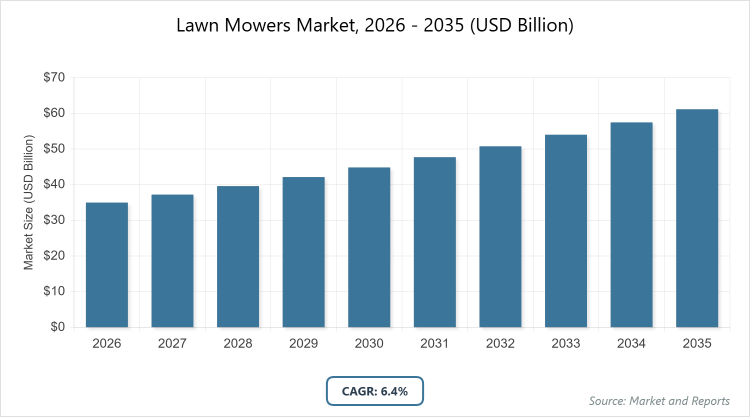
According to MarketnReports, the global Lawn Mowers market size was estimated at USD 35 billion in 2025 and is expected to reach USD 65 billion by 2035, growing at a CAGR of 6.4% from 2026 to 2035. Increasing adoption of battery-powered and robotic models for sustainable lawn care.
Key Insights
- The global lawn mowers market size was valued at USD 35 billion in 2025 and is projected to reach USD 65 billion by 2035.
- The market is anticipated to grow at a CAGR of 6.4% during the forecast period from 2026 to 2035.
- The market is driven by rising demand for eco-friendly battery-powered and robotic mowers, urbanization, and increased focus on landscaping.
- Walk-behind mowers dominate the type segment with a 40% share due to their affordability, ease of use, and suitability for small to medium-sized residential lawns.
- Residential applications dominate with a 60% share because of growing homeownership, DIY gardening trends, and suburban expansion requiring regular lawn maintenance.
- North America dominates the regional segment with a 35% share owing to high disposable incomes, large residential properties, and strong adoption of advanced mowing technologies.
What is the Lawn Mowers Market?
The lawn mowers market refers to the industry involved in the production, distribution, and sale of equipment designed for cutting and maintaining grass in residential, commercial, and public spaces. These machines range from manual push models to advanced robotic and ride-on variants, incorporating technologies like battery power and automation to enhance efficiency and reduce environmental impact. The market definition encompasses tools specifically engineered for lawn maintenance, excluding general gardening equipment, and emphasizes innovations that address consumer demands for convenience, sustainability, and precision in outdoor upkeep.
Market Dynamics
Growth Drivers
The growth drivers in the lawn mowers market are propelled by a surge in environmental awareness and regulatory pressures to reduce emissions, leading to widespread adoption of battery-powered and electric models over traditional gas variants. Urbanization and the expansion of residential areas with maintained green spaces further fuel demand, as consumers seek efficient, low-maintenance solutions for aesthetic landscaping. Technological advancements, such as AI-integrated robotic mowers, enhance user convenience and operational efficiency, attracting both residential and commercial users aiming to minimize labor costs and time.
Restraints
Restraints in the lawn mowers market include high initial costs for advanced models like robotic and battery-powered units, which deter price-sensitive consumers in emerging markets. Supply chain vulnerabilities, particularly for imported batteries and semiconductors, lead to price fluctuations and availability issues. Additionally, seasonal demand patterns and competition from alternative lawn care methods, such as synthetic turf, limit consistent growth across regions.
Opportunities
Opportunities in the lawn mowers market arise from the integration of smart technologies, including IoT connectivity and autonomous features, which enable subscription-based services and remote monitoring for enhanced user engagement. Expansion into developing regions with rising middle-class populations and increasing urbanization presents untapped potential for affordable, eco-friendly models. Partnerships with e-commerce platforms and focus on sustainable manufacturing can capitalize on the growing preference for green products.
Challenges
Challenges in the lawn mowers market involve navigating diverse regional regulations on noise and emissions, which increase compliance costs and complicate product development. Battery life limitations and charging infrastructure gaps hinder adoption in remote or large-scale applications. Moreover, intense competition from established players and new entrants requires continuous innovation to maintain market share.
Lawn Mowers Market: Report Scope
| Report Attributes | Report Details |
| Report Name | Lawn Mowers Market |
| Market Size 2025 | USD 35 Billion |
| Market Forecast 2035 | USD 65 Billion |
| Growth Rate | CAGR of 6.4% |
| Report Pages | 220 |
| Key Companies Covered |
Deere & Company, Husqvarna Group, The Toro Company, Honda Motor Co., Stanley Black & Decker, and Others |
| Segments Covered | By Type, By Application, By End-Use, and By Region |
| Regions Covered | North America, Europe, Asia Pacific (APAC), Latin America, and The Middle East and Africa (MEA) |
| Base Year | 2025 |
| Historical Year | 2020 – 2024 |
| Forecast Year | 2026 – 2035 |
| Customization Scope | Avail customized purchase options to meet your exact research needs. |
Market Segmentation
The Lawn Mowers market is segmented by type, application, end-use, and region.
Based on Type Segment, Walk-behind mowers are the most dominant subsegment, holding 40% market share, followed by ride-on mowers at around 25%. Walk-behind mowers lead due to their cost-effectiveness, maneuverability in confined spaces, and broad appeal to residential users, which drives market growth by catering to the majority of everyday lawn care needs and encouraging frequent upgrades to electric variants.
Based on Application Segment, Residential is the most dominant subsegment with 60% share, followed by commercial at 30%. Residential dominates because of the prevalence of home gardens and suburban lifestyles that prioritize aesthetic maintenance, thereby propelling overall market expansion through sustained demand for user-friendly, sustainable mowers amid rising homeownership rates.
Based on the End-Use Segment, Residential is the most dominant subsegment at 60%, followed by commercial at 25%. Residential leads owing to individual consumer investments in personal outdoor spaces, which fuels market growth by boosting sales of compact, eco-conscious models tailored for easy operation and minimal environmental impact.
Recent Developments
- In January 2026, Honda began U.S. production of its new ProZision battery-powered zero-turn radius lawn mowers, marking its entry into commercial-grade electric models with enhanced durability and quiet operation for professional landscapers.
- In January 2026, MAMMOTION expanded into commercial robotic mowers with the launch of Maston at CES, featuring wire-free operation and AI navigation to improve efficiency in large-scale maintenance.
- In October 2025, Husqvarna introduced AI Vision technology for its robotic lawnmowers, compatible with new camera accessories, enabling smarter obstacle avoidance and edge detection for residential and commercial use.
North America to Dominate the Global Market
- North America is poised to dominate the global lawn mowers market
North America as the dominant country, driven by extensive suburban landscapes, a strong DIY culture, and initiatives like California’s gas engine bans, promoting electric models for over 100 million acres of maintained turf.
Canada contributes significantly, with urban green space expansions in cities like Toronto and Vancouver increasing demand for battery-powered mowers to comply with noise regulations in densely populated areas.
Europe holds a robust position through sustainability-focused policies, with Germany and the UK leading in robotic mower adoption under EU emissions standards, emphasizing low-noise solutions for historic gardens and public parks.
Asia Pacific exhibits rapid growth from urbanization, with China and India as key players investing in affordable electric mowers for emerging middle-class homeowners in megacities like Shanghai and Mumbai.
Latin America and the Middle East & Africa show potential, led by Brazil and South Africa, where commercial landscaping in resorts and urban developments requires durable, weather-resistant mowers for tropical climates.
Key Market Players and Strategies
- Deere & Company focuses on advancing autonomy and electrification through AI-integrated mowers and retrofittable kits, expanding its sustainable offerings to capture premium commercial segments.
- Husqvarna Group emphasizes robotic innovations with AI Vision technology and boundary-wire-free models, targeting eco-conscious consumers via strategic launches and partnerships.
- The Toro Company pursues sustainability with autonomous solutions like the ProLine AMI, enhancing productivity for professional landscapers through tech integrations.
- Honda Motor Co. invests in battery-powered zero-turn mowers, leveraging U.S. manufacturing to meet demand for quiet, high-performance commercial equipment.
- Stanley Black & Decker drives growth via cordless platforms like DeWalt FLEXVOLT, scaling digital channels and eco-friendly products for broader accessibility.
Market Trends
- Surge in battery-powered and electric mowers due to environmental regulations and consumer preference for low-emission options.
- Growing adoption of robotic and autonomous mowers with AI navigation for hands-free lawn care.
- Integration of smart technologies like IoT for remote monitoring and app-controlled operations.
- Expansion of subscription services for maintenance and upgrades in commercial sectors.
- Focus on sustainable materials and recyclable components in product design.
Market Segments and their Subsegments Covered in the Report
By Type
- Walk-Behind Mowers
- Ride-On Mowers
- Robotic Mowers
- Zero-Turn Mowers
- Push Mowers
- Self-Propelled Mowers
- Reel Mowers
- Hover Mowers
- Mulching Mowers
- Tractor Mowers
- Others
By Application
- Residential
- Commercial
- Industrial
- Sports Fields
- Golf Courses
- Parks and Gardens
- Agriculture
- Landscaping
- Municipal
- Infrastructure
- Others
By End-Use
- Residential
- Commercial
- Government and Municipal
- Golf Courses and Sports Facilities
- Landscaping Services
- Agricultural
- Industrial and Institutional
- Hospitality
- Educational Institutions
- Others
- Others
By Region
- North America
- U.S.
- Canada
- Europe
- UK
- Germany
- France
- Rest of Europe
- Asia Pacific
- China
- India
- Japan
- Rest of Asia Pacific
- Latin America
- Brazil
- Mexico
- Rest of Latin America
- Middle East & Africa
- UAE
- South Africa
- Rest of Middle East & Africa
Frequently Asked Questions
Lawn mowers are machines used to cut grass to a uniform height, available in various types like walk-behind, ride-on, and robotic, powered by gas, electricity, or batteries for residential and commercial maintenance.
Key factors include environmental regulations promoting electric models, technological advancements in robotics, urbanization increasing landscaping needs, and rising consumer interest in sustainable gardening.
The market is projected to grow from approximately USD 37 billion in 2026 to USD 65 billion by 2035.
The CAGR is expected to be 6.4% during the forecast period.
North America will contribute the most, driven by large residential properties and adoption of advanced technologies.
Major players include Deere & Company, Husqvarna Group, The Toro Company, Honda Motor Co., and Stanley Black & Decker.
The report provides comprehensive analysis of market size, trends, segments, regional dynamics, key players, and future forecasts.
Stages include raw material procurement, manufacturing, distribution through retailers and e-commerce, end-user application, and after-sales service or recycling.
Trends are moving toward eco-friendly electric and robotic models, with consumers preferring smart, low-maintenance options for convenience and sustainability.
Stricter emissions standards, noise regulations, and incentives for green technologies are pushing the shift from gas to electric mowers.