
IP Intercom Market Size, Share and Trends 2026 to 2035
According to MarketnReports, the global IP Intercom market size was estimated at USD 3.9 billion in 2025 and is expected to reach USD 7.9 billion by 2035, growing at a CAGR of 8.6% from 2026 to 2035. IP Intercom Market is driven by increasing demand for advanced security and smart building solutions.
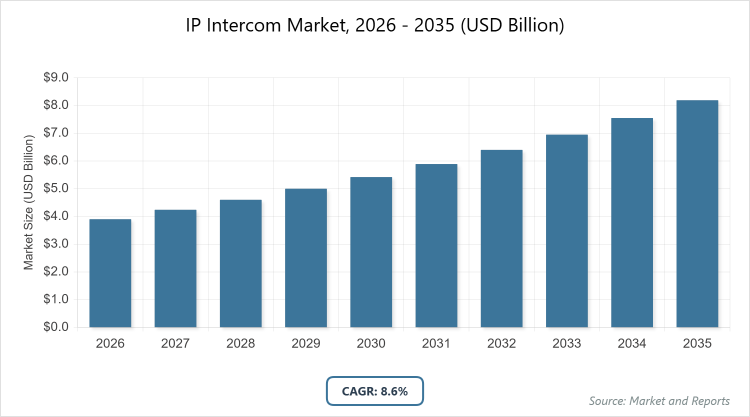
What is the Industry Overview of the IP Intercom Market?
The IP Intercom Market encompasses network-based communication systems that enable audio and video interactions for access control, security, and intercom functions, integrating with IP networks for seamless connectivity in residential, commercial, and industrial settings. This market supports modern security needs by offering features like remote access, integration with smart devices, and AI-enhanced recognition, replacing traditional analog systems with scalable, cost-effective solutions.
It addresses the demand for enhanced safety amid urbanization and digital transformation, with innovations in wireless and cloud-based technologies improving usability and interoperability. The market definition includes all IP-enabled intercom hardware, software, and services, excluding non-IP systems, driven by regulatory emphases on security and the rise of IoT ecosystems for unified building management.
What are the Key Insights into the IP Intercom Market?
- The global IP Intercom Market size was estimated at USD 3.9 Billion in 2025 and is expected to reach USD 7.9 Billion by 2035.
- Growing at a CAGR of 8.6% from 2026 to 2035.
- The IP Intercom Market is driven by increasing demand for advanced security solutions, smart building integrations, and rising urbanization requiring efficient access control systems.
- Dominated subsegment in Type: Video Intercom with 55% share, because of its enhanced security features like visual verification and integration with surveillance systems, preferred for residential and commercial applications.
- Dominated subsegment in Application: Commercial with 40% share, because of the need for robust communication and access control in offices, retail, and hotels amid growing business security concerns.
- Dominated subsegment in End-User: Businesses with 45% share, because of corporate investments in secure, scalable systems for employee and visitor management.
- Dominated region: North America with 35% share, because of advanced technological infrastructure, high adoption of smart homes, and stringent security regulations in the United States.
What are the Market Dynamics of the IP Intercom Market?
Growth Drivers
The growth drivers for the IP Intercom Market include the escalating need for enhanced security in urban environments, where IP systems offer real-time video and audio communication integrated with access control and surveillance, reducing risks in residential and commercial spaces. Rapid advancements in IoT and AI enable features like facial recognition and remote monitoring, appealing to tech-savvy consumers and businesses seeking efficient, scalable solutions. Government regulations mandating improved building security, coupled with smart city initiatives, accelerate adoption, particularly in high-risk sectors like healthcare and education. The shift towards wireless and cloud-based systems lowers installation costs and enhances flexibility, attracting SMEs and homeowners. Increasing e-commerce and remote work trends further boost demand for secure entry systems, fostering innovation and market expansion through partnerships with telecom providers.
Restraints
Restraints in the IP Intercom Market arise from high initial installation costs, including network infrastructure upgrades and integration with existing systems, which deter adoption in budget-constrained regions and small-scale applications. Cybersecurity vulnerabilities pose significant risks, as IP networks are susceptible to hacking, requiring robust encryption that adds complexity and expense. Limited internet penetration in rural or developing areas hinders functionality, relying on stable connectivity for optimal performance. Regulatory variations across countries complicate standardization, increasing compliance burdens for global manufacturers. Economic slowdowns also impact construction and renovation projects, delaying investments in advanced intercom solutions and affecting overall market momentum.
Opportunities
Opportunities in the IP Intercom Market emerge from the integration with smart home ecosystems, enabling voice-activated controls and AI-driven analytics for predictive security, attracting partnerships with tech giants like Amazon and Google for enhanced user experiences. Expansion into emerging markets with urbanization drives demand for affordable, wireless systems in residential complexes and commercial hubs, supported by government subsidies for smart infrastructure. Innovations in biometric and mobile app integrations open avenues for personalized access, targeting hospitality and healthcare for contactless solutions post-pandemic. Sustainability trends favor energy-efficient designs, qualifying for green certifications and premium pricing. Collaborations with 5G providers can enable ultra-low latency video, positioning companies for growth in transportation and industrial applications.
Challenges
Challenges in the IP Intercom Market include ensuring interoperability with diverse legacy systems, as incompatible protocols lead to integration issues, requiring custom solutions that raise costs and timelines. Maintaining data privacy amid increasing regulations like GDPR demands advanced encryption, complicating design and increasing liability risks. Supply chain disruptions for components like chips affect production, leading to delays and price hikes. Educating users on system benefits and maintenance is crucial, as low awareness in non-tech sectors limits adoption. Adapting to evolving cyber threats requires continuous R&D, straining resources for smaller players in a competitive landscape.
IP Intercom Market: Report Scope
| Report Attributes | Report Details |
| Report Name | IP Intercom Market |
| Market Size 2025 | USD 3.9 Billion |
| Market Forecast 2035 | USD 7.9 Billion |
| Growth Rate | CAGR of 8.6% |
| Report Pages | 220 |
| Key Companies Covered |
Aiphone Corporation, Panasonic Corporation, Honeywell International Inc., Samsung Electronics Co., Ltd., Legrand SA, Commend International GmbH, Zenitel Group, Alpha Communications, Siedle & Söhne OHG, Dahua Technology Co., Ltd., and Others |
| Segments Covered | By Type, By Application, By End-User, and By Region |
| Regions Covered | North America, Europe, Asia Pacific (APAC), Latin America, and The Middle East and Africa (MEA) |
| Base Year | 2025 |
| Historical Year | 2020 – 2024 |
| Forecast Year | 2026 – 2035 |
| Customization Scope | Avail customized purchase options to meet your exact research needs. |
The IP Intercom market is segmented by type, application, end-user, and region.
Based on Type Segment. The most dominant segment is Video Intercom, which holds the largest market share due to its superior security features enabling visual identification and integration with CCTV, essential for high-risk environments; this dominance drives the market by enhancing user trust, complying with safety standards, and boosting demand in smart buildings that accelerate overall adoption. The second most dominant segment is Wireless Intercom, favored for its easy installation without cabling; it contributes to market growth by enabling retrofits in existing structures, reducing costs, and supporting mobile connectivity for remote access.
Based on Application Segment. The most dominant segment is Commercial, leading due to the need for efficient visitor management and security in offices and retail; this drives market expansion by integrating with building automation, improving operational efficiency, and attracting investments from corporate sectors. The second most dominant segment is Residential, driven by smart home trends; it propels growth by offering affordable, user-friendly systems that enhance home security and convenience.
Based on End-User Segment. The most dominant segment is Businesses, commanding the majority share owing to corporate focus on secure access control; this dominance fuels market growth by demanding scalable, integrated solutions that support enterprise expansions. The second most dominant segment is Homeowners, driven by rising security awareness; it aids growth by popularizing app-based controls for personal use.
What are the Recent Developments in the IP Intercom Market?
- In December 2025, Hollyland launched the Solidcom SE Wireless Intercom System, designed for seamless team communication in commercial settings with enhanced battery life.
- In August 2025, Aiphone introduced a new IP video intercom with AI facial recognition, targeting residential security enhancements.
- In October 2025, Commend expanded its SIP intercom line with cloud integration for remote management in industrial applications.
How Does Regional Analysis Impact the IP Intercom Market?
- North America to dominate the global market.
North America, valued at USD 1.37 billion in 2025 and projected to reach USD 2.76 billion by 2035 at a CAGR of 8.6%, dominates with over 35% revenue share due to advanced IoT infrastructure, high smart home penetration exceeding 40% in urban areas, and stringent security regulations like NFPA standards mandating intercoms in buildings; Canada contributes through tech hubs in Toronto, but the United States as the dominating country leads with innovations from Silicon Valley firms, supported by federal incentives for smart cities and massive investments in 5G networks enabling low-latency video, driving adoption in commercial and residential sectors with high occupancy rates.
Europe exhibits strong growth, propelled by GDPR compliance and green building directives, with integrations in smart infrastructure projects allocating billions for security upgrades; Germany as the dominating country advances through Industry 4.0 initiatives, leading in industrial applications with firms like Siedle.
Asia Pacific is rapidly expanding, fueled by urbanization rates over 50% and government smart city programs investing trillions; China dominates with massive production scales in Shenzhen, driven by export demands and domestic security needs in megacities.
Latin America shows emerging potential, supported by economic growth and security concerns in urban centers; Brazil leads with Rio’s smart initiatives, integrating intercoms in residential complexes.
The Middle East and Africa are progressively developing, influenced by luxury developments and oil-funded projects; the United Arab Emirates dominates through Dubai’s smart city visions, incorporating advanced IP systems in high-rises.
Who are the Key Market Players in the IP Intercom Market?
Aiphone Corporation. Aiphone Corporation focuses on video intercom innovations, with strategies including AI integrations for facial recognition and expansions in smart home markets.
Panasonic Corporation. Panasonic Corporation emphasizes wireless solutions, strategizing through IoT partnerships for seamless building automation.
Honeywell International Inc. Honeywell International Inc. targets commercial security, employing cloud-based platforms for remote monitoring and compliance.
Samsung Electronics Co., Ltd. Samsung Electronics Co., Ltd. integrates with smart devices, with strategies involving mobile app controls for residential users.
Legrand SA. Legrand SA specializes in wired systems, strategizing via acquisitions for European market dominance in industrial applications.
Commend International GmbH. Commend International GmbH offers SIP intercoms, with strategies focused on industrial durability and 5G compatibility.
Zenitel Group. Zenitel Group provides marine-grade solutions, employing strategies for transportation and critical communications.
Alpha Communications. Alpha Communications targets healthcare, strategizing through nurse call integrations for patient safety.
Siedle & Söhne OHG. Siedle & Söhne OHG emphasizes design-led intercoms, with strategies in premium residential segments.
Dahua Technology Co., Ltd. Dahua Technology Co., Ltd. focuses on video analytics, strategizing via AI for enhanced security features.
What are the Market Trends in the IP Intercom Market?
- Increasing integration with AI for facial recognition and predictive security.
- Shift towards wireless and cloud-based systems for remote access.
- Growing demand for contactless solutions post-pandemic.
- Expansion of smart home and building automation ecosystems.
- Adoption of 5G for low-latency video communication.
What Market Segments and their Subsegments are Covered in the IP Intercom Report?
By Type
-
- Audio Intercom
- Video Intercom
- Wireless Intercom
- Wired Intercom
- IP-Based Door Station
- SIP Intercom
- VoIP Intercom
- Cloud-Based Intercom
- Mobile App Integrated
- Biometric Intercom
- Others
By Application
-
- Residential
- Commercial
- Industrial
- Educational Institutions
- Healthcare Facilities
- Government Buildings
- Transportation Hubs
- Hotels
- Retail Stores
- Offices
- Others
By End-User
-
- Homeowners
- Businesses
- Security Companies
- Property Managers
- Educational Administrators
- Healthcare Providers
- Government Agencies
- Transportation Operators
- Hoteliers
- Retailers
- Others
By Region
-
- North America
- U.S.
- Canada
- Europe
- UK
- Germany
- France
- Rest of Europe
- Asia Pacific
- China
- India
- Japan
- Rest of Asia Pacific
- Latin America
- Brazil
- Mexico
- Rest of Latin America
- Middle East & Africa
- UAE
- South Africa
- Rest of Middle East & Africa
- North America
Chapter 1. Preface
Chapter 2. Executive Summary
Chapter 3. Global IP Intercom Market - Industry Analysis
Chapter 4. Global IP Intercom Market- Competitive Landscape
Chapter 5. Global IP Intercom Market - Type Analysis
Chapter 6. Global IP Intercom Market - Application Analysis
Chapter 7. Global IP Intercom Market - End-User Analysis
Chapter 8. IP Intercom Market - Regional Analysis
Chapter 9. Company Profiles
Frequently Asked Questions
IP Intercoms are network-based systems enabling audio/video communication and access control via IP protocols, integrating with smart devices for security.
Key factors include security demands, smart building trends, AI integrations, and urbanization.
The market is projected to grow from USD 4.2 billion in 2026 to USD 7.9 billion by 2035.
The CAGR is expected to be 8.6% during 2026-2035.
North America will contribute notably, holding 35% share, driven by technology in the United States.
Major players include Aiphone Corporation, Panasonic Corporation, Honeywell International Inc., Samsung Electronics Co., Ltd., Legrand SA, and Commend International GmbH, among others.
The report offers detailed insights on size, forecasts, segmentation, dynamics, regions, players, trends, and strategies.
The value chain includes component manufacturing, system integration, distribution, installation, and maintenance services.
Trends favor AI and wireless tech, with preferences for secure, integrated smart solutions.
Regulations on security standards drive adoption, while sustainability pushes energy-efficient designs.