
(IaaS) Infrastructure as a Service Market Size, Share and Trends 2026 to 2035
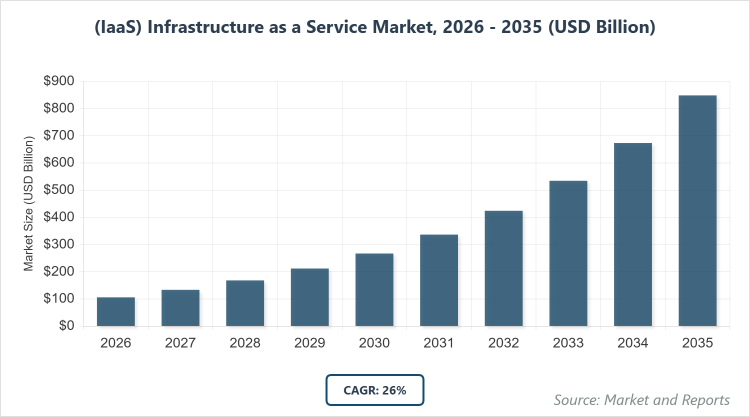
According to MarketnReports, the global (IaaS) Infrastructure as a Service Market size was estimated at USD 106 billion in 2025 and is expected to reach USD 1062 billion by 2035, growing at a CAGR of 26% from 2026 to 2035. (IaaS) Infrastructure as a Service Market is driven by increasing adoption of cloud computing for scalability and cost efficiency.
What is the Industry Overview of (IaaS) Infrastructure as a Service Market?
The (IaaS) Infrastructure as a Service Market encompasses the provision of virtualized computing resources over the internet, allowing businesses to access scalable infrastructure without the need for physical hardware ownership. This market includes core elements such as servers, storage, and networking delivered on-demand through cloud platforms. Market definition refers to a cloud computing model where providers offer fundamental IT infrastructure as a subscription-based service, enabling users to build, manage, and deploy applications in a flexible environment. It supports digital transformation by reducing capital expenditures, enhancing agility, and facilitating rapid innovation across industries.
What are the Key Insights into (IaaS) Infrastructure as a Service Market?
- The global (IaaS) Infrastructure as a Service Market was valued at USD 106 billion in 2025 and is projected to reach USD 1062 billion by 2035.
- The market is expected to grow at a CAGR of 26% during the forecast period from 2026 to 2035.
- The market is driven by rapid digital transformation, increasing demand for scalable IT resources, and the rise of AI and edge computing.
- Public cloud deployment dominates with a 70% share due to its cost-effectiveness and ease of scalability for enterprises seeking rapid resource provisioning.
- Compute services hold the largest subsegment share at 41% because they form the backbone of virtualized processing power, enabling efficient workload management and supporting AI-driven applications.
- North America dominates with a 45% market share, driven by the presence of major providers like AWS and advanced IT infrastructure in the US.
What are the Market Dynamics of (IaaS) Infrastructure as a Service Market?
Growth Drivers
The primary growth drivers for the (IaaS) Infrastructure as a Service Market include the accelerating shift toward digital transformation across enterprises, which demands flexible and scalable IT resources to support remote work, data analytics, and AI workloads. The proliferation of cloud-native applications and the need for cost optimization through pay-as-you-go models further propel adoption, as businesses avoid heavy upfront investments in hardware. Additionally, advancements in 5G and edge computing enhance connectivity and real-time processing, driving demand in sectors like manufacturing and healthcare. Government initiatives promoting cloud adoption in emerging economies also contribute significantly, fostering innovation and operational efficiency.
Restraints
Key restraints in the (IaaS) Infrastructure as a Service Market revolve around data security and privacy concerns, as enterprises grapple with potential breaches and compliance with regulations like GDPR and HIPAA. High dependency on internet connectivity poses risks in regions with unstable infrastructure, leading to latency issues and downtime. Vendor lock-in remains a challenge, making migrations complex and costly. Moreover, the rising costs associated with data transfer and storage in large-scale deployments can deter small and medium enterprises from full adoption, especially amid economic uncertainties.
Opportunities
Opportunities in the (IaaS) Infrastructure as a Service Market are abundant with the integration of AI and machine learning, enabling providers to offer advanced analytics and automation tools that enhance user experiences. The growth of hybrid and multi-cloud strategies opens avenues for seamless interoperability, allowing businesses to optimize workloads across environments. Emerging markets in Asia-Pacific present untapped potential due to increasing internet penetration and digital initiatives. Sustainability-focused solutions, such as green data centers powered by renewable energy, align with global ESG goals, attracting environmentally conscious enterprises.
Challenges
Challenges facing the (IaaS) Infrastructure as a Service Market include the complexity of integrating legacy systems with cloud infrastructure, which often requires significant expertise and resources. Rapid technological evolution demands continuous updates to platforms, straining provider capabilities and user adaptability. Cybersecurity threats, including ransomware and supply chain attacks, necessitate robust defenses, increasing operational costs. Additionally, talent shortages in cloud management and DevOps skills hinder effective implementation, particularly in non-tech industries.
(IaaS) Infrastructure as a Service Market: Report Scope
| Report Attributes | Report Details |
| Report Name | (IaaS) Infrastructure as a Service Market |
| Market Size 2025 | USD 106 Billion |
| Market Forecast 2035 | USD 1062 Billion |
| Growth Rate | CAGR of 26% |
| Report Pages | 230 |
| Key Companies Covered |
Amazon Web Services, Microsoft Azure, Google Cloud Platform, Alibaba Cloud, IBM Cloud, Oracle Cloud, and Others |
| Segments Covered | By Deployment Type, By Service, By Industry, and By Region |
| Regions Covered | North America, Europe, Asia Pacific (APAC), Latin America, and The Middle East and Africa (MEA) |
| Base Year | 2025 |
| Historical Year | 2020 – 2024 |
| Forecast Year | 2026 – 2035 |
| Customization Scope | Avail customized purchase options to meet your exact research needs. |
What is the Market Segmentation of (IaaS) Infrastructure as a Service Market?
The (IaaS) Infrastructure as a Service Market is segmented by deployment type, service, industry, and region.
Based on Deployment Type Segment: Public cloud dominates as the leading segment with a 70% share, owing to its affordability, rapid scalability, and ease of access, which appeal to startups and large enterprises alike for handling variable workloads. Hybrid cloud emerges as the second most dominant at 20%, providing a balance of security and flexibility by combining on-premises control with public cloud elasticity, driving market growth through enhanced data sovereignty and compliance.
Based on Service Segment: Compute services lead with a 41% share, as they deliver essential virtual processing power that underpins application development and AI computations, fueling market expansion by enabling efficient resource allocation. Storage follows as the second dominant at 30%, offering secure, scalable data management solutions that support big data analytics and backup needs, contributing to overall growth by addressing the explosion in data volumes.
Based on Industry Segment: IT & telecom holds the top position with a 25% share, leveraging IaaS for network optimization and service delivery, which propels the market by facilitating innovation in 5G and IoT. BFSI ranks second at 20%, utilizing secure cloud infrastructure for transaction processing and risk management, driving growth through improved operational resilience and customer experiences.
What are the Recent Developments in (IaaS) Infrastructure as a Service Market?
- In December 2023, ZKTeco partnered with Amazon Web Services to launch the Minerva IoT platform, enhancing cloud capabilities for IoT integration and management.
- In August 2023, IBM expanded its collaboration with Oracle to integrate WatsonX AI with Oracle Cloud Infrastructure, boosting AI-driven workloads.
- In May 2023, Microsoft Azure and Google Cloud formed a partnership to enable seamless workload migration between platforms, promoting multi-cloud flexibility.
What is the Regional Analysis of (IaaS) Infrastructure as a Service Market?
North America to dominate the global market
North America leads the (IaaS) Infrastructure as a Service Market with a 45% share, driven by the presence of tech giants like AWS and Microsoft, advanced data centers, and high cloud adoption rates. The United States dominates within the region, fueled by robust investments in AI and digital transformation across industries such as IT and finance.
Europe follows with strong growth, emphasizing data sovereignty and GDPR compliance, where Germany stands out as the leading country due to its industrial base and focus on hybrid cloud solutions in manufacturing and automotive sectors.
Asia-Pacific exhibits the fastest expansion, propelled by digital initiatives and rising internet penetration, with China as the dominant player, supported by government-backed cloud infrastructure and e-commerce giants like Alibaba.
Latin America shows emerging potential, led by Brazil, where increasing SME adoption and telecom advancements drive demand for scalable IaaS.
The Middle East and Africa lag but grow steadily, with the UAE leading through investments in smart cities and oil & gas digitization.
What are the Key Market Players and Strategies in (IaaS) Infrastructure as a Service Market?
- Amazon Web Services (AWS) focuses on expanding its global data center footprint and integrating AI capabilities like SageMaker to enhance scalability and attract enterprises seeking advanced analytics.
- Microsoft Azure emphasizes hybrid cloud solutions through Azure Arc, enabling seamless management of on-premises and cloud resources, while partnering with industries for customized compliance-focused services.
- Google Cloud Platform invests in AI and machine learning tools, such as Vertex AI, to differentiate in data-intensive sectors, alongside sustainability initiatives like carbon-free energy for data centers.
- Alibaba Cloud targets Asia-Pacific growth with localized data centers and e-commerce integrations, leveraging its ecosystem for cost-effective, high-performance computing.
- IBM Cloud prioritizes secure hybrid environments with Red Hat OpenShift, catering to regulated industries like finance through blockchain and quantum computing advancements.
- Oracle Cloud specializes in enterprise-grade databases and ERP integrations, offering autonomous services to reduce operational overhead and appeal to legacy system migrations.
What are the Market Trends in (IaaS) Infrastructure as a Service Market?
- Increasing adoption of hybrid and multi-cloud strategies for better flexibility and risk mitigation.
- Integration of AI and machine learning to optimize resource allocation and predictive analytics.
- Rise of edge computing to reduce latency and support IoT applications.
- Focus on sustainability with green data centers and energy-efficient infrastructure.
- Enhanced security features, including zero-trust models and advanced encryption.
What are the Market Segments and their Subsegments Covered in the (IaaS) Infrastructure as a Service Market Report?
-
Deployment Type
- Public Cloud
- Private Cloud
- Hybrid Cloud
-
Service
- Compute
- Storage
- Networking
- Disaster Recovery as a Service
-
Industry
- IT & Telecom
- BFSI
- Healthcare
- Retail & E-commerce
- Manufacturing
- Government & Defense
- Energy & Utilities
- Education
- Media & Entertainment
- Others
- By Region
-
- North America
- U.S.
- Canada
- Europe
- UK
- Germany
- France
- Rest of Europe
- Asia Pacific
- China
- India
- Japan
- Rest of Asia Pacific
- Latin America
- Brazil
- Mexico
- Rest of Latin America
- Middle East & Africa
- UAE
- South Africa
- Rest of Middle East & Africa
- North America
Frequently Asked Questions
(IaaS) Infrastructure as a Service Market refers to the cloud computing model providing virtualized computing resources like servers, storage, and networking over the internet on a pay-as-you-go basis.
Key factors include digital transformation, AI adoption, cost efficiency, scalability needs, and hybrid cloud trends.
The market is projected to reach USD 1062 billion by 2035.
The CAGR is expected to be 26%.
North America will contribute notably, holding a 45% share.
Major players include AWS, Microsoft Azure, Google Cloud, Alibaba Cloud, IBM Cloud, and Oracle Cloud.
The report provides market size, growth forecasts, segmentation analysis, regional insights, key players, trends, and competitive landscape.
Stages include infrastructure provisioning, resource virtualization, service delivery, user management, and ongoing optimization.
Trends lean toward AI integration and sustainability, with consumers preferring hybrid models for flexibility and security.
Regulations like GDPR and data sovereignty laws, plus environmental pushes for green computing, influence growth.