
Industrial Seals Market Size, Share and Trends 2026 to 2035
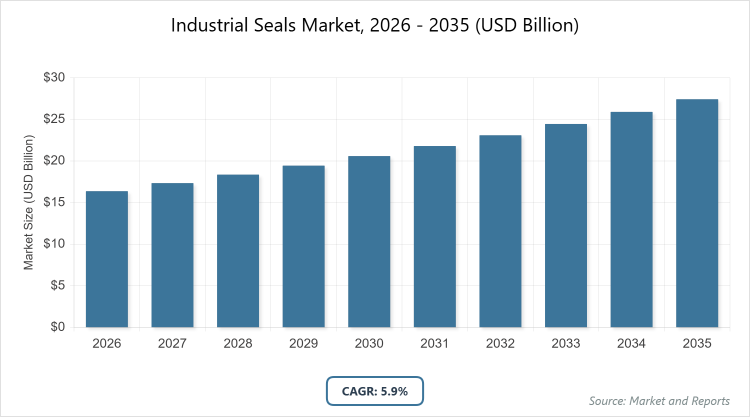
According to MarketnReports, the global Industrial Seals market size was estimated at USD 16.37 billion in 2025 and is expected to reach USD 29.00 billion by 2035, growing at a CAGR of 5.9% from 2026 to 2035. Industrial Seals Market is driven by rising demand from manufacturing and energy sectors amid industrial automation.
What is the Overview of Industrial Seals Market?
The industrial seals market encompasses the design, manufacturing, and distribution of sealing components that prevent fluid or gas leakage in machinery and equipment across diverse industries, ensuring operational efficiency, safety, and longevity. This market includes various seal types such as mechanical, hydraulic, and pneumatic seals, crafted from materials like rubber, metal, and composites to withstand extreme conditions like high pressure, temperature, and chemical exposure. Market definition refers to the sector focused on providing sealing solutions that mitigate downtime and maintenance costs in applications ranging from pumps and valves to engines and compressors, supporting global industrial operations by addressing environmental regulations and enhancing equipment reliability in sectors like oil & gas, automotive, and manufacturing.
What are the Key Insights into Industrial Seals Market?
- The global industrial seals market was valued at USD 16.37 billion in 2025 and is projected to reach USD 29.00 billion by 2035.
- The market is expected to grow at a CAGR of 5.9% during the forecast period from 2026 to 2035.
- The market is driven by expanding industrialization and advancements in sealing technologies for enhanced durability.
- In the type segment, mechanical seals dominate with a 30% share.
- This dominance is due to their superior performance in high-pressure environments and leak prevention, driving market growth by reducing operational failures in critical applications.
- In the application segment, pumps dominate with a 35% share.
- This is attributed to widespread use in fluid handling systems across industries, fueling expansion through efficiency improvements and maintenance reductions.
- In the end-use industry segment, oil & gas dominates with a 25% share.
- This stems from stringent safety requirements and harsh operating conditions, propelling the market by demanding high-reliability seals for exploration and refining.
- Asia Pacific dominates the global market with a 40% share.
- This is owing to rapid manufacturing growth, infrastructure investments, and presence of key industries in China.
What are the Market Dynamics in Industrial Seals?
Growth Drivers
Growth drivers in the industrial seals market are anchored in the surge of industrial automation and the need for reliable sealing solutions to support efficient machinery operations, particularly in expanding sectors like renewable energy and electric vehicles where seals enhance performance and reduce energy loss. Advancements in material science, such as the development of high-performance elastomers and composites, enable seals to withstand extreme conditions, attracting investments from manufacturers aiming to meet evolving regulatory standards for emissions and safety. The rise in global infrastructure projects and maintenance activities in aging industrial facilities further boosts demand, while digitalization through IoT-integrated seals for predictive maintenance drives innovation and market adoption.
Restraints
Restraints in the industrial seals market include fluctuating raw material prices, particularly for specialty polymers and metals, which increase production costs and impact profitability for manufacturers operating on thin margins. The complexity of customizing seals for specific applications requires significant R&D investments, deterring smaller players from competing effectively. Stringent environmental regulations on material usage, such as restrictions on certain chemicals, add compliance burdens and limit material options. Moreover, supply chain disruptions from geopolitical tensions affect timely delivery, hindering market growth in regions dependent on imports.
Opportunities
Opportunities in the industrial seals market emerge from the growing emphasis on sustainable and eco-friendly sealing solutions, such as bio-based materials, which align with global green initiatives and open avenues for differentiation in environmentally regulated industries. The expansion of electric and hybrid vehicle production presents potential for specialized seals in battery systems and motors, targeting the automotive shift toward electrification. Emerging markets in Asia and Africa offer untapped potential with infrastructure booms, where affordable, durable seals can capture share. Partnerships with OEMs for co-development of advanced seals further enhance opportunities for innovation-driven revenue.
Challenges
Challenges in the industrial seals market revolve around the rapid pace of technological change, requiring continuous adaptation to new machinery designs that demand seals with higher tolerances, straining R&D resources. Counterfeit products erode market trust and revenue for branded manufacturers, particularly in unregulated regions. The skills gap in specialized seal installation and maintenance leads to improper usage and failures, necessitating training investments. Additionally, volatile energy prices impact end-use industries like oil & gas, causing demand fluctuations that challenge forecasting and inventory management.
Industrial Seals Market: Report Scope
| Report Attributes | Report Details |
| Report Name | Industrial Seals Market |
| Market Size 2025 | USD 16.37 Billion |
| Market Forecast 2035 | USD 29.00 Billion |
| Growth Rate | CAGR of 5.9% |
| Report Pages | 220 |
| Key Companies Covered | SKF, Freudenberg Group, Flowserve Corporation, Parker Hannifin, Trelleborg Sealing Solutions, and Others |
| Segments Covered | By Type, By Application, By End-Use Industry, and By Region |
| Regions Covered | North America, Europe, Asia Pacific (APAC), Latin America, and The Middle East and Africa (MEA) |
| Base Year | 2025 |
| Historical Year | 2020 – 2024 |
| Forecast Year | 2026 – 2035 |
| Customization Scope | Avail customized purchase options to meet your exact research needs. |
The Industrial Seals market is segmented by type, application, end-use industry, and region.
Based on Type Segment, the most dominant subsegment is mechanical seals, while the second most dominant is O-rings. Mechanical seals lead due to their critical role in dynamic applications requiring leak-proof performance under high speeds and pressures, driving market growth by minimizing downtime in heavy machinery and supporting efficiency in sectors like oil & gas; O-rings rank second as versatile static seals offering cost-effective solutions for a wide range of temperatures and chemicals, contributing to expansion through broad adoption in automotive and manufacturing assemblies.
Based on Application Segment, the most dominant subsegment is pumps, while the second most dominant is valves. Pumps dominate owing to their essential function in fluid transfer across industries, propelling market growth via demand for durable seals that prevent contamination and ensure operational reliability; valves follow as the second dominant, driven by control needs in processing systems, enhancing the market through innovations in seal designs that improve flow regulation and reduce maintenance.
Based on End-Use Industry Segment, the most dominant subsegment is oil & gas, while the second most dominant is automotive. Oil & gas leads because of harsh environments requiring robust seals for exploration and refining equipment, fueling market growth by addressing safety and efficiency mandates; automotive ranks second with seals integral to engine and transmission systems, advancing the market through lightweight materials supporting vehicle electrification trends.
What are Recent Developments in Industrial Seals?
- In Q1 2025, SKF appointed Maria Andersson as President of its Industrial Seals Market division, aiming to accelerate innovation in sustainable sealing solutions.
- In September 2024, Freudenberg Group launched a new line of bio-based seals for renewable energy applications, enhancing environmental compliance.
- In late 2024, Flowserve Corporation acquired a specialty seal manufacturer to expand its portfolio in high-pressure applications for oil & gas.
- In 2025, Trelleborg Sealing Solutions invested in advanced elastomer technology for electric vehicle seals, targeting the automotive shift.
What is the Regional Analysis for Industrial Seals Market?
- Asia Pacific to dominate the global market.
Asia Pacific dominates the industrial seals market, propelled by rapid industrialization, booming manufacturing sectors, and significant investments in infrastructure and energy projects that demand high-quality sealing solutions for efficiency and safety. The region’s growth is further supported by low-cost production capabilities and a large skilled workforce. China dominates within Asia Pacific, driven by its massive manufacturing base, government policies promoting industrial upgrades, and companies like SKF expanding local operations to meet demand in automotive and chemical industries; India contributes through infrastructure developments, Japan focuses on precision engineering, but challenges include environmental regulations tightening material usage.
North America holds a substantial share in the industrial seals market, characterized by advanced technological integrations and strong emphasis on R&D for innovative sealing materials. The presence of key industries like aerospace and oil & gas drives demand. The United States dominates the region, supported by its energy sector and firms like Parker Hannifin leading in custom solutions, alongside shale gas explorations; Canada benefits from mining applications, Mexico leverages automotive manufacturing growth, though high material costs pose restraints.
Europe exhibits steady growth in the industrial seals market, with a focus on sustainability and compliance with EU environmental standards promoting eco-friendly seals. Mature industries in automotive and chemicals fuel innovation. Germany leads as the dominating country, bolstered by its engineering expertise and companies like Freudenberg pioneering advanced seals for machinery; the UK and France follow with strong aerospace sectors, while Eastern Europe offers cost-effective production, despite varying regulatory harmonization.
Latin America shows emerging potential in the industrial seals market, influenced by resource extraction and growing manufacturing. Trade agreements facilitate technology imports. Brazil dominates as the key country, with its oil & gas industry adopting high-performance seals and local firms expanding; Mexico benefits from NAFTA-related automotive ties, Argentina focuses on mining, though economic volatility challenges stability.
The Middle East and Africa (MEA) region is nascent in the industrial seals market, driven by oil-dependent economies and infrastructure projects. Investments in diversification boost demand. South Africa dominates within MEA, supported by mining operations and companies like SKF providing solutions for harsh environments; the UAE invests in energy diversification, Saudi Arabia through Vision 2030, but geopolitical issues and skill gaps restrain growth.
Who are the Key Market Players in Industrial Seals?
SKF focuses on sustainable innovations and digital monitoring for seals, expanding through acquisitions to strengthen its global presence in industrial applications.
Freudenberg Group employs material advancements in bio-based seals, targeting renewable sectors with R&D investments for enhanced durability.
Flowserve Corporation pursues mergers for portfolio expansion, emphasizing high-pressure seals for oil & gas to capture market share.
Parker Hannifin adopts customization strategies for aerospace and automotive, leveraging engineering expertise for performance-driven solutions.
Trelleborg Sealing Solutions concentrates on electrification trends, developing lightweight seals for EVs through collaborative partnerships.
EnPro Industries emphasizes operational efficiencies, investing in advanced manufacturing to meet regulatory demands in chemicals.
What are the Market Trends in Industrial Seals?
– Shift toward sustainable, bio-based materials to meet environmental regulations.
- Integration of IoT for predictive maintenance in smart seals.
- Growth in customized seals for electric and hybrid vehicles.
- Rise in high-performance seals for extreme conditions in renewable energy.
- Expansion of 3D printing for rapid prototyping of seals.
- Focus on low-friction designs to enhance energy efficiency.
- Surge in demand for non-contact seals in food & beverage.
- Adoption of composite materials for lightweight applications.
What Market Segments and Subsegments are Covered in the Industrial Seals Report?
By Type
-
- O-Rings
- Gaskets
- Mechanical Seals
- Oil Seals
- Rotary Seals
- Lip Seals
- Shaft Seals
- Hydraulic Seals
- Pneumatic Seals
- Spring Seals
- Others
By Application
-
- Pumps
- Valves
- Compressors
- Cylinders
- Motors
- Engines
- Gearboxes
- Bearings
- Actuators
- Mixers
- Others
By End-Use Industry
-
- Oil & Gas
- Automotive
- Aerospace
- Chemical Processing
- Manufacturing
- Power Generation
- Pharmaceuticals
- Food & Beverage
- Mining
- Construction
- Others
By Region
-
- North America
- U.S.
- Canada
- Europe
- UK
- Germany
- France
- Rest of Europe
- Asia Pacific
- China
- India
- Japan
- Rest of Asia Pacific
- Latin America
- Brazil
- Mexico
- Rest of Latin America
- Middle East & Africa
- UAE
- South Africa
- Rest of Middle East & Africa
- North America
Frequently Asked Questions
Industrial seals are components used to prevent leakage of fluids or gases in machinery, ensuring efficiency and safety across various industries.
Key factors include industrial automation, material advancements, regulatory compliance, and demand from emerging sectors like renewables.
The Industrial Seals market is projected to grow from approximately USD 16.37 billion in 2025 to USD 29.00 billion by 2035.
The Industrial Seals market is expected to register a CAGR of 5.9% during the forecast period from 2026 to 2035.
Asia Pacific will contribute notably, holding around 40% of the market share due to industrialization and manufacturing growth.
Major players include SKF, Freudenberg Group, Flowserve Corporation, Parker Hannifin, Trelleborg Sealing Solutions, and EnPro Industries, driving growth through innovations and expansions.
The report provides comprehensive analysis including market size, trends, segmentation, regional insights, key players, and forecasts.
The value chain includes raw material sourcing, design and manufacturing, assembly, distribution, and end-user application services.
Trends are evolving toward sustainable materials and smart technologies, with preferences shifting to durable, eco-friendly solutions for efficiency.
Regulatory factors include safety standards like ISO, while environmental factors involve restrictions on hazardous materials pushing for green alternatives.