
Industrial Boilers Market Size, Share and Trends 2026 to 2035
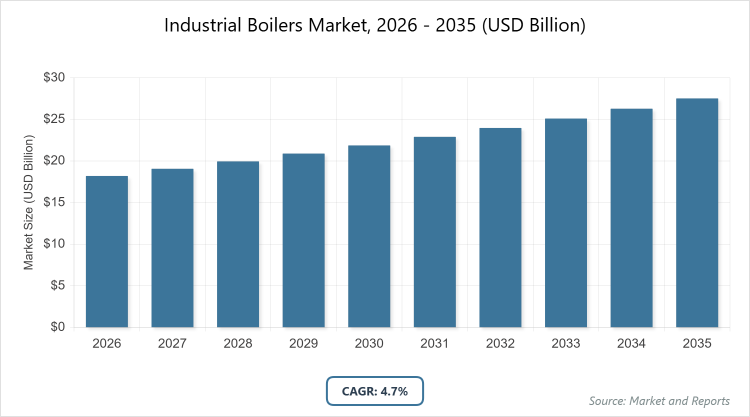
According to MarketnReports, the global Industrial Boilers market size was estimated at USD 18.2 billion in 2025 and is expected to reach USD 28.8 billion by 2035, growing at a CAGR of 4.7% from 2026 to 2035. Rapid industrialization and stringent government regulations on emissions.
What are the Key Insights into the Industrial Boilers Market?
- The global industrial boilers market was valued at USD 18.2 billion in 2025 and is projected to reach USD 28.8 billion by 2035.
- The market is expected to grow at a CAGR of 4.7% during the forecast period from 2026 to 2035.
- The market is driven by rapid industrialization in emerging economies and stringent environmental regulations promoting energy-efficient and low-emission boiler technologies.
- Water-tube boilers dominate the type segment with approximately 60% market share due to their high efficiency in handling large capacities and pressures, making them ideal for heavy industrial applications.
- Natural gas dominates the fuel type segment with around 35% market share because of its cleaner combustion properties, lower operational costs, and widespread availability through expanding infrastructure.
- Chemicals & petrochemicals dominate the application and end-use segments with about 25% market share, driven by the need for consistent high-temperature steam in processing and refining operations.
- Asia Pacific dominates the regional segment with over 50% market share owing to robust industrial growth, particularly in the manufacturing and energy sectors in countries like China and India.
What is the Industrial Boilers Market?
Industry Overview
Industrial boilers are closed vessels that generate steam or hot water through the combustion of fuels or electricity, primarily used for heating, power generation, and process applications across various industries. The market encompasses a wide range of boiler systems designed to meet diverse operational needs, including high-pressure steam production for manufacturing processes and low-pressure hot water for heating purposes. Market definition refers to the global industry involved in the design, manufacturing, installation, and maintenance of these systems, catering to sectors where reliable thermal energy is essential for operations. This market plays a critical role in supporting industrial productivity by providing efficient energy solutions that align with evolving environmental standards and technological advancements.
What are the Market Dynamics of the Industrial Boilers Market?
Growth Drivers
The growth of the industrial boilers market is propelled by increasing demand for efficient thermal energy solutions across expanding manufacturing sectors such as chemicals, food processing, and textiles. Rapid urbanization and industrialization in developing regions have heightened the need for reliable steam and hot water systems to support production processes. Additionally, advancements in boiler technologies, including the integration of IoT for real-time monitoring and predictive maintenance, enhance operational efficiency and reduce downtime, further driving adoption. Government incentives for adopting cleaner fuels like natural gas and biomass also contribute significantly, as industries seek to comply with emission standards while optimizing energy costs.
Restraints
High initial capital investment required for advanced boiler systems poses a significant restraint, particularly for small and medium-sized enterprises in cost-sensitive markets. Stringent environmental regulations on emissions, such as limits on NOx and SOx, increase compliance costs through the need for additional control technologies like scrubbers and catalytic reducers. Volatility in fuel prices, especially for oil and coal, can deter investments in traditional systems, while the shift to renewables demands substantial retrofitting. Moreover, the availability of skilled labor for installation and maintenance remains a challenge in remote or underdeveloped areas, limiting market penetration.
Opportunities
Opportunities in the industrial boilers market arise from the growing emphasis on sustainable energy practices, including the adoption of biomass and hydrogen-ready boilers that align with global decarbonization goals. Emerging markets in the Asia Pacific and Latin America offer potential for expansion through investments in new industrial infrastructure and modernization of existing facilities. The integration of digital technologies like AI-driven diagnostics and modular designs presents avenues for innovation, enabling scalable and customizable solutions. Furthermore, partnerships between manufacturers and energy providers can facilitate the development of hybrid systems that combine traditional fuels with renewables, tapping into niche applications in remote or off-grid operations.
Challenges
Challenges include navigating the complex landscape of varying regional regulations on emissions and safety, which can complicate global supply chains and product standardization. The transition to low-carbon technologies requires overcoming technical hurdles such as fuel compatibility and efficiency losses in hybrid systems. Aging infrastructure in developed regions necessitates costly upgrades, while supply chain disruptions for critical components like heat exchangers can delay projects. Additionally, competition from alternative heating technologies, such as heat pumps and solar thermal systems, poses a threat in sectors prioritizing sustainability over traditional boiler reliability.
Industrial Boilers Market: Report Scope
| Report Attributes | Report Details |
| Report Name | Industrial Boilers Market |
| Market Size 2025 | USD 18.2 Billion |
| Market Forecast 2035 | USD 28.8 Billion |
| Growth Rate | CAGR of 4.7% |
| Report Pages | 220 |
| Key Companies Covered |
Bosch Industriekessel, Cleaver-Brooks, Thermax, Babcock & Wilcox Enterprises, Mitsubishi Heavy Industries, Siemens AG, and Others |
| Segments Covered | By Type, By Fuel Type, By Application, By End-Use Industry, and By Region |
| Regions Covered | North America, Europe, Asia Pacific (APAC), Latin America, and The Middle East and Africa (MEA) |
| Base Year | 2025 |
| Historical Year | 2020 – 2024 |
| Forecast Year | 2026 – 2035 |
| Customization Scope | Avail customized purchase options to meet your exact research needs. |
What is the Market Segmentation of the Industrial Boilers Market?
The Industrial Boilers market is segmented by type, fuel type, application, end-user, and region.
Based on Type Segment, water-tube boilers are the most dominant, holding around 60% share, followed by fire-tube boilers as the second most dominant with about 30% share. Water-tube boilers lead due to their superior ability to handle high pressures and large steam capacities, which is crucial for heavy-duty industrial operations like power generation and chemical processing; this dominance drives the market by enabling efficient energy transfer and scalability, supporting growth in high-demand sectors while fire-tube boilers complement with their simplicity and cost-effectiveness for lower-pressure applications, collectively enhancing market versatility and adoption rates.
Based on Fuel Type Segment, natural gas is the most dominant with approximately 35% share, while biomass emerges as the second most dominant at around 20% share. Natural gas’s prevalence stems from its clean-burning nature, reducing emissions and aligning with regulatory demands, which propels market expansion by facilitating compliance and cost savings in fuel-intensive industries; biomass, gaining traction for its renewable attributes, aids in driving the market through sustainable alternatives that attract eco-conscious end-users, fostering diversification and long-term growth amid shifting energy preferences.
Based on Application Segment, chemicals dominate with about 25% share, and food processing is the second most dominant at roughly 20% share. The chemicals application’s leadership is attributed to the essential role of precise steam control in reactions and distillation, boosting market growth by ensuring operational reliability in a high-volume sector; food processing supports this by requiring hygienic and efficient heating for sterilization and cooking, driving overall market momentum through increased demand for energy-efficient systems that enhance productivity and meet food safety standards.
Based on the end-user segment, chemicals & petrochemicals are the most dominant with 25% share, followed by food & beverages at 20% share. Dominance in chemicals & petrochemicals arises from the need for continuous high-temperature processes, which accelerates market development by promoting advanced boiler integrations for efficiency; the food & beverages sector contributes by demanding low-emission, reliable systems for processing, thereby driving the market through innovations that address hygiene and energy optimization needs.
What are the Recent Developments in the Industrial Boilers Market?
- In March 2025, Larsen & Toubro secured a major contract from NTPC for supplying high-capacity boilers in a thermal power project, emphasizing efficiency and emission controls to support India’s energy infrastructure expansion.
- In August 2025, Bosch launched an IoT-enabled digital platform for boiler monitoring, enhancing predictive maintenance and operational efficiency across industrial applications.
- In February 2025, Cleaver-Brooks introduced a new digital management system for centralized boiler operations, focusing on analytics to optimize fuel usage and reduce downtime.
- In January 2025, Babcock & Wilcox won a contract for boiler cleaning systems in a Southeast Asian power plant, highlighting advancements in maintenance technologies for coal-fired units.
- In May 2024, John Cockerill secured an EPC contract for a large heat recovery boiler in a combined cycle power plant, advancing sustainable energy solutions in Europe.
What is the Regional Analysis of the Industrial Boilers Market?
- Asia Pacific to dominate the global market.
Asia Pacific holds the largest share, over 50%, driven by rapid industrialization and expanding manufacturing bases in countries like China and India. China dominates within the region due to its massive chemical and power sectors, where investments in efficient boiler technologies support energy demands and emission reductions, fostering regional growth through policy-driven infrastructure projects.
North America accounts for a significant portion, around 25%, with the United States as the dominating country owing to stringent environmental regulations and upgrades in aging industrial facilities. The focus on natural gas-fired systems and digital integrations in the chemicals and food industries propels market stability and innovation in energy efficiency.
Europe represents about 15% share, led by Germany, which excels in adopting low-emission and biomass boilers amid decarbonization efforts. Germany’s emphasis on sustainable manufacturing in petrochemicals and pharmaceuticals drives regional advancements, aligning with EU directives for reduced carbon footprints.
Latin America, with a roughly 5% share, is spearheaded by Brazil through investments in food processing and mining sectors. Brazil’s push for biomass utilization in boilers enhances energy independence, contributing to regional opportunities in renewable integrations amid economic diversification.
The Middle East and Africa hold around 5% combined, dominated by Saudi Arabia in the Middle East due to petrochemical expansions and desalination needs. South Africa leads in Africa with mining and manufacturing demands, where oil and gas-fired boilers support industrial resilience despite energy transition challenges.
What are the Key Market Players in the Industrial Boilers Market?
- Bosch Industriekessel focuses on delivering modular, digitally optimized boiler systems with an emphasis on sustainability and customization, supporting alternative fuels and CO2-neutral solutions to enhance efficiency and compliance in global markets.
- Cleaver-Brooks provides integrated boiler-room solutions with advanced controls and lifecycle services, prioritizing emissions reduction and innovation to meet diverse industrial needs while ensuring regulatory adherence.
- Thermax specializes in turnkey solutions emphasizing biomass and clean energy, offering strong after-sales service and environmental compliance for sectors like food processing and chemicals.
- Babcock & Wilcox Enterprises leverages expertise in water-tube boilers and emissions control, focusing on waste heat recovery and renewable integration for complex projects in power and industrial applications.
- Mitsubishi Heavy Industries emphasizes high-efficiency, low-emission systems with advanced combustion and modular designs, driving technological innovation and sustainability through cleaner fuel adaptations.
- Siemens AG integrates innovative building technologies and energy-efficient platforms like Climatix Hub, aiming at digitalization and predictive maintenance for optimized industrial operations.
What are the Market Trends in the Industrial Boilers Market?
- Shift towards high-efficiency condensing boilers to improve energy savings and reduce operational costs.
- Increasing adoption of IoT sensors and AI for predictive maintenance and real-time performance optimization.
- Growing preference for multi-fuel capable systems enabling fuel switching between natural gas, biomass, and hydrogen.
- Emergence of modular and compact designs for faster installation and scalability in urban industrial settings.
- Focus on low-emission technologies incorporating waste-heat recovery and alternative fuels for sustainability.
- Integration of digital twins and IIoT-enabled sensors to enhance service models and efficiency.
- Transition to cleaner fuels like LNG and biogas to comply with stringent emission regulations.
- Rise in customization for specific end-use applications, such as hygienic operations in food sectors.
What Market Segments and Subsegments are Covered in the Industrial Boilers Report?
By Type
- Fire-Tube Boilers
- Water-Tube Boilers
- Electric Boilers
- Condensing Boilers
- Non-Condensing Boilers
- Cast Iron Boilers
- Package Boilers
- Modular Boilers
- Hybrid Boilers
- Vertical Boilers
- Others
By Fuel Type
- Natural Gas
- Oil
- Coal
- Biomass
- Electric
- Fossil Fuels
- Non-Fossil Fuels
- LNG
- Hydrogen
- Biogas
- Others
By Application
- Food Processing
- Chemical
- Refinery
- Pulp & Paper
- Metals & Mining
- Power Generation
- Petrochemicals
- Textiles
- Pharmaceuticals
- Marine
- Others
By End-Use Industry
- Chemicals & Petrochemicals
- Food & Beverages
- Manufacturing
- Oil & Gas
- Paper & Pulp
- Metals & Mining
- Refineries
- Textiles
- Pharmaceuticals
- Primary Metals
- Others
By Region
- North America
- U.S.
- Canada
- Europe
- UK
- Germany
- France
- Rest of Europe
- Asia Pacific
- China
- India
- Japan
- Rest of Asia Pacific
- Latin America
- Brazil
- Mexico
- Rest of Latin America
- Middle East & Africa
- UAE
- South Africa
- Rest of Middle East & Africa
Chapter 1. Preface
Chapter 2. Executive Summary
Chapter 3. Global Industrial Boilers Market - Industry Analysis
Chapter 4. Global Industrial Boilers Market- Competitive Landscape
Chapter 5. Global Industrial Boilers Market - Type Analysis
Chapter 6. Global Industrial Boilers Market - Fuel Type Analysis
Chapter 7. Global Industrial Boilers Market - Application Analysis
Chapter 8. Global Industrial Boilers Market - End-Use Industry Analysis
Chapter 9. Industrial Boilers Market - Regional Analysis
Chapter 10. Company Profiles
Frequently Asked Questions
Industrial boilers are pressure vessels that produce steam or hot water by burning fuels or using electricity, essential for heating, power, and process applications in various industries.
Key factors include rapid industrialization, stringent emission regulations, adoption of clean fuels, technological advancements in efficiency, and expanding manufacturing sectors.
The market is projected to grow from approximately USD 19 billion in 2026 to USD 28.8 billion by 2035.
The CAGR is expected to be 4.7% during the forecast period.
Asia Pacific will contribute notably, driven by industrial growth in China and India.
Major players include Bosch Industriekessel, Cleaver-Brooks, Thermax, Babcock & Wilcox Enterprises, Mitsubishi Heavy Industries, and Siemens AG.
The report provides comprehensive analysis including market size, trends, segmentation, regional insights, key players, and forecasts.
Stages include raw material procurement, design and manufacturing, installation, operation and maintenance, and end-of-life recycling or upgrading.
Trends are shifting towards sustainable, low-emission systems with digital integration, while preferences favor efficient, multi-fuel capable boilers for cost and environmental benefits.
Stringent regulations on emissions like NOx and CO2, along with incentives for renewables, are pushing adoption of cleaner technologies and restraining high-emission systems.