
Industrial Alcohol Market Size, Share and Trends 2026 to 2035
According to MarketnReports, the global Industrial Alcohol Market size was estimated at USD 137.4 Billion in 2025 and is expected to reach USD 285.8 Billion by 2035, growing at a CAGR of 7.6% from 2026 to 2035. Industrial Alcohol Market is driven by rising demand for biofuels and sustainable chemical intermediates.
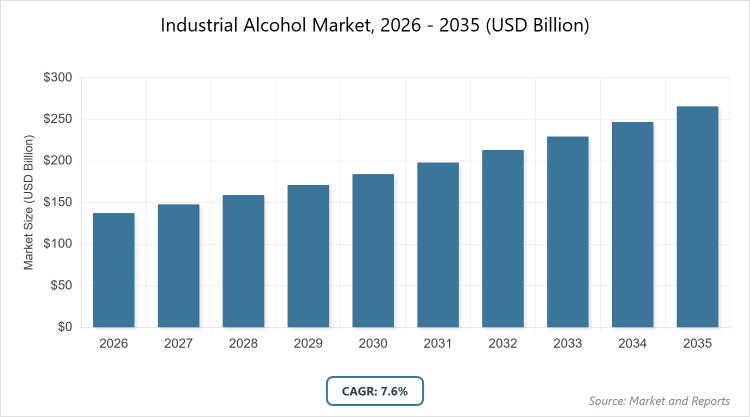
What is the Industry Overview of Industrial Alcohol Market?
The industrial alcohol market encompasses the production, distribution, and application of alcohols derived from various sources for non-beverage purposes, serving as essential raw materials across multiple sectors. Industrial alcohol refers to high-purity alcohols like ethanol, methanol, and isopropanol, which are manufactured through fermentation of sugars, starches, or fossil fuels, and are denatured to prevent human consumption. This market plays a critical role in enabling advancements in renewable energy, pharmaceuticals, and manufacturing, where these alcohols function as solvents, fuels, and intermediates, supporting global efforts toward sustainability and industrial efficiency.
What are the Key Insights into Industrial Alcohol Market?
- The global Industrial Alcohol Market was valued at USD 137.4 Billion in 2025 and is projected to reach USD 285.8 Billion by 2035.
- The market is expected to grow at a CAGR of 7.6% during the forecast period from 2026 to 2035.
- The market is driven by increasing adoption of biofuels, expanding pharmaceutical applications, and rising demand for eco-friendly chemical solvents.
- Ethyl Alcohol dominates the product type segment with a 58% share due to its versatility in fuel blending and pharmaceutical formulations, enabling cost-effective renewable energy solutions and high-purity sanitizers.
- Fuel dominates the application segment with a 40% share owing to government mandates for ethanol blending in transportation fuels, which reduces emissions and supports energy security.
- Pharmaceutical dominates the end-user segment with a 35% share because of its critical role in drug manufacturing and sanitization, driven by global health initiatives and pandemic preparedness.
- Asia Pacific dominates the regional segment with a 45% share attributed to rapid industrialization, high biofuel production in countries like China and India, and supportive policies for renewable chemicals.
What are the Market Dynamics of Industrial Alcohol Market?
Growth Drivers
The primary growth drivers in the industrial alcohol market stem from the escalating global push toward sustainable energy sources, particularly biofuels like ethanol, which are increasingly blended with gasoline to meet environmental regulations and reduce carbon footprints. This demand is amplified by government incentives and subsidies for renewable fuels, such as those under the U.S. Renewable Fuel Standard and similar programs in Europe and Asia, fostering investments in production capacity. Additionally, the pharmaceutical industry's expansion, fueled by rising healthcare needs and the production of sanitizers and disinfectants, especially post-pandemic, has significantly boosted the use of high-purity alcohols. Technological advancements in fermentation processes have also lowered production costs, making bio-based alcohols more competitive against fossil fuel-derived alternatives, thereby driving market penetration across diverse applications.
Restraints
Key restraints in the industrial alcohol market include volatile raw material prices, particularly for feedstocks like corn and sugarcane, which are susceptible to weather fluctuations, geopolitical tensions, and competing demands from the food sector, leading to supply chain disruptions and increased costs. Stringent regulatory frameworks regarding denaturing agents and environmental compliance add complexity and expense to manufacturing, potentially hindering smaller players. Moreover, the shift toward electric vehicles in the automotive sector could reduce long-term demand for alcohol-based fuels, creating uncertainty. Health and safety concerns associated with handling certain alcohols, like methanol, also impose additional operational burdens, limiting market growth in regions with strict labor and environmental laws.
Opportunities
Opportunities abound in the industrial alcohol market through the rising emphasis on green chemistry and circular economy practices, where bio-based alcohols from agricultural waste and cellulosic materials offer sustainable alternatives to petroleum-derived products. Emerging markets in Asia and Latin America present untapped potential due to urbanization and industrial growth, creating demand for alcohols in personal care and chemical intermediates. Innovations in advanced biofuels, such as cellulosic ethanol, open avenues for partnerships with biotech firms to develop low-emission fuels. Furthermore, the integration of digital technologies like AI-driven process optimization can enhance efficiency, attracting investments and enabling market players to capitalize on the global transition to low-carbon economies.
Challenges
Challenges in the industrial alcohol market revolve around intense competition from synthetic alternatives and the need for continuous innovation to meet evolving sustainability standards, which requires substantial R&D investments. Supply chain vulnerabilities, exacerbated by global events like trade wars or pandemics, can lead to shortages and price spikes, affecting profitability. Environmental concerns over water usage and land conversion for feedstock cultivation pose reputational risks and regulatory hurdles. Additionally, fluctuating oil prices influence the economic viability of alcohol fuels, making it difficult to predict demand and plan capacity expansions effectively.
Industrial Alcohol Market Report Scope
| Report Attributes | Report Details |
| Report Name | Industrial Alcohol Market |
| Market Size 2025 | USD 137.4 Billion |
| Market Forecast 2035 | USD 285.8 Billion |
| Growth Rate | CAGR of 7.6% |
| Report Pages | 220 |
| Key Companies Covered |
Cargill Incorporated, Cristalco SAS, MGP Ingredients Inc., and Others |
| Segments Covered | By Product Type, By Application, By End-User, and By Region |
| Regions Covered | North America, Europe, Asia Pacific (APAC), Latin America, and The Middle East and Africa (MEA) |
| Base Year | 2025 |
| Historical Year | 2020 - 2024 |
| Forecast Year | 2026 - 2035 |
| Customization Scope | Avail customized purchase options to meet your exact research needs. |
How is the Market Segmentation of Industrial Alcohol Market?
The Industrial Alcohol Market is segmented by product type, application, end-user, and region. All the segments have been analyzed based on present and future trends and the market is estimated from 2026 to 2035.
Based on Product Type Segment, Ethyl Alcohol emerges as the most dominant subsegment, commanding a significant market share due to its widespread use in biofuels and pharmaceuticals, where its renewable nature and high solvency properties drive efficiency in fuel blending and drug formulation, propelling overall market growth by aligning with global sustainability goals. Isopropyl Alcohol ranks as the second most dominant, valued for its antiseptic qualities in healthcare and electronics cleaning, contributing to market expansion through increased demand in sanitization and precision manufacturing applications.
Based on Application Segment, Fuel stands out as the most dominant subsegment, driven by mandatory ethanol blending policies worldwide that enhance energy security and reduce emissions, significantly boosting market revenues through large-scale adoption in transportation. Chemical Intermediates & Solvent is the second most dominant, as alcohols serve as essential building blocks in producing plastics and coatings, fostering market growth by supporting industrial advancements and eco-friendly chemical processes.
Based on End-User Segment, Automotive is the most dominant subsegment, leveraging industrial alcohols for biofuel integration that lowers vehicle emissions and complies with environmental regulations, driving market momentum through the sector's shift toward sustainable mobility. Pharmaceutical follows as the second most dominant, utilizing high-purity alcohols for drug synthesis and sanitizers, which accelerates market development amid rising global health demands and innovation in medical formulations.
What are the Recent Developments in Industrial Alcohol Market?
- In January 2024, BCL Industries Ltd secured a Rs 339-crore order for ethanol supply, while its subsidiary Svaksha Distillery obtained a Rs 222-crore order, highlighting the growing demand for ethanol in fuel applications and expanding production capacities in India.
- In January 2024, Praj Industries launched India's first pilot project to produce sustainable aviation fuel from alcohol at its R&D facility near Pune, marking a significant step toward bio-based aviation fuels and supporting global decarbonization efforts in the aerospace sector.
- In July 2021, Deepak Nitrite Limited expanded its Isopropyl Alcohol production capacity from 30,000 TPA to 60,000 TPA at its Dahej facility in Gujarat, aiming to meet rising demand in pharmaceuticals and sanitizers amid health-focused market trends.
- In September 2022, Greenfield Global tripled its production capacity for ethanol blends with water-for-injection at its Connecticut plant to nearly 6,000 gallons, addressing increased needs from biopharma customers for high-purity solutions.
- In August 2022, Western New York Energy completed a $38 million expansion to produce high-purity alcohol under the ClearSource brand, enhancing its capabilities in pharmaceutical and industrial applications.
What is the Regional Analysis of Industrial Alcohol Market?
Asia Pacific to dominate the global market.
Asia Pacific holds the dominant position in the industrial alcohol market, driven by rapid industrialization, abundant feedstock availability from agriculture, and supportive government policies promoting biofuels in countries like China and India. China stands out as the dominating country, with its massive ethanol production for fuel blending and chemical industries, fueled by national targets for renewable energy and reducing import dependencies, which collectively propel regional growth through economies of scale and innovation in bio-refineries.
North America exhibits strong growth in the industrial alcohol market, supported by advanced technological infrastructure and regulatory frameworks like the EPA's Renewable Fuel Standard that encourage ethanol use in transportation. The United States is the dominating country, leading with extensive corn-based production and applications in pharmaceuticals and fuels, driven by federal incentives and a robust agricultural sector that ensures supply chain resilience and market leadership.
Europe demonstrates steady expansion in the industrial alcohol market, emphasized by stringent environmental regulations and a focus on sustainable chemicals, with increasing adoption of bio-based alcohols in personal care and pharmaceuticals. Germany emerges as the dominating country, excelling through its chemical industry prowess and EU directives on renewable energy, which foster investments in efficient production methods and circular economy practices.
Latin America shows promising potential in the industrial alcohol market, leveraging rich sugarcane resources for ethanol production, particularly in biofuels amid global energy transitions. Brazil is the dominating country, renowned for its world-leading sugarcane ethanol output that supports domestic fuel needs and exports, bolstered by policies like Proálcool that integrate agriculture with energy security.
The Middle East and Africa region is gradually developing in the industrial alcohol market, with opportunities arising from diversification efforts away from oil dependency toward bio-chemicals. South Africa leads as the dominating country, advancing through investments in grain-based production for industrial solvents and fuels, supported by regional initiatives for sustainable development and job creation in agro-processing.
Who are the Key Market Players in Industrial Alcohol Market?
Cargill Incorporated focuses on expanding its bio-based alcohol portfolio through strategic acquisitions and investments in sustainable feedstock sourcing, enhancing its supply chain to meet growing demand in fuels and chemicals while emphasizing environmental stewardship.
Cristalco SAS employs innovation in high-purity ethanol production for pharmaceuticals and cosmetics, leveraging partnerships with biotech firms to develop eco-friendly processes that improve yield and reduce carbon emissions.
MGP Ingredients Inc. prioritizes diversification into specialty alcohols for food and personal care, utilizing advanced distillation technologies and market analysis to tailor products that align with consumer trends toward natural ingredients.
Grain Processing Corporation adopts vertical integration strategies, controlling feedstock to finished product, which optimizes costs and ensures quality for applications in solvents and intermediates, supporting competitive positioning.
Raízen Energia concentrates on biofuel leadership through large-scale sugarcane ethanol production, implementing digital tools for efficiency and collaborating on sustainable aviation fuel projects to expand into new markets.
Green Plains Inc. pursues growth via capacity expansions and renewable energy initiatives, focusing on low-carbon ethanol for transportation while investing in carbon capture technologies to enhance sustainability credentials.
Exxon Mobil Corporation integrates industrial alcohols into its chemical operations, emphasizing fossil fuel-derived options with R&D in bio-alternatives to balance traditional strengths with emerging green demands.
LyondellBasell Industries leverages its expertise in chemical intermediates, developing alcohol-based solutions for plastics and coatings through innovation hubs that drive product differentiation and regulatory compliance.
Dow Chemical Company commits to circular economy strategies, recycling waste into alcohol feedstocks and partnering on bio-refining projects to create value-added products for diverse end-users.
Royal Dutch Shell Plc shifts toward biofuels and low-emission alcohols, investing in joint ventures for sustainable production and utilizing global networks to distribute eco-friendly fuels internationally.
What are the Market Trends in Industrial Alcohol Market?
- Shift toward bio-based and sustainable alcohols derived from renewable feedstocks like agricultural waste, driven by environmental regulations and consumer preferences for green products.
- Increasing adoption of advanced fermentation technologies to improve production efficiency and reduce costs, enabling scalability in biofuel and pharmaceutical applications.
- Growing demand for high-purity alcohols in sanitizers and disinfectants, accelerated by global health awareness and pandemic preparedness initiatives.
- Expansion of alcohol use in sustainable aviation fuels through pilot projects and collaborations, aiming to decarbonize the aerospace sector.
- Rising focus on circular economy practices, including waste-to-alcohol conversion, to minimize environmental impact and enhance resource utilization.
- Integration of digital tools like AI for process optimization and supply chain management, boosting operational efficiency and market responsiveness.
- Emergence of low-carbon certification programs for alcohols, influencing procurement decisions in chemicals and fuels sectors.
What Market Segments and their Subsegments are Covered in the Industrial Alcohol Report?
- By Product Type
-
- Ethyl Alcohol
- Methyl Alcohol
- Isopropyl Alcohol
- Isobutyl Alcohol
- Benzyl Alcohol
- Others
- By Application
- Fuel
- Chemical Intermediates & Solvent
- Pharmaceuticals
- Personal Care Products
- Food Ingredients
- Others
- By Region
- North America
- U.S.
- Canada
- Europe
- UK
- Germany
- France
- Rest of Europe
- Asia Pacific
- China
- India
- Japan
- Rest of Asia Pacific
- Latin America
- Brazil
- Mexico
- Rest of Latin America
- Middle East & Africa
- UAE
- South Africa
- Rest of Middle East & Africa
- North America
Frequently Asked Questions
The Industrial Alcohol Market refers to the global industry involved in the production and distribution of alcohols like ethanol and methanol for non-potable uses in fuels, chemicals, and pharmaceuticals.
Key factors include rising demand for biofuels, regulatory support for renewable energy, advancements in production technologies, and expanding applications in pharmaceuticals and personal care.
The market value is estimated at USD 137.4 Billion in 2025 and projected to reach USD 285.8 Billion by 2035.
The CAGR is expected to be 7.6% during 2026-2035.
Asia Pacific will contribute notably, driven by industrialization and biofuel production in China and India.
Major players include Cargill Incorporated, Cristalco SAS, MGP Ingredients Inc., Raízen Energia, and Green Plains Inc.
The report provides comprehensive analysis on market size, trends, segments, regional insights, key players, and forecasts from 2026 to 2035.
Stages include feedstock sourcing, fermentation/distillation, denaturing, distribution, and end-use applications in various industries.
Trends are shifting toward sustainable bio-based alcohols, with consumers preferring eco-friendly products in fuels and personal care amid environmental awareness.
Factors include mandates for ethanol blending, emissions regulations, and incentives for renewable feedstocks, promoting growth while imposing compliance costs.