
In-Vitro Toxicology Testing Market Size, Share and Trends 2026 to 2035
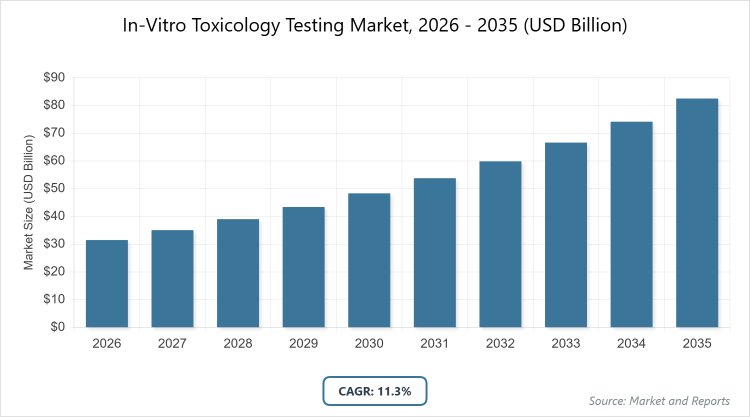
According to MarketnReports, the global In-Vitro Toxicology Testing market size was estimated at USD 31.49 billion in 2025 and is expected to reach USD 91.86 billion by 2035, growing at a CAGR of 11.30% from 2026 to 2035. In-Vitro Toxicology Testing Market is driven by increasing demand for alternatives to animal testing and regulatory pressures to ensure safety in pharmaceuticals and chemicals.
What is the Industry Overview of In-Vitro Toxicology Testing?
The in-vitro toxicology testing market encompasses methods and technologies used to assess the potential toxicity of substances without involving live animals, focusing on cellular and molecular responses to predict human health risks. This market includes a range of assays, models, and technologies designed to evaluate chemical, pharmaceutical, and cosmetic safety through non-animal approaches. Market definition refers to the systematic evaluation of toxic effects using isolated cells, tissues, or organ models in controlled laboratory settings, driven by ethical considerations, regulatory mandates, and the need for efficient, cost-effective screening processes.
What are the Key Insights into In-Vitro Toxicology Testing?
- The global In-Vitro Toxicology Testing market size was estimated at USD 31.49 billion in 2025 and is expected to reach USD 91.86 billion by 2035.
- The market is expected to grow at a CAGR of 11.30% during the forecast period from 2026 to 2035.
- The market is driven by increasing opposition to animal testing, technological advancements in cell-based assays, and stringent regulatory requirements for safety assessments.
- In the technology segment, cell culture technology dominates with a 43.35% share due to its widespread adoption for reliable, reproducible toxicity screening that mimics human physiology effectively.
- In the application segment, systemic toxicology holds the largest share at approximately 40% because it addresses broad organ impacts, essential for pharmaceutical development and regulatory compliance.
- In the end-use segment, the pharmaceutical industry dominates with 47.78% share owing to high demand for early-stage drug toxicity evaluation to reduce failure rates in clinical trials.
- North America dominates the market with a 47.10% share, attributed to advanced research infrastructure, strong regulatory frameworks, and significant investments in alternative testing methods.
What are the Market Dynamics in In-Vitro Toxicology Testing?
Growth Drivers
The primary growth drivers for the in-vitro toxicology testing market include rising ethical concerns over animal testing, leading to global bans and shifts toward humane alternatives. Technological advancements, such as 3D cell cultures and organ-on-chip models, enhance predictive accuracy and efficiency, accelerating adoption in drug discovery. Additionally, increasing R&D investments in pharmaceuticals and cosmetics, coupled with regulatory pressures from agencies like the FDA and EPA to validate non-animal methods, propel market expansion. Government funding for alternative testing initiatives further supports innovation and market penetration.
Restraints
Key restraints in the in-vitro toxicology testing market involve the limitations of current models in fully replicating complex human physiological responses, leading to potential gaps in predictive reliability compared to in-vivo methods. High initial costs for advanced technologies and the need for specialized expertise pose barriers for smaller organizations. Stringent validation requirements for new assays delay market entry, while the lack of standardization across testing protocols can hinder comparability and acceptance.
Opportunities
Opportunities in the in-vitro toxicology testing market arise from the integration of AI and machine learning to enhance data analysis and predictive modeling, opening avenues for more precise toxicity assessments. Expanding applications in personalized medicine and environmental toxicology, driven by growing concerns over chemical exposures, present new growth areas. Emerging markets in Asia-Pacific offer untapped potential due to increasing pharmaceutical manufacturing and regulatory harmonization. Collaborations between academia and industry for developing multi-organ chips also promise innovative solutions.
Challenges
Challenges facing the in-vitro toxicology testing market include the difficulty in modeling chronic toxicities and immune responses accurately, which limits applicability for long-term studies. Regulatory acceptance varies globally, creating hurdles for widespread adoption. Data interpretation complexities from high-throughput screening require advanced bioinformatics, posing skill gaps. Additionally, competition from established in-vivo methods and resistance to change in traditional industries slow transition paces.
In-Vitro Toxicology Testing Market: Report Scope
| Report Attributes | Report Details |
| Report Name | In-Vitro Toxicology Testing Market |
| Market Size 2025 | USD 31.49 Billion |
| Market Forecast 2035 | USD 91.86 Billion |
| Growth Rate | CAGR of 11.30% |
| Report Pages | 220 |
| Key Companies Covered |
Thermo Fisher Scientific Inc., Merck KGaA, Charles River Laboratories International, Inc., Eurofins Scientific, SGS S.A., Labcorp, Agilent Technologies, Inc., Danaher Corporation, Bio-Rad Laboratories, Inc., Evotec S.E., and Others |
| Segments Covered | By Technology, By Application, By End-Use, and By Region |
| Regions Covered | North America, Europe, Asia Pacific (APAC), Latin America, and The Middle East and Africa (MEA) |
| Base Year | 2025 |
| Historical Year | 2020 – 2024 |
| Forecast Year | 2026 – 2035 |
| Customization Scope | Avail customized purchase options to meet your exact research needs. |
How is the Market Segmentation of In-Vitro Toxicology Testing Structured?
The In-Vitro Toxicology Testing market is segmented by technology, application, end-use, and region.
Based on Technology Segment, cell culture technology is the most dominant subsegment, holding approximately 43% market share, followed by high throughput technology as the second most dominant. Cell culture dominates due to its versatility in creating human-relevant models that allow for detailed cellular response analysis, driving the market by enabling cost-effective, high-volume screening that reduces drug development timelines and costs; high throughput complements this by automating processes, further accelerating discovery and enhancing predictive capabilities.
Based on Application Segment, systemic toxicology is the most dominant subsegment with around 40% share, while dermal toxicity ranks second. Systemic toxicology leads because it evaluates comprehensive effects on multiple organs, crucial for ensuring overall safety in pharmaceuticals and chemicals, thereby driving market growth through regulatory compliance and risk mitigation; dermal toxicity follows, supporting the cosmetics industry’s shift to non-animal testing, contributing to market expansion by addressing skin-related safety concerns efficiently.
Based on End-Use Segment, the pharmaceutical industry dominates with about 48% share, with cosmetics & household products as the second dominant. The pharmaceutical sector’s dominance stems from its need for early toxicity detection to minimize clinical failures, propelling the market via increased R&D efficiency; cosmetics follows, driven by bans on animal testing, fostering innovation in alternative methods that sustain market growth.
What are the Recent Developments in In-Vitro Toxicology Testing?
- In June 2023, Lonza acquired Synaffix B.V., a biotechnology company specializing in antibody-drug conjugates, to expand its in-vitro toxicology offerings and strengthen its global presence in advanced testing solutions.
- In October 2022, Thermo Fisher Scientific Inc. expanded its laboratory operations in Highland Heights, Kentucky, to enhance capabilities in in-vitro toxicology testing, supporting faster delivery of life-changing medicines through improved toxicity assessments.
- In February 2023, Evotec relocated its Cyprotex US subsidiary to a new facility in Framingham, Massachusetts, aiming to provide faster turnaround times for in-vitro toxicology services and boost operational efficiency.
- In January 2023, Eurofins Scientific established a new laboratory campus in Hyderabad, India, to advance in-vitro toxicology testing capabilities and cater to growing demand in the Asia-Pacific region.
- In May 2025, Cocrystal Pharma advanced its antiviral drug development, with in-vitro testing showing superior activity against norovirus, highlighting the role of in-vitro methods in therapeutic innovation.
How Does Regional Analysis Impact In-Vitro Toxicology Testing?
- North America to dominate the global market.
North America holds the largest share in the in-vitro toxicology testing market, driven by robust R&D infrastructure, significant government funding for alternative methods, and stringent regulations from the FDA and EPA promoting non-animal testing. The United States dominates within the region, benefiting from high pharmaceutical investments, advanced biotech hubs like Boston and San Francisco, and initiatives like ToxCast that accelerate adoption of predictive toxicology models, ensuring comprehensive safety assessments and fostering innovation.
Europe ranks second in market share, supported by strong regulatory frameworks such as REACH and the EU’s ban on animal testing for cosmetics, which encourage the development and validation of in-vitro alternatives. Germany leads the region with its advanced chemical and pharmaceutical industries, extensive research collaborations, and investments in organ-on-chip technologies, enabling detailed toxicity evaluations that align with environmental and health safety standards.
Asia-Pacific is the fastest-growing region, fueled by expanding pharmaceutical manufacturing, increasing CRO presence, and rising awareness of product safety. China dominates here due to its massive R&D spending, government support for biotech innovation, and adoption of high-throughput screening, which facilitates rapid drug development and addresses growing regulatory demands for non-animal testing methods.
Latin America shows moderate growth, driven by emerging pharmaceutical sectors and international collaborations for technology transfer. Brazil leads the region with investments in research institutes and regulatory alignments with global standards, promoting in-vitro methods to enhance drug safety evaluations and reduce reliance on imported testing services.
The Middle East and Africa exhibit nascent market development, with growth spurred by healthcare improvements and environmental concerns. South Africa dominates in Africa, leveraging academic partnerships and initiatives for alternative testing to address chemical safety, while the UAE leads in the Middle East through investments in biotech infrastructure to support diversified economies.
Who are the Key Market Players in In-Vitro Toxicology Testing?
Thermo Fisher Scientific Inc. focuses on expanding its portfolio through acquisitions and investments in advanced cell culture technologies, emphasizing integrated solutions for high-throughput toxicity screening to enhance predictive accuracy and meet regulatory demands.
Merck KGaA employs strategies centered on innovation in organoid models and collaborations with research institutions, aiming to provide comprehensive in-vitro platforms that accelerate drug discovery while reducing costs associated with traditional testing.
Charles River Laboratories International, Inc. prioritizes service expansion via global laboratory networks and adoption of AI-driven analytics, offering end-to-end toxicology services that ensure compliance and improve efficiency in pharmaceutical R&D.
Eurofins Scientific leverages its extensive testing capabilities and strategic acquisitions to offer validated in-vitro assays, focusing on regulatory compliance and rapid turnaround to support diverse industries including cosmetics and chemicals.
SGS S.A. emphasizes quality assurance through accredited in-vitro methods and international standards alignment, providing tailored toxicity testing solutions that address client-specific needs in safety assessment.
Labcorp invests in advanced bioinformatics and multi-omics approaches, delivering insightful data for toxicity predictions and supporting personalized medicine initiatives.
Agilent Technologies, Inc. concentrates on instrument innovation for molecular imaging and high-resolution analysis, enabling precise in-vitro evaluations that drive scientific advancements.
Danaher Corporation pursues growth through subsidiary synergies, offering integrated workflows for in-vitro testing that enhance reproducibility and scalability.
Bio-Rad Laboratories, Inc. focuses on assay development and quality control tools, ensuring reliable results for academic and industrial applications in toxicology.
Evotec S.E. adopts a partnership model for drug discovery, utilizing in-vitro platforms to identify toxicities early and optimize candidate selection.
What are the Market Trends Shaping In-Vitro Toxicology Testing?
- Increasing adoption of 3D cell culture models for more accurate physiological simulations.
- Integration of AI and machine learning for enhanced data analysis and predictive toxicology.
- Rise in organ-on-chip technologies to mimic multi-organ interactions.
- Growing focus on high-throughput screening for efficient chemical assessments.
- Expansion of omics technologies like toxicogenomics for mechanistic insights.
- Shift toward non-animal alternatives driven by ethical and regulatory pressures.
- Advancements in stem cell-based assays for personalized toxicity testing.
- Increased use of in silico modeling for virtual screening.
- Collaboration between industry and academia for method validation.
- Emphasis on environmental toxicology for chemical safety evaluations.
By Technology
-
- Cell Culture Technology
- High Throughput Technology
- Toxicogenomics
- OMICS Technology
- Molecular Imaging
- In Silico Methods
- Biochemical Assays
- Cellular Assays
- Ex Vivo Models
- Systems Toxicology
- Others
By Application
-
- Systemic Toxicology
- Dermal Toxicity
- Ocular Toxicity
- Endocrine Disruption
- Reproductive Toxicity
- Developmental Toxicity
- Neurotoxicity
- Carcinogenicity
- Immunotoxicity
- Organ Toxicity
- Others
By End-Use
-
- Pharmaceutical Industry
- Cosmetics & Household Products
- Chemical Industry
- Food Industry
- Diagnostics
- Academic & Research Institutes
- Environmental Testing
- Biopharmaceutical Industry
- Medical Device Industry
- Others
By Region
-
- North America
- U.S.
- Canada
- Europe
- UK
- Germany
- France
- Rest of Europe
- Asia Pacific
- China
- India
- Japan
- Rest of Asia Pacific
- Latin America
- Brazil
- Mexico
- Rest of Latin America
- Middle East & Africa
- UAE
- South Africa
- Rest of Middle East & Africa
- North America
Chapter 1. Preface
Chapter 2. Executive Summary
Chapter 3. Global In-Vitro Toxicology Testing Market - Industry Analysis
Chapter 4. Global In-Vitro Toxicology Testing Market- Competitive Landscape
Chapter 5. Global In-Vitro Toxicology Testing Market - Technology Analysis
Chapter 6. Global In-Vitro Toxicology Testing Market - Application Analysis
Chapter 7. Global In-Vitro Toxicology Testing Market - End-Use Analysis
Chapter 8. In-Vitro Toxicology Testing Market - Regional Analysis
Chapter 9. Company Profiles
Frequently Asked Questions
In-vitro toxicology testing refers to laboratory-based methods that evaluate the potential toxic effects of substances using cells, tissues, or organ models outside a living organism, providing ethical alternatives to animal testing for safety assessments in pharmaceuticals, chemicals, and cosmetics.
Key factors include ethical opposition to animal testing, advancements in cell-based technologies, regulatory mandates for non-animal methods, increasing R&D in drug discovery, and the need for cost-effective, predictive toxicity screening.
The market value is projected to grow from USD 31.49 billion in 2025 to USD 91.86 billion by 2035.
The market is expected to grow at a CAGR of 11.30% during the forecast period from 2026 to 2035.
North America will contribute notably, holding the largest share due to advanced infrastructure and regulatory support.
Major players include Thermo Fisher Scientific Inc., Merck KGaA, Charles River Laboratories International, Inc., Eurofins Scientific, and SGS S.A.
The report provides comprehensive analysis including market size, trends, segmentation, regional insights, key players, and forecasts.
Stages include technology development, assay validation, regulatory approval, testing services, data analysis, and application in end-use industries.
Trends show a shift toward AI-integrated predictive models and organ-on-chip systems, with preferences favoring ethical, rapid, and cost-effective non-animal testing methods.
Regulations like the EU's animal testing ban and FDA's alternative methods program, along with environmental concerns over chemical safety, are boosting demand for in-vitro approaches.