
Hyperspectral Imaging System Market Size and Forecast 2026 to 2035
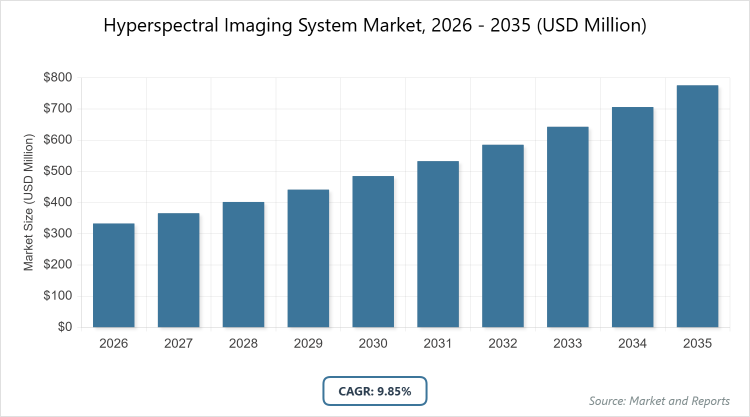
According to MarketnReports, the global Hyperspectral Imaging System market size was estimated at USD 333.14 million in 2025 and is expected to reach USD 852.20 million by 2035, growing at a CAGR of 9.85% from 2026 to 2035. Hyperspectral Imaging System Market is driven by the rising adoption of advanced imaging for precise material identification across agriculture, defense, healthcare, and environmental monitoring.
What are the Key Insights into the Hyperspectral Imaging Systems Market?
- Market Value and CAGR: The global hyperspectral imaging systems market is projected to grow from USD 333.14 million in 2025 to USD 852.20 million by 2035, at a CAGR of 9.85%.
- Dominated Subsegment in Product Segmentation: The camera subsegment dominated with over 72.2% share.
- Dominated Subsegment in Technology Segmentation: The push broom subsegment held the largest share.
- Dominated Subsegment in Application Segmentation: The military subsegment dominated with over 33.6% share.
- Dominated Region: North America held the largest market share of over 40.73%.
What is the Industry Overview of the Hyperspectral Imaging Systems Market?
Hyperspectral imaging systems represent an advanced technology that combines digital imaging with spectroscopy to capture and analyze a wide spectrum of light wavelengths beyond what the human eye can perceive, enabling detailed material identification and characterization in various applications.
This market encompasses devices and solutions designed for precise spectral data collection, offering superior sensitivity and differentiation compared to traditional imaging methods, which allows for non-invasive analysis without requiring prior knowledge of the sample. The industry focuses on enhancing clarity, accuracy, and efficiency in fields where spectral information is critical, driving innovation through compact designs and integrated software that facilitate real-time processing and decision-making across diverse sectors.
What are the Market Dynamics in the Hyperspectral Imaging Systems Market?
Growth Drivers
The market is propelled by the increasing adoption of hyperspectral imaging systems across multiple sectors including research and development, healthcare, defense, food processing, night vision, and remote sensing, which creates substantial demand due to the technology’s ability to provide high clarity and precision in spectral analysis. Technological advancements such as improved sensor designs, higher spectral and spatial resolutions, and the development of lightweight, compact devices further accelerate product integration, enabling applications like rock mineral detection, plant disease diagnosis in agriculture, medical imaging for disease screening, and foreign contaminant identification in food, all of which enhance operational efficiencies and outcomes.
Restraints
Market growth is impeded by the high costs associated with hyperspectral imaging systems, which limit accessibility for smaller organizations and developing regions, coupled with a lack of standardization and interoperability that complicates integration with existing infrastructures. Additionally, the availability of alternative technologies such as multispectral imaging and Fourier transform infrared spectroscopy provides cost-effective substitutes that capture sufficient spectral data for certain applications, thereby diverting potential investments away from hyperspectral solutions, especially in budget-constrained environments where flexibility and affordability are prioritized.
Opportunities
Significant opportunities arise from the expanding applications of hyperspectral imaging in emerging areas such as disease diagnosis, image-guided surgeries, environmental monitoring, and precision agriculture, where the technology’s capability to detect biochemical changes and subtle material differences can lead to breakthroughs in early detection and resource optimization. Furthermore, strategic integrations through mergers and acquisitions among manufacturers are enhancing technological capabilities and market reach, fostering innovation in healthcare and other sectors to meet evolving demands for advanced, non-invasive analytical tools.
Challenges
The industry faces challenges from elevated pricing of hyperspectral systems that restrict widespread adoption, alongside issues with standardization and interoperability that hinder seamless deployment across diverse platforms. In addition, the presence of substitute imaging technologies offers end-users viable alternatives, while limited penetration in underdeveloped economies due to inadequate access, regulatory frameworks, and infrastructure further constrains global expansion, necessitating targeted efforts to address affordability and compatibility to unlock broader market potential.
Hyperspectral Imaging System Market: Report Scope
| Report Attributes | Report Details |
| Report Name | Hyperspectral Imaging System Market |
| Market Size 2025 | USD 333.14 Million |
| Market Forecast 2035 | USD 852.20 Million |
| Growth Rate | CAGR of 9.85% |
| Report Pages | 215 |
| Key Companies Covered |
Corning Inc., Specim,Spectral Imaging Ltd., Resonon Inc., Headwall Photonics, Telops, Norsk Elektro Optikk, Surface Optics Corp., BaySpec Inc., HAIP Solutions GmbH, XIMEA GmbH, imec |
| Segments Covered | By Product, By Technology, By Application, and By Region. |
| Regions Covered | North America, Europe, Asia Pacific (APAC), Latin America, The Middle East and Africa (MEA) |
| Base Year | 2025 |
| Historical Year | 2020 – 2024 |
| Forecast Year | 2026 – 2035 |
| Customization Scope | Avail customized purchase options to meet your exact research needs. |
What is the Market Segmentation in the Hyperspectral Imaging Systems Market?
The Hyperspectral Imaging System market is segmented by product, by technology, by application, and region.
By Product
The camera segment is the most dominant, holding over 72.2% market share, primarily due to technological advancements in sensor development including high-speed, low-cost circuits, and novel signal-processing methods that ensure quality, economic efficiency, and reliability, making it essential for capturing continuous spectral data at each pixel for precise object identification and detail analysis; this dominance drives the market by enabling wider adoption through affordable options and enhanced computing power that support applications in diverse fields like military surveillance and medical diagnostics. The accessories segment is the second most dominant, supporting the core camera functionality with complementary components that enhance system performance, though it trails due to its supplementary role, yet it contributes to market growth by facilitating customization and integration in specialized setups.
By Technology
The push broom segment is the most dominant, capturing the largest market share owing to its efficiency in scanning large areas with high spectral resolution, which is particularly advantageous for applications requiring continuous data acquisition such as remote sensing and environmental monitoring, thereby driving the market through improved accuracy and speed in data collection that outperforms other methods in high-volume scenarios. The snapshot segment emerges as the second most dominant, valued for its ability to capture entire scenes instantaneously, which is ideal for dynamic environments like medical imaging, helping to propel market expansion by addressing needs for real-time analysis where motion artifacts must be minimized.
By Application
The military segment is the most dominant with over 33.6% share, driven by advancements in data management and component fabrication that enable superior accuracy in tracking and identification tasks compared to conventional techniques, thus propelling the market through extensive use in defense operations that demand reliable, high-precision imaging for personnel and object detection. The medical diagnostics segment is the second most dominant and fastest-growing at a CAGR of 12.0%, attributed to its precision in analyzing tissue morphology, structure, and physiology to detect disease-induced biochemical changes, which drives market growth by expanding applications in areas like ophthalmology, wound analysis, and fluorescence microscopy, offering non-invasive diagnostic tools that improve patient outcomes and surgical guidance.
What are the Recent Developments in the Hyperspectral Imaging Systems Market?
- In January 2024, Specim, Spectral Imaging Ltd. partnered with GEONA hyperspectral to serve as its preferred standalone processing solution for the full range of SPECIM airborne hyperspectral sensors, enhancing data handling capabilities for aerial applications.
- In April 2023, Headwall Photonics and K8 announced Aermatica3D srl as an authorized reseller of their remote sensing products in Italy, leveraging engineering expertise to deliver custom solutions and expand market presence in Europe.
- In June 2022, Resonon Inc. launched its Pika IR-L and IR-L+ hyperspectral cameras operating in the 925-1700 nm range, featuring high spectral and spatial resolution in a compact, lightweight design suitable for UAV-based remote sensing, thereby advancing accessibility for field applications.
What is the Regional Analysis of the Hyperspectral Imaging Systems Market?
North America to dominate the market
North America commands the largest market share exceeding 40.73%, bolstered by its advanced healthcare infrastructure, substantial defense expenditures, rapid adoption of innovative technologies, and the concentration of leading industry players, which collectively foster extensive research and development activities; the region’s emphasis on innovation positions hyperspectral imaging as a key tool in shaping future imaging technologies across healthcare, defense, and environmental sectors, with the United States as the dominating country due to its massive defense budget of USD 766 billion in fiscal year 2022, representing 12% of federal spending, and broad application scopes that drive technological integration and market expansion.
Europe experiences robust growth from the rising integration of hyperspectral imaging in industries such as chemicals, pharmaceuticals, medical diagnostics, food, agriculture, aerospace, and defense, supported by advancements in sensor design, high resolutions, compact formats, and lightweight devices that enhance usability and efficiency; the region benefits from collaborative efforts and technological innovations addressing environmental concerns like deforestation and climate change, with the United Kingdom as the dominating country, projected to grow at the fastest rate owing to progress in sensor technologies, data processing, and significant defense spending of nearly USD 57.97 billion in 2021-2022, while France contributes substantially through initiatives in environmental monitoring and hyperspectral collaborations.
Asia Pacific is poised for the fastest compound annual growth rate, fueled by escalating demand in research, remote sensing, precision farming, and mining explorations, where hyperspectral technology enables detailed crop health monitoring, disease identification, and resource optimization in the world’s largest and most diverse agricultural market; the region’s focus on technological innovation and government initiatives further accelerates adoption, with China as the dominating country, holding the largest share through projects like the Gaofen 5 01A hyperspectral satellite for environmental and resource applications, and Japan emerging as the fastest-growing due to its emphasis on research and development in areas such as medical care and space exploration using advanced sensing techniques.
Latin America anticipates moderate expansion driven by growing demand in the healthcare sector, increasing cancer incidence rates, heightened emphasis on research and development, adoption of cutting-edge medical technologies, and favorable government policies that promote innovation and accessibility; the region’s evolving infrastructure supports applications in diagnostics and agriculture, though growth is tempered by economic variations, with Brazil often leading as the dominating country due to its large economy, investments in healthcare advancements, and initiatives in precision agriculture and environmental monitoring that leverage hyperspectral imaging for sustainable development.
The Middle East & Africa region is expected to see moderate growth as nations prioritize enhancements in military and healthcare sectors, with investments in advanced imaging technologies to address security needs and improve medical diagnostics; the focus on modernization drives adoption in defense surveillance and resource exploration, with Saudi Arabia as a dominating country through its substantial defense budget and initiatives to diversify into high-tech industries, alongside South Africa, which leads in healthcare advancements and mining applications, utilizing hyperspectral systems for mineral detection and environmental management.
Who are the Key Market Players and Their Strategies in the Hyperspectral Imaging Systems Market?
- Specim, Spectral Imaging Ltd.: Focuses on partnerships such as with GEONA for processing solutions, product launches like the FX120 and upgraded FX50 for infrared applications, emphasizing innovation in airborne and industrial sensors to expand capabilities in challenging environments and maintain leadership in spectral imaging.
- Headwall Photonics: Employs acquisitions like inno-spec GmbH to bolster industrial applications in recycling and sorting, and reseller partnerships such as with Aermatica3D srl to enhance market reach in Europe, prioritizing custom solutions and technological integration to strengthen its position in remote sensing and industrial sectors.
- Resonon Inc.: Concentrates on new product introductions such as the Pika IR-L and IR-L+ cameras for UAV applications, leveraging compact designs and high resolutions to target remote sensing markets, aiming to increase accessibility and performance for field-based hyperspectral data collection.
- Imec: Demonstrates integrated systems for video-rate acquisition in medical scenarios and launches solutions with partners like XIMEA for machine vision, focusing on research-driven innovations in sensor fusion and software integration to advance applications in healthcare and industrial automation.
- Pixxel: Pursues satellite deployments, such as its third hyperspectral imaging satellite, to enhance space-based data collection, strategizing on global monitoring capabilities for environmental and resource management to capitalize on the growing demand for orbital hyperspectral insights.
What are the Market Trends in the Hyperspectral Imaging Systems Market?
- Increasing integration of hyperspectral imaging with AI and machine learning for automated data analysis and real-time decision-making in applications like precision agriculture and medical diagnostics.
- Rising focus on compact, lightweight, and portable devices to facilitate field deployments in remote sensing, environmental monitoring, and military operations.
- Growing adoption in healthcare for non-invasive disease detection, tissue analysis, and image-guided surgeries, driven by advancements in spectral resolution.
- Expansion of space-based hyperspectral systems through satellite launches for global resource and environmental tracking.
- Emphasis on sustainability, with applications in detecting contaminants in food processing and monitoring climate change impacts.
- Strategic mergers, acquisitions, and partnerships among players to enhance technological capabilities and market penetration.
What Market Segments are Covered in the Report?
By Product
- Cameras
- Accessories
By Technology
- Push Broom
- Snapshot
- Others
By Application
- Military
- Remote Sensing
- Medical Diagnostics
- Machine Vision & Optical Sorting
- Others
By Region
-
- North America
- U.S.
- Canada
- Europe
- UK
- Germany
- France
- Rest of Europe
- Asia Pacific
- China
- India
- Japan
- Rest of Asia Pacific
- Latin America
- Brazil
- Mexico
- Rest of Latin America
- Middle East & Africa
- UAE
- South Africa
- Rest of Middle East & Africa
- North America
Frequently Asked Questions
Hyperspectral imaging system are advanced technology that capture and process information across a wide range of electromagnetic spectrum wavelengths, combining digital imaging with spectroscopy to provide detailed spectral data for each pixel in an image, enabling precise material identification, characterization, and analysis in applications such as defense, healthcare, agriculture, and remote sensing.
Key factors influencing growth include technological advancements in sensor design and resolution, increasing adoption across sectors like healthcare and defense, expanding applications in precision agriculture and environmental monitoring, strategic mergers and acquisitions among manufacturers, and rising investments in research and development, though challenges like high costs and lack of standardization may temper expansion.
The global hyperspectral imaging systems market is projected to grow from USD 333.14 million in 2025 to USD 852.20 million by 2035.
The CAGR value of the hyperspectral imaging systems market during 2026-2035 is expected to be 9.85%.
North America will contribute notably to the hyperspectral imaging systems market value, holding the largest share due to advanced infrastructure, high defense spending, and presence of key players.
The major players driving growth include Corning Inc., Specim,Spectral Imaging Ltd., Resonon Inc., Headwall Photonics, Telops, Norsk Elektro Optikk, Surface Optics Corp., BaySpec Inc., HAIP Solutions GmbH, XIMEA GmbH, imec, through innovations, product launches, partnerships, and acquisitions.
The global hyperspectral imaging systems market report can be expected to provide comprehensive insights including market size and forecasts, segmentation analysis, dynamics such as drivers and restraints, regional overviews, competitive landscape, recent developments, trends, and value chain details.
The value chain includes raw material procurement for sensors and components, manufacturing and assembly of hyperspectral cameras and accessories, software development for data processing, distribution through resellers and partnerships, end-user applications in sectors like military and healthcare, and after-sales support including maintenance and upgrades.
Market trends are evolving towards AI-integrated systems for automated analysis, portable devices for field use, and sustainable applications in environmental monitoring, while consumer preferences shift towards high-resolution, cost-effective solutions that offer real-time capabilities and seamless integration across industries like agriculture and medical diagnostics.
Regulatory factors include standards for data privacy in healthcare applications and export controls on defense-related technologies, while environmental factors involve the push for sustainable practices such as monitoring deforestation and climate change, which boost demand but also require compliance with eco-friendly manufacturing and waste management regulations.