
Hollow Blow Molding Machine Market Size, Share and Trends 2026 to 2035
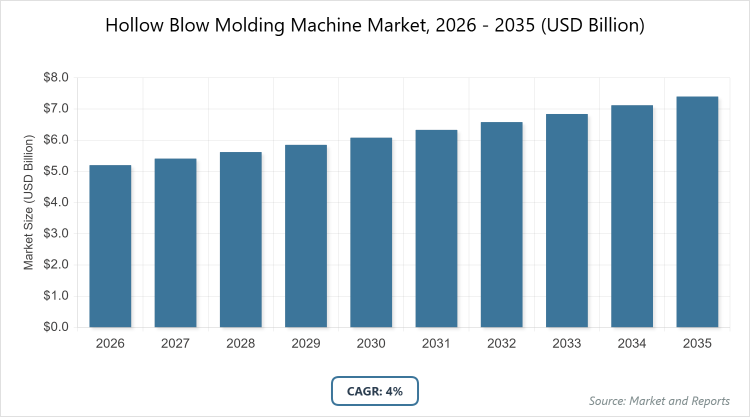
According to MarketnReports, the global Hollow Blow Molding Machine market size was estimated at USD 5.2 billion in 2025 and is expected to reach USD 7.7 billion by 2035, growing at a CAGR of 4% from 2026 to 2035. Hollow Blow Molding Machine Market is driven by rising demand for lightweight and durable plastic packaging solutions across industries.
What are the Key Insights into Hollow Blow Molding Machine Market?
- The global Hollow Blow Molding Machine market size was estimated at USD 5.2 billion in 2025 and is expected to reach USD 7.7 billion by 2035.
- The market is projected to grow at a CAGR of 4% from 2026 to 2035.
- The market is driven by increasing demand for plastic packaging in food & beverage and pharmaceuticals, coupled with advancements in automation.
- The extrusion blow molding machines subsegment dominates the machine type segment with a 65% share due to its versatility in producing large-volume hollow parts efficiently and cost-effectively.
- The injection stretch blow molding machines subsegment is the second most dominant in the machine type segment with a 25% share, driven by its precision in creating lightweight PET bottles that enhance product shelf life and reduce transportation costs.
- The packaging subsegment dominates the application segment with a 55% share because of its widespread use in producing bottles and containers that meet consumer demands for convenient and durable goods.
- The automotive parts subsegment is the second most dominant in the application segment with a 20% share, as it enables the creation of lightweight components that improve fuel efficiency and vehicle performance.
- The food & beverage subsegment dominates the end-user segment with a 40% share owing to the high volume of blow-molded containers required for liquids and perishables, ensuring hygiene and extended shelf life.
- The pharmaceuticals subsegment is the second most dominant in the end-user segment with a 25% share, supported by the need for sterile, tamper-evident packaging that complies with stringent regulatory standards.
- Asia Pacific dominates the global market with a 40% share, attributed to rapid industrialization, low manufacturing costs, and high demand from packaging industries in emerging economies.
What is the Industry Overview of Hollow Blow Molding Machine Market?
The hollow blow molding machine market encompasses equipment designed to produce hollow plastic components by inflating a heated plastic tube, known as a parison, inside a mold until it conforms to the desired shape. This process is essential for manufacturing items like bottles, containers, and automotive parts, offering advantages such as cost-effectiveness, design flexibility, and high production speeds. Market definition refers to the sector involving the design, production, and distribution of these machines, which are categorized by types like extrusion, injection, and stretch blow molding, serving diverse applications in packaging, automotive, and consumer goods. The industry is characterized by technological advancements aimed at improving efficiency, reducing material waste, and integrating automation, while addressing sustainability concerns through the use of recyclable materials and energy-efficient systems.
What are the Market Dynamics of Hollow Blow Molding Machine Market?
Growth Drivers
The primary growth drivers for the hollow blow molding machine market include surging demand from the packaging industry, where these machines enable efficient production of lightweight, recyclable containers that align with consumer preferences for sustainable products. Technological advancements, such as the integration of automation and servo-driven systems, enhance production speeds and reduce operational costs, making them attractive for manufacturers in high-volume sectors like food & beverage and automotive. Additionally, the shift towards bio-based plastics and energy-efficient machinery is propelled by environmental regulations, fostering innovation and expanding market adoption in developing regions with growing industrial bases.
Restraints
Key restraints in the hollow blow molding machine market stem from high initial capital investments required for advanced equipment, which can deter small and medium-sized enterprises from upgrading or entering the market. Environmental concerns over plastic waste and stringent regulations on single-use plastics in regions like Europe pose challenges, forcing manufacturers to adapt to alternative materials that may increase production complexities and costs. Volatility in raw material prices, particularly for petroleum-based resins like polyethylene and polypropylene, further impacts profitability and supply chain stability, limiting market expansion in price-sensitive areas.
Opportunities
Opportunities abound in the hollow blow molding machine market through the adoption of Industry 4.0 technologies, such as AI-driven predictive maintenance and IoT-enabled monitoring, which can optimize operations and minimize downtime for enhanced productivity. The rising focus on sustainable packaging opens avenues for machines compatible with recycled and biodegradable materials, catering to eco-conscious consumers and brands in sectors like cosmetics and healthcare. Emerging markets in Latin America and the Middle East present untapped potential due to increasing urbanization and consumer goods demand, where localized production can reduce logistics costs and support economic growth.
Challenges
Challenges facing the hollow blow molding machine market include the need for skilled labor to operate and maintain sophisticated equipment, as automation integration requires specialized training that may be scarce in certain regions. Intense competition from alternative manufacturing processes, such as thermoforming or 3D printing, threatens market share by offering greater design flexibility for complex shapes. Supply chain disruptions, exacerbated by geopolitical tensions and raw material shortages, can lead to delays and increased costs, complicating efforts to meet fluctuating demand in fast-paced industries like automotive and consumer goods.
Hollow Blow Molding Machine Market: Report Scope
| Report Attributes | Report Details |
| Report Name | Hollow Blow Molding Machine Market |
| Market Size 2025 | USD 5.2 Billion |
| Market Forecast 2035 | USD 7.7 Billion |
| Growth Rate | CAGR of 4% |
| Report Pages | 220 |
| Key Companies Covered |
Nissei ASB Machine Co., Ltd., Bekum Maschinenfabriken GmbH, Sidel Group, Jomar Corporation, Sumitomo Heavy Industries, Ltd., Kautex Maschinenbau GmbH, and Others |
| Segments Covered | By Machine Type, By Application, By End-User, and By Region |
| Regions Covered | North America, Europe, Asia Pacific (APAC), Latin America, and The Middle East and Africa (MEA) |
| Base Year | 2025 |
| Historical Year | 2020 – 2024 |
| Forecast Year | 2026 – 2035 |
| Customization Scope | Avail customized purchase options to meet your exact research needs. |
What is the Market Segmentation of Hollow Blow Molding Machine Market?
The Hollow Blow Molding Machine market is segmented by machine type, application, end-user, and region.
Based on Machine Type Segment: The extrusion blow molding machines segment dominates due to its ability to handle a wide range of materials and produce large, complex hollow parts efficiently, driving market growth through cost savings and high output in industries requiring durable containers. This dominance helps propel the overall market by enabling scalable production that meets rising global demand for packaged goods. The injection stretch blow molding machines segment is the second most dominant, excelling in creating lightweight, high-clarity PET products like bottles, which reduce material usage and transportation costs, thereby supporting sustainability goals and boosting market expansion in beverage sectors.
Based on Application Segment: The packaging segment is the most dominant, as it facilitates the mass production of bottles and jars that ensure product protection and appeal, dominating due to consumer trends toward convenient, ready-to-use items; this drives the market by increasing adoption in e-commerce and retail. The automotive parts segment ranks second, enabling lightweight components like fuel tanks that enhance vehicle efficiency and safety, prominent because of automotive lightweighting initiatives, contributing to market growth through innovation in transportation solutions.
Based on End-User Segment: The food & beverage segment leads as the most dominant, utilizing machines for hygienic, customizable packaging that extends shelf life, driven by global consumption growth; this propels the market via high-volume demands from bottled water and soft drinks industries. The pharmaceuticals segment is second, focusing on sterile, precise containers that comply with health standards, dominant owing to aging populations and drug delivery needs, aiding market advancement through regulatory-compliant manufacturing.
What are the Recent Developments in Hollow Blow Molding Machine Market?
- In 2025, Nissei ASB Machine Co., Ltd. introduced a new series of all-electric injection stretch blow molding machines with enhanced energy efficiency, targeting the PET bottle market to reduce operational costs by up to 30% while improving production speeds.
- Bekum Maschinenfabriken GmbH announced a partnership with a major resin supplier in late 2025 to develop machines compatible with 100% recycled materials, aiming to support circular economy initiatives in Europe and reduce plastic waste.
- Sidel Group launched an AI-integrated blow molding system in early 2026, featuring predictive maintenance capabilities that minimize downtime, catering to high-demand packaging lines in Asia Pacific.
What is the Regional Analysis of Hollow Blow Molding Machine Market?
Asia Pacific to dominate the global market
Asia Pacific holds the dominant position in the hollow blow molding machine market, driven by robust manufacturing infrastructure and high demand from packaging and automotive sectors in countries like China, which accounts for over 50% of the regional share due to its vast production capacity, low labor costs, and government incentives for industrial expansion. The region’s rapid urbanization and rising middle-class consumption further fuel growth, with India emerging as a key player through investments in food processing and e-commerce packaging.
North America follows as a significant market, with the United States leading at approximately 70% of the regional share, supported by advanced technological adoption in healthcare and consumer goods, where innovations in sustainable materials and automation enhance efficiency amid strict environmental regulations.
Europe maintains a strong presence, dominated by Germany with about 30% regional share, owing to its engineering expertise and focus on high-precision machines for automotive and pharmaceutical applications, bolstered by EU policies promoting recyclable plastics and energy-efficient production.
Latin America shows promising growth, led by Brazil at around 40% of the regional market, fueled by expanding beverage industries and foreign investments in manufacturing, though challenges like economic volatility persist.
The Middle East and Africa region is nascent but growing, with South Africa holding about 25% share, driven by increasing demand for packaged goods in urban areas and oil-based resin availability, supporting gradual industrialization.
What are the Key Market Players and Strategies in Hollow Blow Molding Machine Market?
- Nissei ASB Machine Co., Ltd. focuses on innovation through R&D in all-electric and hybrid machines, emphasizing energy efficiency and precision for PET applications, while expanding globally via strategic acquisitions to strengthen its position in emerging markets.
- Bekum Maschinenfabriken GmbH employs sustainability-driven strategies, developing machines for recycled materials and partnering with suppliers to reduce environmental impact, alongside customizing solutions for packaging clients to enhance market penetration in Europe and North America.
- Sidel Group prioritizes digital transformation, integrating IoT and AI for predictive maintenance, and pursues mergers to broaden its portfolio, targeting high-growth sectors like beverages to drive revenue through optimized production systems.
- Jomar Corporation adopts a customer-centric approach, offering modular machines for flexibility and quick changeovers, while investing in training programs to support clients, aiming to capture share in the pharmaceuticals and cosmetics industries.
- Sumitomo Heavy Industries, Ltd. leverages advanced engineering for high-speed extrusion systems, focusing on cost reduction and quality control, with expansion strategies in Asia Pacific through joint ventures to capitalize on regional demand.
- Kautex Maschinenbau GmbH emphasizes automation and Industry 4.0 integration, developing smart machines for automotive parts, and pursues sustainability certifications to appeal to eco-focused clients, enhancing its competitive edge globally.
What are the Market Trends in Hollow Blow Molding Machine Market?
- Increasing adoption of all-electric machines for energy savings and reduced emissions.
- Shift towards bio-based and recycled plastics to meet sustainability regulations.
- Integration of AI and IoT for real-time monitoring and predictive maintenance.
- Growing demand for lightweight automotive components to improve fuel efficiency.
- Expansion of customized machines for small-batch production in niche markets.
- Rise in automation to address labor shortages and enhance production speeds.
- Focus on multi-layer blow molding for enhanced barrier properties in packaging.
What Market Segments and their Subsegments are Covered in the Hollow Blow Molding Machine Report?
By Machine Type
- Extrusion Blow Molding Machines
- Continuous Extrusion Machines
- Accumulator Head Machines
- Injection Blow Molding Machines
- Stretch Blow Molding Machines
- Single-Stage Machines
- Two-Stage Machines
- Rotary Machines
- Linear Shuttle Machines
- Electric Drive Machines
- Others
By Application
- Packaging
- Bottles
- Containers
- Automotive Parts
- Toys
- Medical Devices
- Household Products
- Industrial Drums
- Consumer Goods
- Construction
- Others
By End-User
- Food & Beverage
- Pharmaceuticals
- Cosmetics & Personal Care
- Automotive
- Chemicals
- Consumer Electronics
- Healthcare
- Building & Construction
- Agriculture
- Others
- Others
By Region
- North America
- U.S.
- Canada
- Europe
- UK
- Germany
- France
- Rest of Europe
- Asia Pacific
- China
- India
- Japan
- Rest of Asia Pacific
- Latin America
- Brazil
- Mexico
- Rest of Latin America
- Middle East & Africa
- UAE
- South Africa
- Rest of Middle East & Africa
Frequently Asked Questions
Hollow blow molding machines are specialized equipment used to manufacture hollow plastic products by inflating a heated plastic parison inside a mold, commonly applied in producing bottles, containers, and automotive components.
Key factors include rising demand for sustainable packaging, technological advancements in automation, and expansion in emerging markets, offset by environmental regulations and raw material price volatility.
The market is expected to grow from over USD 5.2 billion in 2025 to USD 7.7 billion by 2035.
The market is projected to grow at a CAGR of 4% during 2026-2035.
Asia Pacific will contribute notably, holding around 40% of the market value due to strong manufacturing and demand in China and India.
Major players include Nissei ASB Machine Co., Ltd., Bekum Maschinenfabriken GmbH, Sidel Group, Jomar Corporation, Sumitomo Heavy Industries, Ltd., and Kautex Maschinenbau GmbH.
The report provides in-depth analysis of market size, trends, segments, regional insights, key players, and forecasts from 2026 to 2035.
Stages include raw material sourcing (resins), machine manufacturing, assembly and distribution, end-user application in molding processes, and recycling or disposal.
Trends are shifting towards sustainable, energy-efficient machines, with consumers preferring eco-friendly packaging, driving demand for recycled material-compatible equipment.
Regulations on plastic waste and emissions are pushing for biodegradable materials and efficient machines, while bans on single-use plastics in some regions challenge growth but spur innovation.