
Healthcare Analytics Market Size, Share and Trends 2026 to 2035
According to MarketnReports, the global Healthcare Analytics market size was estimated at USD 91.6 billion in 2025 and is expected to reach USD 1,610.5 billion by 2035, growing at a CAGR of 33.2% from 2026 to 2035. Healthcare Analytics Market is driven by rapid adoption of AI, big data, and value-based care models to improve patient outcomes and operational efficiency.
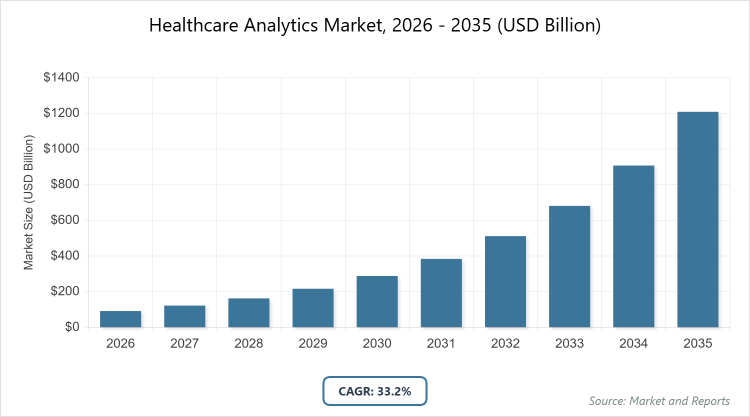
What are the Key Insights into Healthcare Analytics Market?
- The global Healthcare Analytics market was valued at USD 91.6 billion in 2025 and is projected to reach USD 1,610.5 billion by 2035.
- The market is expected to grow at a CAGR of 33.2% during the forecast period from 2026 to 2035.
- The market is driven by exploding healthcare data volumes, AI/ML integration, value-based care shift, and need for cost reduction in providers and payers.
- In the type segment, descriptive analytics dominates with approximately 43-45% market share due to its foundational role in summarizing historical data for quick insights and operational reporting.
- In the application segment, clinical analytics dominates with around 40% share because it directly impacts patient care through outcome prediction and personalized treatment pathways.
- In the end-user segment, healthcare providers hold the largest share at about 40% owing to their high data generation and direct need for analytics in care delivery and efficiency.
- North America dominates the regional market with roughly 45-48% share, driven by advanced IT infrastructure, high EHR adoption, strong reimbursement incentives, and presence of major tech players.
What is the Healthcare Analytics Industry Overview?
The Healthcare Analytics market involves the use of advanced data analysis techniques, tools, and software to extract meaningful insights from vast volumes of healthcare data generated from electronic health records, medical imaging, claims, wearables, and clinical trials, enabling informed decision-making across the healthcare ecosystem. Healthcare analytics is defined as the systematic application of statistical, predictive, prescriptive, and descriptive methods to healthcare data, aimed at optimizing clinical outcomes, reducing costs, enhancing operational efficiency, supporting population health management, and facilitating precision medicine while ensuring compliance with privacy regulations.
What are the Healthcare Analytics Market Dynamics?
Growth Drivers
The Healthcare Analytics market is propelled by exponential growth in healthcare data from EHRs, wearables, genomics, and claims, combined with AI/ML advancements that enable predictive modeling, early disease detection, and personalized medicine. Value-based care models and regulatory pressures push providers and payers to adopt analytics for better outcomes, fraud detection, and cost management. Rising chronic diseases and aging populations increase demand for population health analytics, while cloud adoption lowers entry barriers. Government initiatives and investments in digital health further accelerate adoption globally.
Restraints
Key restraints include high implementation costs for advanced analytics platforms and skilled data professionals, which burden smaller providers. Data privacy concerns under regulations like HIPAA and GDPR, along with interoperability issues among disparate systems, hinder seamless integration. Cybersecurity risks associated with sensitive health data and resistance to change in traditional healthcare workflows slow adoption. Limited digital infrastructure in developing regions further restricts market penetration.
Opportunities
Opportunities abound in emerging markets with rising healthcare digitization, where affordable cloud-based solutions can address resource constraints. Integration of generative AI and NLP for unstructured data analysis opens new avenues in clinical decision support. Expansion into precision medicine, remote monitoring, and real-world evidence generation offers high-growth potential. Partnerships between tech giants and healthcare entities, along with government incentives for digital transformation, create favorable conditions for innovation.
Challenges
Challenges involve ensuring data quality, standardization, and interoperability across fragmented systems, which complicates accurate analytics. Shortage of skilled data scientists and clinicians with analytical expertise persists. Evolving regulatory landscapes and ethical concerns around AI bias require continuous compliance efforts. Balancing innovation speed with patient data security remains a critical hurdle.
Healthcare Analytics Market: Report Scope
| Report Attributes | Report Details |
| Report Name | Healthcare Analytics Market |
| Market Size 2025 | USD 91.6 Billion |
| Market Forecast 2035 | USD 1,610.5 Billion |
| Growth Rate | CAGR of 33.2% |
| Report Pages | 220 |
| Key Companies Covered | Optum, Inc., IBM (Merative), Oracle, McKesson Corporation, IQVIA, and Others |
| Segments Covered | By Type, By Application, By End-User, and By Region |
| Regions Covered | North America, Europe, Asia Pacific (APAC), Latin America, and The Middle East and Africa (MEA) |
| Base Year | 2025 |
| Historical Year | 2020 – 2024 |
| Forecast Year | 2026 – 2035 |
| Customization Scope | Avail customized purchase options to meet your exact research needs. |
What is the Healthcare Analytics Market Segmentation?
The Healthcare Analytics market is segmented by type, application, end-user, and region.
By type, descriptive analytics emerges as the most dominant subsegment, holding over 43% share, due to its essential role in processing historical data for performance reporting and trend identification, which drives the market by providing foundational insights for operational improvements; the second most dominant is predictive analytics, which supports market growth through forecasting patient risks and resource needs, enabling proactive care.
By application, clinical analytics stands as the most dominant, accounting for about 40% share, as it directly enhances patient outcomes via treatment optimization and disease prediction, propelling overall market expansion; financial analytics follows as the second dominant, aiding market drive by identifying cost-saving opportunities and fraud detection.
By end-user, healthcare providers dominate with around 40% share, driven by massive data generation and need for real-time insights in care delivery, which accelerates market growth; healthcare payers are the second dominant, contributing to market advancement through claims analysis and risk management.
What are the Recent Developments in Healthcare Analytics Market?
- In June 2025, Mathematica and Tuva Health partnered to enhance healthcare data analytics for government and public health agencies using advanced algorithms and open-source models.
- In May 2025, Carta Healthcare secured $18.25 million in Series B1 funding to expand its AI-powered clinical data abstraction platform.
- In March 2025, Oracle Health launched an advanced predictive analytics suite leveraging real-world data to reduce hospital readmissions.
- In June 2024, IBM and Telefonica collaborated on AI and data governance solutions for evolving healthcare data management needs.
- In October 2024, Ontada partnered with Microsoft to transform unstructured oncology data using Azure OpenAI for real-world evidence.
What is the Regional Analysis of Healthcare Analytics Market?
- North America to dominate the global market.
North America leads the Healthcare Analytics market, holding approximately 45-48% of the global share in 2025, driven by advanced digital health infrastructure, near-universal EHR adoption, strong reimbursement incentives for value-based care, massive investments in AI/ML technologies, and the presence of leading global players like Optum, IBM, and Oracle. The United States dominates within the region as the primary innovation hub, supported by favorable government policies such as CMS incentives, high chronic disease prevalence requiring data-driven management, extensive R&D funding, and early integration of predictive and prescriptive analytics in hospitals and payers. Canada contributes significantly through its focus on universal healthcare efficiency, provincial digital health strategies, and collaborative initiatives for population health analytics.
Europe follows with a market share of around 25-30%, experiencing steady and consistent growth fueled by GDPR-compliant data governance, EU-wide digital health initiatives like the European Health Data Space (EHDS), and strong emphasis on population health management and cost control in aging societies. Germany is the dominant country, benefiting from its powerful healthcare IT sector, research collaborations under Horizon Europe, high EHR penetration, and demand for advanced analytics in clinical and financial applications. The United Kingdom and France contribute substantially, with the UK advancing through NHS digital transformation programs and AI adoption for operational efficiency, while France focuses on national health data platforms and value-based care models. Europe’s commitment to interoperability, privacy, and cross-border data sharing supports resilient market progress despite regulatory complexities.
Asia-Pacific emerges as the fastest-growing region with about 20% market share in 2025, propelled by rapid healthcare digitization, massive government reforms, rising chronic disease burden, increasing healthcare expenditures, and large-scale investments in AI and cloud infrastructure across emerging economies. China dominates, capitalizing on the Healthy China 2030 plan, enormous patient data volumes from EHRs and wearables, domestic AI advancements, and policy-driven adoption of predictive analytics in hospitals and precision medicine. India and Japan play key roles, with India driven by private hospital expansions, National Digital Health Mission initiatives, and affordable analytics solutions for population health, while Japan emphasizes robotics-integrated monitoring and precision medicine backed by MHLW approvals. Medical tourism, international tech partnerships, and cost-effective cloud platforms accelerate the region’s explosive upward trajectory, often outpacing global CAGR.
Latin America demonstrates emerging potential with a smaller share of around 5-7%, through gradual improvements in digital infrastructure, rising EHR adoption in urban centers, government efforts to enhance care delivery efficiency, and increasing recognition of analytics for chronic disease management despite economic and infrastructure variability. Brazil leads, incorporating data-driven tools in public health systems like SUS for population health and operational analytics, supported by ANVISA regulations and international collaborations. Mexico benefits from medical tourism growth and US-aligned standards facilitating cross-border analytics adoption in financial and clinical areas. Regional training programs, foreign investments, and public-private partnerships present promising opportunities for accelerated future expansion.
The Middle East and Africa hold about 3-5% share, driven by ambitious modernization projects like Saudi Vision 2030, medical tourism in select hubs, and incremental incorporation of analytics in specialized facilities, but constrained by infrastructure limitations, resource disparities, and uneven digital maturity. Saudi Arabia advances prominently through large-scale hospital upgrades, imported cloud-based analytics solutions, and national health data initiatives for operational and population health insights. South Africa contributes via private sector adoption in urban centers and university-led research for chronic disease analytics. International partnerships, specialist training programs, and gradual AI integration offer viable pathways for market development in underserved areas.
What are the Key Market Players in the Healthcare Analytics?
- Optum, Inc. (UnitedHealth Group) focuses on integrated data platforms and AI-driven solutions, leveraging vast claims data for predictive insights and value-based care.
- IBM (Merative) emphasizes Watson Health tools and cloud-based analytics, partnering for AI deployment in clinical and operational decision support.
- Oracle pursues acquisitions like Cerner and launches predictive suites, targeting real-world data for readmission reduction and population health.
- McKesson Corporation concentrates on supply chain and financial analytics, supporting providers with cost management and revenue cycle solutions.
- IQVIA specializes in real-world evidence and life sciences analytics, offering end-to-end data solutions for clinical and commercial applications.
What are the Healthcare Analytics Market Trends?
- Rapid integration of generative AI and NLP for unstructured data processing.
- Shift toward predictive and prescriptive analytics for proactive care.
- Growing adoption of cloud-based platforms for scalability and cost efficiency.
- Emphasis on population health and value-based care models.
- Increased focus on real-world evidence generation for drug development.
- Rising use in fraud detection and revenue cycle management.
- Expansion of partnerships between tech giants and healthcare entities.
What are the Market Segments and Subsegments Covered in the Healthcare Analytics Report?
By Type
-
- Descriptive Analytics
- Predictive Analytics
- Prescriptive Analytics
- Others
By Application
-
- Clinical Analytics
- Financial Analytics
- Operational & Administrative Analytics
- Population Health Management
- Others
By End-User
-
- Healthcare Providers
- Healthcare Payers
- Life Science Companies
- Others
By Region
-
- North America
- U.S.
- Canada
- Europe
- UK
- Germany
- France
- Rest of Europe
- Asia Pacific
- China
- India
- Japan
- Rest of Asia Pacific
- Latin America
- Brazil
- Mexico
- Rest of Latin America
- Middle East & Africa
- UAE
- South Africa
- Rest of Middle East & Africa
- North America
Frequently Asked Questions
Healthcare analytics refers to the use of data analysis tools and techniques to derive actionable insights from healthcare data for improving clinical outcomes, operational efficiency, and cost management.
Factors include AI/ML advancements, big data growth, value-based care adoption, regulatory support, and rising demand for personalized medicine.
The market is projected to grow from approximately USD 91.6 billion in 2026 to USD 1,610.5 billion by 2035.
The CAGR is expected to be 33.2% from 2026 to 2035.
North America will contribute notably, driven by advanced infrastructure and high adoption.
Major players include Optum, Inc., IBM (Merative), Oracle, McKesson Corporation, and IQVIA.
The report provides detailed size, trends, segmentation, regional insights, key players, and forecasts.
Stages include data collection, storage, processing, analysis/modeling, insight generation, and application in decision-making.
Trends favor AI-driven predictive tools and cloud solutions, with preferences for real-time insights and personalized care.
HIPAA/GDPR compliance, value-based care incentives, and data privacy regulations significantly influence adoption.