
Hardware Products of Doors & Windows Market Size and Forecast 2026 to 2035
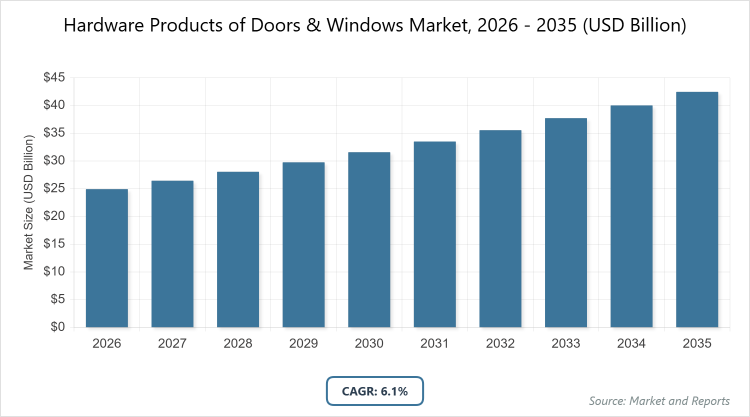
According to MarketnReports, the global Hardware Products of Doors & Windows market size was estimated at USD 24.92 billion in 2025 and is expected to reach USD 47.14 billion by 2035, growing at a CAGR of 6.1% from 2026 to 2035. Hardware Products of Doors & Windows Market is driven by the growth in residential and commercial construction, rising renovation activities, and demand for secure, durable, and energy-efficient building solutions.
What are the Key Insights of the Hardware Products of Doors & Windows Market?
- The global Hardware Products of Doors & Windows market was valued at approximately USD 24.92 Billion in 2025 and is projected to reach USD 47.14 Billion by 2035.
- The market is anticipated to grow at a Compound Annual Growth Rate (CAGR) of 6.1% during the forecast period from 2026 to 2035.
- The Locks subsegment dominates the Product segment.
- The Aluminum subsegment dominates the Material segment.
- The Residential subsegment dominates the End-user segment.
- The Offline subsegment dominates the Distribution Channel segment.
- Asia-Pacific dominates as the leading region in the global market.
What is the Industry Overview of the Hardware Products of Doors & Windows Market?
The Hardware Products of Doors & Windows market encompasses the manufacturing, supply, and distribution of essential components that enhance the functionality, security, aesthetics, and durability of doors and windows in various construction applications. This industry includes a wide array of items such as hinges, locks, handles, latches, fasteners, and weatherstripping, which are integral to residential, commercial, and industrial buildings. These products play a critical role in ensuring energy efficiency, proper ventilation, and overall structural integrity while meeting evolving consumer preferences for stylish and reliable fittings. Manufacturers focus on tailoring solutions to specific customer requirements, incorporating innovations in design and materials to address diverse architectural needs, thereby supporting the broader building and construction sector by providing hardware that combines practicality with visual appeal.
What are the Market Dynamics in the Hardware Products of Doors & Windows Market?
Growth Drivers
The primary growth drivers in the Hardware Products of Doors & Windows market stem from the surging construction activities in both residential and commercial sectors, fueled by urbanization, population growth, and infrastructure development worldwide. Increasing investments in modern buildings, such as office spaces, hotels, retail outlets, and recreational facilities, necessitate high-quality hardware that ensures safety, durability, and ease of use, including features like pressure-resistant handles and efficient crowd management systems. Additionally, the rising adoption of automated and smart doors and windows, integrated with sensory technologies and remote controls, is boosting demand for advanced hardware components that offer enhanced functionality and convenience, thereby propelling market expansion as consumers and builders prioritize innovative solutions for energy efficiency and security.
Restraints
A significant restraint in the Hardware Products of Doors & Windows market is the extended replacement cycle of these products, as high-quality materials like durable metals and alloys are designed for long-term use, often lasting decades without needing substitution. This longevity reduces the frequency of purchases and limits recurring revenue opportunities for manufacturers, particularly since replacing items such as hinges or locks typically involves extensive labor and disruption, deterring unnecessary upgrades. Consequently, the market faces challenges in maintaining steady growth momentum, especially in mature economies where existing infrastructure already features robust, long-lasting hardware installations.
Opportunities
Opportunities in the Hardware Products of Doors & Windows market are abundant due to the continuous launch of innovative, new-age products that cater to shifting consumer preferences for aesthetically pleasing, functional, and technologically advanced hardware. With rising disposable incomes and a focus on home and commercial décor, manufacturers can capitalize on developing items like digital locks, smart handles, and customizable designs that integrate seamlessly with modern architecture. Furthermore, the growing demand for specialized hardware in high-rise buildings, emphasizing wind resistance, fire safety, solar control, and security, opens avenues for expansion as investments in skyscrapers and urban development’s increase, allowing companies to differentiate through material innovations and smart technology integrations to capture emerging market segments.
Challenges
The Hardware Products of Doors & Windows market encounters substantial challenges from intense competition among numerous global and regional players, leading to market saturation, price pressures, and the need for constant product differentiation. Established international firms expanding into new territories compete with local manufacturers who hold strong regional footholds, making it difficult to maintain profit margins amid aggressive pricing strategies and diverse product offerings. Additionally, navigating varying regulatory standards, supply chain disruptions, and the demand for sustainable materials further complicates operations, requiring companies to invest heavily in research and development to stay ahead while addressing environmental concerns and consumer expectations for eco-friendly solutions.
Hardware Products of Doors & Windows Market: Report Scope
| Report Attributes | Report Details |
| Report Name | Hardware Products of Doors & Windows Market |
| Market Size 2025 | USD 24.92 Billion |
| Market Forecast 2035 | USD 47.14 Billion |
| Growth Rate | CAGR of 6.1% |
| Report Pages | 235 |
| Key Companies Covered |
Assa Abloy, Andersen Corporation, Allegion, Stanley Black & Decker, Yale, Roto Frank AG, Schlage, SIEGENIA Group, Pella Corporation, Masonite International, Marvin Windows and Doors, HOPPE AG, Emtek Products Inc. |
| Segments Covered | By Product, By Material, By End Use, By Distribution Channel, and By Region. |
| Regions Covered | North America, Europe, Asia Pacific (APAC), Latin America, The Middle East and Africa (MEA) |
| Base Year | 2025 |
| Historical Year | 2020 – 2024 |
| Forecast Year | 2026 – 2035 |
| Customization Scope | Avail customized purchase options to meet your exact research needs. |
What is the Market Segmentation Analysis for the Hardware Products of Doors & Windows Market?
The Hardware Products of Doors & Windows market is segmented by product, material, end use, distribution channel, and region.
By Product
The Locks segment is the most dominant in the Product category, primarily due to its essential role in providing security and access control in both residential and commercial settings, where rising concerns over safety and burglary prevention drive consistent demand for advanced locking mechanisms, including smart and digital variants that integrate with home automation systems, thereby fueling overall market growth by enhancing user confidence and enabling premium pricing; the Hinges segment follows as the second most dominant, owing to its fundamental function in facilitating smooth door and window operations, with durability and corrosion resistance making it indispensable in high-traffic areas, contributing to market expansion through widespread use in construction and renovation projects that prioritize long-lasting structural components.
By Material
The Aluminum segment dominates the Material category because of its lightweight, corrosion-resistant properties, and cost-effectiveness, making it ideal for a variety of climates and architectural styles, which drives market growth by offering versatile applications in energy-efficient buildings and reducing maintenance costs over time; the Stainless Steel segment is the second most dominant, valued for its superior strength, aesthetic appeal, and resistance to wear, particularly in commercial and industrial environments where hygiene and durability are paramount, thus supporting market advancement by catering to high-end demands and enabling innovations in premium hardware designs.
By End-user
The Residential segment holds the largest share in the End-user category, driven by the booming housing sector, population growth, and increasing home renovation activities that emphasize personalized, secure, and stylish door and window fittings, which propel market growth through high-volume consumption and opportunities for customization in luxury and affordable housing alike; the Commercial segment ranks second, fueled by the expansion of offices, retail spaces, and hospitality venues requiring robust hardware for heavy usage and compliance with safety standards, thereby contributing to market dynamics by addressing the needs of large-scale projects and enhancing operational efficiency in business environments.
By Distribution Channel
The Offline segment dominates the Distribution Channel category as it allows for hands-on product inspection, expert consultations, and immediate availability through hardware stores, wholesalers, and construction suppliers, which drives market growth by building trust and facilitating bulk purchases in the building industry; the Online segment is emerging as the second most dominant, benefiting from the convenience of e-commerce platforms, wider product variety, and competitive pricing, thus accelerating market expansion by reaching remote customers and supporting the shift toward digital shopping trends in hardware procurement.
What are the Recent Developments in the Hardware Products of Doors & Windows Market?
- In June 2023, Godrej Locks & Architectural Fittings and Systems (GLAFS) expanded its portfolio by introducing new Home Décor Handles alongside advanced digital locks, aiming to meet the growing consumer demand for aesthetically appealing and technologically integrated hardware solutions that enhance home security and design, thereby strengthening its market position through innovation and catering to modern residential needs.
- In June 2022, Tesa Assa Abloy unveiled a new collection of door and window handles designed specifically for contemporary and high-end environments, focusing on superior materials, functionality, and style to align with state-of-the-art architectural trends, which positions the company to capture a larger share in the premium segment by addressing evolving preferences for durable and visually striking hardware.
What is the Regional Analysis of the Hardware Products of Doors & Windows Market?
Asia-Pacific to dominate the market
The Asia-Pacific region dominates the global Hardware Products of Doors & Windows market, driven by rapid urbanization, massive population growth, and extensive construction activities in countries like China, India, and Japan, where the demand for energy-efficient and secure hardware is surging due to housing shortages, commercial expansions, and investments in skyscrapers; China stands out as the dominating country, hosting numerous key manufacturers and boasting around five of the world’s top ten tallest buildings, which necessitates advanced hardware for structural stability, wind resistance, and fire safety, further amplified by government initiatives for infrastructure development and a strong export-oriented industry that attracts international buyers through innovative product portfolios and cost-competitive production.
North America exhibits steady growth in the Hardware Products of Doors & Windows market, supported by a focus on product innovation, rising renovation projects, and stringent building codes emphasizing safety and sustainability; the United States emerges as the dominating country, with a high volume of residential and commercial redevelopments—such as the 63.2% of interior design projects being renovations—driving demand for durable hardware like smart locks and hinges, bolstered by technological advancements and consumer preferences for energy-efficient solutions in urban centers like New York and Chicago, where construction booms and e-commerce integration further enhance market accessibility and revenue generation.
Europe maintains a significant presence in the Hardware Products of Doors & Windows market, characterized by a strong emphasis on aesthetic design, environmental regulations, and high-quality manufacturing standards that promote the use of premium materials in hardware; Germany leads as the dominating country, leveraging its robust industrial base and engineering expertise to produce innovative products for both domestic and export markets, with growth fueled by the region’s thriving salon and hospitality sectors—valued at USD 69 billion in 2022—and ongoing investments in sustainable building practices across cities like Berlin and Munich, which prioritize energy-efficient windows and doors to comply with EU green building directives.
Latin America is experiencing gradual expansion in the Hardware Products of Doors & Windows market, influenced by increasing urbanization, infrastructure projects, and a growing middle class seeking improved home security and aesthetics; Brazil dominates as the leading country, with its large population and economic hubs like São Paulo driving demand for affordable yet durable hardware in residential and commercial constructions, supported by government housing programs and foreign investments that enhance supply chains, while challenges like economic volatility are offset by opportunities in export-oriented manufacturing and adoption of modern fittings in emerging urban developments.
The Middle East and Africa region shows promising potential in the Hardware Products of Doors & Windows market, propelled by oil-funded infrastructure megaprojects, tourism developments, and efforts to diversify economies beyond hydrocarbons; the United Arab Emirates (UAE) stands as the dominating country, particularly in Dubai and Abu Dhabi, where iconic skyscrapers and luxury resorts require high-end hardware for security, climate control, and design excellence, with growth accelerated by events like Expo and investments in smart cities that integrate advanced locks and hinges, addressing harsh environmental conditions while fostering partnerships with global players to elevate regional manufacturing capabilities.
Who are the Key Market Players and Their Strategies in the Hardware Products of Doors & Windows Market?
- Dormakaba employs strategies focused on mergers and acquisitions to expand its global footprint, alongside heavy investments in research and development for smart hardware solutions that integrate IoT for enhanced security.
- Assa Abloy prioritizes new product launches, such as advanced digital locks, and forms strategic partnerships with construction firms to penetrate emerging markets while emphasizing sustainability in material sourcing.
- Andersen Corporation leverages regional expansions and collaborations to offer customized window hardware, with a strong emphasis on energy-efficient innovations to meet regulatory demands.
- Allegion adopts a strategy of product differentiation through technological advancements like biometric locks, combined with joint ventures to strengthen supply chains in high-growth regions.
- Stanley Black & Decker focuses on acquisitions to broaden its portfolio and invests in R&D for durable, user-friendly hardware, while pursuing market penetration via online and offline channels.
- Yale emphasizes brand collaborations and new launches of smart security products, targeting residential segments with user-centric designs to drive consumer loyalty.
- Roto Frank AG pursues innovation in hinge and fastening technologies, with strategies including partnerships for co-development and expansion into Asia-Pacific markets.
- Schlage concentrates on high-security lock systems through R&D, employing marketing strategies to build brand trust in commercial applications.
- SIEGENIA Group invests in sustainable manufacturing and product launches for ventilation hardware, using regional expansions to capture European and Asian demands.
- Pella Corporation adopts customization strategies for premium windows hardware, with a focus on joint ventures and digital marketing to enhance customer engagement.
- Masonite International emphasizes cost-effective innovations and supply chain optimizations, pursuing acquisitions to consolidate market share in doors hardware.
- Marvin Windows and Doors focuses on high-end, aesthetic-driven products through R&D, with strategies including collaborations with architects for bespoke solutions.
- HOPPE AG prioritizes design innovation and global expansions, forming agreements with distributors to promote ergonomic handles in residential markets.
- Emtek Products Inc. leverages artisanal craftsmanship in launches, with marketing strategies targeting luxury segments via e-commerce platforms.
- Jeld-Wen employs vertical integration and sustainability initiatives, focusing on partnerships to deliver comprehensive door and window solutions.
What are the Market Trends in the Hardware Products of Doors & Windows Market?
- Increasing consumer demand for aesthetically pleasing and customizable hardware that complements modern interior designs.
- Rising integration of smart technologies, such as IoT-enabled locks and automated systems, for enhanced security and convenience.
- Growing emphasis on sustainable and eco-friendly materials to align with global environmental regulations and consumer preferences.
- Surge in demand for energy-efficient hardware that improves insulation and reduces utility costs in buildings.
- Expansion of e-commerce platforms facilitating easier access to a wider variety of hardware products.
- Innovations in durable, low-maintenance materials like aluminum and stainless steel for long-lasting applications.
- Heightened focus on security features amid rising concerns over home and commercial safety.
What Market Segments are Covered in the Report for the Hardware Products of Doors & Windows Market?
By Product
- Locks
- Handles
- Hinges
- Fasteners
- Latches
- Others
By Material
- Aluminum
- Stainless Steel
- Zinc
- Brass
- Plastic
By End-user
- Residential
- Commercial
- Industrial
By Distribution Channel
- Offline
- Online
By Region
-
- North America
- U.S.
- Canada
- Europe
- UK
- Germany
- France
- Rest of Europe
- Asia Pacific
- China
- India
- Japan
- Rest of Asia Pacific
- Latin America
- Brazil
- Mexico
- Rest of Latin America
- Middle East & Africa
- UAE
- South Africa
- Rest of Middle East & Africa
- North America
Frequently Asked Questions
Hardware Products of Doors & Windows refer to rigid and sturdy tools used to make doors and windows safe, functional, aesthetically pleasing, secure, and long-lasting, including items like locks, hinges, handles, latches, fasteners, and weatherstripping essential for installation in residential, commercial, and industrial buildings.
Key factors influencing growth include rising residential and commercial construction activities, increasing adoption of automated and smart doors/windows, launches of innovative products, demand for energy-efficient solutions, and urbanization in emerging regions, while restraints like long replacement cycles and intense competition may moderate expansion.
The market is projected to grow on the 2025 valuation of USD 24.92 Billion, to reach approximately USD 47.14 Billion by 2035, driven by steady demand across segments.
The Compound Annual Growth Rate (CAGR) for the Hardware Products of Doors & Windows market is expected to be 6.1% during the period from 2026 to 2035.
Asia-Pacific will contribute notably to the market value, dominating with the highest growth due to rapid construction, population-driven housing demand, and presence of key manufacturers in countries like China and India.
Major players include Dormakaba, Assa Abloy, Andersen Corporation, Allegion, Stanley Black & Decker, Yale, Roto Frank AG, Schlage, SIEGENIA Group, Pella Corporation, Masonite International, Marvin Windows and Doors, HOPPE AG, Emtek Products Inc., and Jeld-Wen, who drive growth through innovations, launches, and expansions.
The global report provides comprehensive insights including market size, CAGR, segmentation analysis, dynamics, regional overviews, key players, trends, recent developments, and forecasts, offering stakeholders data for strategic decision-making.
The value chain includes raw material sourcing (metals and plastics), manufacturing and assembly, distribution through offline and online channels, installation by end-users in construction projects, and after-sales services like maintenance and replacements.
Market trends are shifting toward smart, sustainable, and aesthetically focused hardware, with consumers preferring energy-efficient, durable products integrated with technology, driven by urbanization and eco-conscious demands.
Regulatory factors include building codes mandating energy efficiency and safety standards, while environmental factors involve pressures for sustainable materials and reduced carbon footprints, influencing product development and market adoption in regions like Europe and North America.