
Hacksaw Blades Market Size, Share and Trends 2026 to 2035
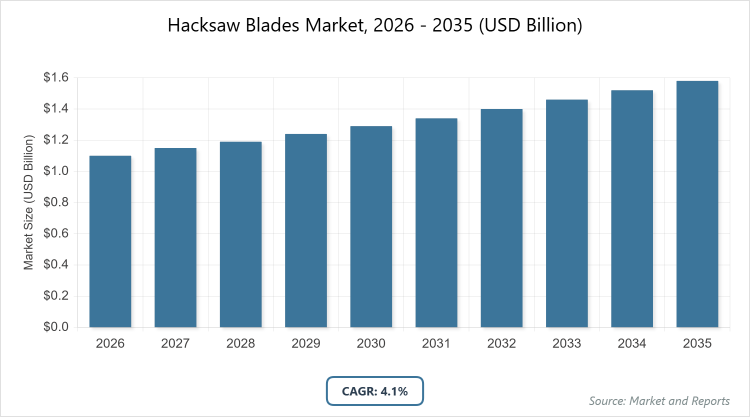
According to MarketnReports, the global Hacksaw Blades market size was estimated at USD 1.1 billion in 2025 and is expected to reach USD 1.6 billion by 2035, growing at a CAGR of 4.1% from 2026 to 2035. Hacksaw Blades Market is driven by rising industrialization, infrastructure development, and increasing demand for affordable, durable manual cutting tools across manufacturing, construction, and DIY sectors.
Key Insights
- The global Hacksaw Blades market is projected to grow from USD 1.1 billion in 2025 to USD 1.6 billion by 2035.
- The market is expected to register a CAGR of 4.1% during the forecast period 2026-2035.
- The market is driven by increasing industrialization, infrastructure investments, and the popularity of manual tools in emerging economies.
- Bi-metal dominates the type segment with approximately 45-50% share due to its superior flexibility, heat resistance, and longevity when cutting tough materials, reducing replacement frequency and enhancing efficiency.
- Metal Cutting dominates the application segment with over 70% share as hacksaw blades are primarily engineered for precise metal fabrication and machining tasks across industries.
- Industrial end-users dominate the end-user segment with around 50% share owing to high-volume usage in manufacturing and maintenance operations requiring reliable, durable tools.
- Asia Pacific dominates the regional segment with over 40% share driven by rapid manufacturing expansion, urbanization, and low-cost production in countries like China and India.
Industry Overview
The hacksaw blades market comprises the production, distribution, and sales of thin, serrated metal blades designed primarily for use in manual hacksaw frames to cut through metals, plastics, wood, and other materials. These blades are fundamental hand tools in metalworking, fabrication, maintenance, repair, and operations (MRO), as well as DIY and professional applications. The market features a range of blade types, including bi-metal for enhanced durability and heat resistance, high-speed steel for high-performance cutting, and carbon steel for economical general-purpose use. Ongoing innovations focus on tooth geometry, coatings, and material compositions to boost cutting efficiency, longevity, and versatility, making hacksaw blades indispensable in industries requiring precise, portable cutting solutions.
Market Dynamics
Growth Drivers
The hacksaw blades market experiences strong growth from rapid industrialization and infrastructure development in emerging economies, where manual cutting tools remain cost-effective and widely accessible. Advancements in blade materials, such as bi-metal and high-speed steel compositions, improve durability, heat resistance, and cutting precision, encouraging adoption in demanding applications like metal fabrication and automotive repair. Rising DIY culture, coupled with growth in construction and manufacturing sectors, further boosts demand for versatile, portable hand tools. Government initiatives supporting industrial growth and urbanization in regions like Asia Pacific amplify the need for reliable cutting solutions in workshops and on-site operations.
Restraints
Fluctuations in raw material prices, particularly for high-carbon steel, alloys, and coatings, pose significant challenges by increasing production costs and squeezing profit margins for manufacturers. Competition from powered alternatives like circular saws, reciprocating saws, and automated cutting machines limits growth in certain professional segments where speed and efficiency are prioritized. Supply chain disruptions, including steel availability and logistics issues, can delay production and raise costs, while variability in blade quality due to inconsistent standards affects user trust and adoption in regulated industries.
Opportunities
Emerging markets in Asia Pacific, Latin America, and Africa offer substantial expansion potential through rising manufacturing bases, infrastructure projects, and growing middle-class DIY activities. Innovations in blade technology, such as advanced coatings for corrosion resistance, variable pitch tooth designs, and eco-friendly materials, create opportunities to meet evolving demands for longer-lasting and sustainable products. Increasing focus on precision cutting and safety in industrial settings drives demand for high-performance blades, while partnerships and localization in developing regions can reduce costs and improve market penetration.
Challenges
Maintaining consistent quality and performance across diverse manufacturing processes remains challenging due to variations in steel grades, heat treatment, and tooth configurations, leading to performance inconsistencies. Harmonizing regulatory and safety standards across regions complicates global distribution and compliance efforts. Intense competition among established players and low-cost producers pressures pricing and innovation investments, while adapting to shifts toward mechanized cutting in mature markets requires continuous R&D to stay relevant.
Hacksaw Blades Market: Report Scope
| Report Attributes | Report Details |
| Report Name | Hacksaw Blades Market |
| Market Size 2025 | USD 1.1 Billion |
| Market Forecast 2035 | USD 1.6 Billion |
| Growth Rate | CAGR of 4.1% |
| Report Pages | 220 |
| Key Companies Covered |
Stanley Black & Decker, Lenox, Klein Tools, L.S. Starrett, Apex Tool Group, and Others |
| Segments Covered | By Type, By Application, By End-user, and By Region |
| Regions Covered | North America, Europe, Asia Pacific (APAC), Latin America, and The Middle East and Africa (MEA) |
| Base Year | 2025 |
| Historical Year | 2020 – 2024 |
| Forecast Year | 2026 – 2035 |
| Customization Scope | Avail customized purchase options to meet your exact research needs. |
Market Segmentation
The Hacksaw Blades market is segmented by type, application, end-user, and region.
Based on Type Segment. Bi-metal holds the dominant position in the type segment due to its combination of high-speed steel teeth and flexible alloy back, providing exceptional durability, heat resistance, and reduced breakage when cutting hard metals, which helps drive market growth by lowering replacement costs and improving productivity in industrial applications. High Speed Steel ranks as the second most dominant segment, valued for its hardness and ability to maintain sharpness at high temperatures, making it suitable for demanding precision tasks and supporting steady demand in professional metalworking.
Based on Application Segment. Metal Cutting is the most dominant application segment as hacksaw blades are fundamentally designed for precise cutting of metals like steel, aluminum, and alloys in fabrication, repair, and manufacturing, driving overall market expansion through essential usage in core industries. Wood Cutting and Plastic Cutting represent secondary applications, gaining traction in DIY and light commercial uses where versatility allows one tool to handle multiple materials, though they contribute less to total volume.
Based on End-user Segment. Industrial end-users dominate due to high-volume requirements in manufacturing, maintenance, and heavy fabrication operations where reliable, durable blades ensure operational efficiency and minimize downtime. Automotive end-users rank second, driven by needs for precise cutting in repair, assembly, and component fabrication, supporting market growth through consistent demand in vehicle production and aftermarket services.
Recent Developments
- In recent years, leading manufacturers have focused on launching enhanced bi-metal blades with improved tooth geometries and anti-corrosion coatings to extend blade life and cutting performance in harsh environments.
- Advancements in material technology have led to the introduction of high-speed steel blades with variable pitch designs, allowing smoother cuts across varying material thicknesses and reducing user fatigue in prolonged applications.
- Key players have expanded production capacities in Asia Pacific to capitalize on regional growth, while introducing eco-friendly and recyclable blade options to align with increasing sustainability demands in industrial sectors.
Regional Analysis
Asia Pacific to dominate the global market.
Asia Pacific leads the global hacksaw blades market due to rapid industrialization, massive infrastructure investments, and expanding manufacturing bases in countries like China and India, where affordable manual tools support small-scale workshops and large-scale production. China dominates the region as the largest producer and consumer, driven by its vast automotive, construction, and metal fabrication sectors.
North America maintains a strong position supported by mature manufacturing, automotive, and construction industries in the United States, where demand for high-quality, durable blades persists in professional and industrial settings despite competition from powered tools.
Europe benefits from established metalworking and automotive sectors in countries like Germany and the United Kingdom, with emphasis on precision and regulatory-compliant tools driving steady replacement demand and innovation adoption.
Latin America shows moderate growth fueled by construction and mining activities in Brazil and Mexico, though limited by economic fluctuations and reliance on imported high-end blades.
The Middle East and Africa exhibit emerging potential through infrastructure projects and oil & gas maintenance in countries like Saudi Arabia and South Africa, with gradual adoption of advanced blades as industrialization progresses.
Key Market Players and Strategies
- Stanley Black & Decker maintains a leading position through extensive product portfolios, global distribution networks, and focus on innovation in durable, high-performance blades for professional users.
- Lenox emphasizes advanced bi-metal technology and precision engineering, with strategies centered on continuous R&D to deliver longer-lasting blades and targeted marketing to industrial and construction sectors.
- Klein Tools prioritizes quality and reliability for professional trades, employing strategies of ergonomic design improvements and strong branding within electrical, plumbing, and maintenance industries.
- L.S. Starrett focuses on precision manufacturing and high-quality materials, with strategies involving product diversification and strong presence in metalworking and fabrication markets.
- Apex Tool Group leverages a broad brand portfolio and global reach, with strategies including acquisitions, cost-competitive offerings, and expansion in emerging markets.
Market Trends
- Growing preference for bi-metal blades due to superior durability and versatility over traditional carbon steel options.
- Increasing adoption of advanced coatings and tooth designs to enhance cutting efficiency and blade longevity.
- Rising demand in DIY and residential sectors driven by home improvement projects and e-commerce accessibility.
- Shift toward sustainable and recyclable materials in response to environmental concerns.
- Expansion of online sales channels for easy access to specialized and replacement blades.
Market Segments and their Subsegments Covered in the Report
By Type
- Bi-metal
- High Speed Steel
- Carbon Steel
- Others
By Application
- Metal Cutting
- Wood Cutting
- Plastic Cutting
- Others
By End-user
- Industrial
- Automotive
- Construction
- DIY/Residential
- Others
By Region
- North America
- U.S.
- Canada
- Europe
- UK
- Germany
- France
- Rest of Europe
- Asia Pacific
- China
- India
- Japan
- Rest of Asia Pacific
- Latin America
- Brazil
- Mexico
- Rest of Latin America
- Middle East & Africa
- UAE
- South Africa
- Rest of Middle East & Africa
Frequently Asked Questions
Hacksaw blades are thin, serrated metal strips with teeth along one edge, designed to fit into hacksaw frames for manually cutting materials like metal, plastic, and wood, serving as essential tools in industrial, professional, and DIY applications.
Key factors include continued industrialization in emerging economies, infrastructure development, advancements in blade materials and designs, growth in construction and automotive sectors, and sustained demand for affordable manual cutting tools alongside DIY trends.
The market is projected to grow from USD 1.1 billion in 2025 to USD 1.6 billion by 2035, reflecting steady expansion driven by industrial and construction demand.
The market is expected to grow at a CAGR of 4.1% during the forecast period 2026-2035.
Asia Pacific will contribute notably due to its rapid manufacturing growth, infrastructure projects, and high demand in China and India.
Major players include Stanley Black & Decker, Lenox, Klein Tools, L.S. Starrett, and Apex Tool Group, through innovation, quality focus, and global market presence.
The report provides comprehensive analysis of market size, growth trends, segmentation, key drivers and restraints, competitive landscape, regional insights, and forecasts to support strategic decision-making.
The value chain includes raw material sourcing (steel and alloys), manufacturing (blade cutting, tooth setting, heat treatment, coating), distribution through wholesalers and retailers, and end-use in industrial, professional, and DIY applications.
Consumers increasingly prefer durable bi-metal blades with advanced features like corrosion-resistant coatings and ergonomic designs, alongside a shift toward sustainable materials and online purchasing for convenience.
Regulatory factors include safety standards for industrial tools and quality compliance, while environmental factors involve demand for recyclable materials and reduced waste from longer-lasting blades, influencing manufacturing practices and product development.