
Gut Health Market Size, Share and Trends 2026 to 2035
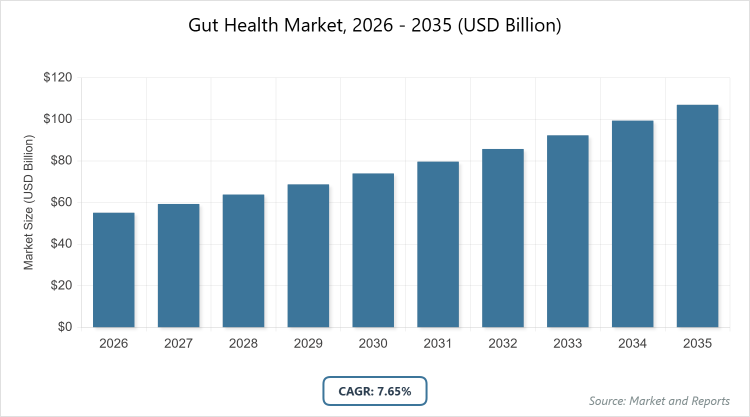
According to MarketnReports, the global Gut Health market size was estimated at USD 55.12 billion in 2025 and is expected to reach USD 115.21 billion by 2035, growing at a CAGR of 7.65% from 2026 to 2035. Gut Health Market is driven by increasing consumer awareness about the importance of digestive health.
What are the Key Insights of the Gut Health Market?
- The global Gut Health market was valued at USD 55.12 billion in 2025 and is projected to reach USD 115.21 billion by 2035.
- The market is expected to grow at a CAGR of 7.65% during the forecast period from 2026 to 2035.
- The Gut Health market is driven by rising awareness of gut microbiome importance, increasing prevalence of digestive disorders, and growing demand for functional foods and supplements.
- In the product type segment, Probiotics dominate with a 55% share due to their direct role in introducing beneficial bacteria to the gut, enhancing microbial balance and overall digestive function.
- In the application segment, Digestive Health dominates with a 45% share as it addresses core issues like IBS and constipation, driving consumer demand for targeted solutions.
- In the end user segment, Adults dominate with a 60% share owing to higher incidence of lifestyle-related gut issues and greater purchasing power for health products.
- North America holds the largest regional share at 35% because of advanced healthcare infrastructure, high consumer awareness, and strong presence of key market players.
What is the Industry Overview of the Gut Health Market?
The Gut Health market encompasses products and solutions aimed at maintaining and improving the digestive system’s functionality, primarily through supporting the gut microbiome. This market includes a wide range of items such as supplements, functional foods, and beverages that promote beneficial bacteria, reduce inflammation, and enhance nutrient absorption. Market definition refers to the industry focused on probiotics, prebiotics, and related products designed to prevent or alleviate gastrointestinal disorders, boost immunity, and contribute to overall wellness by optimizing gut flora balance.
What are the Market Dynamics of the Gut Health Market?
Growth Drivers
The primary growth drivers in the Gut Health market include escalating consumer awareness regarding the gut-brain axis and its impact on mental health, coupled with a surge in lifestyle-related digestive issues such as irritable bowel syndrome and bloating due to poor dietary habits. Additionally, advancements in microbiome research have led to innovative product formulations, while the integration of gut health ingredients into everyday foods and beverages has expanded market accessibility. The rise of e-commerce platforms has further facilitated easy access to these products, boosting sales globally.
Restraints
Key restraints affecting the Gut Health market involve stringent regulatory frameworks that require extensive clinical evidence for health claims, which can delay product launches and increase development costs for manufacturers. Moreover, the high price point of premium gut health supplements may limit adoption in price-sensitive emerging markets, where consumers prioritize affordability over specialized health benefits. Concerns over product efficacy and potential side effects, such as gastrointestinal discomfort from overuse, also hinder widespread consumer trust and market penetration.
Opportunities
Opportunities in the Gut Health market are abundant, particularly in the realm of personalized nutrition driven by advancements in genetic testing and AI, allowing for tailored probiotic strains that cater to individual microbiome needs. Expansion into untapped regions like Asia-Pacific and Latin America presents significant potential due to growing middle-class populations and increasing health consciousness. Furthermore, collaborations between food tech companies and research institutions could lead to novel synbiotic products, opening new revenue streams in functional beverages and snacks.
Challenges
Challenges facing the Gut Health market include intense competition from generic supplements and counterfeit products, which erode brand loyalty and market share for established players. Supply chain disruptions, especially for sourcing rare bacterial strains or natural prebiotic fibers, can lead to production delays and increased costs. Additionally, educating consumers on the science behind gut health remains a hurdle, as misconceptions about quick fixes versus long-term benefits may slow adoption rates in less informed demographics.
Gut Health Market: Report Scope
| Report Attributes | Report Details |
| Report Name | Gut Health Market |
| Market Size 2025 | USD 55.12 Billion |
| Market Forecast 2035 | USD 115.21 Billion |
| Growth Rate | CAGR of 7.65% |
| Report Pages | 216 |
| Key Companies Covered | Danone, Nestle, Yakult Honsha, Procter & Gamble, Unilever, General Mills, Abbott Laboratories, Kerry Group, and Others |
| Segments Covered | By Product Type, By Application, By End User, and By Region |
| Regions Covered | North America, Europe, Asia Pacific (APAC), Latin America, and The Middle East and Africa (MEA) |
| Base Year | 2025 |
| Historical Year | 2020 – 2024 |
| Forecast Year | 2026 – 2035 |
| Customization Scope | Avail customized purchase options to meet your exact research needs. |
What is the Market Segmentation of the Gut Health Market?
The Gut Health market is segmented by type, application, end-user, and region.
Based on Product Type Segment, Probiotics emerge as the most dominant subsegment, commanding a significant market share due to their proven efficacy in restoring gut flora and preventing digestive ailments, which drives overall market growth by meeting consumer demands for natural health solutions; the second most dominant is Prebiotics, which supports probiotic growth and enhances nutrient absorption, contributing to market expansion through complementary use in functional foods and supplements.
Based on Application Segment, Digestive Health stands out as the most dominant, fueled by the rising incidence of gut disorders and its direct alignment with core market objectives, propelling growth via targeted therapies; Immune System follows as the second dominant, leveraging the gut’s role in immunity to attract health-conscious consumers and drive innovation in preventive products.
Based on End User Segment, Adults are the most dominant, driven by higher disposable incomes and prevalence of stress-induced gut issues, which accelerates market growth through volume sales; Elderly represent the second dominant, as aging populations seek solutions for weakened digestion, fostering demand for age-specific formulations and contributing to sustained market momentum.
What are the Recent Developments in the Gut Health Market?
- In 2025, Danone introduced a new line of plant-based probiotic yogurts enriched with prebiotics, aiming to cater to vegan consumers and expand its market reach in North America and Europe.
- Nestle announced a strategic partnership with a microbiome research firm in late 2025 to develop personalized gut health supplements using AI-driven formulations, enhancing product efficacy and consumer engagement.
- Yakult Honsha launched an innovative synbiotic beverage in Asia-Pacific markets in early 2026, focusing on immune support amid rising health concerns, which boosted its regional sales significantly.
What is the Regional Analysis of the Gut Health Market?
- North America to dominate the global market
North America leads the Gut Health market with a strong emphasis on preventive healthcare and high consumer spending on wellness products; the United States dominates this region due to its advanced research facilities, widespread availability of supplements, and growing awareness campaigns about microbiome health, contributing to robust market growth.
Europe follows closely, driven by stringent food safety regulations and a preference for organic products; Germany stands out as the dominating country here, owing to its innovative food industry and high demand for functional beverages that support digestive wellness.
Asia Pacific exhibits the fastest growth potential, fueled by urbanization and dietary shifts; China dominates this region with its massive population base, increasing adoption of Western health trends, and expanding e-commerce channels for gut health supplements.
Latin America is emerging steadily, supported by rising middle-class incomes; Brazil leads as the dominating country, thanks to its focus on natural remedies and growing export of fermented foods like kombucha.
Middle East and Africa shows nascent development, hindered by economic challenges but boosted by tourism-driven health trends; South Africa dominates, with its developing healthcare sector and increasing imports of probiotic products.
Who are the Key Market Players in the Gut Health Market?
- Danone employs strategies such as product innovation and acquisitions to strengthen its portfolio in probiotics and fermented dairy, focusing on sustainability to appeal to eco-conscious consumers.
- Nestle leverages R&D investments and global distribution networks to introduce gut-friendly cereals and beverages, emphasizing partnerships with health experts for credibility.
- Yakult Honsha prioritizes direct marketing and clinical studies to promote its signature probiotic drinks, expanding into new markets through localized production.
- Procter & Gamble utilizes branding and e-commerce integrations to market digestive supplements, targeting niche segments like women’s health.
- Unilever adopts a multi-brand approach with acquisitions in the wellness space, promoting plant-based gut health options aligned with consumer trends.
- General Mills focuses on incorporating prebiotics into everyday snacks, using data analytics for targeted advertising to drive sales growth.
- Abbott Laboratories emphasizes pharmaceutical-grade supplements with evidence-based claims, collaborating with healthcare providers for endorsements.
- Kerry Group specializes in ingredient solutions for gut health, offering B2B services to enhance product formulations across industries.
What are the Market Trends in the Gut Health Market?
- Increasing adoption of plant-based and vegan gut health products to align with sustainable lifestyles.
- Rise in personalized nutrition solutions using microbiome testing for customized supplements.
- Growing integration of gut health ingredients in beauty and skincare products for holistic wellness.
- Expansion of e-commerce and subscription models for convenient access to probiotics.
- Emphasis on clean-label and natural ingredients to build consumer trust.
- Surge in research linking gut health to mental well-being, driving new product categories.
- Adoption of advanced delivery systems like microencapsulation for better efficacy.
What Market Segments and their Subsegments are Covered in the Report?
By Product Type
- Probiotics
- Prebiotics
- Synbiotics
- Digestive Enzymes
- Fermented Foods
- Dietary Fibers
- Postbiotics
- Herbal Supplements
- Omega-3 Fatty Acids
- Vitamins
- Others
By Application
- Digestive Health
- Immune System
- Metabolism Management
- Energy Management
- Weight Management
- Mental Health
- Skin Health
- Inflammation Reduction
- Heart Health
- Bone Health
- Others
By End User
- Adults
- Children
- Elderly
- Athletes
- Pregnant Women
- Pets
- Livestock
- Hospitals
- Pharmacies
- Online Consumers
- Others
By Region
- North America
- U.S.
- Canada
- Europe
- UK
- Germany
- France
- Rest of Europe
- Asia Pacific
- China
- India
- Japan
- Rest of Asia Pacific
- Latin America
- Brazil
- Mexico
- Rest of Latin America
- Middle East & Africa
- UAE
- South Africa
- Rest of Middle East & Africa
Chapter 1. Preface
1.1 Report Description and Scope1.2 Research Scope1.3 Research Methodology1.3.1 Market Research Type1.3.2 Market Research MethodologyChapter 2. Executive Summary
2.1 Global Gut Health Market, (2026 - 2035) (USD Billion)2.2 Global Gut Health Market: SnapshotChapter 3. Global Gut Health Market - Industry Analysis
3.1 Gut Health Market: Market Dynamics3.2 Market Drivers3.2.1 The gut health market is driven by rising awareness of the gut-brain connection, increasing digestive disorders, microbiome research innovations, functional food integration, and global e-commerce accessibility.3.3 Market Restraints3.3.1 The gut health market is restrained by strict regulations, high product costs, limited affordability in emerging markets, and consumer concerns over efficacy and side effects.3.4 Market Opportunities3.4.1 The gut health market offers opportunities through personalized nutrition, AI and genetic testing, expansion in emerging regions, and innovation in synbiotic foods, beverages, and snacks.3.5 Market Challenges3.5.1 The gut health market faces challenges from counterfeit products, supply chain disruptions, intense competition, and the need for stronger consumer education on long-term gut health benefits.3.6 Porter’s Five Forces Analysis3.7 Market Attractiveness Analysis3.7.1 Market Attractiveness Analysis By Product Type3.7.2 Market Attractiveness Analysis By Application3.7.3 Market Attractiveness Analysis By End UserChapter 4. Global Gut Health Market- Competitive Landscape
4.1 Company Market Share Analysis4.1.1 Global Gut Health Market: Company Market Share, 20254.2 Strategic Development4.2.1 Acquisitions & mergers4.2.2 New Product launches4.2.3 Agreements, partnerships, collaborations, and joint ventures4.2.4 Research and development and regional expansion4.3 Price Trend AnalysisChapter 5. Global Gut Health Market - Product Type Analysis
5.1 Global Gut Health Market Overview: Product Type5.1.1 Global Gut Health Market share, By Product Type, 2025 and 20355.2 Probiotics5.2.1 Global Gut Health Market by Probiotics, 2026 - 2035 (USD Billion)5.3 Prebiotics5.3.1 Global Gut Health Market by Prebiotics, 2026 - 2035 (USD Billion)5.4 Synbiotics5.4.1 Global Gut Health Market by Synbiotics, 2026 - 2035 (USD Billion)5.5 Digestive Enzymes5.5.1 Global Gut Health Market by Digestive Enzymes, 2026 - 2035 (USD Billion)5.6 Fermented Foods5.6.1 Global Gut Health Market by Fermented Foods, 2026 - 2035 (USD Billion)5.7 Dietary Fibers5.7.1 Global Gut Health Market by Dietary Fibers, 2026 - 2035 (USD Billion)5.8 Postbiotics5.8.1 Global Gut Health Market by Postbiotics, 2026 - 2035 (USD Billion)5.9 Herbal Supplements5.9.1 Global Gut Health Market by Herbal Supplements, 2026 - 2035 (USD Billion)5.10 Omega-3 Fatty Acids5.10.1 Global Gut Health Market by Omega-3 Fatty Acids, 2026 - 2035 (USD Billion)5.11 Vitamins5.11.1 Global Gut Health Market by Vitamins, 2026 - 2035 (USD Billion)Chapter 6. Global Gut Health Market - Application Analysis
6.1 Global Gut Health Market Overview: Application6.1.1 Global Gut Health Market Share, By Application, 2025 and 20356.2 Digestive Health6.2.1 Global Gut Health Market by Digestive Health, 2026 - 2035 (USD Billion)6.3 Immune System6.3.1 Global Gut Health Market by Immune System, 2026 - 2035 (USD Billion)6.4 Metabolism Management6.4.1 Global Gut Health Market by Metabolism Management, 2026 - 2035 (USD Billion)6.5 Energy Management6.5.1 Global Gut Health Market by Energy Management, 2026 - 2035 (USD Billion)6.6 Weight Management6.6.1 Global Gut Health Market by Weight Management, 2026 - 2035 (USD Billion)6.7 Mental Health6.7.1 Global Gut Health Market by Mental Health, 2026 - 2035 (USD Billion)6.8 Skin Health6.8.1 Global Gut Health Market by Skin Health, 2026 - 2035 (USD Billion)6.9 Inflammation Reduction6.9.1 Global Gut Health Market by Inflammation Reduction, 2026 - 2035 (USD Billion)6.10 Heart Health6.10.1 Global Gut Health Market by Heart Health, 2026 - 2035 (USD Billion)6.11 Bone Health6.11.1 Global Gut Health Market by Bone Health, 2026 - 2035 (USD Billion)Chapter 7. Global Gut Health Market - End User Analysis
7.1 Global Gut Health Market Overview: End User7.1.1 Global Gut Health Market Share, By End User, 2025 and 20357.2 Adults7.2.1 Global Gut Health Market by Adults, 2026 - 2035 (USD Billion)7.3 Children7.3.1 Global Gut Health Market by Children, 2026 - 2035 (USD Billion)7.4 Elderly7.4.1 Global Gut Health Market by Elderly, 2026 - 2035 (USD Billion)7.5 Athletes7.5.1 Global Gut Health Market by Athletes, 2026 - 2035 (USD Billion)7.6 Pregnant Women7.6.1 Global Gut Health Market by Pregnant Women, 2026 - 2035 (USD Billion)7.7 Pets7.7.1 Global Gut Health Market by Pets, 2026 - 2035 (USD Billion)7.8 Livestock7.8.1 Global Gut Health Market by Livestock, 2026 - 2035 (USD Billion)7.9 Hospitals7.9.1 Global Gut Health Market by Hospitals, 2026 - 2035 (USD Billion)7.10 Pharmacies7.10.1 Global Gut Health Market by Pharmacies, 2026 - 2035 (USD Billion)7.11 Online Consumers7.11.1 Global Gut Health Market by Online Consumers, 2026 - 2035 (USD Billion)Chapter 8. Gut Health Market - Regional Analysis
8.1 Global Gut Health Market Regional Overview8.2 Global Gut Health Market Share, by Region, 2025 & 2035 (USD Billion)8.3 North America8.3.1 North America Gut Health Market, 2026 - 2035 (USD Billion)8.3.1.1 North America Gut Health Market, by Country, 2026 - 2035 (USD Billion)8.3.2 North America Gut Health Market, by Product Type, 2026 - 20358.3.2.1 North America Gut Health Market, by Product Type, 2026 - 2035 (USD Billion)8.3.3 North America Gut Health Market, by Application, 2026 - 20358.3.3.1 North America Gut Health Market, by Application, 2026 - 2035 (USD Billion)8.3.4 North America Gut Health Market, by End User, 2026 - 20358.3.4.1 North America Gut Health Market, by End User, 2026 - 2035 (USD Billion)8.4 Europe8.4.1 Europe Gut Health Market, 2026 - 2035 (USD Billion)8.4.1.1 Europe Gut Health Market, by Country, 2026 - 2035 (USD Billion)8.4.2 Europe Gut Health Market, by Product Type, 2026 - 20358.4.2.1 Europe Gut Health Market, by Product Type, 2026 - 2035 (USD Billion)8.4.3 Europe Gut Health Market, by Application, 2026 - 20358.4.3.1 Europe Gut Health Market, by Application, 2026 - 2035 (USD Billion)8.4.4 Europe Gut Health Market, by End User, 2026 - 20358.4.4.1 Europe Gut Health Market, by End User, 2026 - 2035 (USD Billion)8.5 Asia Pacific8.5.1 Asia Pacific Gut Health Market, 2026 - 2035 (USD Billion)8.5.1.1 Asia Pacific Gut Health Market, by Country, 2026 - 2035 (USD Billion)8.5.2 Asia Pacific Gut Health Market, by Product Type, 2026 - 20358.5.2.1 Asia Pacific Gut Health Market, by Product Type, 2026 - 2035 (USD Billion)8.5.3 Asia Pacific Gut Health Market, by Application, 2026 - 20358.5.3.1 Asia Pacific Gut Health Market, by Application, 2026 - 2035 (USD Billion)8.5.4 Asia Pacific Gut Health Market, by End User, 2026 - 20358.5.4.1 Asia Pacific Gut Health Market, by End User, 2026 - 2035 (USD Billion)8.6 Latin America8.6.1 Latin America Gut Health Market, 2026 - 2035 (USD Billion)8.6.1.1 Latin America Gut Health Market, by Country, 2026 - 2035 (USD Billion)8.6.2 Latin America Gut Health Market, by Product Type, 2026 - 20358.6.2.1 Latin America Gut Health Market, by Product Type, 2026 - 2035 (USD Billion)8.6.3 Latin America Gut Health Market, by Application, 2026 - 20358.6.3.1 Latin America Gut Health Market, by Application, 2026 - 2035 (USD Billion)8.6.4 Latin America Gut Health Market, by End User, 2026 - 20358.6.4.1 Latin America Gut Health Market, by End User, 2026 - 2035 (USD Billion)8.7 The Middle-East and Africa8.7.1 The Middle-East and Africa Gut Health Market, 2026 - 2035 (USD Billion)8.7.1.1 The Middle-East and Africa Gut Health Market, by Country, 2026 - 2035 (USD Billion)8.7.2 The Middle-East and Africa Gut Health Market, by Product Type, 2026 - 20358.7.2.1 The Middle-East and Africa Gut Health Market, by Product Type, 2026 - 2035 (USD Billion)8.7.3 The Middle-East and Africa Gut Health Market, by Application, 2026 - 20358.7.3.1 The Middle-East and Africa Gut Health Market, by Application, 2026 - 2035 (USD Billion)8.7.4 The Middle-East and Africa Gut Health Market, by End User, 2026 - 20358.7.4.1 The Middle-East and Africa Gut Health Market, by End User, 2026 - 2035 (USD Billion)Chapter 9. Company Profiles
9.1 Danone9.1.1 Overview9.1.2 Financials9.1.3 Product Portfolio9.1.4 Business Strategy9.1.5 Recent Developments9.2 Nestle9.2.1 Overview9.2.2 Financials9.2.3 Product Portfolio9.2.4 Business Strategy9.2.5 Recent Developments9.3 Yakult Honsha9.3.1 Overview9.3.2 Financials9.3.3 Product Portfolio9.3.4 Business Strategy9.3.5 Recent Developments9.4 Procter & Gamble9.4.1 Overview9.4.2 Financials9.4.3 Product Portfolio9.4.4 Business Strategy9.4.5 Recent Developments9.5 Unilever9.5.1 Overview9.5.2 Financials9.5.3 Product Portfolio9.5.4 Business Strategy9.5.5 Recent Developments9.6 General Mills9.6.1 Overview9.6.2 Financials9.6.3 Product Portfolio9.6.4 Business Strategy9.6.5 Recent Developments9.7 Abbott Laboratories9.7.1 Overview9.7.2 Financials9.7.3 Product Portfolio9.7.4 Business Strategy9.7.5 Recent Developments9.8 Kerry Group9.8.1 Overview9.8.2 Financials9.8.3 Product Portfolio9.8.4 Business Strategy9.8.5 Recent Developments
Frequently Asked Questions
Gut Health refers to the optimal functioning of the digestive system, primarily through a balanced microbiome that supports digestion, immunity, and overall well-being.
Key factors include rising awareness of microbiome benefits, increasing digestive disorders, advancements in product innovation, and expanding e-commerce accessibility.
The market is projected to grow from approximately USD 55.12 billion in 2025 to USD 115.21 billion by 2035.
The CAGR is expected to be 7.65% during the forecast period.
North America will contribute notably, holding the largest share due to high consumer awareness and advanced infrastructure.
Major players include Danone, Nestlé, Yakult Honsha, Procter & Gamble, and Unilever.
The report provides comprehensive analysis, including market size, trends, segmentation, regional insights, key players, and forecasts.
Stages include raw material sourcing, manufacturing and formulation, packaging, distribution and logistics, retail and e-commerce, and end-consumer usage.
Trends are shifting towards personalized, plant-based products with clean labels, while consumers prefer evidence-based, convenient options for daily wellness.
Regulatory factors include strict health claim approvals by bodies like FDA, while environmental concerns drive demand for sustainable sourcing and eco-friendly packaging.