
Gluten Free Products Market Size, Share and Trends 2026 to 2035
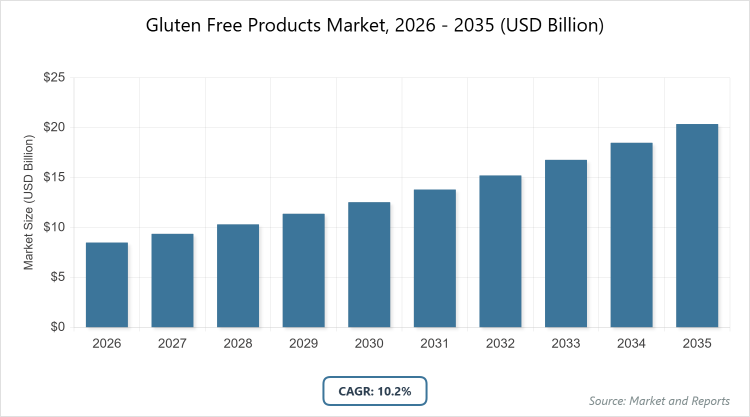
According to MarketnReports, the global Gluten Free Products Market size was estimated at USD 8.5 billion in 2025 and is expected to reach USD 21.6 billion by 2035, growing at a CAGR of 10.2% from 2026 to 2035. Gluten Free Products Market is driven by increasing prevalence of celiac disease and rising health consciousness among consumers.What are the Key Insights of Gluten Free Products Market?
- The global Gluten Free Products Market was valued at USD 8.5 billion in 2025 and is projected to reach USD 21.6 billion by 2035.
- The Gluten Free Products Market is anticipated to grow at a CAGR of 10.2% during the forecast period from 2026 to 2035.
- The Gluten Free Products Market is driven by rising celiac disease diagnoses, health trends, and product innovations in taste and variety.
- The bakery products segment dominates with a 30% share due to high demand for gluten-free bread and pastries as staple alternatives.
- The snacks & RTE products segment is the second most dominant, favored for convenience and on-the-go consumption.
- The supermarkets & hypermarkets segment dominates with a 31% share owing to wide product availability and consumer trust in retail chains.
- The online retail segment is the second most dominant, driven by e-commerce growth and discreet purchasing options.
- The households end-user segment dominates with a 60% share as families adopt gluten-free diets for health and allergy management.
- North America dominates the Gluten Free Products Market with a 52% share driven by high awareness, regulatory support, and product variety in the US.
What is the Industry Overview of Gluten Free Products Market?
The Gluten Free Products Market comprises food and beverage items formulated without gluten, a protein found in wheat, barley, and rye, catering to individuals with celiac disease, gluten sensitivity, or those adopting gluten-free lifestyles for health reasons. Market definition includes bakery products, snacks, dairy alternatives, and beverages made from gluten-free grains like rice, quinoa, and almond flour, emphasizing clean-label ingredients, nutritional fortification, and taste parity with traditional products to appeal to a broader consumer base beyond medical necessities, supporting sectors like retail, foodservice, and e-commerce where innovation addresses texture challenges and enhances accessibility for diverse dietary preferences.
What are the Market Dynamics of Gluten Free Products Market?
Growth Drivers
The increasing prevalence of celiac disease and gluten intolerance, affecting millions globally, propels demand for safe alternatives, with diagnostic advancements enabling more identifications and dietary shifts. Health and wellness trends, including clean eating and plant-based diets, expand the market beyond medical needs, as consumers seek nutrient-rich options fortified with vitamins and fibers. Product innovations, such as improved textures mimicking gluten-containing foods through alternative flours like almond and chickpea, enhance appeal, supported by celebrity endorsements and social media influence driving mainstream adoption.
Restraints
High production costs from specialized ingredients and manufacturing processes to avoid cross-contamination inflate prices, limiting accessibility in price-sensitive emerging markets. Limited shelf life and texture challenges in gluten-free items lead to consumer dissatisfaction and returns, hindering repeat purchases. Regulatory variations across regions complicate labeling and certification, increasing compliance burdens for international players.
Opportunities
Expanding e-commerce platforms offer direct-to-consumer models, enabling niche brands to reach global audiences with personalized subscriptions and variety packs. Emerging markets in Asia-Pacific present growth through rising middle-class incomes and urbanization, fostering demand for premium health foods. Partnerships with food tech for bioengineered gluten-free grains could reduce costs and improve quality, opening new segments like functional beverages.
Challenges
Supply chain disruptions for gluten-free grains amid climate variability affect raw material availability and prices, impacting production scales. Achieving taste parity with traditional products requires ongoing R&D, straining smaller manufacturers. Counterfeit or mislabeled items erode consumer trust, necessitating robust verification systems amid growing market fragmentation.
Gluten Free Products Market: Report Scope
| Report Attributes | Report Details |
| Report Name | Gluten Free Products Market |
| Market Size 2025 | USD 8.5 Billion |
| Market Forecast 2035 | USD 21.6 Billion |
| Growth Rate | CAGR of 10.2% |
| Report Pages | 220 |
| Key Companies Covered |
General Mills Inc., Conagra Brands Inc., Kellogg Co., The Kraft Heinz Company, The Hain Celestial Group, Dr. Schär, Barilla G. e R. Fratelli S.p.A, Ecotone, Siete Foods, Seitz Glutenfree, and Others. |
| Segments Covered | By Product Type, By Distribution Channel, By End-User, and By Region. |
| Regions Covered | North America, Europe, Asia Pacific (APAC), Latin America, and The Middle East and Africa (MEA) |
| Base Year | 2025 |
| Historical Year | 2020 - 2024 |
| Forecast Year | 2026 - 2035 |
| Customization Scope | Avail customized purchase options to meet your exact research needs. |
What is the Market Segmentation of Gluten Free Products Market?
The Gluten Free Products Market is segmented by product type, distribution channel, end-user, and region.By Product Type Segment: The bakery products segment dominates due to its role as everyday essentials like bread and cakes, driving the market by fulfilling staple needs for gluten-sensitive consumers and expanding through innovative recipes. The snacks & RTE products segment is the second most dominant, offering convenience for busy lifestyles, contributing to growth via portable, flavorful options that attract health-conscious buyers.
By Distribution Channel Segment: The supermarkets & hypermarkets segment leads as it provides one-stop shopping with dedicated aisles, propelling market expansion by enhancing visibility and trial purchases. The online retail segment follows as the second dominant, enabling global access and reviews, fostering growth through subscription models and targeted marketing.
By End-User Segment: The households segment holds dominance with family-wide adoption for daily meals, accelerating market demand by addressing allergies and preferences at home. The food service industry segment ranks second, driven by menu inclusions in restaurants, boosting the market via inclusive dining experiences.
What are the Recent Developments in Gluten Free Products Market?
- In December 2024, Revyve and Lallemand Bio-Ingredients Savory announced a strategic partnership for North American distribution, focusing on sustainable, gluten-free innovations.
- In October 2024, Dr. Schär launched Peanut Butter Blondie Bites, Chocolate Brownie Bites, and Mini Honeygrams as new gluten-free snacks.
- In June 2025, BFree introduced Dutch Crunch Rolls, a gluten-free, vegan bread fortified with vitamins.
- In May 2025, Kameda LT Foods launched Krispy Hopu, a gluten-free snack under the Kari Kari brand.
- In April 2025, Dr. Schär acquired Canyon Bakehouse, expanding its gluten-free bakery portfolio.
What is the Regional Analysis of Gluten Free Products Market?
North America to dominate the global market.North America leads the Gluten Free Products Market with a 52% share, primarily driven by the US through high celiac awareness, FDA labeling regulations, and widespread retail availability in supermarkets.
Europe follows with strong growth, led by Germany via EU gluten-free standards and health-focused consumers demanding premium bakery items.
Asia Pacific exhibits rapid expansion, dominated by China with rising middle-class adoption and e-commerce platforms for imported products.
Latin America shows steady progress, with Brazil emphasizing snacks amid increasing gluten sensitivity diagnoses.
The Middle East and Africa region grows gradually, led by the UAE through tourism-driven foodservice demands for inclusive options.
What are the Key Market Players and Strategies of Gluten Free Products Market?
General Mills Inc. focuses on portfolio expansion with brands like Chex, investing in R&D for taste improvements and acquiring startups for dairy alternatives.
Conagra Brands Inc. emphasizes clean-label snacks, partnering with retailers for dedicated sections and launching vegan-gluten-free lines.
Kellogg Co. pursues innovation in cereals, forming alliances for plant-based ingredients and targeting online sales growth.
The Kraft Heinz Company develops condiments and RTE meals, leveraging mergers for supply chain efficiency and sustainability certifications.
The Hain Celestial Group prioritizes organic gluten-free products, expanding in Europe through acquisitions and eco-friendly packaging.
Dr. Schär specializes in bakery acquisitions like Canyon Bakehouse, investing in allergen-free facilities for global exports.
Barilla G. e R. Fratelli S.p.A innovates pasta alternatives, collaborating on nutritional enhancements for health-conscious markets.
Ecotone focuses on sustainable sourcing, launching fortified snacks and pursuing B-Corp status for brand loyalty.
Siete Foods targets ethnic-inspired snacks, emphasizing family-owned authenticity and e-commerce direct sales.
Seitz Glutenfree develops premium bakery items, partnering with foodservice for custom solutions and clean ingredients.
What are the Market Trends of Gluten Free Products Market?
- Increasing innovation in taste and texture to mimic gluten-containing foods.
- Rise in plant-based and vegan gluten-free combinations for broader appeal.
- Growth of online retail and subscription models for convenience.
- Emphasis on clean-label and organic certifications.
- Expansion of functional products with added nutrients.
- Adoption of sustainable packaging to reduce environmental impact.
- Integration of global flavors in snacks and meals.
- Focus on allergen-free manufacturing to avoid cross-contamination.
- Surge in foodservice menus offering gluten-free options.
- Use of alternative grains like quinoa and teff for diversity.
What are the Market Segments and their Subsegment Covered in the Gluten Free Products Market Report?
By Product Type- Bakery Products
- Snacks & RTE Products
- Pasta & Pizza
- Dairy Alternatives
- Condiments & Sauces
- Meat Alternatives
- Cereals & Grains
- Desserts & Ice Creams
- Beverages
- Supplements
- Others
- Supermarkets & Hypermarkets
- Convenience Stores
- Online Retail
- Specialty Stores
- Drugstores & Pharmacies
- Health Food Stores
- Club Stores
- Independent Retailers
- Foodservice Outlets
- Direct Sales
- Others
- Households
- Food Service Industry
- Healthcare Facilities
- Educational Institutions
- Corporate Offices
- Hospitality Sector
- Retail Consumers
- Celiac Patients
- Health-Conscious Individuals
- Athletes
- Others
By Region
- North America
- U.S.
- Canada
- Europe
- UK
- Germany
- France
- Rest of Europe
- Asia Pacific
- China
- India
- Japan
- Rest of Asia Pacific
- Latin America
- Brazil
- Mexico
- Rest of Latin America
- Middle East & Africa
- UAE
- South Africa
- Rest of Middle East & Africa
Frequently Asked Questions
Gluten Free Products Market involves foods and beverages without gluten, catering to health and dietary needs.
Celiac prevalence, health trends, and product innovations will drive growth.
The market is projected to reach USD 21.6 billion by 2035.
The CAGR is expected to be 10.2%.
North America will contribute notably due to high awareness and regulations.
Major players include General Mills Inc., Conagra Brands Inc., and Dr. Schär.
The report offers analysis, forecasts, segments, trends, and strategies.
Stages include ingredient sourcing, formulation, manufacturing, packaging, and distribution.
Trends favor innovative, sustainable products, with preferences shifting to taste parity and nutrition.
Labeling regulations and sustainability mandates influence product development.