
GLP-1 Receptor Agonist Market Size, Share and Trends 2026 to 2035
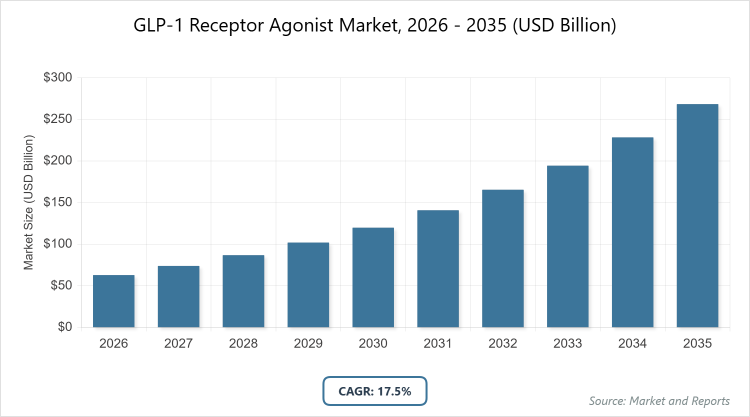
According to MarketnReports, the global GLP-1 Receptor Agonist Market size was estimated at USD 62.86 billion in 2025 and is expected to reach USD 315.33 billion by 2035, growing at a CAGR of 17.5% from 2026 to 2035. GLP-1 Receptor Agonist Market is driven by the rising prevalence of type 2 diabetes and obesity globally.
What are the Key Insights into the GLP-1 Receptor Agonist Market?
- The global GLP-1 receptor agonist market size was valued at USD 62.86 billion in 2025 and is projected to reach USD 315.33 billion by 2035.
- The market is expected to grow at a CAGR of 17.5% during the forecast period from 2026 to 2035.
- The market is driven by increasing prevalence of type 2 diabetes and obesity, advancements in drug formulations, and expanding indications for cardiovascular benefits.
- In the drug segment, semaglutide dominates with a 58% share due to its superior efficacy in weight loss and glycemic control, supported by popular brands like Ozempic and Wegovy.
- In the application segment, type 2 diabetes mellitus dominates with a 62% share because of the high global incidence and proven effectiveness of GLP-1 agonists in managing the condition.
- In the route of administration segment, parenteral dominates with a 80% share owing to established injectable formulations offering sustained release and better bioavailability.
- North America dominates the regional market with a 76% share, driven by high obesity rates, advanced healthcare infrastructure, and strong presence of key pharmaceutical companies.
What is the Industry Overview of the GLP-1 Receptor Agonist Market?
The GLP-1 receptor agonist market comprises pharmaceutical drugs that mimic the action of the glucagon-like peptide-1 hormone, enhancing insulin secretion, suppressing glucagon release, and promoting satiety to manage blood glucose levels and support weight loss. This market focuses on treatments primarily for type 2 diabetes and obesity, with expanding applications in cardiovascular risk reduction and other metabolic disorders. Market definition involves injectable and oral formulations that target GLP-1 receptors to improve glycemic control and metabolic health, addressing the growing global burden of chronic conditions through innovative therapies that offer dual benefits in glucose management and weight reduction.
What are the Market Dynamics in the GLP-1 Receptor Agonist Market?
Growth Drivers
The growth drivers in the GLP-1 receptor agonist market are significantly influenced by the escalating global prevalence of type 2 diabetes and obesity, which necessitate effective therapeutic interventions that not only control blood sugar but also aid in substantial weight management, thereby increasing demand for these dual-action drugs. Regulatory approvals for expanded indications, such as cardiovascular risk reduction, have broadened the market scope, encouraging healthcare providers to prescribe GLP-1 agonists more frequently due to their multifaceted benefits supported by robust clinical evidence from trials like LEADER and SUSTAIN. Innovations in drug delivery, including once-weekly injectables and oral formulations, enhance patient compliance and convenience, reducing barriers to adherence and driving higher adoption rates. Additionally, strategic investments by pharmaceutical giants in R&D and manufacturing capacity expansions address supply shortages, ensuring sustained market growth amid rising patient awareness and healthcare spending on chronic disease management.
Restraints
Restraints in the GLP-1 receptor agonist market include the high cost of these therapies, which limits accessibility in low- and middle-income countries and even in developed markets where insurance coverage may be inadequate, leading to out-of-pocket expenses that deter widespread adoption. Supply chain disruptions and manufacturing challenges have resulted in global shortages, as seen with popular drugs like semaglutide, frustrating patients and providers while slowing market penetration. Gastrointestinal side effects, such as nausea and vomiting, associated with these medications can lead to high discontinuation rates, impacting long-term usage and overall market growth. Furthermore, patent expirations and the emergence of biosimilars pose threats to market leaders, potentially eroding profit margins through increased competition and price pressures.
Opportunities
Opportunities in the GLP-1 receptor agonist market are emerging from the exploration of new therapeutic indications beyond diabetes and obesity, such as non-alcoholic steatohepatitis and neurodegenerative diseases, which could significantly expand the addressable patient population and drive revenue diversification. The development of next-generation formulations, including oral and combination therapies with other incretin mimetics like GIP agonists, offers potential for improved efficacy and reduced side effects, attracting investment and fostering innovation. Growing healthcare infrastructure in emerging markets like Asia-Pacific presents untapped potential, where rising diabetes prevalence and increasing disposable incomes could boost demand through targeted marketing and partnerships. Moreover, collaborations between pharmaceutical companies and digital health platforms for personalized medicine and adherence monitoring can enhance patient outcomes, creating value-added services that differentiate products in a competitive landscape.
Challenges
Challenges in the GLP-1 receptor agonist market stem from intense competition among key players, leading to pricing pressures and the need for continuous innovation to maintain market share, which strains R&D resources and timelines. Regulatory hurdles and stringent approval processes for new indications or formulations can delay product launches, hindering timely market entry and revenue generation. Patient adherence remains a concern due to injection-related discomfort and side effects, necessitating education and support programs that add to operational costs. Additionally, geopolitical tensions and supply chain vulnerabilities expose the market to risks of disruptions, affecting global distribution and availability of these critical therapies.
GLP-1 Receptor Agonist Market: Report Scope
| Report Attributes | Report Details |
| Report Name | GLP-1 Receptor Agonist Market |
| Market Size 2025 | USD 62.86 Billion |
| Market Forecast 2035 | USD 315.33 Billion |
| Growth Rate | CAGR of 17.5% |
| Report Pages | 220 |
| Key Companies Covered |
Novo Nordisk A/S, Eli Lilly and Company, Sanofi, AstraZeneca, Boehringer Ingelheim, and Others. |
| Segments Covered | By Drug, By Application, By Route of Administration, and By Region. |
| Regions Covered | North America, Europe, Asia Pacific (APAC), Latin America, and The Middle East and Africa (MEA) |
| Base Year | 2025 |
| Historical Year | 2020 - 2024 |
| Forecast Year | 2026 - 2035 |
| Customization Scope | Avail customized purchase options to meet your exact research needs. |
How is the Market Segmentation Structured in the GLP-1 Receptor Agonist Market?
The GLP-1 Receptor Agonist Market is segmented by drug, application, route of administration, and region.
By Drug Segment, the market is divided into various categories where semaglutide emerges as the most dominant subsegment, followed by tirzepatide as the second most dominant. Semaglutide's dominance is due to its proven efficacy in achieving significant weight loss and glycemic control, backed by strong clinical data and popular brands like Ozempic and Wegovy; this drives the market by addressing the dual needs of diabetes management and obesity treatment, expanding patient access and boosting overall adoption. Tirzepatide, the second dominant, offers superior dual GLP-1/GIP agonism for enhanced outcomes, contributing to market growth through innovative mechanisms that improve metabolic health and attract patients seeking advanced therapies.
By Application Segment, type 2 diabetes mellitus stands out as the most dominant subsegment, with obesity as the second most dominant. Type 2 diabetes mellitus dominates because of the high global prevalence and the established role of GLP-1 agonists in improving insulin sensitivity and reducing cardiovascular risks; this segment drives the market by fulfilling critical needs in chronic disease management, supported by guidelines recommending these drugs as first-line therapies. Obesity, the second dominant, benefits from the weight-loss properties of GLP-1 agonists, propelling market expansion through new approvals and growing recognition of obesity as a treatable medical condition.
By Route of Administration Segment, parenteral is the most dominant subsegment, while oral ranks as the second most dominant. Parenteral dominates owing to its reliable bioavailability and sustained release formulations that ensure consistent therapeutic effects; this drives the market by providing effective long-term management options for patients, enhancing compliance in chronic conditions. Oral, as second dominant, gains traction for its convenience and non-invasive nature, contributing to growth by broadening accessibility and appealing to patients averse to injections.
What are the Recent Developments in the GLP-1 Receptor Agonist Market?
- In August 2025, Novo Nordisk announced FDA approval of Wegovy as the first GLP-1 receptor agonist for adults with Metabolic Dysfunction-associated Steatohepatitis (MASH) with moderate to advanced fibrosis, excluding cirrhosis, alongside diet and exercise.
- In June 2025, MBX Biosciences submitted an IND application to the FDA for MBX 4291, a long-acting GLP-1/GIP receptor co-agonist prodrug for obesity, receiving clearance in July.
- In April 2025, Meitheal Pharmaceuticals announced approval and launch of Liraglutide injection in the United States.
- In March 2025, Novo Nordisk expanded its GLP-1 manufacturing facilities in Denmark and the U.S. with a €2 billion investment to triple production capacity for Ozempic and Wegovy by 2027.
- In February 2025, Eli Lilly committed $5.3 billion to a manufacturing hub in Indiana to meet demand for Mounjaro and Zepbound.
What is the Regional Analysis of the GLP-1 Receptor Agonist Market?
North America to dominate the global market.
North America leads the GLP-1 receptor agonist market, supported by high prevalence of diabetes and obesity, advanced healthcare infrastructure, and favorable reimbursement policies that facilitate widespread adoption. The United States dominates within the region, driven by significant R&D investments, presence of major players like Eli Lilly, and regulatory approvals for expanded indications, which enhance market penetration and innovation in treatments.
Europe holds a substantial share in the GLP-1 receptor agonist market, propelled by universal healthcare systems and increasing awareness of metabolic disorders. Germany emerges as the dominating country, with strong pharmaceutical manufacturing and high diabetes rates, where companies like Sanofi focus on accessible therapies, contributing to growth through policy support and clinical advancements.
Asia Pacific is the fastest-growing region in the GLP-1 receptor agonist market, fueled by urbanization, dietary changes, and rising chronic disease burdens. China dominates, attributed to its large patient population and government initiatives for diabetes management, accelerating adoption of affordable generics and local innovations to address escalating health needs.
Latin America shows promising growth in the GLP-1 receptor agonist market, aided by improving healthcare access and awareness campaigns. Brazil is the dominating country, driven by public health programs targeting obesity and diabetes, utilizing partnerships for drug distribution to enhance treatment availability amid economic developments.
The Middle East and Africa region is emerging in the GLP-1 receptor agonist market, with opportunities from healthcare investments and rising lifestyle diseases. Saudi Arabia dominates, owing to Vision 2030 reforms emphasizing chronic disease management, employing imported therapies and local collaborations to tackle diabetes prevalence effectively.
Who are the Key Market Players in the GLP-1 Receptor Agonist Market?
Novo Nordisk A/S focuses on expanding manufacturing capacity and R&D for next-generation formulations, with strategies including acquisitions and partnerships to maintain leadership in semaglutide-based products like Ozempic and Wegovy.
Eli Lilly and Company emphasizes dual-agonist innovations like tirzepatide, pursuing growth through clinical trials for new indications and investments in supply chain enhancements to meet global demand.
Sanofi offers affordable options like lixisenatide, adopting strategies such as collaborations for combination therapies and market expansions in emerging regions to strengthen its portfolio.
AstraZeneca develops exenatide extended-release, with strategies involving regulatory approvals for cardiovascular benefits and digital health integrations for patient adherence.
Boehringer Ingelheim partners for novel molecules, focusing on biosimilars and oral formulations to capture market share through cost-effective alternatives.
What are the Market Trends Shaping the GLP-1 Receptor Agonist Market?
- Expansion into new indications like NASH and cardiovascular diseases beyond diabetes and obesity.
- Development of oral formulations to improve patient compliance over injectables.
- Increasing focus on combination therapies with GIP agonists for enhanced efficacy.
- Growing biosimilar competition following patent expirations on key drugs.
- Emphasis on real-world evidence and digital tools for personalized treatment monitoring.
What Market Segments and Their Subsegments are Covered in the GLP-1 Receptor Agonist Market Report?
By Drug- Semaglutide
- Liraglutide
- Dulaglutide
- Exenatide
- Lixisenatide
- Albiglutide
- Tirzepatide
- Others
- Type 2 Diabetes Mellitus
- Obesity
- Cardiovascular Risk Reduction
- Others
- Parenteral
- Oral
- Others
By Region
- North America
- U.S.
- Canada
- Europe
- UK
- Germany
- France
- Rest of Europe
- Asia Pacific
- China
- India
- Japan
- Rest of Asia Pacific
- Latin America
- Brazil
- Mexico
- Rest of Latin America
- Middle East & Africa
- UAE
- South Africa
- Rest of Middle East & Africa
Frequently Asked Questions
The GLP-1 receptor agonist market includes drugs that activate GLP-1 receptors to manage blood sugar and promote weight loss in conditions like diabetes and obesity.
Key factors include rising diabetes and obesity rates, innovative formulations, expanded indications, and increasing healthcare investments.
The market is projected to grow from approximately USD 62.86 billion in 2026 to USD 315.33 billion by 2035.
The CAGR is expected to be 17.5% during 2026-2035.
North America will contribute notably, holding around 76% of the market value due to high disease prevalence and infrastructure.
Major players include Novo Nordisk A/S, Eli Lilly and Company, Sanofi, AstraZeneca, and Boehringer Ingelheim.
The report offers comprehensive insights on size, trends, segmentation, regional analysis, key players, and forecasts to 2035.
Stages include R&D, clinical trials, manufacturing, distribution, and patient administration.
Trends shift towards oral and combination therapies, with preferences for convenient, effective options addressing multiple conditions.
Approvals for new indications and sustainability in manufacturing influence growth and innovation.