
Garbage Bags (Trash Bags) Market Size, Share and Trends 2026 to 2035
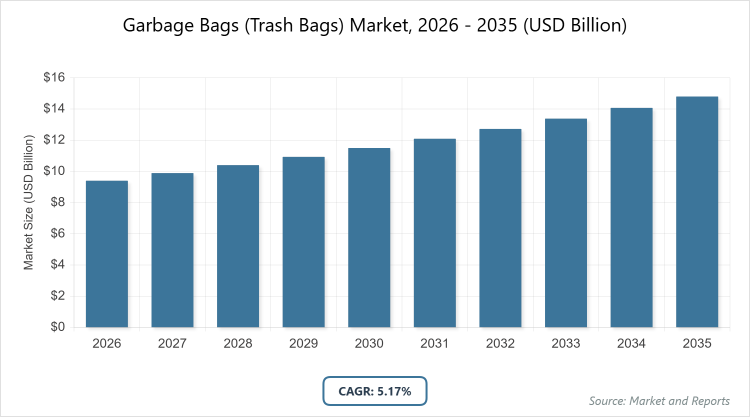
According to MarketReports, the global Garbage Bags (Trash Bags) market size was estimated at USD 9.4 billion in 2025 and is expected to reach USD 14.8 billion by 2035, growing at a CAGR of 5.17% from 2026 to 2035. The global garbage bags market is primarily driven by increasing urbanization and rising awareness regarding hygiene and effective waste management across residential and industrial sectors.
What are the Key Insights into the Garbage Bags (Trash Bags) Market?
- The global garbage bags market is projected to grow from approximately USD 9.4 billion in 2026 to USD 14.8 billion by 2035, reflecting a compound annual growth rate (CAGR) of around 5.17%.
- Among types, the drawstring segment dominates, offering user-friendly closure mechanisms that enhance convenience.
- In material segments, low-density polyethylene (LDPE) holds the leading position, valued for its flexibility and cost-effectiveness.
- By end-use, the residential category is the most prominent, driven by everyday household waste management needs.
- Asia Pacific emerges as the dominant region, contributing the largest market share due to rapid urbanization and population density.
What is the Garbage Bags (Trash Bags) Industry?
Industry Overview
The garbage bags, also known as trash bags, industry encompasses the manufacturing, distribution, and sale of flexible containers primarily used for the collection, storage, and disposal of waste materials in households, commercial establishments, and industrial settings. These bags are engineered for durability, leak resistance, and ease of use, often featuring closures like drawstrings or ties, and are made from various polymers or eco-friendly alternatives to handle solid, liquid, or hazardous refuse while minimizing odors and contamination.
Serving as an essential component of waste management systems, the market bridges consumer convenience with environmental sustainability, addressing needs from everyday household trash to large-scale municipal and industrial waste handling, and evolving through innovations that enhance strength, capacity, and biodegradability to align with global hygiene and pollution control standards.
What Drives the Garbage Bags (Trash Bags) Market?
Growth Drivers
The garbage bags market is driven by rapid urbanization and population growth, which escalates waste generation and necessitate efficient disposal solutions, coupled with heightened awareness of hygiene and sanitation post-global health crises, boosting demand for reliable, odor-controlling bags in residential and commercial sectors.
Stringent government regulations mandating waste segregation and reduction of plastic pollution propel the adoption of biodegradable and recyclable variants, while innovations in material science, such as antimicrobial coatings and enhanced durability, attract consumers seeking premium products. Additionally, the expansion of e-commerce and retail channels facilitates broader accessibility, further amplified by rising disposable incomes in emerging economies that enable shifts toward convenient, high-quality trash management options.
Restraints
Fluctuations in raw material prices, particularly for petroleum-based plastics like polyethylene, impose cost pressures on manufacturers, leading to higher product prices that can deter price-sensitive consumers in developing regions. Environmental concerns and regulatory bans on single-use plastics create barriers to traditional bag production, forcing companies to navigate compliance issues and invest in alternatives amid consumer backlash against non-degradable waste. Moreover, intense competition from reusable containers and waste reduction initiatives reduces overall demand, while supply chain disruptions from geopolitical events exacerbate availability and inflate logistics expenses.
Opportunities
The shift toward sustainable materials opens avenues for biodegradable and compostable garbage bags, driven by eco-conscious consumer preferences and corporate sustainability goals, allowing manufacturers to premiumize products and enter green markets. Emerging economies present untapped potential through infrastructure development and waste management programs, where localized production and partnerships can capture growing urban demand. Technological advancements, including smart bags with sensors for waste monitoring or scented variants for odor control, provide differentiation opportunities in competitive landscapes, further supported by online retail expansion for direct-to-consumer sales.
Challenges
Navigating diverse regulatory landscapes poses challenges, as varying global standards on plastic use and recycling require adaptive strategies that increase operational complexity and costs for international players. The high initial investment in R&D for eco-friendly alternatives, coupled with consumer skepticism about their performance compared to traditional plastics, hinders widespread adoption. Additionally, counterfeit products in unregulated markets erode brand trust, while environmental activism amplifies scrutiny on the industry’s carbon footprint, demanding continuous innovation to balance profitability with sustainability.
Garbage Bags (Trash Bags) Market: Report Scope
| Report Attributes | Report Details |
| Report Name | Garbage Bags (Trash Bags) Market |
| Market Size 2025 | USD 9.4 Billion |
| Market Forecast 2035 | USD 14.8 Billion |
| Growth Rate | CAGR of 5.17% |
| Report Pages | 195 |
| Key Companies Covered | Berry Global Group, Inc., Novolex Holdings, LLC, The Clorox Company (Glad), Reynolds Consumer Products, Poly-America, L.P., Inteplast Group, and International Plastics |
| Segments Covered | By Type, By Material, By End-Use, By Region |
| Regions Covered | North America, Europe, Asia Pacific (APAC), Latin America, The Middle East and Africa (MEA) |
| Base Year | 2025 |
| Historical Year | 2020 – 2024 |
| Forecast Year | 2026 – 2035 |
| Customization Scope | Avail customized purchase options to meet your exact research needs. |
How is the Garbage Bags (Trash Bags) Market Segmented?
The garbage bags (trash bags) market is segmented by type, material, end-use, and region.
By type, including drawstring, star sealed, flat seal, and others, with drawstring emerging as the most dominant due to its secure closure system that prevents leaks and simplifies tying, making it ideal for residential and commercial use where ease of handling is paramount; this dominance drives the market by appealing to convenience-oriented consumers and commanding higher margins through value-added features like scented options, while star sealed ranks as the second most dominant, excelling in strength and leak-proof design for heavy or wet waste, supporting market growth via industrial applications and cost efficiency in bulk packaging.
By material, the market divides into low-density polyethylene (LDPE), high-density polyethylene (HDPE), biodegradable, and others, where LDPE dominates owing to its superior flexibility, puncture resistance, and affordability, catering to high-volume household needs and enabling mass production; its prevalence propels market expansion by maintaining low costs and broad accessibility, whereas HDPE follows as the second dominant, prized for its rigidity and strength in larger capacities, contributing to growth in commercial sectors through durability and environmental compliance in recyclable forms.
By end-use, segments include residential, commercial, and industrial, with residential leading as it addresses daily waste disposal in homes, driven by urbanization and hygiene trends that increase per-capita consumption; this segment fuels overall market dynamics by generating consistent demand and fostering innovations like odor-neutralizing bags, while commercial secures second place, utilized in offices, retail, and hospitality for efficient waste handling, enhancing market resilience through bulk procurements and regulatory-driven sustainability shifts.
What are the Recent Developments in the Garbage Bags (Trash Bags) Market?
- In May 2024, Berry Global launched a new line of Colour Scents trash bags incorporating Microban antimicrobial technology, designed to inhibit bacterial growth and odors, targeting residential users and strengthening its position in the hygiene-focused segment amid growing consumer demand for sanitary waste solutions.
- In late 2025, Novolex announced the acquisition of a biodegradable materials startup, expanding its eco-friendly portfolio and enabling the introduction of compostable garbage bags for commercial applications, as part of a strategy to comply with tightening plastic regulations and capture the sustainable market share.
- In early 2026, The Clorox Company (Glad) partnered with recycling firms to roll out a take-back program for used bags, promoting circular economy practices and enhancing brand loyalty through environmental initiatives that address plastic waste concerns.
How Does Regional Performance Vary in the Garbage Bags (Trash Bags) Market?
- Asia Pacific to dominate the market
Asia Pacific leads the garbage bags market, propelled by explosive urban growth, massive population bases, and increasing waste volumes from industrialization; China dominates this region with its vast manufacturing capabilities, government-led waste management reforms, and high domestic consumption, fostering innovation in affordable, high-volume products that export globally and support local sustainability goals. The region’s emphasis on cost-effective plastics and emerging biodegradable trends further accelerates adoption, while countries like India contribute through rural-urban migration and hygiene campaigns.
North America exhibits strong performance in the garbage bags sector, supported by advanced waste infrastructure, stringent environmental policies, and high consumer spending on premium products; the United States stands out as the dominating country, leveraging widespread retail networks, insurance-linked hygiene standards, and innovations in scented and antimicrobial bags to drive residential and commercial demand. Canada complements this with its focus on recycling mandates, ensuring steady growth amid eco-conscious shifts.
Europe maintains a mature market for garbage bags, influenced by rigorous EU regulations on plastic reduction and circular economy principles; Germany emerges as the leading country, excelling in engineering sustainable alternatives and exporting high-quality biodegradable options, while comprehensive recycling systems and consumer preferences for eco-labels propel adoption across households and industries. The UK and France add momentum through urban waste initiatives and bans on single-use items.
Latin America shows emerging growth in the garbage bags market, driven by improving urban sanitation and middle-class expansion; Brazil predominates with its large population centers and investments in municipal waste programs, promoting affordable LDPE bags alongside biodegradable pilots to address environmental challenges. Mexico supports regional dynamics through trade agreements and industrial demand, with both countries benefiting from expanding awareness campaigns and private healthcare developments targeting mobility solutions.
The Middle East & Africa region represents a developing landscape for garbage bags, focused on oil-rich economies and tourism-driven hygiene needs; the United Arab Emirates leads, investing in modern waste facilities and luxury hospitality sectors that favor durable, imported products, while South Africa advances through policy reforms targeting plastic pollution in urban areas. Saudi Arabia and other Gulf nations contribute via infrastructure projects, though affordability remains a barrier in broader African sub-regions.
Who are the Key Market Players in the Garbage Bags (Trash Bags) Industry?
- Berry Global Group, Inc. focuses on sustainability through R&D in antimicrobial and biodegradable technologies, while pursuing acquisitions to expand its global footprint in eco-friendly segments.
- Novolex Holdings, LLC emphasizes mergers and partnerships to integrate sustainable materials, launching compostable lines and optimizing supply chains for cost efficiency in emerging markets.
- The Clorox Company (Glad) invests in branding and innovation, such as odor-control features, while collaborating on recycling programs to enhance environmental credentials and consumer loyalty.
- Reynolds Consumer Products leverages retail partnerships and product diversification, introducing drawstring variants with enhanced strength to capture residential market share.
- Poly-America, L.P. prioritizes cost-effective manufacturing and bulk distribution, focusing on HDPE bags for industrial applications to maintain competitive pricing.
- Inteplast Group adopts vertical integration strategies, expanding into biodegradable options and targeting commercial sectors through customized solutions.
- International Plastics concentrates on export-oriented growth, investing in quality certifications to penetrate regulated markets like Europe.
What are the Current Market Trends in Garbage Bags (Trash Bags)?
- Increasing adoption of biodegradable and compostable materials to meet regulatory and consumer demands for sustainability.
- Integration of antimicrobial and odor-neutralizing technologies for enhanced hygiene in residential and healthcare applications.
- Growth in drawstring and scented variants for user convenience and premium positioning.
- Expansion of e-commerce channels, enabling customized and bulk purchases.
- Focus on recycled content in bags to support circular economy initiatives.
- Rise in industrial-grade bags with higher capacity for waste management efficiency.
- Shift toward eco-labeling and transparent supply chains amid environmental activism.
What Market Segments are Covered in the Report?
By Type
- Drawstring
- Star Sealed
- Flat Seal
- Others
By Material
- Low-Density Polyethylene (LDPE)
- High-Density Polyethylene (HDPE)
- Biodegradable
- Others
By End-Use
- Residential
- Commercial
- Industrial
By Region
-
- North America
- U.S.
- Canada
- Europe
- UK
- Germany
- France
- Rest of Europe
- Asia Pacific
- China
- India
- Japan
- Rest of Asia Pacific
- Latin America
- Brazil
- Mexico
- Rest of Latin America
- Middle East & Africa
- UAE
- South Africa
- Rest of Middle East & Africa
- North America
Frequently Asked Questions
Garbage bags are flexible, disposable containers made from plastic or biodegradable materials, designed for collecting and disposing of waste to maintain hygiene and prevent leaks or odors.
Key factors include urbanization-driven waste increase, regulatory pushes for sustainable materials, technological innovations in product features, and expanding e-commerce accessibility.
The market is expected to grow from approximately USD 9.4 billion in 2026 to USD 14.8 billion by 2035, fueled by demand in emerging regions.
The compound annual growth rate (CAGR) is projected to be around 5.17% from 2026 to 2035, reflecting steady expansion.
Asia Pacific will contribute notably, holding the largest share due to population growth and urbanization.
Major players include Berry Global Group, Inc., Novolex Holdings, LLC, The Clorox Company (Glad), Reynolds Consumer Products, Poly-America, L.P., Inteplast Group, and International Plastics, driving growth via sustainability and innovation.
The report offers insights into market size, trends, segmentation, regional analysis, key players, and forecasts to guide strategic decisions.
Stages include raw material sourcing (polymers, additives), manufacturing and extrusion, distribution via wholesalers/retailers, end-user sales, and recycling/disposal.
Trends are moving toward eco-friendly, biodegradable options with features like antimicrobial protection, as consumers prioritize sustainability and convenience.
Regulations banning single-use plastics and promoting recycling increase costs but drive innovation in sustainable materials, while environmental concerns push for reduced carbon footprints.