
Gable Boxes Market Size, Share and Trends 2026 to 2035
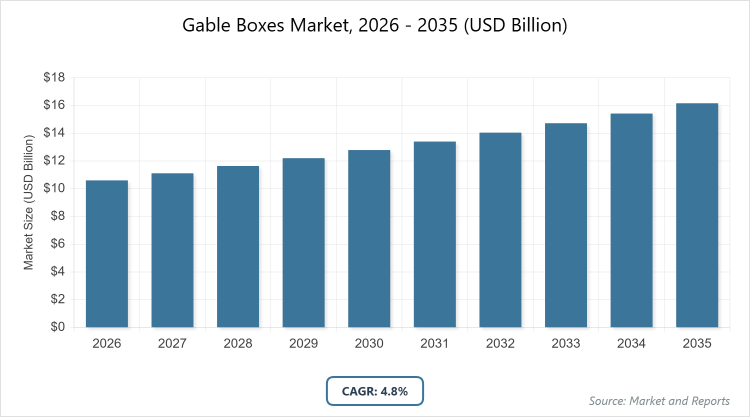
According to MarketnReports, the global Gable Boxes market size was estimated at USD 10.6 billion in 2025 and is expected to reach USD 17 billion by 2035, growing at a CAGR of 4.8% from 2026 to 2035. Gable Boxes Market is driven by increasing demand for sustainable, convenient, and visually appealing packaging solutions across food takeaway, retail, and e-commerce sectors.
Key Insights
- The global Gable Boxes market is projected to expand from USD 10.6 billion in 2025 to USD 17 billion by 2035.
- The market is expected to register a CAGR of 4.8% during the forecast period 2026-2035.
- The market is driven by growing preference for eco-friendly and customizable packaging, expansion of food takeaway services, and booming e-commerce activities.
- Paper Gable Boxes dominate the type segment with approximately 60% share due to their recyclability, cost-effectiveness, lightweight nature, and alignment with sustainability trends.
- Food & Beverages end-use segment dominates with over 45% share, primarily because of high demand for convenient takeaway and packaged food solutions in restaurants and delivery services.
- Asia Pacific region dominates with around 35% market share, fueled by rapid urbanization, rising disposable incomes, expanding food industry, and significant e-commerce growth in countries like China and India.
What is the Gable Boxes Market?
The Gable Boxes market refers to the global industry involved in the manufacturing, distribution, and utilization of gable-style packaging boxes, which feature a distinctive triangular or peaked top that forms a built-in handle for easy carrying. These boxes, typically constructed from paperboard, cardboard, or other foldable materials, provide a combination of functionality, aesthetic appeal, and portability. Gable boxes are versatile and widely adopted for packaging takeout food, gifts, confectionery, cosmetics, retail items, and promotional products, offering advantages such as easy assembly, customization potential, and eco-friendly options compared to traditional rigid packaging.
Market Dynamics
Growth Drivers
The Gable Boxes market experiences robust growth due to several key factors. Rising consumer preference for sustainable packaging has accelerated adoption of paper-based gable boxes, which are recyclable and biodegradable, aligning with global environmental regulations and corporate sustainability goals. The surge in food takeaway and delivery services, particularly post-pandemic, has increased demand for convenient carry-out packaging that maintains product freshness and offers branding opportunities. Additionally, the rapid expansion of e-commerce and online retail requires durable, attractive, and easy-to-handle packaging for shipping gifts, cosmetics, and confectionery items. Customization capabilities, such as printing and window features, further drive usage in retail and promotional applications.
Restraints
Despite positive growth, the market faces certain restraints. Fluctuations in raw material prices, particularly paperboard and pulp, can impact production costs and profitability for manufacturers. Competition from alternative packaging formats, such as flexible pouches, plastic bags, or rigid boxes, which may offer lower costs or better durability in specific uses, poses a challenge. Additionally, supply chain disruptions and varying recycling infrastructure across regions limit widespread adoption in some markets.
Opportunities
Significant opportunities exist in the shift toward fully biodegradable and compostable materials, which can open new avenues in eco-conscious markets. Emerging economies in Asia and Latin America present untapped potential due to increasing urbanization and retail modernization. Innovations in printing technologies and smart packaging integration provide branding and functionality enhancements, attracting premium segments like cosmetics and confectionery. The continued rise in online shopping and subscription boxes further creates demand for premium, customizable gable solutions.
Challenges
The market encounters challenges related to regulatory compliance, as stricter packaging waste laws and extended producer responsibility requirements demand continuous adaptation. Ensuring consistent quality across customized orders while maintaining cost efficiency remains difficult for smaller manufacturers. Environmental concerns over non-recycled materials and the need for improved recycling rates in developing regions also pose ongoing hurdles.
Gable Boxes Market: Report Scope
| Report Attributes | Report Details |
| Report Name | Gable Boxes Market |
| Market Size 2025 | USD 10.6 Billion |
| Market Forecast 2035 | USD 17 Billion |
| Growth Rate | CAGR of 4.8% |
| Report Pages | 220 |
| Key Companies Covered |
Smurfit Kappa Group, WestRock Company, DS Smith, International Paper Company, Mondi Group, and Others |
| Segments Covered | By Type, By Application, By End-Use, and By Region |
| Regions Covered | North America, Europe, Asia Pacific (APAC), Latin America, and The Middle East and Africa (MEA) |
| Base Year | 2025 |
| Historical Year | 2020 – 2024 |
| Forecast Year | 2026 – 2035 |
| Customization Scope | Avail customized purchase options to meet your exact research needs. |
Gable Boxes Market Segmentation
The Gable Boxes market is segmented by type, application, end-use, and region.
Based on Type Segment, Paper Gable Boxes dominate the market due to their superior sustainability profile, recyclability, and alignment with consumer and regulatory demands for eco-friendly solutions. These boxes are lightweight, cost-effective, and offer excellent printability for branding, driving their preference in food takeaway and retail applications. Windowed Gable Boxes are the second most dominant, as the transparent window allows product visibility, enhancing appeal for confectionery, gifts, and retail display while maintaining structural integrity and convenience.
Based on Application Segment, Food Takeaway Packaging leads as the most dominant application, supported by the global expansion of quick-service restaurants, food delivery platforms, and consumer preference for portable, hygienic packaging. This segment benefits from the handle design that facilitates easy carrying of hot or multiple items. Gift & Confectionery Packaging ranks as the second most dominant, driven by seasonal demand, premium branding opportunities, and aesthetic customization that elevates product presentation in retail and e-commerce channels.
Based on End-Use Segment, Food & Beverages represent the most dominant end-use, propelled by high-volume usage in restaurants, cafes, and delivery services where convenience, food safety, and branding are critical. Cosmetics & Personal Care emerges as the second most dominant, benefiting from the premium look and customization potential that help brands differentiate products in competitive retail and online markets.
Gable Boxes Market Recent Developments
- In 2025, Smurfit Kappa Group introduced a new line of fully recyclable paper gable boxes with enhanced barrier properties for food takeaway, aimed at reducing plastic usage in the sector.
- DS Smith announced a partnership in early 2025 with major e-commerce platforms to supply customized gable boxes featuring advanced printing and sustainable materials, targeting the growing online gift and retail segment.
- WestRock Company launched innovative windowed gable boxes in 2024-2025 with improved venting features for hot food applications, addressing freshness concerns in delivery services.
- International Paper Company invested in expanded production capacity for eco-friendly gable boxes in Asia Pacific in 2025, capitalizing on regional demand growth.
Gable Boxes Market Regional Analysis
Asia Pacific to dominate the global market.
Asia Pacific holds the leading position in the Gable Boxes market due to rapid industrialization, population growth, and increasing adoption of packaged food and e-commerce in countries like China and India. China dominates the region with its massive manufacturing base and high demand from food delivery and retail sectors, while India follows closely with rising urbanization and sustainability initiatives.
North America remains a strong market, led by the United States, where advanced retail branding, premium gable box usage in cosmetics and gifts, and well-established e-commerce drive consistent demand.
Europe shows steady growth, with countries like Germany and the United Kingdom emphasizing recyclable packaging regulations and premium applications in confectionery and personal care.
Latin America exhibits emerging potential, particularly in Brazil and Mexico, driven by expanding food service and retail modernization.
The Middle East and Africa region is growing gradually, with increasing adoption in urban areas for takeaway food and promotional packaging.
Key Market Players and Strategies
- Smurfit Kappa Group focuses on sustainable innovations and global expansion, emphasizing recyclable materials and partnerships with food brands to enhance market penetration.
- WestRock Company prioritizes customization and advanced printing technologies, targeting premium segments in retail and cosmetics while investing in eco-friendly production processes.
- DS Smith employs a strategy of collaboration with e-commerce and retail giants, offering tailored gable box solutions to support branding and sustainability goals.
- International Paper Company leverages its extensive supply chain and invests in capacity expansion in high-growth regions, focusing on cost-effective paper-based products.
- Mondi Group concentrates on circular economy principles, developing biodegradable options and expanding in emerging markets to capture rising demand.
Market Trends
- Increasing adoption of sustainable and recyclable paper-based gable boxes to meet environmental regulations and consumer preferences.
- Growing demand for windowed and custom-printed designs to enhance product visibility and brand appeal.
- Expansion of e-commerce driving need for durable, attractive carry packaging for gifts and retail items.
- Rising usage in food takeaway services due to convenience and hygiene benefits.
- Shift toward biodegradable materials and reduced plastic alternatives across applications.
Market Segments and their Subsegments Covered in the Report
By Type
- Paper Gable Boxes
- Plastic Gable Boxes
- Corrugated Gable Boxes
- Windowed Gable Boxes
- Others
By Application
- Food Takeaway Packaging
- Gift & Confectionery Packaging
- Retail & Product Display
- Cosmetics Packaging
- Others
By End-Use
- Food & Beverages
- Cosmetics & Personal Care
- Retail & E-commerce
- Confectionery
- Others
By Region
- North America
- U.S.
- Canada
- Europe
- UK
- Germany
- France
- Rest of Europe
- Asia Pacific
- China
- India
- Japan
- Rest of Asia Pacific
- Latin America
- Brazil
- Mexico
- Rest of Latin America
- Middle East & Africa
- UAE
- South Africa
- Rest of Middle East & Africa
Frequently Asked Questions
Gable Boxes are packaging solutions featuring a triangular peaked top that serves as a handle, typically made from paperboard or cardboard, used for convenient carrying of food, gifts, cosmetics, and retail items.
Key factors include rising demand for sustainable packaging, growth in food delivery and e-commerce, consumer preference for customizable designs, and regulatory pushes for eco-friendly materials.
The market is projected to grow from approximately USD 11 billion in 2026 to USD 17 billion by 2035.
The market is expected to grow at a CAGR of 4.8% during the forecast period.
Asia Pacific will contribute notably due to its dominant share and high growth rates in emerging economies.
Major players include Smurfit Kappa Group, WestRock Company, DS Smith, International Paper Company, and Mondi Group.
The report provides comprehensive analysis of market size, trends, segmentation, regional insights, key players, dynamics, and forecasts to guide strategic decisions.
The value chain includes raw material sourcing (pulp/paperboard), manufacturing and printing, distribution to end-users, packaging application, and end-of-life recycling or disposal.
Trends show a shift toward eco-friendly, customizable, and visually appealing designs, with consumers favoring sustainable options and brands emphasizing branding through printing and windows.
Strict packaging waste regulations, extended producer responsibility laws, and consumer demand for recyclable/biodegradable materials positively influence growth while pushing manufacturers to innovate.