
Furniture Market Size, Share and Trends 2026 to 2035
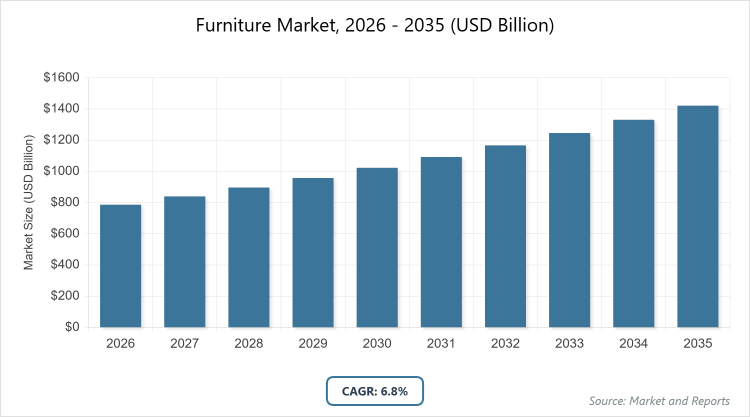
According to MarketnReports, the global Furniture market size was estimated at USD 786.13 billion in 2025 and is expected to reach USD 1,518.8 billion by 2035, growing at a CAGR of 6.8% from 2026 to 2035. Furniture Market is driven by rising demand for home furnishings and real estate development.
What are the Key Insights of the Furniture Market?
- The global furniture market was valued at USD 786.13 billion in 2025 and is expected to reach USD 1,518.8 billion by 2035.
- The market is anticipated to grow at a CAGR of 6.8% during the forecast period from 2026 to 2035.
- The market is driven by increasing urbanization, rising disposable incomes, and advancements in sustainable and smart furniture technologies.
- In the material segment, wood dominated with a 39.39% share.
- In the product segment, bedroom furniture dominated with a 35.69% share.
- In the end-use segment, residential dominated with a 61.44% share.
- The Asia Pacific region dominated with a 38.23% share, driven by rapid urbanization, booming real estate sectors, and increasing disposable incomes in emerging economies.
What is the Furniture Industry Overview?
The furniture industry encompasses the design, manufacturing, distribution, and retailing of various furnishings used in residential, commercial, and institutional settings to enhance functionality, comfort, and aesthetics. Market definition refers to the global ecosystem involving products such as seating, storage, and bedroom items made from materials like wood, metal, and plastic, catering to end-uses in homes and offices. This market thrives on consumer lifestyles, urbanization trends, and innovations in design, where suppliers source raw materials, manufacturers produce customizable pieces, and retailers deliver through offline and online channels to meet diverse demands for durable, stylish, and sustainable solutions.
What are the Market Dynamics in the Furniture Industry?
Growth Drivers
The furniture market’s growth is propelled by escalating urbanization and real estate developments worldwide, which increase the need for functional and stylish furnishings in new homes and commercial spaces. Rising disposable incomes in developing regions enable consumers to invest in premium and customizable products, while technological integrations such as IoT-enabled smart furniture enhance user experience and drive innovation. Additionally, government initiatives in infrastructure, like housing projects in Asia and the Middle East, boost demand across residential and commercial sectors, fostering market expansion through improved accessibility and diverse product offerings.
Restraints
High production costs associated with sustainable materials and advanced technologies pose significant barriers, limiting affordability for price-sensitive consumers and straining manufacturer margins. Supply chain disruptions, including raw material shortages and fluctuating prices for wood and metals, exacerbate operational challenges and delay deliveries. Stringent regulatory compliance for environmental standards and product safety adds complexity and costs, particularly for smaller players, while economic uncertainties and inflation can reduce discretionary spending on non-essential furnishings, hindering overall market progress.
Opportunities
Emerging e-commerce platforms present vast opportunities by expanding reach to underserved markets and enabling personalized shopping experiences through virtual showrooms and augmented reality tools. The shift toward eco-friendly and modular designs opens avenues for innovation using recycled materials, appealing to environmentally conscious consumers and aligning with global sustainability goals. Growth in emerging economies, coupled with investments in commercial infrastructure like hotels and offices, allows for market penetration and diversification, while collaborations with tech firms for smart furniture can create new revenue streams and competitive advantages.
Challenges
Intense competition from both global giants and local artisans requires continuous product differentiation and innovation to maintain market share, often increasing R&D expenditures. Shifting consumer preferences toward multifunctional and minimalist designs demand agile manufacturing processes, which can be difficult for traditional setups to adapt. Environmental regulations mandating low-emission production and waste reduction add operational hurdles, while geopolitical tensions and trade barriers disrupt international supply chains, impacting cost efficiency and timely market responses.
| Report Attributes | Report Details |
| Report Name | Furniture Market |
| Market Size 2025 | USD 786.13 Billion |
| Market Forecast 2035 | USD 1,518.8 Billion |
| Growth Rate | CAGR of 6.8% |
| Report Pages | 217 |
| Key Companies Covered | IKEA, Ashley Furniture Industries Inc., RH (Restoration Hardware), Williams-Sonoma Inc., La-Z-Boy Inc., Oppein Home Group Inc., Jason Furniture (HangZhou) Co. Ltd., Steelcase Inc., Raymour & Flanigan, American Signature |
| Segments Covered | By Material, By Product, By End-Use, and By Region |
| Regions Covered | North America, Europe, Asia Pacific (APAC), Latin America, and The Middle East and Africa (MEA) |
| Base Year | 2025 |
| Historical Year | 2020 – 2024 |
| Forecast Year | 2026 – 2035 |
| Customization Scope | Avail customized purchase options to meet your exact research needs. |
How is the Furniture Market Segmented?
The Furniture market is segmented by material, product, end-use, and region.
Based on Material Segment. The most dominant segment is wood, which leads due to its timeless appeal, strength, and adaptability in crafting various furniture styles, from traditional to contemporary, thereby driving market growth through consistent demand in both residential and commercial applications where quality and longevity are prioritized. The second most dominant segment is plastic, gaining traction for its affordability, lightweight properties, and versatility in modern designs, helping to propel the market by catering to budget-conscious consumers and enabling innovative, durable products in urban settings with space constraints.
Based on Product Segment. The most dominant segment is bedroom furniture, excelling because of its fundamental necessity in households, coupled with trends in home personalization and wellness-focused features like ergonomic mattresses, which significantly contribute to market expansion by addressing daily comfort needs amid rising real estate activities. The second most dominant segment is storage furniture, prominent for its utility in optimizing limited spaces in urban dwellings and offices, driving the market through demand for multifunctional units that enhance organization and efficiency in fast-paced lifestyles.
Based on End-Use Segment. The most dominant segment is residential, prevailing owing to widespread home ownership aspirations, renovation booms, and family-oriented purchases that emphasize comfort and style, thereby fueling market growth via increased consumer spending on interior enhancements. The second most dominant segment is commercial, thriving on expansions in hospitality, offices, and healthcare facilities requiring durable and aesthetic furnishings, aiding market propulsion by aligning with business investments in productive and appealing environments.
What are the Recent Developments in the Furniture Market?
- In April 2025, Paola Lenti introduced the “Alma” outdoor seating collection, featuring biodegradable recycled polyester upholstery and CNC-machined aluminum frames, emphasizing sustainability and innovation in outdoor furnishings to meet growing eco-conscious consumer demands.
- In February 2024, La-Z-Boy Inc. extended leases and undertook showroom renovations in preparation for the High Point and Las Vegas Markets, aiming to enhance retail experiences and showcase new collections to boost brand visibility and sales.
- In December 2024, RH (Restoration Hardware) opened its Newport Beach Gallery, a 97,000 square foot four-level luxury hub, integrating retail with hospitality elements to create immersive shopping environments and drive premium segment growth.
- In November 2024, RH inaugurated its Raleigh Gallery, a 60,000 square foot three-level space, focusing on experiential retail to engage customers with curated lifestyles and strengthen market presence in key regions.
What is the Regional Analysis of the Furniture Market?
- Asia Pacific to dominate the global market.
Asia Pacific holds the leading position in the furniture market, driven by rapid urbanization, a burgeoning middle class, and extensive real estate developments that spur demand for affordable and modern furnishings. The region’s dominance is bolstered by cost-effective manufacturing hubs and export capabilities, with China emerging as the dominating country due to its massive production scale, technological advancements in smart furniture, and government support for industrial growth, contributing significantly to global supply chains and innovation.
North America exhibits strong growth through a focus on sustainable and high-quality designs, supported by robust consumer spending on home improvements and office setups. The United States dominates this region, fueled by high disposable incomes, renovation trends where households spend USD 1,200-2,000 annually on furnishings, and a shift toward eco-friendly materials, enabling the market to thrive amid evolving work-from-home dynamics and e-commerce penetration.
Europe maintains a mature market characterized by emphasis on craftsmanship, design innovation, and adherence to strict environmental standards, catering to discerning consumers seeking premium and customizable products. Germany stands out as the dominating country, leveraging its engineering expertise, export-oriented industry, and initiatives in sustainable manufacturing like using FSC-certified timber, which drive regional leadership in quality-driven segments.
Latin America experiences steady expansion tied to infrastructure improvements and rising urban populations, with demand for functional and budget-friendly furniture in residential sectors. Brazil dominates, propelled by its large domestic market, natural resource abundance for wood-based products, and government housing programs that stimulate local production and consumption, fostering growth despite economic variabilities.
The Middle East and Africa region shows promising potential through investments in tourism, hospitality, and urban projects, increasing the need for commercial and luxury furnishings. The United Arab Emirates leads as the dominating country, supported by ambitious developments like Dubai’s real estate expansions and sustainability-focused initiatives, attracting international brands and boosting demand for high-end, tech-integrated furniture.
Who are the Key Market Players in the Furniture Industry?
IKEA IKEA employs strategies focused on affordable, flat-pack designs that facilitate easy assembly and transportation, combined with a strong emphasis on sustainability through the use of renewable materials and circular economy practices, enabling it to capture a broad consumer base across over 50 countries and drive accessibility in the global market.
Ashley Furniture Industries Inc. Ashley Furniture Industries Inc. leverages vertical integration in manufacturing and distribution to control costs and ensure quality, while investing in diverse product lines from traditional to contemporary styles, allowing it to dominate the mid-range segment and expand through extensive retail networks and online platforms.
RH (Restoration Hardware) RH adopts a luxury-focused approach with immersive gallery experiences that blend retail, hospitality, and design services, emphasizing timeless aesthetics and premium materials to target high-end consumers, thereby strengthening brand loyalty and market share in upscale furnishings.
Williams-Sonoma, Inc. Williams-Sonoma, Inc. pursues omnichannel retailing strategies, combining physical stores with robust e-commerce and digital marketing, while prioritizing sustainable sourcing and innovative kitchen and home products to appeal to lifestyle-oriented buyers and sustain growth in competitive markets.
La-Z-Boy Inc. La-Z-Boy Inc. implements showroom renovations and lease extensions to enhance customer engagement, alongside product innovations in comfort-focused recliners and seating, positioning it to capitalize on aging populations and home comfort trends for steady revenue increases.
What are the Current Market Trends in Furniture?
- Increasing adoption of smart furniture integrated with IoT features, such as wireless charging desks and sleep-monitoring beds, to enhance functionality in modern homes.
- Growing preference for eco-friendly “green furniture” utilizing recycled, biodegradable materials like reclaimed wood and bamboo to align with sustainability demands.
- Rising demand for multifunctional and space-saving designs suited for urban living and hybrid work environments, emphasizing modularity and efficiency.
- Shift toward high-end, tech-integrated products with minimalist styles that cater to wellness and aesthetic priorities among consumers.
- Post-pandemic surge in home improvement projects boosting segments like storage and bedroom furniture for better organization and comfort.
What Market Segments and Subsegments are Covered in the Report?
By Material
-
Wood
-
Metal
-
Plastic
-
Glass
-
Others
By Product
- Bedroom Furniture
- Seating Furniture
- Storage Furniture
- Desks and Tables
- Others
By End-Use
- Residential
- Commercial
By Region
- North America
- U.S.
- Canada
- Europe
- UK
- Germany
- France
- Rest of Europe
- Asia Pacific
- China
- India
- Japan
- Rest of Asia Pacific
- Latin America
- Brazil
- Mexico
- Rest of Latin America
- Middle East & Africa
- UAE
- South Africa
- Rest of Middle East & Africa
Chapter 1. Preface
1.1 Report Description and Scope1.2 Research Scope1.3 Research Methodology1.3.1 Market Research Type1.3.2 Market Research MethodologyChapter 2. Executive Summary
2.1 Global Furniture Market, (2026 - 2035) (USD Billion)2.2 Global Furniture Market: SnapshotChapter 3. Global Furniture Market - Industry Analysis
3.1 Furniture Market: Market Dynamics3.2 Market Drivers3.2.1 The furniture market is driven by rapid urbanization, real estate growth, rising disposable incomes, smart furniture adoption, and government-led housing and infrastructure initiatives worldwide.3.3 Market Restraints3.3.1 The furniture market faces challenges from high costs of sustainable materials and technologies, supply chain disruptions, regulatory compliance burdens, and economic uncertainty reducing consumer spending.3.4 Market Opportunities3.4.1 Opportunities are driven by e-commerce expansion, eco-friendly and modular designs, growth in emerging economies, commercial infrastructure investments, and smart furniture collaborations.3.5 Market Challenges3.5.1 The furniture market faces challenges from intense competition, rapidly changing design preferences, strict environmental regulations, and geopolitical and trade disruptions affecting supply chains and costs.3.6 Porter’s Five Forces Analysis3.7 Market Attractiveness Analysis3.7.1 Market Attractiveness Analysis By Material3.7.2 Market Attractiveness Analysis By Product3.7.3 Market Attractiveness Analysis By End-UseChapter 4. Global Furniture Market- Competitive Landscape
4.1 Company Market Share Analysis4.1.1 Global Furniture Market: Company Market Share, 20254.2 Strategic Development4.2.1 Acquisitions & mergers4.2.2 New Product launches4.2.3 Agreements, partnerships, collaborations, and joint ventures4.2.4 Research and development and regional expansion4.3 Price Trend AnalysisChapter 5. Global Furniture Market - Material Analysis
5.1 Global Furniture Market Overview: Material5.1.1 Global Furniture Market share, By Material, 2025 and 20355.2 Wood5.2.1 Global Furniture Market by Wood, 2026 - 2035 (USD Billion)5.3 Metal5.3.1 Global Furniture Market by Metal, 2026 - 2035 (USD Billion)5.4 Plastic5.4.1 Global Furniture Market by Plastic, 2026 - 2035 (USD Billion)5.5 Glass5.5.1 Global Furniture Market by Glass, 2026 - 2035 (USD Billion)5.6 Others5.6.1 Global Furniture Market by Others, 2026 - 2035 (USD Billion)Chapter 6. Global Furniture Market - Product Analysis
6.1 Global Furniture Market Overview: Product6.1.1 Global Furniture Market Share, By Product, 2025 and 20356.2 Bedroom Furniture6.2.1 Global Furniture Market by Bedroom Furniture, 2026 - 2035 (USD Billion)6.3 Seating Furniture6.3.1 Global Furniture Market by Seating Furniture, 2026 - 2035 (USD Billion)6.4 Storage Furniture6.4.1 Global Furniture Market by Storage Furniture, 2026 - 2035 (USD Billion)6.5 Desks and Tables6.5.1 Global Furniture Market by Desks and Tables, 2026 - 2035 (USD Billion)6.6 Others6.6.1 Global Furniture Market by Others, 2026 - 2035 (USD Billion)Chapter 7. Global Furniture Market - End-Use Analysis
7.1 Global Furniture Market Overview: End-Use7.1.1 Global Furniture Market Share, By End-Use, 2025 and 20357.2 Residential7.2.1 Global Furniture Market by Residential, 2026 - 2035 (USD Billion)7.3 Commercial7.3.1 Global Furniture Market by Commercial, 2026 - 2035 (USD Billion)Chapter 8. Furniture Market - Regional Analysis
8.1 Global Furniture Market Regional Overview8.2 Global Furniture Market Share, by Region, 2025 & 2035 (USD Billion)8.3 North America8.3.1 North America Furniture Market, 2026 - 2035 (USD Billion)8.3.1.1 North America Furniture Market, by Country, 2026 - 2035 (USD Billion)8.3.2 North America Furniture Market, by Material, 2026 - 20358.3.2.1 North America Furniture Market, by Material, 2026 - 2035 (USD Billion)8.3.3 North America Furniture Market, by Product, 2026 - 20358.3.3.1 North America Furniture Market, by Product, 2026 - 2035 (USD Billion)8.3.4 North America Furniture Market, by End-Use, 2026 - 20358.3.4.1 North America Furniture Market, by End-Use, 2026 - 2035 (USD Billion)8.4 Europe8.4.1 Europe Furniture Market, 2026 - 2035 (USD Billion)8.4.1.1 Europe Furniture Market, by Country, 2026 - 2035 (USD Billion)8.4.2 Europe Furniture Market, by Material, 2026 - 20358.4.2.1 Europe Furniture Market, by Material, 2026 - 2035 (USD Billion)8.4.3 Europe Furniture Market, by Product, 2026 - 20358.4.3.1 Europe Furniture Market, by Product, 2026 - 2035 (USD Billion)8.4.4 Europe Furniture Market, by End-Use, 2026 - 20358.4.4.1 Europe Furniture Market, by End-Use, 2026 - 2035 (USD Billion)8.5 Asia Pacific8.5.1 Asia Pacific Furniture Market, 2026 - 2035 (USD Billion)8.5.1.1 Asia Pacific Furniture Market, by Country, 2026 - 2035 (USD Billion)8.5.2 Asia Pacific Furniture Market, by Material, 2026 - 20358.5.2.1 Asia Pacific Furniture Market, by Material, 2026 - 2035 (USD Billion)8.5.3 Asia Pacific Furniture Market, by Product, 2026 - 20358.5.3.1 Asia Pacific Furniture Market, by Product, 2026 - 2035 (USD Billion)8.5.4 Asia Pacific Furniture Market, by End-Use, 2026 - 20358.5.4.1 Asia Pacific Furniture Market, by End-Use, 2026 - 2035 (USD Billion)8.6 Latin America8.6.1 Latin America Furniture Market, 2026 - 2035 (USD Billion)8.6.1.1 Latin America Furniture Market, by Country, 2026 - 2035 (USD Billion)8.6.2 Latin America Furniture Market, by Material, 2026 - 20358.6.2.1 Latin America Furniture Market, by Material, 2026 - 2035 (USD Billion)8.6.3 Latin America Furniture Market, by Product, 2026 - 20358.6.3.1 Latin America Furniture Market, by Product, 2026 - 2035 (USD Billion)8.6.4 Latin America Furniture Market, by End-Use, 2026 - 20358.6.4.1 Latin America Furniture Market, by End-Use, 2026 - 2035 (USD Billion)8.7 The Middle-East and Africa8.7.1 The Middle-East and Africa Furniture Market, 2026 - 2035 (USD Billion)8.7.1.1 The Middle-East and Africa Furniture Market, by Country, 2026 - 2035 (USD Billion)8.7.2 The Middle-East and Africa Furniture Market, by Material, 2026 - 20358.7.2.1 The Middle-East and Africa Furniture Market, by Material, 2026 - 2035 (USD Billion)8.7.3 The Middle-East and Africa Furniture Market, by Product, 2026 - 20358.7.3.1 The Middle-East and Africa Furniture Market, by Product, 2026 - 2035 (USD Billion)8.7.4 The Middle-East and Africa Furniture Market, by End-Use, 2026 - 20358.7.4.1 The Middle-East and Africa Furniture Market, by End-Use, 2026 - 2035 (USD Billion)Chapter 9. Company Profiles
9.1 IKEA9.1.1 Overview9.1.2 Financials9.1.3 Product Portfolio9.1.4 Business Strategy9.1.5 Recent Developments9.2 Ashley Furniture Industries Inc.9.2.1 Overview9.2.2 Financials9.2.3 Product Portfolio9.2.4 Business Strategy9.2.5 Recent Developments9.3 RH (Restoration Hardware)9.3.1 Overview9.3.2 Financials9.3.3 Product Portfolio9.3.4 Business Strategy9.3.5 Recent Developments9.4 Williams-Sonoma Inc.9.4.1 Overview9.4.2 Financials9.4.3 Product Portfolio9.4.4 Business Strategy9.4.5 Recent Developments9.5 La-Z-Boy Inc.9.5.1 Overview9.5.2 Financials9.5.3 Product Portfolio9.5.4 Business Strategy9.5.5 Recent Developments9.6 Oppein Home Group Inc.9.6.1 Overview9.6.2 Financials9.6.3 Product Portfolio9.6.4 Business Strategy9.6.5 Recent Developments9.7 Jason Furniture (HangZhou) Co. Ltd.9.7.1 Overview9.7.2 Financials9.7.3 Product Portfolio9.7.4 Business Strategy9.7.5 Recent Developments9.8 Steelcase Inc.9.8.1 Overview9.8.2 Financials9.8.3 Product Portfolio9.8.4 Business Strategy9.8.5 Recent Developments9.9 Raymour & Flanigan9.9.1 Overview9.9.2 Financials9.9.3 Product Portfolio9.9.4 Business Strategy9.9.5 Recent Developments9.10 American Signature9.10.1 Overview9.10.2 Financials9.10.3 Product Portfolio9.10.4 Business Strategy9.10.5 Recent Developments
Frequently Asked Questions
Furniture refers to movable objects designed to support various human activities such as seating, sleeping, and storage, typically made from materials like wood, metal, or plastic, and used in residential or commercial spaces to enhance comfort, functionality, and aesthetics.
Key factors include rising urbanization and real estate developments, increasing disposable incomes in emerging markets, technological advancements in smart and sustainable designs, e-commerce expansion, and government infrastructure initiatives that boost demand across segments.
The furniture market is projected to grow from an estimated value post-2025 base of USD 786.13 billion, reaching approximately USD 1,518.8 billion by 2035, reflecting steady expansion driven by global trends.
The CAGR value of the furniture market during 2026-2035 is expected to be 6.8%, supported by ongoing innovations and market dynamics.
Asia Pacific will contribute notably to the furniture market value, holding a dominant share due to rapid economic growth, population density, and infrastructure investments.
Major players driving growth include IKEA, Ashley Furniture Industries Inc., RH (Restoration Hardware), Williams-Sonoma Inc., La-Z-Boy Inc., Oppein Home Group Inc., Jason Furniture (HangZhou) Co. Ltd., Steelcase Inc., Raymour & Flanigan, American Signature, through strategies like innovation, sustainability, and global expansion.
The global furniture market report provides comprehensive analysis including market size, forecasts, segmentation, regional insights, key player strategies, trends, dynamics, and opportunities for informed decision-making.
The value chain includes raw material suppliers providing timber, metals, and plastics; manufacturers processing and innovating products; distributors and retailers handling logistics and sales through offline and online channels; and end-users in residential and commercial sectors consuming the final goods.
Market trends are evolving toward smart, IoT-integrated, and eco-friendly furniture, while consumer preferences shift to multifunctional, sustainable, and customizable designs prioritizing wellness, affordability, and style in urban lifestyles.
Regulatory factors include strict environmental standards promoting low-emission production and sustainable sourcing, such as FSC certifications and antimicrobial requirements for healthcare furniture, alongside building codes and trade policies influencing supply chains and innovation.