
FTIR Spectrometer Market Size, Share and Trends 2026 to 2035
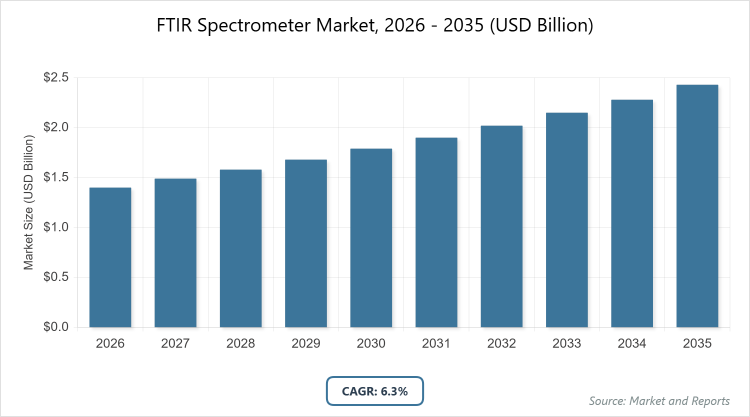
According to MarketnReports, the global FTIR Spectrometer market size was estimated at USD 1.4 billion in 2025 and is expected to reach USD 2.6 billion by 2035, growing at a CAGR of 6.3% from 2026 to 2035. FTIR Spectrometer Market is driven by increasing demand for advanced analytical instruments in pharmaceutical research and environmental monitoring.
What are the Key Insights for FTIR Spectrometer?
- The global FTIR Spectrometer market was valued at USD 1.4 billion in 2025 and is projected to reach USD 2.6 billion by 2035.
- The market is expected to grow at a CAGR of 6.3% during the forecast period from 2026 to 2035.
- The market is driven by rising adoption in pharmaceutical quality control and environmental analysis.
- Benchtop FTIR Spectrometers dominate the product type segment with a 55% share due to their high precision and widespread use in laboratory settings.
- Pharmaceuticals dominate the application segment with a 32% share owing to stringent regulatory requirements for drug development and testing.
- Pharmaceutical & Biotechnology Companies dominate the end-user segment with a 35% share because of their extensive R&D activities requiring accurate molecular analysis.
- North America dominates the regional segment with a 38% share attributed to advanced research infrastructure and presence of key manufacturers.
What is the FTIR Spectrometer Industry Overview?
The FTIR Spectrometer market encompasses instruments that utilize Fourier Transform Infrared spectroscopy to analyze the molecular composition of materials by measuring their absorption of infrared light. This technology is essential for identifying chemical bonds and functional groups in samples, making it a cornerstone in various scientific and industrial applications. Market definition includes all devices, from benchtop to portable models, used for qualitative and quantitative analysis across sectors like pharmaceuticals, chemicals, and environmental testing. It involves the production, distribution, and utilization of these spectrometers, driven by the need for precise material characterization without destructive testing.
What are the Market Dynamics for FTIR Spectrometer?
Growth Drivers The primary growth drivers for the FTIR Spectrometer market include technological advancements in spectroscopy that enhance resolution and speed of analysis, making these instruments indispensable in research and quality control. Increasing investments in pharmaceutical R&D, particularly for drug discovery and formulation, further propel demand as FTIR provides rapid, non-destructive testing capabilities. Additionally, growing environmental regulations worldwide necessitate precise monitoring of pollutants and materials, boosting adoption in testing labs. The shift towards automation in industrial processes also contributes, as integrated FTIR systems improve efficiency and reduce operational costs.
Restraints
Restraints in the FTIR Spectrometer market stem from high initial costs associated with advanced models, which can deter small and medium-sized enterprises from adoption. Limited skilled personnel to operate and interpret complex spectral data poses another challenge, leading to underutilization in certain regions. Moreover, the sensitivity of FTIR to sample preparation and environmental conditions, such as humidity, can affect accuracy and reliability, hindering widespread use in field applications. Competition from alternative spectroscopic techniques like Raman or NMR also limits market expansion in niche areas.
Opportunities
Opportunities abound in the FTIR Spectrometer market with the rise of portable and handheld devices, enabling on-site analysis in industries like food safety and forensics. Emerging markets in Asia Pacific offer growth potential due to expanding industrial bases and increasing focus on quality standards. Integration with AI and machine learning for automated data analysis presents avenues for innovation, enhancing user-friendliness and expanding applications. Furthermore, the growing emphasis on sustainable practices opens doors for FTIR in green chemistry and renewable energy material testing.
Challenges
Challenges facing the FTIR Spectrometer market include rapid technological obsolescence, requiring frequent upgrades and increasing maintenance costs for users. Regulatory compliance variations across regions complicate global standardization and market entry for manufacturers. Supply chain disruptions, particularly for specialized components like detectors and lasers, can impact production timelines. Additionally, data privacy concerns in connected FTIR systems integrated with cloud analytics pose risks in sensitive industries like pharmaceuticals.
FTIR Spectrometer Market: Report Scope
| Report Attributes | Report Details |
| Report Name | FTIR Spectrometer Market |
| Market Size 2025 | USD 1.4 Billion |
| Market Forecast 2035 | USD 2.6 Billion |
| Growth Rate | CAGR of 6.3% |
| Report Pages | 220 |
| Key Companies Covered |
Thermo Fisher Scientific Inc., Bruker Corporation, PerkinElmer Inc., Agilent Technologies, Shimadzu Corporation, and Others |
| Segments Covered | By Product Type, By Application, By End-User, and By Region |
| Regions Covered | North America, Europe, Asia Pacific (APAC), Latin America, and The Middle East and Africa (MEA) |
| Base Year | 2025 |
| Historical Year | 2020 – 2024 |
| Forecast Year | 2026 – 2035 |
| Customization Scope | Avail customized purchase options to meet your exact research needs. |
What is the Market Segmentation for FTIR Spectrometer?
The FTIR Spectrometer market is segmented by product type, application, end-user, and region.
Based on Product Type Segment, Benchtop FTIR Spectrometers are the most dominant with a 55% share, followed by Portable FTIR Spectrometers as the second most dominant at 25%. Benchtop models dominate due to their superior resolution, stability, and versatility in controlled lab environments, driving the market by enabling detailed research and quality assurance in high-volume settings. Portable variants contribute by offering flexibility for field applications, thus expanding market reach and supporting real-time decision-making in industries requiring mobility.
Based on Application Segment, Pharmaceuticals is the most dominant with a 32% share, followed by Chemicals at 20%. Pharmaceuticals leads because of its critical role in drug identification, purity testing, and compliance with FDA regulations, propelling market growth through increased R&D investments. The chemicals application supports this by facilitating material synthesis and process optimization, enhancing overall industrial efficiency and innovation.
Based on End-User Segment, Pharmaceutical & Biotechnology Companies are the most dominant with a 35% share, followed by Chemical Industries at 22%. Pharmaceutical & Biotechnology Companies dominate owing to their need for precise molecular profiling in drug development pipelines, driving the market via high adoption rates and technological integrations. Chemical Industries follow, aiding growth through applications in product formulation and safety assessments.
What are the Recent Developments in FTIR Spectrometer?
- In February 2024, Bruker Corporation launched the BEAM, a new dedicated single-point FTIR spectrometer designed for industrial quality control and process analytical technology, enhancing efficiency with improved spectral resolution and user-friendly software.
- In 2023, Thermo Fisher Scientific introduced the Nicolet Summit PRO FTIR Spectrometer, featuring advanced AI-driven analytics for faster data interpretation, targeting pharmaceutical and academic users to streamline workflows.
- In late 2024, Agilent Technologies acquired a spectroscopy startup to bolster its FTIR portfolio, focusing on portable solutions for environmental monitoring, which is expected to expand its market presence in emerging regions.
What is the Regional Analysis for FTIR Spectrometer?
North America to dominate the global market.
North America holds the largest share, driven by robust R&D infrastructure and key players like Thermo Fisher and Bruker. The United States dominates within the region due to high investments in pharmaceuticals and biotechnology, supported by favorable government policies and advanced academic institutions.
Europe follows with significant growth from stringent environmental regulations and chemical industry advancements. Germany leads as the dominating country, benefiting from its strong manufacturing base and focus on precision engineering in spectroscopy applications.
Asia Pacific is the fastest-growing region, fueled by industrialization and increasing quality control needs. China dominates here, owing to its expanding pharmaceutical sector and government initiatives for technological upgrades in testing equipment.
Latin America shows moderate growth, primarily in environmental and food testing. Brazil is the dominating country, driven by agricultural exports requiring stringent quality analyses.
The Middle East and Africa exhibit emerging potential, with oil & gas applications leading. Saudi Arabia dominates, supported by petrochemical investments and efforts to diversify economies through advanced analytical tools.
Who are the Key Market Players in FTIR Spectrometer?
- Thermo Fisher Scientific Inc. Thermo Fisher Scientific Inc. focuses on innovation through product launches like the Nicolet series, emphasizing integration with digital platforms for enhanced data management. Their strategy includes strategic acquisitions to expand FTIR capabilities and global distribution networks to capture emerging markets.
- Bruker Corporation. Bruker Corporation prioritizes R&D in high-resolution FTIR systems, such as the INVENIO line, with a strategy centered on partnerships with academic institutions and customization for industrial applications to maintain competitive edge.
- PerkinElmer Inc. PerkinElmer Inc. employs a strategy of bundling FTIR spectrometers with software solutions for automated analysis, targeting pharmaceutical clients while expanding into environmental sectors through targeted marketing and service support.
- Agilent Technologies. Agilent Technologies leverages mergers and technology integrations to offer versatile FTIR solutions, focusing on portable models and sustainability initiatives to appeal to diverse end-users and regions.
- Shimadzu Corporation. Shimadzu Corporation adopts cost-effective manufacturing and regional expansions in Asia Pacific, with strategies involving user training programs and collaborations for application-specific developments in chemicals and food testing.
What are the Market Trends for FTIR Spectrometer?
- Miniaturization of devices leading to more portable and handheld FTIR spectrometers for on-site analysis.
- Integration of AI and machine learning for automated spectral data interpretation and predictive maintenance.
- Growing adoption in food safety and quality control due to regulatory pressures.
- Advancements in hyphenated techniques combining FTIR with chromatography for enhanced analytical capabilities.
- Shift towards sustainable and eco-friendly materials in spectrometer manufacturing.
- Increasing use in semiconductor and nanotechnology for precise material characterization.
What Market Segments and Subsegments are Covered in the FTIR Spectrometer Report?
By Product Type
-
Benchtop FTIR Spectrometers
-
Portable FTIR Spectrometers
-
Micro FTIR Spectrometers
-
FTIR Imaging Spectrometers
-
FTIR Microscopes
-
Attenuated Total Reflection (ATR) FTIR
-
Gas FTIR Analyzers
-
Liquid FTIR Analyzers
-
Continuous Wave FTIR
-
Time-Resolved FTIR
-
Others
By Application
- Pharmaceuticals
- Chemicals
- Food & Beverage
- Environmental Testing
- Petrochemical Engineering
- Polymer Science
- Organic Synthesis
- Oil & Gas
- Metal & Mining
- Semiconductor
- Others
By End-User
- Pharmaceutical & Biotechnology Companies
- Chemical Industries
- Academic & Research Institutes
- Environmental Testing Laboratories
- Food & Beverage Industry
- Petrochemical Companies
- Polymer Manufacturers
- Oil & Gas Companies
- Metal & Mining Companies
- Semiconductor Manufacturers
- Others
By Region
- North America
- U.S.
- Canada
- Europe
- UK
- Germany
- France
- Rest of Europe
- Asia Pacific
- China
- India
- Japan
- Rest of Asia Pacific
- Latin America
- Brazil
- Mexico
- Rest of Latin America
- Middle East & Africa
- UAE
- South Africa
- Rest of Middle East & Africa
Frequently Asked Questions
FTIR Spectrometers are analytical instruments that use infrared light to identify and quantify chemical substances based on their molecular vibrations.
Key factors include technological advancements, rising pharmaceutical R&D, environmental regulations, and adoption of portable devices.
The market is projected to grow from approximately USD 1.5 billion in 2026 to USD 2.6 billion by 2035.
The CAGR is expected to be 6.3% during the forecast period.
North America will contribute notably, holding the largest share due to advanced infrastructure.
Major players include Thermo Fisher Scientific Inc., Bruker Corporation, PerkinElmer Inc., Agilent Technologies, and Shimadzu Corporation.
The report provides comprehensive analysis including size, trends, segments, regional insights, and forecasts.
Stages include raw material sourcing, manufacturing, distribution, end-user application, and after-sales service.
Trends lean towards portable, AI-integrated devices, with preferences for user-friendly, high-accuracy systems in diverse applications.
Stringent regulations in pharmaceuticals and environmental monitoring drive demand for compliant, precise analytical tools.