
Food Traceability (Tracking Technologies) Market Size, Share and Trends 2026 to 2035
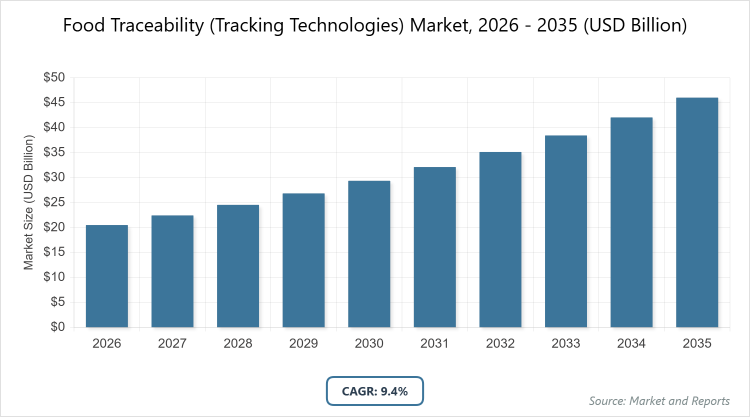
According to MarketnReports, the global Food Traceability (Tracking Technologies) market size was estimated at USD 20.5 billion in 2025 and is expected to reach USD 50.2 billion by 2035, growing at a CAGR of 9.4% from 2026 to 2035. Food Traceability (Tracking Technologies) Market is driven by stringent food safety regulations and rising consumer demand for transparency in supply chains.
What is Food Traceability (Tracking Technologies)? An Industry Overview
Food traceability tracking technologies encompass systems and tools that enable the monitoring and recording of food products throughout the supply chain, from farm to consumer, using methods like RFID, blockchain, and IoT to ensure safety, authenticity, and compliance. The market definition includes hardware, software, and services that facilitate real-time data capture, verification, and analysis to prevent contamination, reduce waste, and enhance recall efficiency, supporting industries in maintaining quality control, building consumer trust, and adhering to global standards such as FSMA and EU regulations for sustainable and transparent food ecosystems.
What are the Key Insights of Food Traceability (Tracking Technologies) Market?
- The global Food Traceability (Tracking Technologies) market was valued at USD 20.5 billion in 2025 and is projected to reach USD 50.2 billion by 2035.
- The global Food Traceability (Tracking Technologies) market is expected to grow at a CAGR of 9.4% during the forecast period 2026-2035.
- The Food Traceability (Tracking Technologies) market is driven by increasing foodborne illness incidents and the need for supply chain visibility.
- The RFID subsegment dominates the technology segment with a 35% share due to its cost-effectiveness and real-time tracking capabilities in logistics.
- The fresh food produce subsegment dominates the application segment with a 30% share owing to high perishability and regulatory focus on fruits and vegetables.
- The food manufacturers subsegment dominates the end-user segment with a 40% share because of the need for compliance and quality assurance in production.
- North America dominates the global Food Traceability (Tracking Technologies) market with a 35% share attributed to strict FDA regulations and advanced tech adoption in the U.S.
What are the Market Dynamics of Food Traceability (Tracking Technologies)?
Growth Drivers
The food traceability tracking technologies market is propelled by escalating global food safety concerns, with over 600 million annual foodborne illness cases reported by WHO, driving governments to mandate technologies like blockchain for rapid recalls and contamination prevention. Advancements in IoT and AI enable seamless integration across supply chains, reducing losses by up to 20% through predictive analytics, while consumer preferences for ethical sourcing boost adoption in retail. Corporate sustainability goals, such as zero-waste initiatives, further accelerate demand, as companies like Walmart leverage RFID for end-to-end visibility, enhancing efficiency and brand loyalty.
Restraints
High implementation costs for advanced systems, including hardware and software integration, pose barriers for small-scale farmers and SMEs, with initial setups exceeding USD 100,000 in developing regions. Data privacy issues and interoperability challenges between legacy systems and new technologies hinder seamless adoption, as varying standards create silos. Additionally, limited digital infrastructure in rural supply chains restricts real-time tracking, leading to gaps in visibility and slower market penetration in agrarian economies.
Opportunities
The rise of blockchain for immutable records presents opportunities in emerging markets, where platforms like IBM Food Trust can reduce fraud in exports, attracting investments from agribusiness giants. Integration with e-commerce for direct-to-consumer traceability, such as QR codes on packaging, enables premium pricing for verified products. Government subsidies in Asia for smart farming tech open avenues for scalable solutions, while partnerships with logistics firms can expand applications in cold chain management for perishables.
Challenges
Ensuring data accuracy amid complex global supply chains remains a challenge, as manual entry errors and counterfeit inputs undermine trust in traceability systems. Regulatory fragmentation across borders complicates compliance, requiring customizable yet standardized solutions. Cybersecurity threats to connected IoT devices pose risks of data breaches, necessitating robust encryption that increases complexity and costs for providers.
Food Traceability (Tracking Technologies) Market: Report Scope
| Report Attributes | Report Details |
| Report Name | Food Traceability (Tracking Technologies) Market |
| Market Size 2025 | USD 20.5 Billion |
| Market Forecast 2035 | USD 50.2 Billion |
| Growth Rate | CAGR of 9.4% |
| Report Pages | 220 |
| Key Companies Covered |
IBM, SAP, Honeywell, Oracle, TraceX Technologies, Bioledger, and Others |
| Segments Covered | By Technology, By Application, By End-User, and By Region |
| Regions Covered | North America, Europe, Asia Pacific (APAC), Latin America, and The Middle East and Africa (MEA) |
| Base Year | 2025 |
| Historical Year | 2020 – 2024 |
| Forecast Year | 2026 – 2035 |
| Customization Scope | Avail customized purchase options to meet your exact research needs. |
The Food Traceability (Tracking Technologies) market is segmented by technology, application, end-user, and region.
Based on Technology Segment: The RFID segment is the most dominant, holding a 35% market share, as it provides affordable, automated tracking for inventory and logistics, driven by its ease of integration in warehouses. This dominance drives market growth by enabling efficient recall processes and reducing shrinkage. The blockchain segment is the second most dominant with a 25% share, offering secure, transparent ledgers for end-to-end visibility, which propels the market through fraud prevention and consumer trust building.
Based on Application Segment: The fresh food produce segment is the most dominant, capturing a 30% share, due to high vulnerability to spoilage and regulatory scrutiny on fruits and vegetables. Its dominance accelerates market growth by supporting farm-to-fork monitoring. The meat & poultry segment ranks second with a 25% share, where traceability combats contamination risks, driving the market with safety enhancements.
Based on End-User Segment: The food manufacturers segment is the most dominant, with a 40% share, attributed to the need for quality control and compliance in processing. This leads market growth by optimizing supply chains. The food retailers segment is second with a 30% share, using traceability for inventory management, propelling growth through consumer-facing transparency.
What are the Recent Developments in Food Traceability (Tracking Technologies) Market?
- In 2025, IBM expanded its Food Trust blockchain platform, partnering with major retailers to trace over 1 million products in real-time.
- SAP launched an AI-enhanced traceability module for its S/4HANA, focusing on predictive risk analysis for supply chains.
- Honeywell introduced advanced RFID sensors for cold chain monitoring, targeting dairy and seafood applications.
- Oracle acquired a startup specializing in IoT for farm-level tracking, enhancing its cloud offerings.
- TraceX Technologies raised funding for blockchain solutions in Asia, emphasizing sustainable sourcing for exports.
What is the Regional Analysis of Food Traceability (Tracking Technologies) Market?
- North America to dominate the global market
North America holds a 35% share in the Food Traceability (Tracking Technologies) market, driven by rigorous safety laws. The United States dominates, with FDA’s FSMA mandating traceability for over 80% of food supply, supported by Walmart and Kroger implementations.
Europe maintains a strong position in the Food Traceability (Tracking Technologies) market, fueled by EU regulations. Germany leads, with its food industry using blockchain for organic certification, aligned with farm-to-fork strategies.
Asia-Pacific is the fastest-growing region for Food Traceability (Tracking Technologies), propelled by export demands. China dominates, with government initiatives tracing agricultural products for safety, backed by Alibaba integrations.
Latin America is emerging in the Food Traceability (Tracking Technologies) market, focusing on exports. Brazil leads, adopting RFID for beef traceability to meet international standards.
The Middle East and Africa show potential in Food Traceability (Tracking Technologies), driven by halal certifications. The UAE is a key player, implementing IoT for imported food monitoring in Dubai.
Who are the Key Market Players and Strategies in Food Traceability (Tracking Technologies)?
IBM focuses on blockchain scalability, partnering with retailers for end-to-end visibility.
SAP emphasizes AI integrations, expanding modules for risk prediction.
Honeywell prioritizes sensor hardware, collaborating on cold chain solutions.
Oracle pursues acquisitions for IoT enhancements, targeting cloud-based traceability.
TraceX Technologies specializes in sustainable sourcing, raising funds for Asian expansions.
Bioledger develops decentralized ledgers, focusing on organic food verification.
What are the Market Trends in Food Traceability (Tracking Technologies)?
- Increasing adoption of blockchain for immutable supply chain records.
- Integration of AI for predictive contamination detection.
- Growth in IoT sensors for real-time monitoring.
- Shift toward consumer-facing QR codes for transparency.
- Emphasis on sustainable and ethical sourcing traceability.
- Expansion of RFID in logistics for efficiency.
What are the Market Segments and their Subsegment Covered in the Food Traceability (Tracking Technologies) Report?
By Technology
-
- RFID
- Barcodes
- Blockchain
- GPS
- Infrared
- Biometrics
- IoT Sensors
- QR Codes
- NFC
- Satellite Imaging
- Others
By Application
-
- Fresh Food Produce
- Meat & Poultry
- Seafood
- Dairy Products
- Beverage Products
- Processed Food
- Grains & Cereals
- Fruits & Vegetables
- Bakery Products
- Frozen Food
- Others
By End-User
-
- Food Manufacturers
- Warehouse/Pack Farms
- Food Retailers
- Defense & Security Departments
- Government Departments
- Logistics Providers
- Farmers
- Consumers
- Pharmaceutical Companies
- Hospitals
- Others
By Region
-
- North America
- U.S.
- Canada
- Europe
- UK
- Germany
- France
- Rest of Europe
- Asia Pacific
- China
- India
- Japan
- Rest of Asia Pacific
- Latin America
- Brazil
- Mexico
- Rest of Latin America
- Middle East & Africa
- UAE
- South Africa
- Rest of Middle East & Africa
- North America
Frequently Asked Questions
Food Traceability (Tracking Technologies) are systems using tools like RFID and blockchain to monitor food products across supply chains for safety and transparency.
Key factors include regulatory mandates, consumer transparency demands, and tech advancements in IoT.
The market is projected to grow from USD 22.4 billion in 2026 to USD 50.2 billion by 2035.
The market is expected to grow at a CAGR of 9.4% during 2026-2035.
North America will contribute notably, holding a 35% share due to strict regulations.
Major players include IBM, SAP, Honeywell, Oracle, TraceX Technologies, and Bioledger.
The report provides market size, trends, segmentation, regional insights, key players, and forecasts.
Stages include data capture, system integration, analysis, verification, and reporting.
Trends emphasize blockchain and AI, with consumers favoring transparent, sustainable sourcing.
Food safety laws and sustainability goals drive adoption of traceable systems.