
Flexible Secondary Rechargeable Battery Market Size, Share and Trends 2026 to 2035
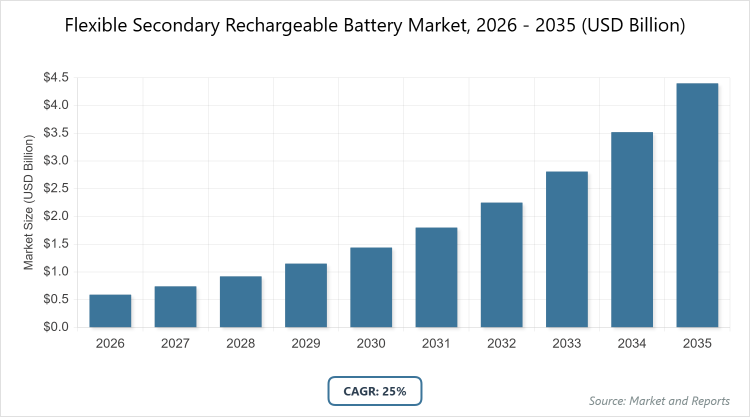
According to MarketnReports, the global Flexible Secondary Rechargeable Battery market size was estimated at USD 0.59 billion in 2025 and is expected to reach USD 4.5 billion by 2035, growing at a CAGR of 25% from 2026 to 2035. Flexible Secondary Rechargeable Battery Market is driven by the rising demand for wearable electronics and advancements in battery technology.
What is Flexible Secondary Rechargeable Battery? An Industry Overview
Flexible secondary rechargeable batteries are innovative energy storage devices designed to be bendable, lightweight, and conformable to various shapes, utilizing rechargeable chemistries such as lithium-ion or lithium-polymer to provide repeated charge-discharge cycles. The market definition encompasses batteries that maintain performance under mechanical stress, suitable for integration into curved or flexible applications like wearables, medical devices, and foldable electronics, emphasizing safety, high energy density, and longevity. This industry focuses on advancing materials like thin-film electrodes and solid-state electrolytes to meet the growing need for portable, efficient power sources in an increasingly mobile and connected world.
What are the Key Insights of Flexible Secondary Rechargeable Battery Market?
- The global Flexible Secondary Rechargeable Battery market was valued at USD 0.59 billion in 2025 and is projected to reach USD 4.5 billion by 2035.
- The global Flexible Secondary Rechargeable Battery market is expected to grow at a CAGR of 25% during the forecast period 2026-2035.
- The Flexible Secondary Rechargeable Battery market is driven by increasing adoption of wearable devices and IoT applications.
- The thin-film batteries subsegment dominates the type segment with a 35% share due to their lightweight and high energy density suitable for compact devices.
- The wearable devices subsegment dominates the application segment with a 38% share owing to the surge in fitness trackers and smartwatches.
- The consumer electronics subsegment dominates the end-user segment with a 40% share because of integration in smartphones and laptops.
- Asia Pacific dominates the global Flexible Secondary Rechargeable Battery market with a 40% share attributed to strong manufacturing bases in China and South Korea.
What are the Market Dynamics of Flexible Secondary Rechargeable Battery?
Growth Drivers
The flexible secondary rechargeable battery market is driven by the escalating demand for portable and wearable electronics, where devices like smartwatches and fitness trackers require batteries that can conform to curved surfaces without compromising performance. Advancements in nanotechnology and materials science, such as the development of graphene-based electrodes, enhance energy density and cycle life, making these batteries more viable for commercial use. Government incentives for sustainable energy solutions and the push toward miniaturization in consumer products further accelerate adoption, as manufacturers seek to integrate flexible power sources to improve device design and user experience.
Restraints
High production costs associated with advanced materials and manufacturing processes limit widespread adoption, particularly in price-sensitive markets where traditional rigid batteries remain cheaper alternatives. Technical challenges, including reduced energy density compared to conventional batteries and issues with durability under repeated bending, pose reliability concerns for critical applications. Additionally, supply chain dependencies on rare earth materials and fluctuating raw material prices create volatility, hindering scaling efforts for emerging players.
Opportunities
The integration of flexible batteries in emerging sectors like electric vehicles and medical implants presents significant opportunities, as they enable lighter, more adaptable designs that enhance vehicle range and patient comfort. Expanding IoT ecosystems and smart packaging applications offer avenues for innovation, with batteries powering sensors in flexible labels for real-time tracking. Collaborations between tech giants and startups can accelerate R&D, unlocking new chemistries like solid-state options that address safety concerns and open markets in aerospace and defense.
Challenges
Ensuring safety and stability under mechanical stress remains a key challenge, as flexible designs are prone to degradation or short-circuiting during bending, requiring rigorous testing standards. Intellectual property disputes and the need for standardized regulations across regions complicate global market entry for new technologies. Moreover, competition from alternative energy storage solutions, such as supercapacitors, challenges market share, necessitating continuous innovation to maintain relevance in fast-evolving tech landscapes.
Flexible Secondary Rechargeable Battery Market: Report Scope
| Report Attributes | Report Details |
| Report Name | Flexible Secondary Rechargeable Battery Market |
| Market Size 2025 | USD 0.59 Billion |
| Market Forecast 2035 | USD 4.5 Billion |
| Growth Rate | CAGR of 25% |
| Report Pages | 220 |
| Key Companies Covered |
Samsung SDI, LG Chem, Panasonic, Blue Spark Technologies, Imprint Energy, BrightVolt, and Others |
| Segments Covered | By Type, By Application, By End-User, and By Region |
| Regions Covered | North America, Europe, Asia Pacific (APAC), Latin America, and The Middle East and Africa (MEA) |
| Base Year | 2025 |
| Historical Year | 2020 – 2024 |
| Forecast Year | 2026 – 2035 |
| Customization Scope | Avail customized purchase options to meet your exact research needs. |
The Flexible Secondary Rechargeable Battery market is segmented by type, application, end-user, and region.
Based on Type Segment: The thin-film batteries segment is the most dominant, holding a 35% market share, as they offer superior flexibility and thin profiles ideal for integration into compact devices, driven by their ability to maintain high performance in limited spaces. This dominance drives market growth by enabling advancements in wearables and IoT, reducing weight and enhancing design possibilities. The flexible lithium-ion batteries segment is the second most dominant with a 30% share, providing higher energy density for demanding applications, which propels the market through improved efficiency in consumer electronics.
Based on Application Segment: The wearable devices segment is the most dominant, capturing a 38% share, due to the booming fitness and health monitoring industry requiring batteries that conform to body movements without bulk. Its dominance accelerates market growth by fostering innovation in smart textiles and accessories. The consumer electronics segment ranks second with a 25% share, where foldable smartphones and tablets demand flexible power, driving the market with enhanced user experiences and product differentiation.
Based on End-User Segment: The consumer electronics segment is the most dominant, with a 40% share, attributed to rapid adoption in gadgets like earbuds and e-readers seeking lightweight energy solutions. This leads market growth by spurring demand for customized battery designs. The healthcare segment is second with a 20% share, utilizing flexible batteries in patches and implants, propelling growth through medical advancements and remote monitoring.
What are the Recent Developments in Flexible Secondary Rechargeable Battery Market?
- In July 2025, Lyten expanded its flexible battery capabilities by acquiring Northvolt’s largest battery energy storage operations in Europe, enhancing production for wearable applications.
- In July 2025, Panasonic launched a $4 billion EV battery facility in Kansas, incorporating flexible designs for improved vehicle integration.
- In January 2025, Forge Battery secured a $100 million contract with the U.S. DOE to support its North Carolina gigafactory expansion, focusing on flexible solid-state technologies.
- In August, LG Energy Solution announced a strategic partnership with a leading automotive manufacturer to develop flexible battery solutions tailored for electric vehicles.
- In October, Samsung SDI launched a new line of flexible batteries designed specifically for wearable technology, emphasizing durability and energy density.
What is the Regional Analysis of Flexible Secondary Rechargeable Battery Market?
- Asia Pacific to dominate the global market
Asia Pacific leads the Flexible Secondary Rechargeable Battery market with a 40% share, propelled by robust manufacturing ecosystems and government support for electronics innovation. China dominates the region, with companies like CATL advancing flexible lithium technologies amid massive EV and wearable production, supported by national policies for battery self-sufficiency.
Europe holds a strong position in the Flexible Secondary Rechargeable Battery market, driven by sustainability initiatives and R&D investments. Germany is the dominant country, leveraging automotive giants like Volkswagen for EV integrations, aligning with EU green deals for reduced emissions.
North America maintains significant growth in the Flexible Secondary Rechargeable Battery market, fueled by tech hubs and venture funding. The United States dominates, with Silicon Valley firms like Apple pioneering wearables, backed by DOE grants for advanced materials.
Latin America is emerging in the Flexible Secondary Rechargeable Battery market, focusing on renewable integrations. Brazil leads, adopting flexible solutions for portable solar devices in remote areas, supported by energy access programs.
The Middle East and Africa show potential in the Flexible Secondary Rechargeable Battery market, emphasizing off-grid applications. The UAE is a key player, investing in smart city projects with flexible batteries for IoT, attracting global partnerships.
Who are the Key Market Players and Strategies in Flexible Secondary Rechargeable Battery?
Samsung SDI focuses on high-density flexible lithium-ion batteries, partnering with electronics firms for wearable integrations.
LG Chem emphasizes solid-state advancements, investing in R&D for EV and medical applications to enhance safety.
Panasonic prioritizes scalable production, collaborating on automotive projects for flexible EV packs.
Blue Spark Technologies specializes in printed batteries, targeting healthcare patches through OEM alliances.
Imprint Energy pursues zinc-based flexible solutions, expanding via acquisitions for IoT sensors.
BrightVolt develops polymer electrolytes, focusing on military and aerospace for rugged designs.
What are the Market Trends in Flexible Secondary Rechargeable Battery?
- Increasing integration in foldable smartphones and tablets for enhanced portability.
- Advancements in solid-state electrolytes for improved safety and energy density.
- Growing adoption in medical wearables for continuous health monitoring.
- Shift toward sustainable materials like graphene for eco-friendly batteries.
- Expansion into EV components for lighter, more efficient designs.
- Rise of printed battery technologies for cost-effective mass production.
What are the Market Segments and their Subsegment Covered in the Flexible Secondary Rechargeable Battery Report?
By Type
-
- Thin-Film Batteries
- Printed Batteries
- Curved Batteries
- Flexible Lithium-Ion Batteries
- Flexible Lithium Polymer Batteries
- Flexible Zinc-Carbon Batteries
- Flexible Solid-State Batteries
- Flexible Sodium-Ion Batteries
- Flexible Flow Batteries
- Flexible Supercapacitors
- Others
By Application
-
- Wearable Devices
- Medical Devices
- Consumer Electronics
- Smart Cards
- IoT Devices
- Flexible Displays
- Electric Vehicles
- Military Equipment
- Robotics
- Energy Harvesting
- Others
By End-User
-
- Consumer Electronics
- Healthcare
- Automotive
- Aerospace & Defense
- Retail
- Industrial
- Government
- Transportation
- Energy & Utilities
- Education
- Others
By Region
-
- North America
- U.S.
- Canada
- Europe
- UK
- Germany
- France
- Rest of Europe
- Asia Pacific
- China
- India
- Japan
- Rest of Asia Pacific
- Latin America
- Brazil
- Mexico
- Rest of Latin America
- Middle East & Africa
- UAE
- South Africa
- Rest of Middle East & Africa
- North America
Chapter 1. Preface
Chapter 2. Executive Summary
Chapter 3. Global Flexible Secondary Rechargeable Battery Market - Industry Analysis
Chapter 4. Global Flexible Secondary Rechargeable Battery Market- Competitive Landscape
Chapter 5. Global Flexible Secondary Rechargeable Battery Market - Type Analysis
Chapter 6. Global Flexible Secondary Rechargeable Battery Market - Application Analysis
Chapter 7. Global Flexible Secondary Rechargeable Battery Market - End-User Analysis
Chapter 8. Flexible Secondary Rechargeable Battery Market - Regional Analysis
Chapter 9. Company Profiles
Frequently Asked Questions
Flexible Secondary Rechargeable Batteries are bendable, rechargeable energy storage devices designed for applications requiring conformability and lightweight power.
Key factors include rising demand for wearables, advancements in materials, and integration in IoT and EVs.
The market is projected to grow from USD 0.74 billion in 2026 to USD 4.5 billion by 2035.
The market is expected to grow at a CAGR of 25% during 2026-2035.
Asia Pacific will contribute notably, holding a 40% share due to manufacturing prowess.
Major players include Samsung SDI, LG Chem, Panasonic, Blue Spark Technologies, Imprint Energy, and BrightVolt.
The report provides market size, trends, segmentation, regional insights, key players, and forecasts.
Stages include raw material sourcing, electrode fabrication, assembly, testing, and distribution.
Trends favor solid-state and printed technologies, with consumers preferring lightweight, safe batteries for portables.
Sustainability regulations and e-waste policies drive eco-friendly designs, while safety standards influence adoption.