
Flavors And Fragrance Market Size, Share and Trends 2026 to 2035
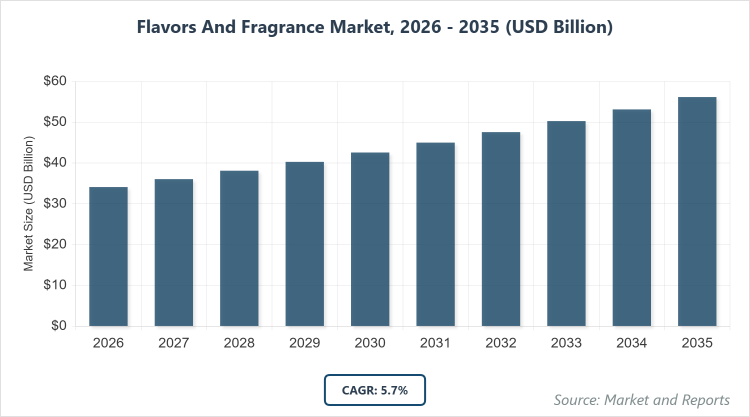
According to MarketnReports, the global Flavors and Fragrances market size was estimated at USD 34.1 billion in 2025 and is expected to reach USD 59.4 billion by 2035, growing at a CAGR of 5.7% from 2026 to 2035. The Rising demand for natural and organic products in the food, beverages, and personal care industries.
What are the Key Insights into the flavors and Fragrances Market?
- The global Flavors and Fragrances market was valued at USD 34.1 billion in 2025 and is projected to reach USD 59.4 billion by 2035.
- The market is expected to grow at a CAGR of 5.7% during the forecast period from 2026 to 2035.
- The market is driven by increasing consumer preference for natural ingredients, growth in processed foods, and expansion in the personal care sector.
- The natural subsegment dominates the ingredient segment with a 74.6% share due to rising health consciousness and clean-label demands that encourage sustainable sourcing and premium pricing; the flavors subsegment leads the product segment with a 55.6% share owing to its extensive use in food and beverages for taste enhancement and product differentiation; the beverages subsegment holds a 33% share in the application segment because of surging demand for flavored drinks in emerging markets and innovation in functional beverages.
- Asia-Pacific dominates with a 35% share due to rapid urbanization, population growth, and booming food & beverage industries in countries like China and India.
What is the Flavors and Fragrances Market?
Industry Overview
The Flavors and Fragrances market encompasses the creation, production, and distribution of compounds that enhance sensory experiences in food, beverages, personal care, and household products, focusing on taste and scent to meet consumer preferences for appealing and differentiated goods. Market definition includes both synthetic and natural ingredients used to formulate flavors for edible items and fragrances for non-edible applications, supporting industries in delivering consistent quality, innovation, and compliance with health and sustainability standards amid evolving global demands.
What are the Market Dynamics in the Flavors and Fragrances Market?
Growth Drivers
The escalating demand for natural and organic products, driven by health-aware consumers seeking clean-label options free from artificial additives, serves as a primary growth driver for the Flavors And Fragrance market, prompting manufacturers to innovate with plant-based and biotech-derived ingredients to align with wellness trends. Expansion in the food and beverage industry, particularly in emerging economies, fuels market growth through increased consumption of processed and convenience foods that require flavor enhancements to improve palatability and shelf life. Advancements in extraction technologies and sustainable sourcing practices enable cost-effective production of high-quality fragrances for personal care, further accelerating adoption across cosmetics and household sectors.
Restraints
Volatility in raw material prices, influenced by climate changes and supply chain disruptions affecting natural sources like essential oils and spices, acts as a significant restraint, increasing production costs and challenging profitability for smaller players. Stringent regulatory requirements on ingredient safety and labeling, varying across regions, impose compliance burdens that delay product launches and limit market entry for innovative formulations. The prevalence of synthetic alternatives facing consumer backlash due to health concerns restricts growth in segments prioritizing affordability over natural appeal.
Opportunities
The rise of functional flavors and fragrances, incorporating health benefits like probiotics or aromatherapy elements, presents opportunities to tap into the wellness market, allowing differentiation in competitive categories such as nutraceuticals and premium personal care. Strategic partnerships with biotechnology firms for enzyme-based production open avenues for eco-friendly innovations, reducing dependency on traditional agriculture and appealing to sustainability-focused brands. Growing e-commerce penetration enables direct-to-consumer models for customized scents and tastes, expanding reach in untapped demographics.
Challenges
Sustainability issues in sourcing natural ingredients, amid environmental concerns like deforestation and biodiversity loss, pose challenges requiring investment in ethical supply chains and certifications to maintain consumer trust. Intense competition from private-label brands erodes market share for established players, necessitating continuous R&D to stay ahead in innovation and cost management. Adapting to shifting consumer preferences for exotic and ethnic profiles demands agile formulation capabilities, complicating global standardization efforts.
Flavors And Fragrance Market: Report Scope
| Report Attributes | Report Details |
| Report Name | Flavors And Fragrance Market |
| Market Size 2025 | USD 34.1 Billion |
| Market Forecast 2035 | USD 59.4 Billion |
| Growth Rate | CAGR of 5.7% |
| Report Pages | 220 |
| Key Companies Covered |
Givaudan, International Flavors & Fragrances (IFF), Firmenich SA, Symrise AG, Takasago International Corp., Mane SA, BASF SE, Sensient Technologies Corp., Kerry Group plc, Robertet SA, and Others |
| Segments Covered | By Ingredient, By Product, By Application, and By Region |
| Regions Covered | North America, Europe, Asia Pacific (APAC), Latin America, and The Middle East and Africa (MEA) |
| Base Year | 2025 |
| Historical Year | 2020 – 2024 |
| Forecast Year | 2026 – 2035 |
| Customization Scope | Avail customized purchase options to meet your exact research needs. |
How is the Market Segmentation of Flavors And Fragrance?
The Flavors And Fragrance market is segmented by ingredient, product, application, and region.
Based on Ingredient Segment, the natural subsegment is the most dominant with a 74.6% share, driven by consumer shifts toward health-conscious and eco-friendly products that prioritize transparency and reduce synthetic chemical exposure, thereby boosting market growth through premium pricing and expanded applications in organic goods; the synthetic subsegment is the second most dominant, offering cost-effective and consistent alternatives that support large-scale production and drive accessibility in price-sensitive markets.
Based on Product Segment, the flavors subsegment is the most dominant with a 55.6% share, as it caters to the expanding food and beverage industry where taste innovation enhances product appeal and consumer loyalty, propelling market growth via diversification in processed foods; the fragrances subsegment is the second most dominant, fueling demand in personal care through sensory branding that elevates user experience and supports premium positioning.
Based on Application Segment, the beverages subsegment is the most dominant with a 33% share, owing to rising consumption of flavored and functional drinks that require versatile formulations to meet diverse tastes, driving market expansion through hydration trends and non-alcoholic innovations; the cosmetics & toiletries subsegment is the second most dominant, leveraging fragrances for emotional appeal and brand differentiation that enhance product efficacy perception.
What are the Recent Developments in the Flavors and Fragrances Market?
- In April 2025, Givaudan completed the acquisition of Naturex, a leading natural ingredients company, strengthening its position in the natural and organic ingredients segment by broadening its product portfolio and expanding its customer base.
- In May 2025, Symrise AG announced the opening of its new innovation center in Bangalore, India, to solidify its presence in the Indian market and create locally relevant solutions for customers through enhanced research and development.
- In March 2024, BASF Aroma Ingredients expanded its Isobionics portfolio with Natural beta-Caryophyllene 80, a biotech-derived natural flavor offering high purity and broad applications in food, beverages, and fragrances.
- In January 2024, International Flavors & Fragrances Inc. introduced new sustainable flavor solutions, focusing on plant-based innovations to meet growing demand for eco-friendly products in the food industry.
How is the Regional Analysis of Flavors And Fragrance Market?
- Asia-Pacific to dominate the global market.
Asia-Pacific leads the Flavors and Fragrances market with a 35% share, fueled by rapid urbanization and a burgeoning middle class in China, the dominant country, where increasing disposable incomes drive demand for flavored processed foods and premium personal care items.
North America holds a 30% share, supported by strong innovation in clean-label products and wellness trends in the United States, the leading country, emphasizing natural ingredients in beverages and cosmetics to cater to health-conscious consumers.
Europe accounts for a 25% share, driven by stringent regulations and a sustainability focus in Germany, the key country, promoting natural fragrances in the household and fine fragrance sectors for eco-friendly branding.
Latin America represents a 5% share, with Brazil as the dominant country, experiencing growth through expanding food exports and local flavor preferences in snacks and beverages amid economic recovery.
The Middle East and Africa hold a 5% share, led by the UAE through luxury fragrance markets and tourism-driven personal care demand, fostering innovations in halal-certified products.
Who are the Key Market Players in Flavors And Fragrance?
- Givaudan pursues acquisitions like Naturex to bolster natural ingredient capabilities, focusing on sustainable innovation and regional expansion to capture emerging market demands.
- International Flavors & Fragrances (IFF) emphasizes plant-based and biotech solutions through R&D investments, partnering with food brands for customized flavors to enhance sustainability and product differentiation.
- Firmenich SA integrates digital scent technologies and ethical sourcing, collaborating on wellness-focused fragrances to strengthen its position in personal care and fine fragrances.
- Symrise AG expands innovation centers in high-growth regions like India, prioritizing natural extracts and AI-driven formulation to meet clean-label trends.
- Takasago International Corp. leverages modular production for agile responses to consumer preferences, focusing on Asian markets with exotic flavor profiles.
- Mane SA invests in biotech fermentation for eco-friendly ingredients, targeting premium beverages and cosmetics through strategic alliances.
- BASF SE advances its Isobionics portfolio with natural flavors, emphasizing supply chain resilience and regulatory compliance for global distribution.
- Sensient Technologies Corp. specializes in color-flavor synergies, adopting clean extraction methods to appeal to organic food sectors.
- Kerry Group plc focuses on functional flavors for health benefits, expanding through acquisitions to diversify in dairy and savory applications.
- Robertet SA prioritizes artisanal essential oils, enhancing traceability for luxury fragrances and sustainable partnerships.
What are the Market Trends in Flavors and Fragrances?
- Increasing adoption of natural and biotech-derived ingredients to align with clean-label and sustainability preferences.
- Growth in functional flavors incorporating health benefits like immunity-boosting elements in beverages and snacks.
- Rise of personalized fragrances through AI and customization in personal care and fine fragrances.
- Expansion of plant-based and vegan options to cater to ethical consumer demands in food and cosmetics.
- Integration of sensory marketing in e-commerce for virtual scent experiences and product trials.
What Market Segments and Subsegments are Covered in the Flavors And Fragrance Report?
By Ingredient
- Natural
- Synthetic
By Product
- Flavors
- Fragrances
By Application
- Beverages
- Dairy Products
- Bakery
- Savory & Snacks
- Confectionery Products
- Fine Fragrances
- Cosmetics & Toiletries
- Soap & Detergents
- Household & Air Care
By Region
-
- North America
- U.S.
- Canada
- Europe
- UK
- Germany
- France
- Rest of Europe
- Asia Pacific
- China
- India
- Japan
- Rest of Asia Pacific
- Latin America
- Brazil
- Mexico
- Rest of Latin America
- Middle East & Africa
- UAE
- South Africa
- Rest of Middle East & Africa
- North America
Chapter 1. Preface
Chapter 2. Executive Summary
Chapter 3. Global Flavors And Fragrance Market - Industry Analysis
Chapter 4. Global Flavors And Fragrance Market- Competitive Landscape
Chapter 5. Global Flavors And Fragrance Market - Ingredient Analysis
Chapter 6. Global Flavors And Fragrance Market - Product Analysis
Chapter 7. Global Flavors And Fragrance Market - Application Analysis
Chapter 8. Flavors And Fragrance Market - Regional Analysis
Chapter 9. Company Profiles
Frequently Asked Questions
Flavors and fragrances are compounds used to enhance taste and scent in food, beverages, personal care, and household products, derived from natural or synthetic sources.
Key factors include rising demand for natural ingredients, expansion in food & beverage sectors, sustainability trends, and innovations in biotech formulations.
The market is projected to grow from USD 36.05 billion in 2026 to USD 59.4 billion by 2035.
The CAGR is expected to be 5.7% from 2026 to 2035.
Asia-Pacific will contribute notably, holding around 35% of the market share due to urbanization and industry growth.
Major players include Givaudan, International Flavors & Fragrances (IFF), Firmenich SA, Symrise AG, and Takasago International Corp.
The report provides comprehensive analysis of market size, trends, segmentation, regional insights, key players, and forecasts from 2026 to 2035.
Stages include raw material sourcing, extraction/formulation, blending, quality testing, packaging, distribution, and end-use application.
Trends are shifting toward natural, sustainable, and functional options, with preferences for personalized, vegan, and health-beneficial products.
Stringent safety regulations and environmental sustainability mandates drive innovation in green sourcing, while climate impacts on raw materials influence supply chains.