
Flavored Cigars Market Size, Share and Trends 2026 to 2035
According to MarketnReports, the global Flavored Cigars market size was estimated at USD 7.93 billion in 2025 and is expected to reach USD 25.49 billion by 2035, growing at a CAGR of 12.4% from 2026 to 2035. The High appeal among young adults and innovation in flavor profiles.
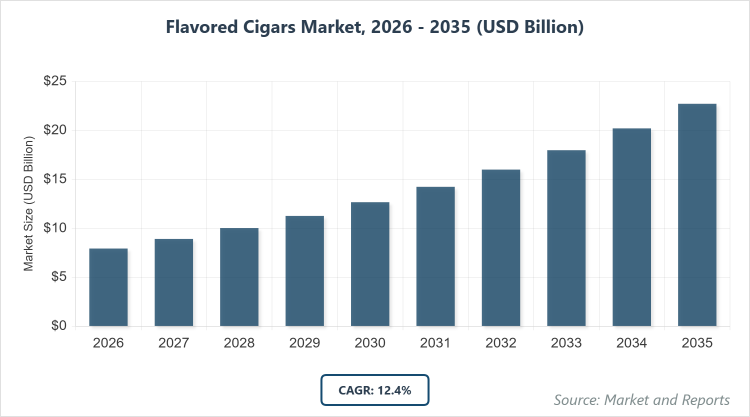
What are the Key Insights into the flavored cigars market?
- The global Flavored Cigars market was valued at USD 7.93 billion in 2025 and is projected to reach USD 25.49 billion by 2035.
- The market is expected to grow at a CAGR of 12.4% during the forecast period from 2026 to 2035.
- The market is driven by rising demand among young adults, flavor innovation, and premiumization trends.
- The machine-made subsegment dominates the type segment with a 85% share due to its affordability and consistent quality appealing to mass consumers; the fruit subsegment leads the flavor segment with a 30% share owing to its refreshing appeal and popularity in social settings; the convenience stores subsegment holds a 41% share in the distribution channel segment because of easy accessibility and impulse purchases.
- North America dominates with a 45% share due to established cigar culture, high disposable incomes, and strong retail infrastructure in the United States.
What is the Flavored Cigars Market?
Industry Overview
The Flavored Cigars market involves the production, distribution, and consumption of cigars infused with various flavors such as fruit, chocolate, vanilla, and menthol to enhance the smoking experience and attract a broader consumer base beyond traditional tobacco enthusiasts. Market definition includes both machine-made and hand-rolled cigars that incorporate natural or synthetic flavorings during manufacturing, catering to evolving preferences for aromatic and milder options in social and recreational settings while navigating regulatory landscapes focused on tobacco products.
What are the Market Dynamics in the Flavored Cigars Market?
Growth Drivers
The increasing appeal of flavored cigars among young adults and casual smokers serves as a primary growth driver for the Flavored Cigars market, as these demographics seek milder, aromatic alternatives to traditional tobacco products, expanding the consumer base beyond seasoned enthusiasts. Innovation in flavor profiles, such as fruit, chocolate, and exotic infusions, drives market expansion by offering unique sensory experiences that align with evolving lifestyle trends and social consumption occasions. Rising disposable incomes in emerging economies further propel demand for premium flavored variants, encouraging manufacturers to invest in quality enhancements and marketing strategies that position these products as lifestyle accessories.
Restraints
Stringent regulatory restrictions on flavored tobacco products, including bans in regions like the United States and Europe aimed at reducing youth initiation, act as a significant restraint, limiting market accessibility and forcing reformulations that may alter product appeal. High taxation policies on tobacco items increase retail prices, deterring price-sensitive consumers and constraining growth in developing markets where affordability is key. Health concerns and anti-smoking campaigns raise awareness of risks associated with flavored cigars, potentially shifting consumer preferences toward alternatives like e-cigarettes and reducing overall demand.
Opportunities
The trend toward customization and personalization in flavored cigars presents opportunities for market players to offer bespoke flavor combinations and packaging, catering to niche preferences and enhancing brand loyalty among discerning consumers. Expansion into untapped markets in Asia-Pacific and Latin America, where rising urbanization and Western influences boost demand for premium tobacco experiences, opens avenues for growth through strategic partnerships and localized marketing. Advancements in natural flavor extraction and sustainable sourcing provide opportunities to appeal to health-conscious and eco-aware consumers, differentiating products in a competitive landscape.
Challenges
Navigating diverse regulatory environments across regions poses challenges, as varying restrictions on flavors and advertising require adaptive compliance strategies that increase operational costs and complexity. Intense competition from alternative nicotine delivery systems, such as vaping devices with similar flavor options, threatens market share by offering perceived healthier or more convenient alternatives. Supply chain vulnerabilities in sourcing quality tobacco and flavor ingredients, influenced by climate changes and geopolitical factors, challenge consistent product quality and availability.
Flavored Cigars Market: Report Scope
| Report Attributes | Report Details |
| Report Name | Flavored Cigars Market |
| Market Size 2025 | USD 7.93 Billion |
| Market Forecast 2035 | USD 25.49 Billion |
| Growth Rate | CAGR of 12.4% |
| Report Pages | 220 |
| Key Companies Covered |
Swisher International, Scandinavian Tobacco Group, Imperial Brands, Drew Estate, General Cigar, Oettinger Davidoff, Rocky Patel Premium Cigars, Gurkha Cigars, Arnold Andre, Avanti Cigar, and Others |
| Segments Covered | By Type, By Flavor, By Distribution Channel, and By Region |
| Regions Covered | North America, Europe, Asia Pacific (APAC), Latin America, and The Middle East and Africa (MEA) |
| Base Year | 2025 |
| Historical Year | 2020 – 2024 |
| Forecast Year | 2026 – 2035 |
| Customization Scope | Avail customized purchase options to meet your exact research needs. |
How is the Market Segmentation of Flavored Cigars?
The Flavored Cigars market is segmented by type, flavor, distribution channel, and region.
Based on Type Segment, the machine-made subsegment is the most dominant with a 85% share, as its automated production ensures affordability and uniformity that attract mass-market consumers seeking convenient flavored options, driving market growth by broadening accessibility and supporting high-volume sales; the hand-rolled subsegment is the second most dominant, appealing to premium seekers with artisanal craftsmanship that enhances flavor authenticity and elevates the smoking experience.
Based on Flavor Segment, the fruit subsegment is the most dominant with a 30% share, due to its vibrant and refreshing profiles that draw in younger demographics and casual users, propelling market expansion through innovative blends that align with health trends and social preferences; the chocolate & coffee subsegment is the second most dominant, offering indulgent tastes that cater to sophisticated palates and boost demand in premium categories.
Based on Distribution Channel Segment, the convenience stores subsegment is the most dominant with a 41% share, providing easy access for impulse buys and catering to on-the-go consumers, which drives market growth by facilitating widespread availability and quick purchases; the online subsegment is the second most dominant, enabling global reach and personalized shopping experiences that expand consumer options and fuel e-commerce adoption.
What are the Recent Developments in the Flavored Cigars Market?
- In July 2025, a major cigar company acquired a flavored cigar specialist to strengthen its product portfolio and expand distribution reach, enhancing its competitive edge in premium segments.
- In March 2025, a new premium flavored cigar line was launched featuring novel fruit blends and luxury packaging, targeting upscale smokers seeking unique experiences.
- In January 2025, Scandinavian Tobacco Group introduced Signature Action Mix cigarillos with dual capsules combining berry and mint flavors, innovating for younger consumers.
- In April 2024, Rocky’s Cigars expanded its premium brand launch in emerging markets, unveiling new flavored variants to capture growing demand.
How is the Regional Analysis of the Flavored Cigars Market?
- North America is expected to dominate the global market.
North America leads the Flavored Cigars market with a 45% share, driven by a mature consumer base and robust retail channels in the United States, the dominant country, where high disposable incomes and cultural acceptance fuel demand for diverse flavor innovations.
Europe holds a 25% share, supported by premium preferences in Germany, the leading country, emphasizing traditional craftsmanship blended with flavored options to comply with regulations and attract younger users.
Asia-Pacific accounts for a 20% share, with rapid growth propelled by urbanization in China, the key country, where increasing western influences and disposable incomes drive adoption of flavored cigars in social settings.
Latin America represents a 5% share, led by Brazil as the dominant country, benefiting from local tobacco heritage and expanding exports of flavored variants amid economic improvements.
The Middle East and Africa hold a 5% share, with the UAE emerging as a hub through luxury markets and tourism, fostering demand for premium flavored cigars in high-end retail.
Who are the Key Market Players in Flavored Cigars?
- Swisher International focuses on mass-market flavored innovations and acquisitions to expand its portfolio, targeting affordability and wide distribution for younger demographics.
- Scandinavian Tobacco Group emphasizes premium flavored launches like dual-capsule cigarillos, leveraging partnerships to enhance flavor diversity and market penetration.
- Imperial Brands invests in regulatory-compliant flavored variants and digital marketing, strengthening its position in Europe through brand diversification.
- Drew Estate specializes in infused flavors for niche enthusiasts, pursuing experiential retail strategies to build loyalty in premium segments.
- General Cigar adopts sustainable sourcing for natural flavors, collaborating on limited-edition releases to appeal to health-conscious consumers.
- Oettinger Davidoff prioritizes luxury hand-rolled flavored cigars, expanding through high-end lounges and global alliances.
- Rocky Patel Premium Cigars innovates with exotic blends, focusing on emerging markets via targeted expansions and flavor customization.
- Gurkha Cigars leverages bold flavor profiles and packaging, employing celebrity endorsements to capture affluent markets.
- Arnold Andre concentrates on European compliance and organic flavors, enhancing distribution through specialty channels.
- Avanti Cigar offers value-driven machine-made options, investing in online platforms to broaden accessibility.
What are the Market Trends in Flavored Cigars?
- Rising demand for natural and organic flavor infusions aligns with health-conscious consumer preferences.
- Growth in premium and limited-edition flavored variants targeting affluent and experiential smokers.
- The increasing popularity of fruit and exotic blends among younger demographics for social consumption.
- Expansion of online sales channels offering customization and subscription models.
- Shift toward sustainable sourcing and eco-friendly packaging amid regulatory pressures.
What Market Segments and Subsegments are Covered in the Flavored Cigars Report?
By Type
- Machine-Made
- Hand-Rolled
By Flavor
- Fruit
- Chocolate & Coffee
- Vanilla & Cream
- Menthol
By Distribution Channel
- Online
- Specialty Tobacco Shops
- Convenience Stores
- Supermarkets & Hypermarkets
By Region
-
- North America
- U.S.
- Canada
- Europe
- UK
- Germany
- France
- Rest of Europe
- Asia Pacific
- China
- India
- Japan
- Rest of Asia Pacific
- Latin America
- Brazil
- Mexico
- Rest of Latin America
- Middle East & Africa
- UAE
- South Africa
- Rest of Middle East & Africa
- North America
Frequently Asked Questions
Flavored cigars are tobacco products infused with various aromatic essences like fruit, chocolate, or menthol to enhance taste and appeal.
Key factors include young adult demand, flavor innovation, premiumization, and regulatory changes.
The market is projected to grow from USD 8.91 billion in 2026 to USD 25.49 billion by 2035.
The CAGR is expected to be 12.4% from 2026 to 2035.
North America will contribute notably, holding around 45% of the market share due to strong consumer base.
Major players include Swisher International, Scandinavian Tobacco Group, Imperial Brands, Drew Estate, and General Cigar.
The report provides in-depth analysis including market size, trends, segmentation, regional insights, key players, and forecasts from 2026 to 2035.
Stages include tobacco sourcing, flavor infusion, manufacturing, packaging, distribution, and retail.
Trends are shifting toward natural flavors and premium options, with preferences for exotic and customizable experiences among younger users.
Flavor bans and anti-smoking campaigns constrain growth, while sustainable sourcing demands influence production practices.