
Fish Oil Market Size, Share and Trends 2026 to 2035
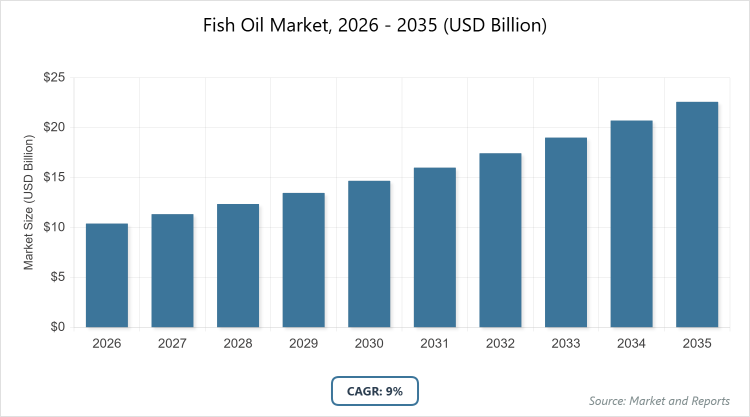
According to MarketnReports, the global Fish Oil market size was estimated at USD 10.4 billion in 2025 and is expected to reach USD 24.6 billion by 2035, growing at a CAGR of 9% from 2026 to 2035. Fish Oil Market is driven by expanding recognition of omega-3 fatty acids’ role in supporting heart, brain, and joint health.
What are Fish Oil Market Key Insights?
- The global fish oil market size was estimated at USD 10.4 billion in 2025 and is expected to reach USD 24.6 billion by 2035.
- The global fish oil market is expected to grow at a CAGR of 9% from 2026 to 2035.
- The market is driven by increasing awareness of omega-3 health benefits and expanding applications in aquaculture and supplements.
- Salmon oil dominates the product type segment with a 45% share, as it offers superior EPA and DHA levels for cardiovascular health, cognitive performance, and immune support.
- Aquaculture feed dominates the application segment with a 50% share, due to its essential role in providing omega-3 to farmed fish for optimal growth and nutritional quality.
- Aquaculture farms dominate the end-user segment with a 50% share, driven by the global expansion of sustainable aquaculture practices requiring nutrient-rich feeds.
- Asia Pacific dominates the region segment with a 35% share, owing to its massive aquaculture industry, particularly in China, which boosts demand for fish oil in feed formulations.
What is Fish Oil Market Industry Overview?
The fish oil market encompasses the production, processing, and distribution of oils derived from fatty fish species rich in omega-3 fatty acids such as eicosapentaenoic acid (EPA) and docosahexaenoic acid (DHA). This market serves diverse sectors including human nutrition, animal feed, and pharmaceuticals, where fish oil is valued for its anti-inflammatory properties and essential nutrient profile. Market definition refers to fish oil as a natural lipid extract from fish tissues, primarily used to enhance health outcomes in both humans and animals through supplements, fortified foods, and feed formulations.
What are Fish Oil Market Dynamics?
Growth Drivers
The primary growth drivers in the fish oil market include rising consumer awareness of omega-3 fatty acids’ benefits for heart health, cognitive function, and inflammation reduction, leading to increased demand for dietary supplements and functional foods. Technological advancements in aquaculture, such as sustainable farming systems, have amplified the need for fish oil in feed to enhance fish quality and yield. Regulatory support for nutritional health claims and preventive healthcare further propels market expansion, with governments promoting omega-3 intake to address chronic diseases.
Restraints
Market restraints stem from volatility in raw material supply due to overfishing, climate change impacts like El Niño, and strict fishing quotas, causing price fluctuations and supply shortages. Environmental concerns over contaminants such as heavy metals and PCBs require costly purification processes, limiting accessibility for smaller producers. Competition from plant-based omega-3 alternatives like algal oil also poses a challenge, as consumers shift toward vegan and sustainable options amid ethical concerns about marine sourcing.
Opportunities
Opportunities arise from diversification into alternative sources like krill and algal oils to mitigate supply risks, alongside investments in high-purity, pharmaceutical-grade fish oil for medical applications. Emerging markets in Asia and Latin America offer growth potential through expanding aquaculture and rising health consciousness. Innovation in oxidation-resistant formulations and sustainability certifications can attract premium consumers, while partnerships for biotech-enhanced extraction methods promise improved efficiency and product quality.
Challenges
Challenges include balancing demand between human nutrition and aquaculture sectors, leading to supply strains and elevated costs. Stringent global regulations on contaminants and sustainable sourcing demand significant capital for compliance and infrastructure. Market fragmentation with numerous small players complicates quality control, while economic factors like inflation and trade barriers disrupt global supply chains.
Fish Oil Market: Report Scope
| Report Attributes | Report Details |
| Report Name | Fish Oil Market |
| Market Size 2025 | USD 10.4 Billion |
| Market Forecast 2035 | USD 24.6 Billion |
| Growth Rate | CAGR of 9% |
| Report Pages | 250 |
| Key Companies Covered |
Omega Protein Corporation, DSM, BASF SE, Croda International Plc, and Others |
| Segments Covered | By Product Type, By Application, By End-User, and By Region |
| Regions Covered | North America, Europe, Asia Pacific (APAC), Latin America, and The Middle East and Africa (MEA) |
| Base Year | 2025 |
| Historical Year | 2020 – 2024 |
| Forecast Year | 2026 – 2035 |
| Customization Scope | Avail customized purchase options to meet your exact research needs. |
What is Fish Oil Market Segmentation?
The Fish Oil market is segmented by product type, application, end-user, and region.
Based on Product Type Segment. Salmon oil is the most dominant subsegment, holding a 45% share, followed by anchovy oil as the second most dominant with a 20% share. Salmon oil dominates due to its high concentration of EPA and DHA, which supports cardiovascular and cognitive health, driving demand in supplements and pharma; it helps propel the market by addressing consumer needs for premium, effective omega-3 sources. Anchovy oil is second dominant because it serves as a primary raw material for large-scale production, offering cost-effective volume for aquaculture feed, contributing to market growth through reliable supply for industrial applications.
Based on Application Segment. Aquaculture feed is the most dominant subsegment, holding a 50% share, followed by dietary supplements as the second most dominant with a 30% share. Aquaculture feed dominates as it is essential for enriching farmed fish with omega-3, ensuring nutritional quality and supporting the global aquaculture boom; it drives the market by meeting the rising demand for sustainable seafood production. Dietary supplements are second dominant owing to growing health awareness, providing convenient omega-3 intake for wellness; they fuel market expansion by catering to preventive healthcare trends.
Based on End-User Segment. Aquaculture farms are the most dominant subsegment, holding a 50% share, followed by consumers as the second most dominant with a 25% share. Aquaculture farms dominate due to their reliance on fish oil for feed to optimize fish health and yield in large-scale operations; this drives the market by aligning with the expansion of global aquaculture. Consumers are second dominant as they seek fish oil for personal health benefits through supplements; they contribute to market growth via direct retail demand for wellness products.
What are Fish Oil Market Recent Developments?
- In May 2025, Omega Protein partnered with a biotech firm to advance lipid purification, achieving clinical-grade EPA/DHA levels through enzymatic hydrolysis, enhancing extraction efficiency and product stability for nutraceuticals.
- Peru’s anchovy production surged in 2025, stabilizing prices and improving global accessibility, as noted in IFFO reports, aiding supply chain reliability amid recovering yields post-El Niño.
- Corpesca acquired Pesquera Diamante’s assets in 2025 to strengthen its raw material base and export capabilities, consolidating operations in Latin America for better market positioning.
- Global fish oil production rose 34% in Q1 2025 compared to the previous year, driven by yield recovery from European and Peruvian waters, impacting pricing and availability positively.
- In November 2025, Peruvian authorities set a 1.63 million metric ton quota for the second fishing season, supporting projected global output of 1.2-1.3 million tons of fish oil for the year.
What is Fish Oil Market Regional Analysis?
Asia Pacific to dominate the global market.
Asia Pacific leads the fish oil market with a 35% share, driven by robust aquaculture in China, the dominating country, where demand for omega-3-enriched feed supports massive seafood production; India’s growing health supplement sector adds to regional momentum through increasing consumer adoption.
North America holds significant market presence, with the United States as the dominating country, fueled by high demand for dietary supplements and regulatory emphasis on omega-3 health claims; Canada’s sustainable fishing practices contribute to steady supply for pharmaceuticals and pet nutrition.
Europe maintains a strong position, led by Norway as the dominating country, renowned for salmon oil production and innovations in sustainable sourcing; Germany’s focus on pharma-grade oils and the UK’s supplement market enhance regional growth through quality-driven exports.
Latin America is emerging rapidly, with Peru as the dominating country, benefiting from abundant anchovy resources and export-oriented processing; Chile’s advancements in purification technologies support aquaculture and global supply chains.
The Middle East and Africa show gradual progress, with South Africa as the dominating country, driven by expanding awareness of omega-3 benefits and investments in local processing; the UAE’s growing pet food and supplement markets aid regional development.
Who are Fish Oil Market Key Players?
- Omega Protein Corporation. Omega Protein Corporation leads with vertical integration in marine operations and refining, focusing on sustainability through MSC certifications and biotech partnerships for enhanced EPA/DHA extraction; it employs strategies like supply chain control and product diversification into nutraceuticals and pet food to maintain a 15% global share.
- DSM. DSM emphasizes clinical-grade omega-3 formulations, investing in bioavailability enhancements and drug delivery systems; its strategies include R&D for custom EPA/DHA ratios and global distribution networks to target pharmaceutical and supplement markets.
- BASF SE. BASF SE specializes in high-stability oils, utilizing international partnerships for sustainable sourcing; strategies involve innovation in oxidation-resistant products and expansion into aquaculture feed to leverage regulatory support for health claims.
- Croda International Plc. Croda International Plc focuses on ultra-refined, low-toxin oils via molecular distillation; its strategies include niche targeting in cosmetics and pharma, with emphasis on third-party certifications like USP for premium positioning.
- GC Rieber VivoMega. GC Rieber VivoMega prioritizes sustainable Norwegian sourcing for exclusive EPA/DHA blends in aquaculture; strategies encompass fishery partnerships and cold storage logistics to ensure quality and supply stability.
What are Fish Oil Market Trends?
- Increasing emphasis on sustainable sourcing with MSC certifications to address environmental concerns and consumer preferences for ethical products.
- Shift toward pharmaceutical-grade fish oil with high-potency concentrates (85%+ EPA/DHA) for medical applications like cardiovascular drugs.
- Growth in e-commerce distribution, enhancing accessibility through non-store channels for supplements and functional foods.
- Innovation in oxidation-resistant formulations and packaging to extend shelf life in aquaculture feed and pet nutrition.
- Rising incorporation of fish oil in functional beverages and infant nutrition for targeted health benefits across age groups.
What are Fish Oil Market Segments Covered?
-
By Product Type
- Salmon Oil
- Cod Liver Oil
- Tuna Oil
- Sardine Oil
- Anchovy Oil
- Menhaden Oil
- Herring Oil
- Mackerel Oil
- Krill Oil
- Squalene Oil
- Others
-
By Application
- Aquaculture Feed
- Dietary Supplements
- Pharmaceuticals
- Animal Nutrition & Pet Feed
- Functional Foods
- Functional Beverages
- Cosmetics
- Infant Nutrition
- Livestock Feed
- Beauty Products
- Others
-
By End-User
- Aquaculture Farms
- Pharmaceutical Companies
- Consumers
- Food & Beverage Manufacturers
- Pet Food Producers
- Cosmetic Companies
- Hospitals
- Animal Farms
- Retailers
- Others
- Others
By Region
- North America
- U.S.
- Canada
- Europe
- UK
- Germany
- France
- Rest of Europe
- Asia Pacific
- China
- India
- Japan
- Rest of Asia Pacific
- Latin America
- Brazil
- Mexico
- Rest of Latin America
- Middle East & Africa
- UAE
- South Africa
- Rest of Middle East & Africa
Frequently Asked Questions
Fish oil is a lipid extracted from the tissues of oily fish, rich in omega-3 fatty acids like EPA and DHA, used for health benefits in supplements, feed, and pharmaceuticals.
Key factors include rising health awareness, aquaculture expansion, regulatory support for omega-3 claims, and innovations in sustainable sourcing and purification.
The market is projected to grow from USD 10.4 billion in 2025 to USD 24.6 billion by 2035.
The CAGR is expected to be 9%.
Asia Pacific will contribute notably, driven by its dominant aquaculture sector.
Major players include Omega Protein Corporation, DSM, BASF SE, Croda International Plc, and GC Rieber VivoMega.
The report offers in-depth analysis of market size, trends, segments, regional outlook, key players, and forecasts.
Stages include raw material sourcing from fisheries, processing and refinement, distribution through channels, and end-use in supplements or feed.
Trends lean toward sustainable, certified products; consumers prefer high-purity, plant-alternative options for ethical and health reasons.
Regulations on contaminants and fishing quotas, plus environmental sustainability mandates, influence supply and drive innovation in eco-friendly practices.