
Fiber Bragg Grating (FBG) Market Size, Share and Trends 2026 to 2035
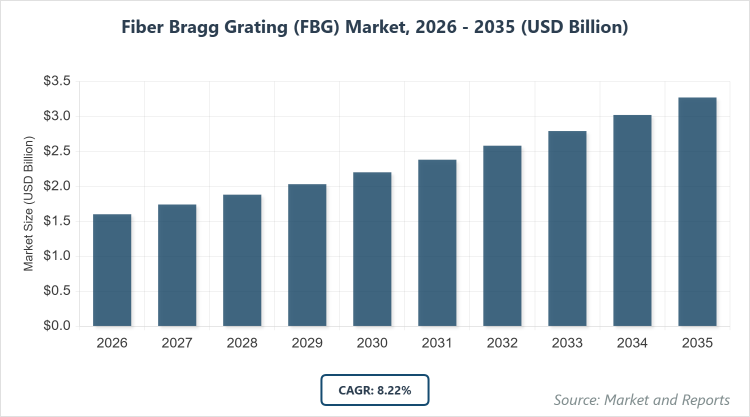
According to MarketnReports, the global Fiber Bragg Grating (FBG) market size was estimated at USD 1.605 billion in 2025 and is expected to reach USD 3.537 billion by 2035, growing at a CAGR of 8.22% from 2026 to 2035. Fiber Bragg Grating (FBG) Market is driven by increasing demand for advanced sensing technologies in structural health monitoring.
What is Fiber Bragg Grating (FBG)? An Industry Overview
Fiber Bragg Grating (FBG) is a type of distributed Bragg reflector constructed in a short segment of optical fiber that reflects particular wavelengths of light and transmits all others, functioning as a sensor for measuring strain, temperature, pressure, and vibration in various applications. The market definition encompasses FBG-based sensors and systems used for real-time monitoring in industries like aerospace, oil & gas, and civil engineering, offering advantages such as immunity to electromagnetic interference, multiplexing capability, and durability in harsh environments, supporting the growth of smart infrastructure and predictive maintenance while complying with safety and regulatory standards for reliable data acquisition.
What are the Key Insights of Fiber Bragg Grating (FBG) Market?
- The global Fiber Bragg Grating (FBG) market was valued at USD 1.605 billion in 2025 and is projected to reach USD 3.537 billion by 2035.
- The global Fiber Bragg Grating (FBG) market is expected to grow at a CAGR of 8.22% during the forecast period 2026-2035.
- The Fiber Bragg Grating (FBG) market is driven by advancements in telecommunications, structural health monitoring, and increasing adoption in oil & gas industries.
- The strain sensor subsegment dominates the type segment with a 37.78% share due to its critical role in monitoring structural integrity in aerospace and civil engineering.
- The structural health monitoring subsegment dominates the application segment with a 30% share owing to rising infrastructure projects and safety regulations requiring real-time data.
- The aerospace and defense subsegment dominates the end-user segment with a 28.31% share because of high demand for precise sensing in harsh environments.
- North America dominates the global Fiber Bragg Grating (FBG) market with a 35.42% share due to advanced technological infrastructure and strong R&D investments in the U.S.
What are the Market Dynamics of Fiber Bragg Grating (FBG)?
Growth Drivers
The Fiber Bragg Grating (FBG) market is propelled by the expanding telecommunications sector, where FBG sensors enable high-speed data transmission and network monitoring, with global 5G rollout demanding wavelength-division multiplexing that FBG facilitates for efficient bandwidth management. Advancements in structural health monitoring for bridges and buildings, driven by urbanization and safety standards, utilize FBG’s multiplexing capability to monitor multiple points with a single fiber, reducing costs by up to 50% compared to traditional sensors. Government investments in smart cities and renewable energy, such as wind turbine monitoring, further boost demand, as FBG provides durable, EMI-immune solutions for harsh environments, fostering innovation and market expansion.
Restraints
High initial costs for FBG interrogation systems and installation, often exceeding traditional sensors by 2-3 times due to specialized equipment, limit adoption in cost-sensitive industries like small-scale civil engineering projects. Technical challenges in temperature-strain cross-sensitivity require compensation techniques, increasing complexity and R&D expenses. Regulatory delays in certification for aerospace and medical applications, averaging 2-4 years, hinder market entry, while supply chain dependencies on rare earth dopants for fiber production create vulnerabilities to price fluctuations.
Opportunities
The integration of FBG with IoT and AI for predictive analytics offers opportunities in smart mining and oil & gas, where real-time vibration monitoring can prevent failures, potentially saving billions in downtime. Emerging markets in Asia-Pacific provide growth through infrastructure booms, where affordable FBG can address seismic monitoring needs. Partnerships for multi-parameter sensors, combining strain and temperature in one device, can expand into healthcare for biomedical applications, capitalizing on the aging population’s demand for non-invasive monitoring.
Challenges
Achieving accurate signal processing in noisy environments poses challenges, as multiplexing limits can overload systems in large-scale applications, requiring advanced demodulation that elevates costs. Data privacy and security in connected FBG networks for critical infrastructure risk cyber threats, necessitating encryption standards. Limited awareness in traditional industries demands education, while competition from wireless sensors in remote areas challenges FBG’s wired nature, requiring hybrid solutions to sustain growth.
Fiber Bragg Grating (FBG) Market: Report Scope
| Report Attributes | Report Details |
| Report Name | Fiber Bragg Grating (FBG) Market |
| Market Size 2025 | USD 1.605 Billion |
| Market Forecast 2035 | USD 3.537 Billion |
| Growth Rate | CAGR of 8.22% |
| Report Pages | 220 |
| Key Companies Covered | FBGS Technologies, HBM FiberSensing, Proximion AB, Micron Optics, ITF Technologies, Luna Innovations, and Others |
| Segments Covered | By Type, By Application, By End-User, and By Region |
| Regions Covered | North America, Europe, Asia Pacific (APAC), Latin America, and The Middle East and Africa (MEA) |
| Base Year | 2025 |
| Historical Year | 2020 – 2024 |
| Forecast Year | 2026 – 2035 |
| Customization Scope | Avail customized purchase options to meet your exact research needs. |
The Fiber Bragg Grating (FBG) market is segmented by type, application, end-user, and region.
Based on Type Segment: The strain sensor segment is the most dominant, holding a 37.78% market share, as it excels in detecting mechanical deformations in structures, driven by its high sensitivity and multiplexing capability for large-scale monitoring. This dominance drives market growth by enabling cost-effective structural health assessments in infrastructure. The temperature sensor segment is the second most dominant with a 30% share, valued for its stability in extreme conditions, which propels the market through applications in energy sectors.
Based on Application Segment: The structural health monitoring segment is the most dominant, capturing a 30% share, due to increasing infrastructure investments requiring real-time integrity checks. Its dominance accelerates market growth by reducing maintenance costs. The temperature monitoring segment ranks second with a 25% share, essential for industrial processes, driving the market with safety enhancements.
Based on End-User Segment: The aerospace and defense segment is the most dominant, with a 28.31% share, attributed to stringent safety needs for aircraft monitoring. This leads market growth by supporting advanced composites. The oil and gas segment is second with a 25% share, using FBG for pipeline integrity, propelling growth through remote sensing.
What are the Recent Developments in Fiber Bragg Grating (FBG) Market?
- In January 2025, FBGS Technologies introduced a new multi-parameter FBG sensor for aerospace, combining strain and temperature in one fiber.
- In February 2025, HBM FiberSensing expanded its oil & gas portfolio with high-temperature FBG for downhole monitoring.
- In March 2025, Proximion AB partnered with a telecom firm for FBG in 5G infrastructure.
- In April 2025, Micron Optics launched AI-enhanced interrogation systems for structural health.
- In May 2025, ITF Technologies acquired a startup for bio-FBG in medical applications.
What is the Regional Analysis of Fiber Bragg Grating (FBG) Market?
- North America to dominate the global market
North America holds a 35.42% share in the Fiber Bragg Grating (FBG) market, driven by R&D investments. The United States dominates, with aerospace leaders using FBG for aircraft monitoring, supported by NASA grants.
Europe maintains a strong position in the Fiber Bragg Grating (FBG) market, fueled by infrastructure projects. Germany leads, with applications in wind energy and civil engineering.
Asia Pacific is the fastest-growing region for Fiber Bragg Grating (FBG), with a 9.16% CAGR, propelled by industrialization. China dominates, adopting for smart grids and oil exploration.
Latin America is emerging in the Fiber Bragg Grating (FBG) market, focusing on mining. Brazil leads, using for structural safety in resources.
The Middle East and Africa show potential in the Fiber Bragg Grating (FBG) market, driven by oil & gas. Saudi Arabia is a key player, implementing for pipeline integrity.
Who are the Key Market Players and Strategies in Fiber Bragg Grating (FBG)?
FBGS Technologies focuses on multi-parameter sensors, launching for aerospace integrations.
HBM FiberSensing emphasizes high-temperature expansions, targeting oil & gas.
Proximion AB pursues telecom partnerships, advancing 5G applications.
Micron Optics introduces AI systems, enhancing structural monitoring.
ITF Technologies acquires for bio-applications, expanding medical portfolios.
Luna Innovations develops vibration sensors, focusing on energy sectors.
What are the Market Trends in Fiber Bragg Grating (FBG)?
- Increasing adoption in structural health monitoring for infrastructure.
- Growth in multi-parameter FBG for combined sensing.
- Expansion in oil & gas for downhole applications.
- Integration with AI for data analysis.
- Rise in telecom for 5G networks.
- Focus on bio-FBG for medical monitoring.
What are the Market Segments and their Subsegment Covered in the Fiber Bragg Grating (FBG) Report?
By Type
-
- Temperature Sensor
- Strain Sensor
- Pressure Sensor
- Vibration Sensor
- Acoustic Sensor
- Others
By Application
-
- Structural Health Monitoring
- Temperature Monitoring
- Vibration and Acoustic Monitoring
- Pressure Monitoring
- Others
By End-User
-
- Aerospace and Defense
- Oil and Gas
- Telecommunication
- Civil Engineering
- Energy and Utilities
- Industrial
- Others
Frequently Asked Questions
Fiber Bragg Grating (FBG) is an optical fiber sensor that reflects specific wavelengths for measuring strain, temperature, and other parameters.
Key factors include sensing demand in infrastructure, oil & gas advancements, and AI integration.
The market is projected to grow from USD 1.737 billion in 2026 to USD 3.537 billion by 2035.
The market is expected to grow at a CAGR of 8.22% during 2026-2035.
North America will contribute notably, holding a 35.42% share due to R&D focus.
Major players include FBGS Technologies, HBM FiberSensing, Proximion AB, Micron Optics, ITF Technologies, and Luna Innovations.
The report provides market size, trends, segmentation, regional analysis, key players, and forecasts.
Stages include fiber fabrication, grating inscription, sensor packaging, system integration, and deployment.
Trends favor multi-parameter and AI-integrated sensors, with preferences for reliable, harsh-environment applications.
Safety regulations in aerospace and oil & gas drive adoption for monitoring.