
Facade System Market Size, Share and Trends 2026 to 2035
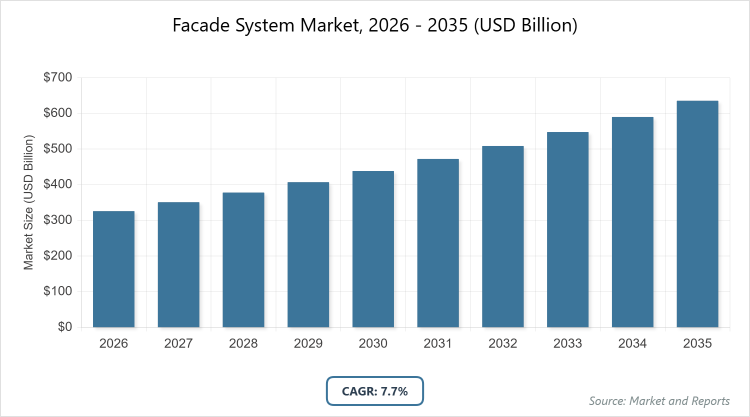
According to MarketnReports, the global Facade System market size was estimated at USD 326 billion in 2025 and is expected to reach USD 685 billion by 2035, growing at a CAGR of 7.7% from 2026 to 2035. Facade System Market is driven by rapid urbanization, surging construction activities worldwide, and increasing demand for energy-efficient and sustainable building envelopes.
What are the Key Insights in the Facade System Market?
- The global Facade System market was valued at USD 326 billion in 2025 and is projected to reach USD 685 billion by 2035.
- The market is anticipated to grow at a CAGR of 7.7% during 2026-2035.
- The market is driven by rapid urbanization, sustainability mandates, and technological advancements in energy-efficient materials.
- Ventilated Facades dominate the type segment with approximately 62% share, as they offer superior thermal performance, moisture control, and energy savings through air circulation.
- Commercial end-use dominates with around 52% share, owing to high demand for large-scale office, retail, and institutional projects requiring advanced aesthetic and functional facades.
- Asia Pacific dominates the regional landscape with about 38% share, fueled by explosive construction growth, infrastructure investments, and urbanization in countries like China and India.
What Defines the Facade System Market?
The Facade System market encompasses the design, manufacturing, and installation of exterior building envelopes that serve as protective, aesthetic, and functional barriers between the interior and exterior environments. These systems include various components such as curtain walls, cladding, panels, and ventilated structures made from materials like glass, metal, stone, and composites. Facade systems provide thermal insulation, weather resistance, natural lighting optimization, acoustic performance, and structural integrity while enhancing architectural appeal. The market involves stakeholders from construction, architecture, engineering, and material science, focusing on innovative solutions that meet modern demands for sustainability, energy efficiency, and adaptability in both new builds and retrofits.
What are the Market Dynamics in the Facade System Market?
Growth Drivers
The primary growth drivers include escalating urbanization across emerging economies, leading to increased high-rise and commercial construction that demands sophisticated facade solutions. Stringent global building codes emphasizing energy efficiency and reduced carbon emissions propel adoption of high-performance facades with features like solar control and natural ventilation. Technological innovations in materials such as smart glass, BIPV (building-integrated photovoltaics), and modular systems reduce energy consumption and operational costs, while rising retrofitting activities in aging infrastructure further boost demand.
Restraints
High initial costs associated with advanced facade materials, design complexity, and skilled installation labor pose significant barriers, particularly in price-sensitive markets. Lack of standardized regulations across regions and potential supply chain disruptions for specialized materials like high-performance glass can delay projects and increase expenses, limiting broader adoption in developing areas.
Opportunities
Opportunities lie in the expansion of green building certifications and net-zero initiatives, driving demand for sustainable facades incorporating renewable energy integration and dynamic shading. Emerging markets present untapped potential through infrastructure megaprojects, while advancements in kinetic and smart facades offer differentiation for energy optimization and adaptive performance in varying climates.
Challenges
Challenges include navigating evolving environmental regulations and fire safety standards that require continuous innovation and compliance testing. Shortage of skilled workforce for complex installations and competition from alternative building envelope solutions can impact project timelines and market penetration.
Facade System Market: Report Scope
| Report Attributes | Report Details |
| Report Name | Facade System Market |
| Market Size 2025 | USD 326 Billion |
| Market Forecast 2035 | USD 685 Billion |
| Growth Rate | CAGR of 7.7% |
| Report Pages | 220 |
| Key Companies Covered |
Saint-Gobain, Kingspan Group, Permasteelisa, Schüco, Enclos Corp., Lindner Group, and Others |
| Segments Covered | By Type (Ventilated Facades, Non-Ventilated Facades, Curtain Walls, Cladding Systems, and Others), By End-Use (Commercial, Residential, Industrial, and Others), and By Region |
| Regions Covered | North America, Europe, Asia Pacific (APAC), Latin America, and The Middle East and Africa (MEA) |
| Base Year | 2025 |
| Historical Year | 2020 – 2024 |
| Forecast Year | 2026 – 2035 |
| Customization Scope | Avail customized purchase options to meet your exact research needs. |
How is the Facade System Market Segmented?
The Facade System market is segmented by type (Ventilated Facades, Non-Ventilated Facades, Curtain Walls, Cladding Systems, and Others), by end-use (Commercial, Residential, Industrial, and Others), and by region.
Based on Type segment, Ventilated Facades are the most dominant, holding the largest share due to their ability to provide excellent insulation, reduce thermal bridging, and enable natural air flow for energy savings, making them ideal for modern sustainable buildings. The second most dominant is Curtain Walls, preferred for their lightweight structure, extensive glazing for natural light, and aesthetic flexibility in high-rise commercial projects, driving market growth through efficient installation and performance.
Based on End-Use segment, Commercial is the most dominant, accounting for the majority share as it encompasses office towers, retail spaces, and institutional buildings requiring durable, visually striking facades that enhance branding and energy efficiency. The second most dominant is Residential, growing rapidly due to rising demand for aesthetic home exteriors, retrofitting for energy savings, and urbanization pushing multi-family housing developments.
What are the Recent Developments in the Facade System Market?
- In June 2024, Royal Jaarbeurs announced a new biennial trade event for the European Façade Industry in spring 2025, partnering with the European Façade Network and universities to foster innovation and collaboration.
- In May 2024, Dow extended capacity in high-performance façade chemicals through a minority equity investment in SAS Chemicals, enhancing supply for advanced facade solutions.
- In September 2024, Pura Facades launched educational initiatives with in-person courses to improve cladding knowledge among designers and architects.
- In November 2022, Saint-Gobain strengthened its BIPV portfolio by extending partnership with PV manufacturer Megasol, acquiring a minority stake for integrated solar facade solutions.
Which Region Dominates the Facade System Market?
Asia Pacific to dominate the global market.
Asia Pacific leads due to rapid urbanization, massive infrastructure investments, and booming commercial and residential construction in countries like China and India. China contributes significantly through cost-effective materials, skilled labor, and large-scale projects incorporating advanced facade technologies. India follows with growing high-rise developments and sustainability focus, supported by government initiatives.
North America shows steady growth driven by green building codes, retrofitting of aging structures, and demand for high-performance systems in the US and Canada, with emphasis on LEED certifications and energy-efficient glazing.
Europe maintains strong momentum through stringent energy regulations, retrofitting programs, and adoption of smart and kinetic facades, particularly in Germany and France, where thermal efficiency and carbon reduction are priorities.
Latin America and Middle East & Africa exhibit emerging growth, with Middle East boosted by iconic real estate projects in UAE and Saudi Arabia, while Latin America benefits from infrastructure expansion.
Who are the Key Market Players and Their Strategies?
- Saint-Gobain focuses on innovation in sustainable materials, expanding its high-performance glass and BIPV offerings through partnerships and R&D to lead in energy-efficient solutions.
- Kingspan Group emphasizes insulated panels and modular systems, investing in global expansion and sustainability to capture demand in commercial and industrial sectors.
- Permasteelisa specializes in complex curtain wall projects, leveraging engineering expertise for iconic high-rise buildings and strategic acquisitions for technological advancement.
- Schüco prioritizes system solutions for windows and facades, with a focus on digitalization and energy-efficient designs to meet European regulatory standards.
- Enclos Corp. excels in custom facade engineering for North American markets, emphasizing project execution and collaboration with architects for high-profile commercial developments.
- Lindner Group offers comprehensive facade and interior solutions, driving growth through prefabrication and sustainability initiatives across Europe and beyond.
What are the Current Market Trends in the Facade System Market?
- Increasing adoption of sustainable and net-zero facade designs with integrated renewable energy features.
- Growth in smart facades incorporating sensors, automated shading, and dynamic controls for climate adaptation.
- Shift toward prefabricated and modular systems for faster installation and cost reduction.
- Rising use of high-performance glass and composites for better daylighting and thermal efficiency.
- Emphasis on biophilic and aesthetic designs blending natural elements with modern architecture.
- Focus on fire-resistant and low-maintenance materials amid stricter safety regulations.
What Market Segments and Subsegments are Covered in the Facade System Report?
By Type
- Ventilated Facades
- Non-Ventilated Facades
- Curtain Walls
- Cladding Systems
- Others
By End-Use
- Commercial
- Residential
- Industrial
- Others
By Region
- North America
- U.S.
- Canada
- Europe
- UK
- Germany
- France
- Rest of Europe
- Asia Pacific
- China
- India
- Japan
- Rest of Asia Pacific
- Latin America
- Brazil
- Mexico
- Rest of Latin America
- Middle East & Africa
- UAE
- South Africa
- Rest of Middle East & Africa
Frequently Asked Questions
Facade Systems are exterior building envelopes that provide protection, insulation, aesthetics, and functionality, including components like curtain walls, cladding, and ventilated panels made from various materials.
Key factors include urbanization, sustainability regulations, energy efficiency demands, technological advancements in materials, and infrastructure investments in emerging economies.
The market is projected to grow from approximately USD 351 billion in 2026 to USD 685 billion by 2035.
The market is expected to grow at a CAGR of 7.7% during the forecast period.
Asia Pacific will contribute the most, driven by high construction volumes in China and India.
Major players include Saint-Gobain, Kingspan Group, Permasteelisa, Schüco, Enclos Corp., and Lindner Group.
The report provides comprehensive analysis of market size, growth drivers, segmentation, regional insights, key players, trends, and forecasts to guide strategic decisions.
Stages include raw material supply (glass, metal), component manufacturing, system design and engineering, installation, and after-sales services/maintenance.
Preferences are shifting toward sustainable, smart, and modular facades that prioritize energy efficiency, aesthetics, and adaptability to climate change.
Stringent energy codes, carbon reduction mandates, green building certifications like LEED, and fire safety standards are accelerating adoption of high-performance and eco-friendly facades.