
ePharmacy Market Size, Share and Trends 2026 to 2035
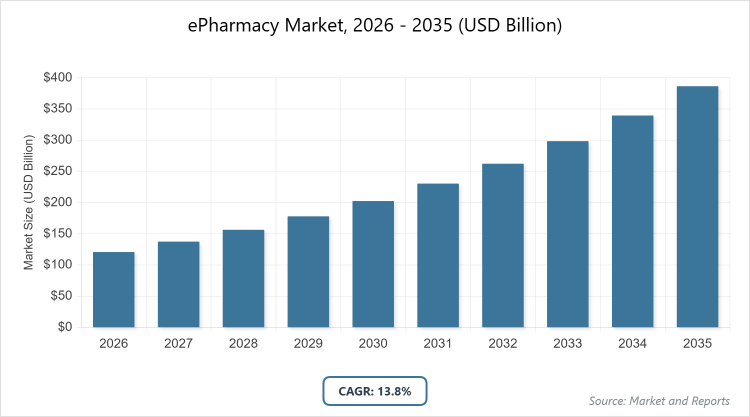
According to MarketnReports, the global ePharmacy market size was estimated at USD 120.72 billion in 2025 and is expected to reach USD 439.73 billion by 2035, growing at a CAGR of 13.8% from 2026 to 2035. ePharmacy Market is driven by increasing internet penetration and convenience in medication delivery.
What is the Overview of ePharmacy Market?
The ePharmacy market encompasses the online sale and delivery of prescription and over-the-counter medications, wellness products, and healthcare services through digital platforms, enabling consumers to access pharmaceuticals conveniently via apps or websites without visiting physical stores. This market integrates technology like telemedicine, AI-driven recommendations, and secure payment systems to ensure compliance, authenticity, and personalized care, addressing barriers in traditional pharmacy access. Market definition refers to the digital ecosystem facilitating the procurement, dispensing, and management of drugs and health products, driven by consumer demand for accessibility, cost-effectiveness, and privacy, while supporting healthcare systems through efficient supply chains and reduced operational costs in an increasingly digitalized world.
What are the Key Insights into ePharmacy Market?
- The global ePharmacy market was valued at USD 120.72 billion in 2025 and is projected to reach USD 439.73 billion by 2035.
- The market is expected to grow at a CAGR of 13.8% during the forecast period from 2026 to 2035.
- The market is driven by rising chronic diseases and digital health adoption.
- In the product type segment, prescription drugs dominate with a 71% share.
- This dominance is due to regulatory support and convenience for chronic patients, driving market growth by enabling secure online refills and reducing in-person visits.
- In the application segment, app-based delivery dominates with a 70% share.
- This is attributed to mobile accessibility and real-time tracking, fueling expansion through user-friendly interfaces that enhance customer retention.
- In the end-user segment, consumers dominate with a 60% share.
- This stems from direct-to-consumer models offering privacy and variety, propelling the market by catering to individual health needs efficiently.
- North America dominates the global market with a 42% share.
- This is owing to advanced infrastructure and high internet penetration in the United States.
What are the Market Dynamics in ePharmacy?
Growth Drivers
Growth drivers in the ePharmacy market are propelled by the increasing prevalence of chronic diseases requiring regular medication, coupled with the convenience of online platforms that offer 24/7 access and home delivery, attracting busy consumers and elderly populations seeking hassle-free healthcare solutions. Government initiatives promoting digital health and e-prescriptions streamline processes, reducing paperwork and errors while enhancing efficiency. Technological advancements like AI for personalized recommendations and blockchain for secure transactions build trust and compliance. Moreover, the expansion of internet and smartphone penetration in emerging markets opens new avenues, driving adoption through affordable access to a wide range of products.
Restraints
Restraints in the ePharmacy market include stringent regulatory hurdles varying by region, which complicate operations and require significant compliance investments, delaying market entry for new players. Concerns over counterfeit drugs and data privacy erode consumer trust, limiting adoption in sensitive healthcare transactions. Limited internet access in rural areas restricts market reach, while high logistics costs for cold-chain products increase pricing pressures. Additionally, resistance from traditional pharmacies and physicians accustomed to in-person interactions hinders digital shift.
Opportunities
Opportunities in the ePharmacy market arise from integrating telemedicine services, allowing seamless prescription fulfillment and consultations, appealing to remote patients and expanding service portfolios. The rise of subscription models for chronic medications offers recurring revenue and convenience, targeting loyal customers. Emerging markets with growing middle classes present untapped potential for localized platforms. Partnerships with insurance providers for direct billing enhance affordability, while innovations in sustainable packaging attract eco-conscious consumers, fostering brand differentiation.
Challenges
Challenges in the ePharmacy market involve navigating diverse regulatory landscapes, requiring adaptable compliance strategies that increase operational complexity. Ensuring product authenticity amid counterfeit risks demands robust verification systems, straining resources. Supply chain disruptions affect timely delivery, impacting customer satisfaction. Additionally, building consumer trust in digital platforms for health products necessitates strong cybersecurity measures against data breaches.
ePharmacy Market: Report Scope
| Report Attributes | Report Details |
| Report Name | ePharmacy Market |
| Market Size 2025 | USD 120.72 Billion |
| Market Forecast 2035 | USD 439.73 Billion |
| Growth Rate | CAGR of 13.8% |
| Report Pages | 220 |
| Key Companies Covered | CVS Health Corporation, Walgreens Boots Alliance, Amazon Pharmacy, Express Scripts Holding Company, DocMorris, and Others |
| Segments Covered | By Product Type, By Application, By End-User, and By Region |
| Regions Covered | North America, Europe, Asia Pacific (APAC), Latin America, and The Middle East and Africa (MEA) |
| Base Year | 2025 |
| Historical Year | 2020 – 2024 |
| Forecast Year | 2026 – 2035 |
| Customization Scope | Avail customized purchase options to meet your exact research needs. |
The ePharmacy market is segmented by product type, application, end-user, and region.
Based on Product Type Segment, the most dominant subsegment is prescription drugs, while the second most dominant is over-the-counter drugs. Prescription drugs lead due to the need for convenient refills for chronic conditions and regulatory e-prescription support, driving market growth by reducing access barriers and improving adherence through digital reminders; over-the-counter drugs rank second as they offer quick purchases for common ailments, contributing to expansion via impulse buys and broad availability.
Based on Application Segment, the most dominant subsegment is app-based delivery, while the second most dominant is web-based platforms. App-based delivery dominates owing to mobile convenience and real-time features, propelling market growth through higher engagement and faster service; web-based platforms follow as the second dominant, driven by desktop accessibility for detailed searches, enhancing the market via integrated e-commerce tools.
Based on End-User Segment, the most dominant subsegment is consumers, while the second most dominant is hospitals & clinics. Consumers lead because of direct access to medications and privacy, fueling market growth by empowering self-management; hospitals & clinics rank second with bulk procurement needs, advancing the market through efficient supply chains.
What are Recent Developments in ePharmacy?
- In March 2025, Truemeds raised $44 million in Series C funding to expand its online pharmacy operations in India.
- In May 2025, MyDawa secured $20 million in Series B funding to enhance its e-pharmacy platform in Kenya.
- In September 2025, Plazza raised USD 1.4 million in seed funding for its quick medicine delivery service.
- In August 2025, Truemeds closed $85 million in Series C funding for healthtech advancements.
What is the Regional Analysis for ePharmacy Market?
- North America to dominate the global market.
North America holds the largest share in the ePharmacy market, driven by high internet penetration, advanced healthcare infrastructure, and consumer preference for convenient online services, fostering innovation in digital prescriptions and delivery. The region’s growth is bolstered by regulatory support for telehealth and strong e-commerce ecosystems. The United States dominates within North America, accounting for the majority due to giants like Amazon Pharmacy and CVS Health leading with integrated platforms, high smartphone usage enabling app-based orders, and policies like the Ryan Haight Act facilitating controlled substance dispensing; Canada contributes through universal healthcare integrations, while Mexico benefits from growing digital adoption, though challenges include varying state regulations.
Europe maintains a strong position in the ePharmacy market, characterized by unified EU regulations promoting cross-border sales and data protection via GDPR, enhancing consumer trust in online platforms. The emphasis on sustainable healthcare drives adoption of digital solutions. Germany leads as the dominating country, supported by its efficient pharmacy networks and companies like DocMorris offering comprehensive services, alongside high digital literacy; the UK and France follow with NHS-backed e-prescriptions, while Eastern Europe offers growth in affordable access, despite infrastructure disparities.
Asia Pacific is the fastest-growing region in the ePharmacy market, propelled by surging smartphone penetration, urbanization, and government digital health initiatives. Increasing chronic disease burdens accelerate demand for convenient access. China dominates within the region, driven by platforms like Alibaba Health and massive e-commerce integration, supported by policies promoting online sales; India contributes through apps like PharmEasy amid rising teleconsultations, Japan focuses on elderly care deliveries, but challenges include regulatory harmonization.
Latin America exhibits steady growth in the ePharmacy market, influenced by improving internet access and urban healthcare needs. Regional platforms address affordability. Brazil dominates as the key country, with its large market and companies like Droga Raia expanding online, aided by ANVISA regulations; Mexico benefits from proximity to US markets, Argentina focuses on chronic care, though economic volatility poses restraints.
The Middle East and Africa (MEA) region shows emerging potential in the ePharmacy market, driven by mobile health adoption and tourism-related services. Investments in digital infrastructure boost growth. South Africa dominates within MEA, supported by platforms like Netcare and regulatory advancements for online dispensing; the UAE invests in high-tech solutions for expatriates, Saudi Arabia through Vision 2030 e-health goals, but limited access in rural areas challenges expansion.
Who are the Key Market Players in ePharmacy?
CVS Health Corporation focuses on digital integration with telehealth and subscription services to enhance accessibility and customer retention.
Walgreens Boots Alliance employs omnichannel strategies, combining online orders with in-store pickup for convenience and trust-building.
Amazon Pharmacy pursues aggressive expansion through acquisitions and AI-driven recommendations to personalize medication management.
Express Scripts Holding Company adopts cost-saving models with mail-order deliveries and insurance integrations for efficient prescription fulfillment.
DocMorris concentrates on European regulatory compliance and cross-border sales to capture regional market share.
Giant Eagle leverages partnerships for localized services and loyalty programs to boost repeat business.
What are the Market Trends in ePharmacy?
- Increasing integration of AI for personalized recommendations and predictive inventory.
- Rise in subscription models for chronic medications enhancing adherence.
- Expansion of telemedicine-linked prescriptions for seamless fulfillment.
- Growth in eco-friendly packaging and sustainable sourcing.
- Surge in app-based platforms with real-time tracking.
- Focus on data privacy with blockchain for secure transactions.
- Adoption of AR for virtual consultations and product trials.
- Emphasis on affordable generics in emerging markets.
What Market Segments and Subsegments are Covered in the ePharmacy Report?
By Product Type
-
- Prescription Drugs
- Over-the-Counter Drugs
- Skin Care
- Dental
- Cold and Flu
- Vitamins
- Weight Loss
- Other Product Types
- Wellness Products
- Medical Devices
- Personal Care
- Others
By Application
-
- Online Pharmacies
- App-Based Delivery
- Web-Based Platforms
- Telemedicine Integration
- Subscription Services
- B2B Supply
- Direct-to-Consumer
- Hospital Pharmacies
- Clinic Supply
- Retail Chain Online
- Others
By End-User
-
- Consumers
- Hospitals & Clinics
- Primary Care Centers
- Home Care Settings
- Pharmacies
- Insurance Companies
- Government
- Pharmaceutical Companies
- Elderly Care Facilities
- Corporate Wellness
- Others
By Region
-
- North America
- U.S.
- Canada
- Europe
- UK
- Germany
- France
- Rest of Europe
- Asia Pacific
- China
- India
- Japan
- Rest of Asia Pacific
- Latin America
- Brazil
- Mexico
- Rest of Latin America
- Middle East & Africa
- UAE
- South Africa
- Rest of Middle East & Africa
- North America
Frequently Asked Questions
ePharmacy refers to online platforms for purchasing and delivering medications and health products conveniently.
Key factors include digital adoption, chronic disease rise, and regulatory support for online prescriptions.
The ePharmacy market is projected to grow from approximately USD 120.72 billion in 2025 to USD 439.73 billion by 2035.
The ePharmacy market is expected to register a CAGR of 13.8% during the forecast period from 2026 to 2035.
North America will contribute notably, holding around 42% of the market share due to advanced infrastructure.
Major players include CVS Health Corporation, Walgreens Boots Alliance, Amazon Pharmacy, Express Scripts Holding Company, DocMorris, and Giant Eagle, driving growth through digital innovations and expansions.
The report provides in-depth analysis of size, trends, segments, regions, players, and forecasts.
The value chain includes sourcing, platform development, prescription verification, dispensing, delivery, and customer support.
Trends shift toward AI personalization and subscriptions, with preferences for convenient, secure online access.
Regulatory factors include e-prescription laws, while environmental factors involve sustainable packaging demands.