
Energy Meter Market Size, Share and Trends 2026 to 2035
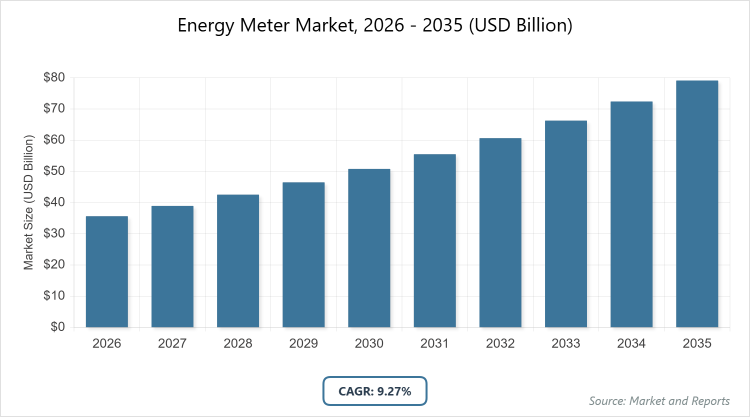
According to MarketnReports, the global Energy Meter market size was estimated at USD 35.63 billion in 2025 and is expected to reach USD 86.44 billion by 2035, growing at a CAGR of 9.27% from 2026 to 2035. Energy Meter Market is driven by the growing demand for smart electricity meters and government initiatives for energy efficiency.
What is Energy Meter? An Industry Overview
An energy meter is a device designed to measure and record the consumption of electricity, gas, or water in residential, commercial, or industrial settings, providing accurate data for billing, monitoring, and management purposes. The market definition includes both traditional analog and advanced digital or smart meters that incorporate communication technologies for real-time data transmission, enabling utilities to optimize distribution, detect outages, and implement demand-response strategies. This industry encompasses hardware, software, and services that support energy measurement, contributing to sustainable energy practices, grid modernization, and consumer empowerment through detailed usage insights.
What are the Key Insights of Energy Meter Market?
- The global Energy Meter market was valued at USD 35.63 billion in 2025 and is projected to reach USD 86.44 billion by 2035.
- The global Energy Meter market is expected to grow at a CAGR of 9.27% during the forecast period 2026-2035.
- The Energy Meter market is driven by increasing investments in smart grid infrastructure and rising energy consumption globally.
- The electricity meter subsegment dominates the type segment with a 60% share due to rapid urbanization and growing initiatives for smart cities.
- The residential subsegment dominates the end-use segment with a 60% share owing to increasing consumer electronics usage and energy awareness.
- The hardware subsegment dominates the component segment with a 65% share because of the essential role of physical metering devices in deployments.
- Asia Pacific dominates the global Energy Meter market with a 34% share attributed to massive infrastructural investments and population growth in countries like China and India.
What are the Market Dynamics of Energy Meter?
Growth Drivers
The energy meter market is propelled by the surging demand for smart metering solutions driven by government mandates for energy efficiency and smart city initiatives, such as India’s Smart Meter National Program aiming to install millions of units. Advancements in IoT and communication technologies enable real-time data analytics, reducing operational costs for utilities and enhancing grid reliability amid rising renewable integration. Additionally, increasing global energy consumption, projected to rise significantly by 2050, coupled with urbanization in developing regions, fosters the need for accurate monitoring and billing systems to manage demand effectively.
Restraints
High initial deployment costs, including infrastructure for digital networks and skilled labor, act as a significant barrier, particularly in developing economies where budget constraints limit widespread adoption. Concerns over data privacy and cybersecurity vulnerabilities in connected meters deter investments, as breaches could compromise consumer information and grid stability. Moreover, resistance from traditional utility models and the lack of standardized regulations across regions hinder seamless integration and market expansion.
Opportunities
The proliferation of electric vehicles and distributed energy resources opens avenues for advanced meters capable of handling bidirectional flows and EV charging integration, creating new revenue models for utilities. Emerging markets in Asia-Pacific and Africa present opportunities for cost-effective, scalable solutions through partnerships with local governments, leveraging pay-as-you-go models to address affordability. Technological innovations in AI and cloud computing offer potential for enhanced predictive maintenance and consumer engagement features, expanding market reach.
Challenges
Ensuring interoperability between diverse metering systems and legacy infrastructure poses technical challenges, requiring substantial upgrades that increase complexity and costs. Fluctuating raw material prices and supply chain disruptions affect hardware production, impacting deployment timelines. Furthermore, low awareness and adoption in rural areas of developing countries, combined with inadequate supporting infrastructure like reliable internet, limit the full realization of smart meter benefits.
Energy Meter Market: Report Scope
| Report Attributes | Report Details |
| Report Name | Energy Meter Market |
| Market Size 2025 | USD 35.63 Billion |
| Market Forecast 2035 | USD 86.44 Billion |
| Growth Rate | CAGR of 9.27% |
| Report Pages | 220 |
| Key Companies Covered |
Honeywell International Inc., Siemens AG, Itron Inc., Landis+Gyr, Schneider Electric, Badger Meter, and Others |
| Segments Covered | By Type, By End-Use, By Component, and By Region |
| Regions Covered | North America, Europe, Asia Pacific (APAC), Latin America, and The Middle East and Africa (MEA) |
| Base Year | 2025 |
| Historical Year | 2020 – 2024 |
| Forecast Year | 2026 – 2035 |
| Customization Scope | Avail customized purchase options to meet your exact research needs. |
The Energy Meter market is segmented by type, end-use, component, and region.
Based on Type Segment: The electricity meter segment is the most dominant, holding a 60% market share, as it addresses the escalating global power demand and smart grid initiatives, driven by its ability to facilitate accurate billing and outage management. This dominance drives market growth by enabling utilities to optimize energy distribution and integrate renewables efficiently. The gas meter segment is the second most dominant with a 25% share, benefiting from rising natural gas consumption and safety monitoring needs, which propels the market through improved leak detection and consumption analytics.
Based on End-Use Segment: The residential segment is the most dominant, capturing a 60% share, due to widespread consumer electronics adoption and government subsidies for smart home integrations. Its dominance accelerates market growth by promoting energy conservation and dynamic pricing awareness among households. The commercial segment ranks second with a 25% share, where businesses seek cost savings through precise monitoring, driving the market with applications in energy management systems.
Based on Component Segment: The hardware segment is the most dominant, with a 65% share, attributed to the core need for physical devices in metering infrastructure. This leads market growth by supporting large-scale rollouts and technological upgrades. The software segment is second with a 35% share, essential for data analytics and integration, propelling growth through enhanced functionality and user interfaces.
What are the Recent Developments in Energy Meter Market?
- In September 2025, Metron presented WaterScope Utility and Metron Spectrum Wave, advanced analytics and ultrasonic smart meters for improved data capture and operations.
- In July 2025, Genus Power Infrastructures Limited shipped Smart Ultrasonic Water Meters to international markets, marking expansion in water management solutions.
- In May 2025, Oakter unveiled OAKMETER Smart Energy Meter with AMI and IoT for real-time analytics and utility communication.
- In November 2025, Itron launched enhanced smart pay solutions for utilities, focusing on prepaid metering in North America.
- In January 2025, Honeywell integrated advanced LTE services into smart meters for secure IoT connectivity in smart grids.
What is the Regional Analysis of Energy Meter Market?
- Asia Pacific to dominate the global market
Asia Pacific commands a 34% share in the Energy Meter market, driven by rapid urbanization and infrastructural investments. China dominates the region, with massive smart meter deployments under national energy reforms, supporting loss reduction and renewable integration in megacities.
Europe holds a significant position in the Energy Meter market, fueled by decarbonization goals and regulatory mandates. The UK leads, with government targets for net-zero emissions by 2050, promoting widespread smart meter installations for energy efficiency.
North America maintains steady growth in the Energy Meter market, propelled by smart grid advancements. The United States dominates, leveraging utility upgrades and cybersecurity focus to enhance outage management and distributed energy orchestration.
Latin America is emerging in the Energy Meter market, with emphasis on reducing non-technical losses. Brazil leads, adopting prepaid and AMI meters to improve billing accuracy in urban and rural areas amid economic expansion.
The Middle East and Africa exhibit promising growth in the Energy Meter market, driven by utility commercialization. The UAE is a key player, integrating smart meters in smart city projects for dynamic pricing and energy optimization.
Who are the Key Market Players and Strategies in Energy Meter?
Honeywell International Inc. focuses on integrating LTE and IoT for secure smart metering, partnering with telecoms to enhance connectivity.
Siemens AG emphasizes advanced grid technologies, acquiring firms to expand AMI capabilities for energy efficiency.
Itron Inc. prioritizes prepaid and analytics solutions, collaborating on utility programs for demand response.
Landis+Gyr pursues sensor-integrated meters, investing in acquisitions for home energy ecosystems.
Schneider Electric specializes in software integrations, forming alliances for comprehensive energy management.
Badger Meter develops ultrasonic technologies, expanding through product launches for water and gas sectors.
What are the Market Trends in Energy Meter?
- Rising adoption of AMI for bidirectional communication and real-time data.
- Integration of AI and machine learning for predictive analytics.
- Shift toward prepaid and pay-as-you-go models in emerging markets.
- Focus on cybersecurity and data privacy in connected meters.
- Expansion of smart meters for EV charging and DER management.
- Advancements in low-power, rugged designs for remote areas.
What are the Market Segments and their Subsegment Covered in the Energy Meter Report?
By Type
-
- Electromechanical Meters
- Electronic Meters
- Smart Meters
- Digital Meters
- Prepaid Meters
- Analog Meters
- Induction Meters
- AMI Meters
- AMR Meters
- RF Meters
- Others
By End-Use
-
- Residential
- Commercial
- Industrial
- Utilities
- Government
- Healthcare
- Retail
- Transportation
- Education
- Energy Sector
- Others
By Component
-
- Hardware
- Software
- Consulting Services
- Implementation Services
- Managed Services
- Training Services
- License
- Maintenance Services
- Integration Services
- Automation Tools
- Others
By Region
-
- North America
- U.S.
- Canada
- Europe
- UK
- Germany
- France
- Rest of Europe
- Asia Pacific
- China
- India
- Japan
- Rest of Asia Pacific
- Latin America
- Brazil
- Mexico
- Rest of Latin America
- Middle East & Africa
- UAE
- South Africa
- Rest of Middle East & Africa
- North America
Chapter 1. Preface
Chapter 2. Executive Summary
Chapter 3. Global Energy Meter Market - Industry Analysis
Chapter 4. Global Energy Meter Market- Competitive Landscape
Chapter 5. Global Energy Meter Market - Type Analysis
Chapter 6. Global Energy Meter Market - End-Use Analysis
Chapter 7. Global Energy Meter Market - Component Analysis
Chapter 8. Energy Meter Market - Regional Analysis
Chapter 9. Company Profiles
Frequently Asked Questions
Energy Meters are devices that measure and record consumption of electricity, gas, or water, enabling accurate billing and energy management.
Key factors include government initiatives for smart grids, rising energy demand, and technological advancements in metering.
The market is projected to grow from USD 38.98 billion in 2026 to USD 86.44 billion by 2035.
The market is expected to grow at a CAGR of 9.27% during 2026-2035.
Asia Pacific will contribute notably, holding a 34% share due to infrastructural growth and population demands.
Major players include Honeywell International Inc., Siemens AG, Itron Inc., Landis+Gyr, Schneider Electric, and Badger Meter.
The report provides market size, trends, segmentation, regional insights, key players, and forecasts.
Stages include component manufacturing, design and development, assembly and integration, deployment, and maintenance services.
Trends emphasize AI integration and smart communication, with consumers preferring real-time monitoring for efficiency.
Government mandates for energy efficiency and emission reductions drive adoption of smart meters for sustainable practices.