
Energy Harvesting System Market Size, Share and Trends 2026 to 2035
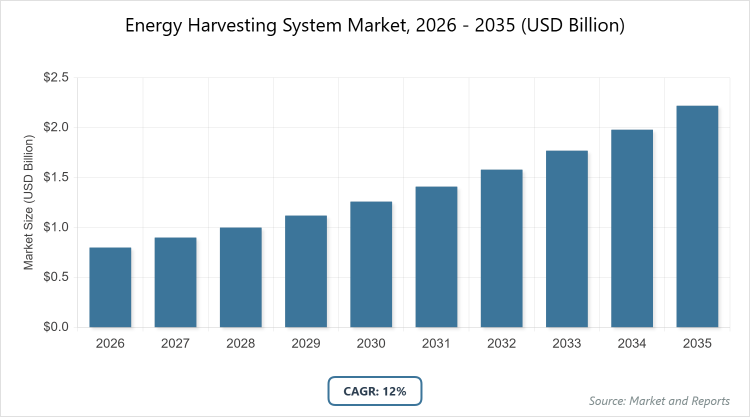
According to MarketnReports, the global Energy Harvesting System Market size was estimated at USD 0.8 billion in 2025 and is expected to reach USD 2.4 billion by 2035, growing at a CAGR of 12% from 2026 to 2035. Energy Harvesting System Market is driven by the increasing demand for sustainable, battery-free solutions in IoT and wireless sensor networks.What are the Key Insights of the Energy Harvesting System Market?
- The energy harvesting system market was valued at USD 0.8 billion in 2025 and is projected to reach USD 2.4 billion by 2035.
- The market is expected to grow at a CAGR of 12% during the forecast period from 2026 to 2035.
- The market is driven by the proliferation of IoT devices and the push for sustainable, low-maintenance energy solutions.
- Light Energy Harvesting dominates the technology segment with a 41% share because of its maturity, high efficiency in ambient light conditions, and widespread applicability in outdoor and indoor settings; Transducers dominate the component segment with a 35% share due to their critical role in converting ambient energy into electrical power efficiently; Building & Home Automation dominates the application segment with a 30% share owing to the demand for self-powered sensors in smart buildings for energy management and automation.
- North America dominates the market with a 39% share due to advanced IoT adoption, significant R&D investments, and supportive government policies for sustainable technologies.
What is the Industry Overview of the Energy Harvesting System Market?
The energy harvesting system market encompasses technologies that capture and convert ambient energy sources, such as light, vibration, thermal gradients, and radio frequency signals, into usable electrical power for low-energy devices and sensors. Market definition refers to integrated systems including transducers, power management circuits, and storage components that enable self-powered operations in applications like IoT, wearables, and smart infrastructure, eliminating the need for frequent battery replacements and promoting sustainability. This market addresses the growing need for maintenance-free, eco-friendly power solutions in remote or hard-to-access environments, supporting the expansion of wireless networks and autonomous devices while reducing environmental impact through minimized battery waste and enhanced energy efficiency in diverse industrial, consumer, and building sectors.
What are the Market Dynamics of the Energy Harvesting System Market?
Growth Drivers
The energy harvesting system market is fueled by the rapid expansion of IoT ecosystems and wireless sensor networks, which require reliable, battery-free power sources to operate in remote or inaccessible locations without maintenance. Advancements in ultra-low-power electronics and efficient transducers enable the capture of minute ambient energies, making these systems viable for applications in smart cities, industrial monitoring, and consumer wearables. Government initiatives promoting green energy and reducing electronic waste further drive adoption, as harvesting technologies align with sustainability goals by minimizing battery usage. Additionally, the integration with emerging technologies like 5G and edge computing enhances data transmission efficiency, creating demand for autonomous devices that support real-time analytics and predictive maintenance across sectors.
Restraints
High initial development and integration costs for energy harvesting components, such as specialized transducers and power management ICs, act as a significant restraint, particularly for small-scale deployments in cost-sensitive markets. The intermittent and low-power nature of ambient energy sources leads to variability in output, limiting reliability in environments with inconsistent energy availability like indoor settings or low-vibration areas. Moreover, technical challenges in energy storage and conversion efficiency result in power losses, hindering scalability for high-demand applications. Regulatory hurdles related to material safety and electromagnetic compatibility, along with a lack of standardized protocols, further complicate widespread implementation and slow market penetration in emerging economies.
Opportunities
Opportunities emerge from the growing emphasis on sustainable electronics and the development of hybrid harvesting systems that combine multiple energy sources for enhanced reliability and output. The rise of smart infrastructure projects in developing regions opens avenues for affordable, scalable solutions in agriculture, environmental monitoring, and healthcare wearables. Advancements in nanomaterials and flexible electronics present potential for innovative applications in portable devices and textiles. Partnerships between semiconductor firms and IoT providers can accelerate commercialization, while incentives for carbon-neutral technologies create funding for R&D in efficient storage and management, positioning the market for expansion in untapped sectors like aerospace and marine.
Challenges
Challenges include optimizing energy conversion efficiency in diverse environments, as ambient sources vary widely, requiring adaptive systems that increase complexity and costs. Ensuring long-term durability and performance stability under harsh conditions, such as extreme temperatures or humidity, remains difficult, impacting adoption in industrial settings. Intellectual property issues and the need for skilled expertise in system design limit innovation among smaller players. Furthermore, competition from advanced battery technologies with longer lifespans poses a threat, as harvesting systems must prove superior cost-benefit ratios to shift preferences away from traditional power sources.
Energy Harvesting System Market: Report Scope
| Report Attributes | Report Details |
| Report Name | Energy Harvesting System Market |
| Market Size 2025 | USD 0.8 Billion |
| Market Forecast 2035 | USD 2.4 Billion |
| Growth Rate | CAGR of 12% |
| Report Pages | 220 |
| Key Companies Covered |
Texas Instruments, STMicroelectronics, Analog Devices, EnOcean, Microchip Technology, Powercast, and Others. |
| Segments Covered | By Technology, By Component, By Application, and By Region. |
| Regions Covered | North America, Europe, Asia Pacific (APAC), Latin America, and The Middle East and Africa (MEA) |
| Base Year | 2025 |
| Historical Year | 2020 - 2024 |
| Forecast Year | 2026 - 2035 |
| Customization Scope | Avail customized purchase options to meet your exact research needs. |
What is the Market Segmentation of the Energy Harvesting System Market?
The Energy Harvesting System Market is segmented by technology, component, application, and region.By Technology Segment: The Light Energy Harvesting segment dominates with a 41% share, utilizing photovoltaic cells to convert ambient light into power efficiently, driving the market by enabling reliable operation in varied lighting conditions and supporting widespread IoT integration. The Vibration Energy Harvesting segment is the second most dominant at 25%, harnessing mechanical movements through piezoelectric materials, which helps propel market growth by powering sensors in industrial machinery and transportation where vibrations are abundant.
By Component Segment: The Transducers segment dominates with a 35% share, as they are essential for energy conversion from ambient sources, driving the market through innovations that improve efficiency and compatibility with low-power devices. The Power Management Integrated Circuits segment is the second most dominant at 30%, optimizing harvested energy distribution and storage, contributing to market expansion by enabling seamless integration in battery-free systems.
By Application Segment: The Building & Home Automation segment dominates with a 30% share, employing harvesting for self-powered sensors and controls, driving the market via smart building initiatives that reduce energy costs and enhance automation. The Consumer Electronics segment is the second most dominant at 25%, focusing on wearables and portable devices, propelling growth through demand for maintenance-free power in everyday gadgets.
What are the Recent Developments in the Energy Harvesting System Market?
- In July 2025, Energous Corporation unveiled its e-Sense Tag, a battery-free wireless sensor for temperature and location monitoring, targeting retail, logistics, and cold-chain applications to enable sustainable tracking solutions.
- In June 2025, Asahi Kasei Microdevices launched a new series of power management ICs for energy-harvesting applications, designed to efficiently manage charging in IoT sensors, remote controls, and Bluetooth devices.
- In May 2025, a smart insole integrating solar energy harvesting, pressure sensors, and AI was introduced to monitor health conditions like plantar fasciitis and Parkinson’s disease, showcasing advancements in wearable healthcare.
- In April 2025, Asahi Kasei Microdevices released power-management ICs tailored for energy-harvesting, supporting efficient battery charging and discharging in low-power electronics.
- In September 2025, Pavegen secured additional funding to expand its energy-generating floor tiles, with projects in the Middle East and Asia demonstrating kinetic harvesting scalability.
- In January 2025, Enphase Energy expanded its IQ8 microinverters to Latin America, enhancing solar energy harvesting for residential and commercial systems with high-efficiency production.
What is the Regional Analysis of the Energy Harvesting System Market?
North America to dominate the global market.North America leads the energy harvesting system market, driven by robust IoT adoption, substantial investments in smart infrastructure, and policies promoting sustainability and reduced battery waste. The United States dominates the region, with companies like Texas Instruments and Analog Devices spearheading innovations in power management and transducers, supported by initiatives like the CHIPS Act to bolster semiconductor manufacturing and R&D in green technologies.
Europe exhibits strong growth through a focus on environmental regulations and renewable energy transitions under the EU Green Deal. Germany dominates the region, leveraging its industrial base and firms like EnOcean to integrate harvesting in building automation and automotive sectors, emphasizing energy-efficient solutions for carbon neutrality.
Asia Pacific is the fastest-growing region, fueled by rapid urbanization, government incentives for smart cities, and expanding electronics manufacturing. China leads as the dominating country, with massive deployments in consumer electronics and industrial IoT, backed by national strategies for technological self-sufficiency and sustainable development.
Latin America shows emerging potential with investments in renewable infrastructure and agriculture monitoring. Brazil dominates, adopting harvesting for remote sensors in farming and energy management, supported by programs to enhance connectivity and attract tech investments.
The Middle East and Africa demonstrate opportunities in solar-rich environments and off-grid applications. The United Arab Emirates leads, incorporating systems into smart city projects like Dubai's initiatives, driven by diversification beyond oil and investments in innovation hubs.
What are the Key Market Players and Strategies in the Energy Harvesting System Market?
Texas Instruments: Texas Instruments focuses on developing ultra-low-power microcontrollers and power management ICs, partnering with IoT firms to integrate harvesting in wireless sensors, emphasizing efficiency to expand in building automation and wearables.
STMicroelectronics: STMicroelectronics pursues innovation in transducers and RF harvesting, investing in R&D for hybrid systems and collaborations with automotive players to enhance reliability in vibration-based applications.
Analog Devices: Analog Devices employs strategies centered on advanced PMICs and energy storage solutions, targeting industrial IoT through acquisitions and ecosystem partnerships to optimize power for remote monitoring.
EnOcean: EnOcean prioritizes battery-free wireless standards, forming alliances for smart building integrations and focusing on standardization to drive adoption in Europe and beyond.
Microchip Technology: Microchip Technology concentrates on cost-effective components like sensors and processors, leveraging open-source tools and global supply chains to penetrate consumer electronics markets.
Powercast: Powercast adopts RF harvesting expertise, partnering with logistics firms for wireless charging solutions and investing in scalable modules for asset tracking.
What are the Market Trends in the Energy Harvesting System Market?
- Advancements in hybrid energy harvesting combining multiple sources for improved reliability and output.
- Integration with IoT and 5G for self-powered sensors in smart cities and industrial applications.
- Focus on sustainable, battery-free solutions to reduce electronic waste and environmental impact.
- Development of ultra-low-power ICs enabling efficient energy management in wearables and remote devices.
- Rise of kinetic and solar harvesting in healthcare for monitoring devices like smart insoles.
- Expansion of RF harvesting for controlled environments like asset tracking and logistics.
- Emphasis on nanomaterials and flexible electronics for innovative, embeddable systems.
- Partnerships for scalable manufacturing to lower costs and accelerate commercialization.
- Regulatory-driven adoption in regions prioritizing green energy and carbon neutrality.
- Growth in edge computing support through autonomous power for real-time data processing.
What are the Market Segments and their Subsegments Covered in the Energy Harvesting System Market Report?
By Technology
- Light Energy Harvesting
- Vibration Energy Harvesting
- RF Energy Harvesting
- Thermal Energy Harvesting
- Piezoelectric
- Electromagnetic
- Kinetic
- Solar
- Thermoelectric
- Electrostatic
- Others
By Component
- Transducers
- Power Management Integrated Circuits
- Storage Systems
- Sensors
- Processors
- Wireless Modules
- Secondary Batteries
- Supercapacitors
- Solar Cells
- Piezoelectric Generators
- Others
By Application
- Building & Home Automation
- Consumer Electronics
- Industrial
- Transportation
- Security
- Healthcare
- Wearables
- Environmental Monitoring
- Agriculture
- Aerospace & Defense
- Others
By Region
- North America
- U.S.
- Canada
- Europe
- UK
- Germany
- France
- Rest of Europe
- Asia Pacific
- China
- India
- Japan
- Rest of Asia Pacific
- Latin America
- Brazil
- Mexico
- Rest of Latin America
- Middle East & Africa
- UAE
- South Africa
- Rest of Middle East & Africa
Frequently Asked Questions
The energy harvesting system market involves technologies that capture ambient energy from sources like light, vibration, and heat to power low-energy devices without batteries.
Key factors include IoT expansion, sustainability initiatives, advancements in low-power electronics, and government incentives for green technologies.
The market is projected to grow from USD 0.8 billion in 2025 to USD 2.4 billion by 2035.
The CAGR is expected to be 12% from 2026 to 2035.
North America will contribute notably, holding a 39% share due to technological advancements and investments.
Major players include Texas Instruments, STMicroelectronics, Analog Devices, EnOcean, Microchip Technology, and Powercast.
The report provides in-depth analysis of market size, trends, segments, regional outlooks, key players, and forecasts from 2026 to 2035.
Stages include raw material sourcing, component manufacturing, system integration, distribution, and end-user deployment with maintenance services.
Trends are shifting toward hybrid systems and sustainable solutions, with consumers preferring battery-free, eco-friendly devices for convenience and environmental benefits.
Regulations on waste reduction and incentives for renewables promote adoption, while environmental concerns drive demand for non-toxic, efficient harvesting technologies.