
Energy-as-a-Service Market Size, Share and Trends 2026 to 2035
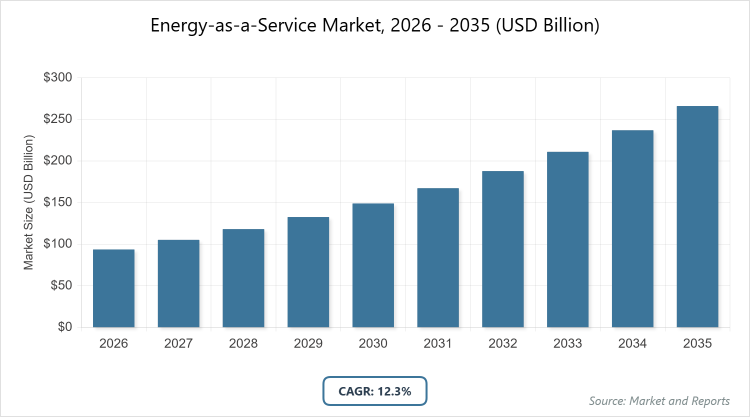
According to MarketnReports, the global Energy-as-a-Service market size was estimated at USD 93.67 billion in 2025 and is expected to reach USD 298.87 billion by 2035, growing at a CAGR of 12.3% from 2026 to 2035. Increasing adoption of sustainable energy solutions and cost-saving models.
What are the Key Insights of the Energy-as-a-Service Market?
- The Energy-as-a-Service market was valued at USD 93.67 billion in 2025 and is projected to reach USD 298.87 billion by 2035.
- The Energy-as-a-Service market is expected to grow at a CAGR of 12.3% during the forecast period 2026-2035.
- The Energy-as-a-Service market is driven by rising demand for energy efficiency, regulatory support for renewables, and advancements in smart grid technologies.
- Energy Supply dominates the service type segment with a 40% share, as it provides direct access to reliable energy without ownership burdens.
- Commercial dominates the end-user segment with a 45% share, due to high energy demands in buildings and cost-saving incentives.
- Platform dominates the component segment with a 35% share, enabling integrated management and data analytics for optimization.
- North America dominates the regional segment with a 40% share, owing to favorable policies, technological advancements, and strong corporate sustainability initiatives.
What is the Energy-as-a-Service Market?
Industry Overview
The Energy-as-a-Service (EaaS) market involves providing comprehensive energy solutions on a subscription or pay-per-use basis, allowing customers to access energy efficiency, supply, and optimization without upfront capital investments. Market definition encompasses services that integrate renewable energy sources, smart technologies, and management systems to deliver reliable, sustainable energy, reducing operational costs and environmental impact for commercial, industrial, and residential users while promoting decarbonization and grid resilience.
What are the Market Dynamics in the Energy-as-a-Service Market?
Growth Drivers
The Energy-as-a-Service market is propelled by the global shift towards sustainability, with governments implementing incentives and regulations to promote renewable energy adoption and reduce carbon emissions. Technological advancements in IoT, AI, and cloud computing enable real-time energy monitoring and optimization, allowing providers to offer customized solutions that lower costs and enhance efficiency for end-users. Additionally, the rising energy prices and volatility encourage businesses to opt for predictable subscription models, fostering partnerships between utilities and tech firms to expand service offerings.
Restraints
High initial setup costs for infrastructure, despite the as-a-service model, remain a restraint, particularly in regions with underdeveloped grids or limited financing options. Regulatory complexities and varying standards across countries can delay project implementations and increase compliance burdens. Moreover, concerns over data security and privacy in connected energy systems may hinder adoption among risk-averse industries.
Opportunities
Opportunities abound in the integration of EaaS with emerging technologies like electric vehicles and microgrids, creating new revenue streams through bundled services. Expanding into developing markets with growing urbanization offers potential for scalable solutions tailored to local energy needs. Furthermore, the focus on net-zero goals opens avenues for innovative financing models and collaborations with renewable energy developers.
Challenges
Challenges include grid integration issues with intermittent renewables, requiring advanced storage solutions to ensure reliability. Market fragmentation with numerous providers leads to competition and potential service overlaps, complicating customer choices. Additionally, economic uncertainties and supply chain disruptions can affect the availability of key components like batteries and sensors.
Energy-as-a-Service Market: Report Scope
| Report Attributes | Report Details |
| Report Name | Energy-as-a-Service Market |
| Market Size 2025 | USD 93.67 Billion |
| Market Forecast 2035 | USD 298.87 Billion |
| Growth Rate | CAGR of 12.3% |
| Report Pages | 220 |
| Key Companies Covered |
Schneider Electric, Siemens, Engie, Honeywell, General Electric, and Others |
| Segments Covered | By Service Type, By End-User, By Component, and By Region |
| Regions Covered | North America, Europe, Asia Pacific (APAC), Latin America, and The Middle East and Africa (MEA) |
| Base Year | 2025 |
| Historical Year | 2020 – 2024 |
| Forecast Year | 2026 – 2035 |
| Customization Scope | Avail customized purchase options to meet your exact research needs. |
What is the Market Segmentation of the Energy-as-a-Service Market?
The Energy-as-a-Service market is segmented by service type, end-user, component, and region.
Based on the Service Type Segment, energy supply is the most dominant, holding a 40% share, followed by energy efficiency at 30%. Energy supply’s dominance arises from its core function in delivering seamless power without capital expenditure, driving the market by enabling businesses to focus on core operations while achieving energy security and cost predictability.
Based on the end-user segment, commercial is the most dominant with a 45% share, followed by industrial at 35%. Commercial leads due to the sector’s emphasis on building efficiency and sustainability certifications, propelling market growth through widespread adoption in offices and retail spaces that reduce utility bills and enhance environmental credentials.
Based on Component Segment, the platform is the most dominant with a 35% share, followed by software at 25%. Platform dominates as it facilitates centralized control and analytics, fueling market expansion by integrating diverse energy assets and providing actionable insights for optimization.
What are the Recent Developments in the Energy-as-a-Service Market?
- In 2025, Schneider Electric partnered with a major utility to launch an EaaS platform for commercial buildings, incorporating AI for predictive maintenance and energy savings.
- Siemens acquired a startup specializing in microgrid solutions in late 2025, enhancing its EaaS offerings for industrial clients with renewable integration.
- Engie expanded its EaaS operations in North America during 2025, introducing demand response services for data centers to optimize peak energy usage.
- Honeywell announced new collaborations with renewable developers in 2025, focusing on storage-as-a-service to support grid stability.
What is the Regional Analysis of the Energy-as-a-Service Market?
- North America is expected to dominate the global market.
North America holds the largest share at 40%, with the United States as the dominating country due to robust regulatory frameworks, high technology adoption, and investments in smart infrastructure that accelerate EaaS implementations in commercial and industrial sectors.
Europe accounts for a significant portion, led by Germany through stringent decarbonization policies, advanced renewable integrations, and EU-wide incentives promoting energy efficiency.
Asia Pacific is the fastest-growing region, with China dominating via rapid urbanization, government subsidies for clean energy, and expanding industrial demands.
Latin America shows emerging growth, dominated by Brazil with increasing focus on sustainable energy models and partnerships for grid modernization.
The Middle East and Africa exhibit potential, with the UAE leading through ambitious net-zero strategies and investments in diversified energy services.
Who are the Key Market Players in the Energy-as-a-Service Market?
- Schneider Electric focuses on integrated platforms, acquisitions, and sustainability-driven solutions to expand EaaS globally.
- Siemens emphasizes digital twins and microgrid technologies, partnering with utilities for optimized energy services.
- Engie prioritizes renewable-based EaaS, leveraging financing models and international expansions.
- Honeywell drives innovation through AI analytics and building management systems for efficiency.
- General Electric utilizes hardware expertise in turbines and grids, focusing on hybrid energy solutions.
What are the Market Trends in the Energy-as-a-Service Market?
- Increasing integration of AI and IoT for real-time energy optimization.
- Shift towards renewable and hybrid energy sources in EaaS models.
- Growth in microgrid and storage-as-a-service for resilience.
- Adoption of pay-per-use models in commercial sectors.
- Focus on decarbonization and ESG compliance driving demand.
What Market Segments and Subsegments are Covered in the Report?
By Service Type
- Energy Supply
- Energy Efficiency
- Demand Response
- Optimization
- Maintenance
- Microgrid
- EV Charging
- Distributed Generation
- Renewable Integration
- Storage as a Service
- Others
By End-User
- Commercial
- Industrial
- Residential
- Utilities
- Government
- Healthcare
- Education
- Transportation
- Data Centers
- Hospitality
- Others
By Component
- Platform
- Energy Assets
- Services
- Software
- Hardware
- Sensors
- Controls
- Batteries
- Solar Panels
- Analytics
- Others
By Region
- North America
- U.S.
- Canada
- Europe
- UK
- Germany
- France
- Rest of Europe
- Asia Pacific
- China
- India
- Japan
- Rest of Asia Pacific
- Latin America
- Brazil
- Mexico
- Rest of Latin America
- Middle East & Africa
- UAE
- South Africa
- Rest of Middle East & Africa
Chapter 1. Preface
Chapter 2. Executive Summary
Chapter 3. Global Energy-as-a-Service Market - Industry Analysis
Chapter 4. Global Energy-as-a-Service Market- Competitive Landscape
Chapter 5. Global Energy-as-a-Service Market - Service Type Analysis
Chapter 6. Global Energy-as-a-Service Market - End-User Analysis
Chapter 7. Global Energy-as-a-Service Market - Component Analysis
Chapter 8. Energy-as-a-Service Market - Regional Analysis
Chapter 9. Company Profiles
Frequently Asked Questions
Energy-as-a-service is a business model where energy solutions, including supply, efficiency, and optimization, are provided on a subscription basis without upfront costs.
Key factors include regulatory support for renewables, technological advancements in smart grids, and rising demand for cost-effective energy management.
The market is projected to grow from approximately USD 105 billion in 2026 to USD 298.87 billion by 2035.
The expected CAGR is 12.3% from 2026 to 2035.
North America will contribute notably, driven by advanced infrastructure and policies.
Major players include Schneider Electric, Siemens, Engie, Honeywell, and General Electric.
The report provides detailed analysis of size, trends, segments, regions, players, and forecasts.
Stages include solution design, installation, operation, maintenance, and optimization services.
Trends favor sustainable, digital solutions, with preferences shifting to flexible, low-capex models.
Decarbonization regulations and environmental incentives promote growth, while compliance standards influence adoption.