
Electronic Health Records Market Size, Share and Trends 2026 to 2035
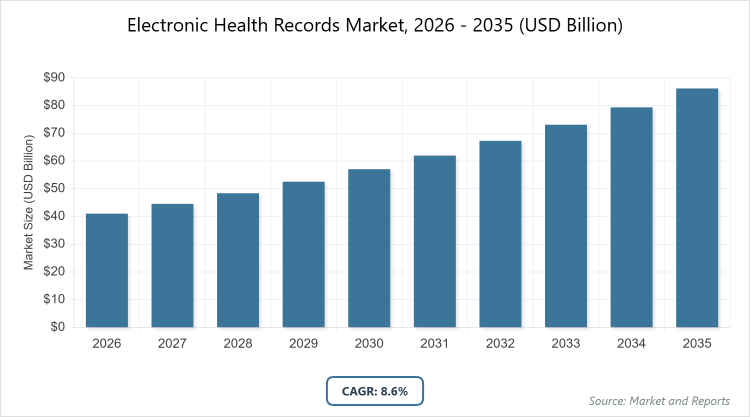
According to MarketnReports, the global Electronic Health Records market size was estimated at USD 41 billion in 2025 and is expected to reach USD 93 billion by 2035, growing at a CAGR of 8.6% from 2026 to 2035. Electronic Health Records Market is driven by increasing adoption of digital healthcare solutions to improve patient care and operational efficiency.
What are the Key Insights of the Electronic Health Records Market?
- The global Electronic Health Records market was valued at USD 41 billion in 2025 and is projected to reach USD 93 billion by 2035.
- The market is anticipated to grow at a CAGR of 8.6% during the forecast period.
- The market is driven by rising government initiatives for healthcare digitization and the need for efficient patient data management.
- The cloud-based subsegment dominated the deployment segment with 83% share.
- The cloud-based dominance is due to its scalability, lower upfront costs, ease of access, and enhanced data security features compared to traditional systems.
- The hospital subsegment dominated the end-user segment with 53% share.
- Hospitals dominate due to high patient volumes, complex care requirements, and the need for integrated systems to handle multidisciplinary data.
- The clinical subsegment dominated the application segment with 40% share.
- Clinical applications dominate because they form the core of EHR functionality, enabling real-time access to patient data for diagnosis and treatment, which directly impacts care quality.
- North America held the largest regional share of 44%.
- North America’s dominance stems from advanced healthcare infrastructure, stringent regulatory frameworks like HITECH Act, and high adoption rates among providers.
What is the Electronic Health Records Market Overview?
The Electronic Health Records (EHR) market encompasses digital systems designed to store, manage, and share patient health information across healthcare providers. EHRs are comprehensive platforms that replace traditional paper-based records, enabling secure access to patient data such as medical history, diagnoses, medications, treatment plans, immunization dates, allergies, radiology images, and laboratory test results. The market definition includes software, hardware, and services that facilitate the digitization of healthcare processes, promoting interoperability, data analytics, and improved clinical decision-making. This market plays a pivotal role in modernizing healthcare delivery by enhancing efficiency, reducing errors, and supporting value-based care models.
What are the Market Dynamics in the Electronic Health Records Industry?
Growth Drivers
The primary growth drivers for the Electronic Health Records market include the global push towards healthcare digitization, supported by government policies and incentives aimed at improving patient outcomes and reducing costs. Increasing prevalence of chronic diseases necessitates efficient data management for coordinated care, while advancements in AI and cloud computing enhance EHR capabilities, making them more user-friendly and interoperable. Additionally, the shift to value-based care models encourages providers to adopt EHRs for better analytics and population health management, driving widespread implementation across diverse healthcare settings.
Restraints
Key restraints in the Electronic Health Records market involve high implementation costs, particularly for small and medium-sized providers, which include software licensing, training, and infrastructure upgrades. Data privacy and security concerns, amplified by rising cyber threats, deter adoption due to potential breaches of sensitive patient information. Interoperability issues between different EHR systems also pose challenges, leading to fragmented data silos that hinder seamless information exchange among providers and increase operational inefficiencies.
Opportunities
Opportunities in the Electronic Health Records market arise from expanding into emerging economies where healthcare infrastructure is rapidly modernizing, creating demand for affordable, scalable EHR solutions. Integration of emerging technologies like blockchain for secure data sharing and wearable device connectivity for real-time monitoring opens new avenues for innovation. Partnerships between tech giants and healthcare providers can accelerate AI-driven predictive analytics, while regulatory relaxations in telehealth post-pandemic offer prospects for EHR enhancements in remote care delivery.
Challenges
Challenges facing the Electronic Health Records market include user resistance from healthcare professionals due to steep learning curves and workflow disruptions during transitions from legacy systems. Ensuring compliance with evolving regulations across regions adds complexity and costs. Moreover, maintaining data accuracy and addressing disparities in digital literacy among users can impede effective utilization, while the need for continuous updates to counter cybersecurity risks strains resources for ongoing maintenance and upgrades.
Electronic Health Records Market: Report Scope
| Report Attributes | Report Details |
| Report Name | Electronic Health Records Market |
| Market Size 2025 | USD 41 Billion |
| Market Forecast 2035 | USD 93 Billion |
| Growth Rate | CAGR of 8.6% |
| Report Pages | 220 |
| Key Companies Covered | Epic Systems Corporation, Oracle Health (Cerner), MEDITECH, Veradigm (Allscripts), Athenahealth, eClinicalWorks, and Others |
| Segments Covered | By Deployment, By Application, By End-User, and By Region |
| Regions Covered | North America, Europe, Asia Pacific (APAC), Latin America, and The Middle East and Africa (MEA) |
| Base Year | 2025 |
| Historical Year | 2020 – 2024 |
| Forecast Year | 2026 – 2035 |
| Customization Scope | Avail customized purchase options to meet your exact research needs. |
How is the Electronic Health Records Market Segmented?
The Electronic Health Records market is segmented by deployment, application, end-user, and region.
Based on Deployment Segment. The cloud-based deployment is the most dominant, holding over 83% market share, followed by web-based as the second most dominant. Cloud-based systems dominate due to their flexibility, remote accessibility, and reduced IT maintenance needs, which drive market growth by enabling smaller providers to adopt advanced features without heavy investments; this scalability helps expand EHR usage globally, fostering better data sharing and cost savings that propel overall market expansion.
Based on Application Segment. The clinical application is the most dominant, capturing around 40% share, with administrative as the second most dominant. Clinical applications lead because they directly support core healthcare functions like diagnosis and treatment planning through real-time data access, driving the market by improving accuracy and efficiency in patient care; this dominance accelerates adoption as providers prioritize tools that enhance clinical outcomes and integrate with emerging tech like AI for predictive insights.
Based on End-User Segment. Hospitals are the most dominant end-user, with approximately 53% share, followed by ambulatory surgical centers as the second most dominant. Hospitals dominate owing to their handling of high-volume, complex patient data requiring robust integration, which drives the market by necessitating advanced EHRs for coordinated care; this leadership promotes innovation in large-scale systems, benefiting the broader market through economies of scale and standardized practices.
What are the Recent Developments in the Electronic Health Records Market?
- In May 2024, Athenahealth launched customizable EHR solutions tailored for specialty providers, such as women’s health and urgent care centers, to improve workflow efficiency and patient care customization.
- In October 2024, Oracle introduced a new cloud-based EHR equipped with AI capabilities, aimed at simplifying navigation and setup for healthcare providers to enhance usability and data-driven decision-making.
- In October 2025, Harris Healthcare partnered with Enovacom to advance medical device interoperability, accelerating the integration of devices with EHR systems for better data flow.
- In January 2024, Cerner (now Oracle Health) launched Cerner Unity, a cloud-based EHR system focused on improving interoperability and patient care coordination across providers.
How Does Regional Analysis Impact the Electronic Health Records Market?
North America to dominate the global market.
North America dominates the Electronic Health Records market due to robust government support through initiatives like the HITECH Act, high technology adoption rates, and a mature healthcare ecosystem. The United States is the dominating country, driven by widespread EHR implementation in over 85% of hospitals, fueled by incentives for meaningful use and a focus on data analytics for population health; this leadership fosters innovation and sets global standards for interoperability.
Europe holds a significant share in the Electronic Health Records market, supported by EU-wide digital health strategies and investments in eHealth infrastructure. Germany emerges as the dominating country, with strong regulatory frameworks like the Digital Healthcare Act promoting EHR adoption for seamless patient data exchange; this drives regional growth through emphasis on privacy via GDPR and integration with national health systems for efficient care delivery.
Asia Pacific is the fastest-growing region in the Electronic Health Records market, propelled by rapid healthcare digitization and increasing government funding for IT infrastructure. China leads as the dominating country, with initiatives like the Internet Plus Healthcare pushing EHR adoption in over 80% of public hospitals; this accelerates market expansion through large-scale implementations and AI integration for managing vast patient populations.
Latin America is emerging in the Electronic Health Records market, with growing investments in digital health to address access disparities. Brazil is the dominating country, supported by the National Health Informatics Strategy that mandates EHR use in public systems; this fosters growth by improving data management in underserved areas and enabling telehealth for remote regions.
The Middle East and Africa region shows potential in the Electronic Health Records market, driven by efforts to modernize healthcare amid urbanization. The United Arab Emirates dominates, with visions like Dubai Health Strategy 2026 promoting EHRs for integrated care; this drives adoption through smart city integrations and partnerships for secure, patient-centric systems.
Who are the Key Market Players in the Electronic Health Records Industry?
- Epic Systems Corporation. Epic Systems focuses on developing comprehensive, interoperable EHR platforms with a strategy centered on large-scale implementations in hospitals and health systems, emphasizing user-centric design and data analytics to enhance clinical outcomes; the company pursues growth through strategic partnerships and continuous innovation in AI-driven tools for predictive care.
- Oracle Health (Cerner). Oracle Health, following the acquisition of Cerner, employs a cloud-first strategy to integrate EHRs with advanced analytics and AI, aiming to improve data interoperability across global healthcare networks; it focuses on mergers and expansions to broaden its footprint, prioritizing scalable solutions for population health management.
- MEDITECH. MEDITECH adopts a strategy of providing affordable, integrated EHR systems tailored for mid-sized hospitals and ambulatory settings, with emphasis on mobility and real-time data access; the company drives growth via product launches like mobile apps and collaborations to enhance device interoperability.
- Veradigm (Allscripts). Veradigm leverages an open-platform strategy for its EHR solutions, focusing on connectivity with third-party apps and analytics for value-based care; it pursues acquisitions and partnerships to expand into population health and revenue cycle management, targeting ambulatory and specialty practices.
- Athenahealth. Athenahealth’s strategy revolves around cloud-based EHRs with built-in revenue cycle management, emphasizing ease of use and customization for specialty providers; the company grows through product innovations and acquisitions to support urgent care and women’s health, enhancing operational efficiency.
- eClinicalWorks. eClinicalWorks implements a patient-engagement focused strategy with EHRs that integrate telehealth and mobile access, targeting independent practices; it expands via international partnerships and AI enhancements for chronic care management, prioritizing affordability and user training.
What are the Current Market Trends in Electronic Health Records?
- Integration of AI and machine learning for predictive analytics and automated clinical decision support.
- Growing adoption of cloud-based EHRs for enhanced scalability and remote access.
- Emphasis on interoperability standards to facilitate seamless data exchange between systems.
- Rise in patient-centric features, including mobile apps and portals for self-management.
- Incorporation of blockchain technology for improved data security and privacy.
- Expansion of telehealth integrations within EHR platforms post-pandemic.
- Focus on cybersecurity measures to combat increasing data breaches.
- Use of wearables and IoT devices for real-time health data incorporation.
- Shift towards value-based care models driving analytics and reporting tools.
- Regulatory pushes for digital health equity in underserved regions.
What Market Segments and Subsegments are Covered in the Electronic Health Records Report?
By Deployment
- On-premise
- Cloud-based
- Web-based
- Hybrid
- Client-server based
- Acute
- Ambulatory
- Post-acute
- Standalone
- Integrated
- Others
By Application
- Clinical
- Administrative
- Reporting in Healthcare
- Healthcare Financing
- Clinical Research
- Patient Management
- Billing
- Scheduling
- Prescription Management
- Referral Management
- Others
By End-User
- Hospitals
- Clinics
- Ambulatory Surgical Centers
- Specialty Clinics
- Physician Offices
- Diagnostic Centers
- Pharmacies
- Long-term Care Facilities
- Government
- Research Institutions
- Others
By Region
- North America
- U.S.
- Canada
- Europe
- UK
- Germany
- France
- Rest of Europe
- Asia Pacific
- China
- India
- Japan
- Rest of Asia Pacific
- Latin America
- Brazil
- Mexico
- Rest of Latin America
- Middle East & Africa
- UAE
- South Africa
- Rest of Middle East & Africa
Frequently Asked Questions
Electronic Health Records (EHR) are digital versions of patients' paper charts, containing comprehensive health information that can be shared across authorized providers for coordinated care.
Key factors include government incentives for digitization, rising chronic disease prevalence, AI integrations, and the need for efficient data management in healthcare.
The market is projected to grow from USD 41 billion in 2025 to USD 93 billion by 2035.
The CAGR is expected to be 8.6% from 2026 to 2035.
North America will contribute notably, driven by advanced infrastructure and regulatory support.
Major players include Epic Systems Corporation, Oracle Health (Cerner), MEDITECH, Veradigm (Allscripts), Athenahealth, and eClinicalWorks.
The report offers in-depth analysis of market size, trends, segments, key players, regional outlook, and forecasts from 2026 to 2035.
Stages include software development, hardware integration, implementation services, data migration, training, maintenance, and ongoing support.
Trends lean towards AI-enhanced tools and patient portals, while consumers prefer user-friendly, mobile-accessible systems for better engagement.
Regulations like HIPAA and GDPR enforce data privacy, while environmental factors include sustainable cloud solutions reducing paper use.