
Electric Vehicles Market Size, Share and Trends 2026 to 2035
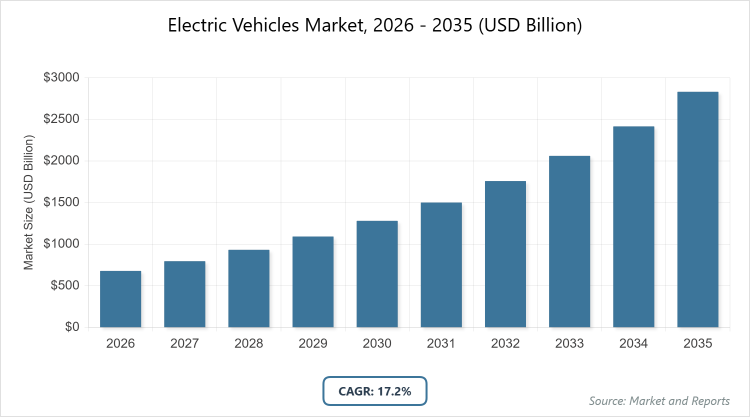
According to MarketnReports, the global Electric Vehicles market size was estimated at USD 678.66 billion in 2025 and is expected to reach USD 3338.87 billion by 2035, growing at a CAGR of 17.2% from 2026 to 2035. Government incentives, technological advancements in batteries, and growing environmental awareness.
What are the Key Insights of the Electric Vehicles Market?
- The Electric Vehicles market was valued at USD 678.66 billion in 2025 and is projected to reach USD 3338.87 billion by 2035.
- The Electric Vehicles market is expected to grow at a CAGR of 17.2% during the forecast period 2026-2035.
- The Electric Vehicles market is driven by supportive government policies, declining battery costs, and increasing consumer demand for sustainable mobility.
- Passenger cars dominate the vehicle type segment with a 70% share, due to high consumer adoption, incentives, and wide model availability.
- Battery Electric Vehicles (BEV) dominate the propulsion type segment with a 60% share, owing to zero-emission benefits and advancements in range technology.
- Personal dominates the application segment with a 65% share, driven by individual commuting needs and urban electrification trends.
- Asia Pacific dominates the regional segment with a 50% share, attributed to China’s manufacturing dominance, subsidies, and rapid infrastructure development.
What is the Electric Vehicles Market?
Industry Overview
The Electric Vehicles (EV) market comprises battery-powered or hybrid vehicles that use electric motors for propulsion, reducing reliance on fossil fuels and emissions compared to traditional internal combustion engines. Market definition includes passenger cars, commercial vehicles, and two-wheelers equipped with electric drivetrains, supported by charging infrastructure and battery technologies, aiming to promote sustainable transportation, energy efficiency, and urban mobility while addressing challenges in range, cost, and grid integration.
What are the Market Dynamics in the Electric Vehicles Market?
Growth Drivers
The electric vehicle market is experiencing robust growth due to escalating environmental concerns and stringent emission regulations worldwide, prompting governments to offer incentives like tax rebates and subsidies that make EVs more affordable and attractive to consumers. Advancements in battery technology, such as solid-state batteries and faster charging, address range anxiety and improve performance, encouraging adoption across personal and commercial sectors. Additionally, the expansion of charging infrastructure, supported by public-private partnerships, enhances convenience and accessibility, while falling battery costs reduce vehicle prices, driving mass market penetration in urban areas.
Restraints
High upfront costs of EVs compared to conventional vehicles remain a key restraint, particularly in price-sensitive markets where limited subsidies hinder widespread adoption among lower-income consumers. Inadequate charging infrastructure in rural and developing regions creates barriers to long-distance travel and convenience, deterring potential buyers. Moreover, supply chain vulnerabilities for critical materials like lithium and cobalt lead to price volatility and production delays, impacting market stability and scalability.
Opportunities
Opportunities in the Electric Vehicles market are expanding with the integration of EVs into smart grids and vehicle-to-grid (V2G) systems, enabling energy storage and revenue generation for owners through bidirectional charging. The rise of autonomous driving technologies opens avenues for electric autonomous vehicles in ride-sharing and logistics, reducing operational costs. Furthermore, untapped markets in Africa and Latin America present potential for affordable EV models tailored to local needs, supported by international investments in infrastructure.
Challenges
Challenges include addressing battery recycling and disposal to mitigate environmental impacts from lithium-ion waste, requiring advanced recycling technologies and regulations. Grid capacity strains from widespread EV charging demand, and infrastructure upgrades to prevent blackouts. Additionally, geopolitical tensions affecting raw material supplies pose risks to global supply chains, necessitating diversification and local sourcing strategies.
Electric Vehicles Market: Report Scope
| Report Attributes | Report Details |
| Report Name | Electric Vehicles Market |
| Market Size 2025 | USD 678.66 Billion |
| Market Forecast 2035 | USD 3338.87 Billion |
| Growth Rate | CAGR of 17.2% |
| Report Pages | 220 |
| Key Companies Covered |
Tesla, BYD, Volkswagen, General Motors, Ford, and Others |
| Segments Covered | By Vehicle Type, By Propulsion Type, By Application, and By Region |
| Regions Covered | North America, Europe, Asia Pacific (APAC), Latin America, and The Middle East and Africa (MEA) |
| Base Year | 2025 |
| Historical Year | 2020 – 2024 |
| Forecast Year | 2026 – 2035 |
| Customization Scope | Avail customized purchase options to meet your exact research needs. |
What is the Market Segmentation of the Electric Vehicles Market?
The Electric Vehicles market is segmented by vehicle type, propulsion type, application, and region.
Based on Vehicle Type Segment, passenger cars are the most dominant, holding a 70% share, followed by commercial vehicles at 20%. Passenger cars’ dominance stems from consumer-focused incentives, diverse model offerings, and urban commuting needs, driving the market by accelerating electrification and reducing emissions in high-density areas.
Based on the Propulsion Type Segment, Battery Electric Vehicles (BEV) is the most dominant with a 60% share, followed by Plug-in Hybrid Electric Vehicles (PHEV) at 25%. BEV leads due to full electrification benefits and government zero-emission mandates, propelling market growth through longer ranges and lower operating costs that attract eco-conscious buyers.
Based on Application Segment, personal is the most dominant with a 65% share, followed by commercial at 20%. Personal dominates as individuals prioritize sustainable daily transport, fueling market expansion by increasing home charging adoption and supporting infrastructure development.
What are the Recent Developments in the Electric Vehicles Market?
- In May 2025, the IEA published the Global EV Outlook 2025, reporting a 35% increase in Q1 EV sales and projecting over 20 million units sold in 2025, representing 25% of total car sales.
- In December 2025, US EV sales declined 36% year-over-year in Q4 due to the end of federal tax credits, with overall 2025 sales down 2% from 2024, setting a cautious outlook for 2026.
- In October 2025, Recurrent’s 2025 EV Market Report highlighted record new and used EV sales, with average range increasing 4% to 293 miles and charging speeds improving 7%.
- In November 2025, emerging markets like Viet Nam and Thailand saw EV sales shares reach 40% and 20% respectively, driven by low-cost models and local production.
What is the Regional Analysis of the Electric Vehicles Market?
- Asia Pacific to dominate the global market.
Asia Pacific holds the largest share at 50%, with China as the dominating country due to massive subsidies, extensive manufacturing, and over 50% EV sales share in 2025, driving innovation in batteries and supply chains.
North America accounts for a significant share, led by the United States through policy shifts, new models like the 2026 Chevrolet Bolt, and infrastructure improvements, despite Q4 2025 sales dips.
Europe maintains strong growth, with Germany dominating via EU regulations, high BEV adoption, and investments in charging networks for urban mobility.
Latin America shows emerging potential, dominated by Brazil, with increasing incentives and partnerships for affordable EVs amid economic recovery.
The Middle East and Africa exhibit gradual expansion, with the UAE leading through smart city initiatives and EV integrations in logistics.
Who are the Key Market Players in the Electric Vehicles Market?
- Tesla focuses on vertical integration, battery advancements, and autonomous driving to maintain leadership in BEV sales.
- BYD prioritizes affordable models, vertical supply chains, and expansion in emerging markets for PHEV and BEV dominance.
- Volkswagen emphasizes ID series electrification, partnerships for charging, and sustainability in European markets.
- General Motors drives growth through the Ultium platform, new affordable EVs like the Bolt, and commercial fleet transitions.
- Ford leverages F-150 Lightning, hybrid pivots, and global alliances for truck and SUV electrification.
What are the Market Trends in the Electric Vehicles Market?
- Shift towards affordable mainstream models amid policy changes and demand slowdowns.
- Growth in emerging markets with low-cost EVs is driving global sales.
- Integration of AI and 5G for enhanced connectivity and autonomous features.
- Focus on sustainable batteries and rare earth elimination in motors.
- Rise in hybrid and extended-range EVs as transitional options.
What Market Segments and Subsegments are Covered in the Report?
By Vehicle Type
- Passenger Cars
- Commercial Vehicles
- Two-Wheelers
- Three-Wheelers
- Buses
- Trucks
- Vans
- Scooters
- Motorcycles
- E-Bikes
- Others
By Propulsion Type
- Battery Electric Vehicles (BEV)
- Plug-in Hybrid Electric Vehicles (PHEV)
- Hybrid Electric Vehicles (HEV)
- Fuel Cell Electric Vehicles (FCEV)
- Others
By Application
- Personal
- Commercial
- Industrial
- Logistics
- Public Transportation
- Agriculture
- Mining
- Construction
- Defense
- Others
By Region
- North America
- U.S.
- Canada
- Europe
- UK
- Germany
- France
- Rest of Europe
- Asia Pacific
- China
- India
- Japan
- Rest of Asia Pacific
- Latin America
- Brazil
- Mexico
- Rest of Latin America
- Middle East & Africa
- UAE
- South Africa
- Rest of Middle East & Africa
Frequently Asked Questions
Electric vehicles are automobiles powered by electric motors using rechargeable batteries or hybrid systems, offering zero or low emissions compared to traditional fuel vehicles.
Key factors include government incentives, battery tech advancements, charging infrastructure expansion, and environmental regulations.
The market is projected to grow from approximately USD 795 billion in 2026 to USD 3338.87 billion by 2035.
The expected CAGR is 17.2% during 2026-2035.
Asia Pacific will contribute notably, driven by high adoption in China and India.
Major players include Tesla, BYD, Volkswagen, General Motors, and Ford.
The report provides comprehensive analysis of size, trends, segments, regions, players, and forecasts.
Stages include raw material sourcing, battery manufacturing, vehicle assembly, distribution, and after-sales services.
Trends favor affordable models and hybrids, with preferences shifting to sustainable, tech-integrated vehicles.
Emission standards and subsidies promote growth, while policy changes like tax credit ends impact sales.