
Electric Vehicle Supply Equipment Market Size, Share and Trends 2026 to 2035
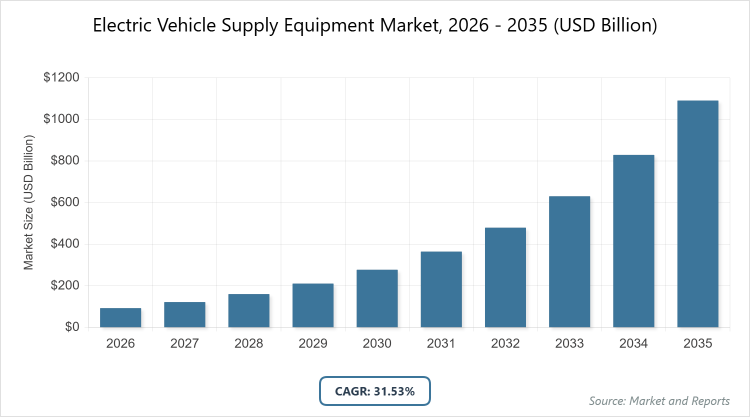
According to MarketnReports, the global Electric Vehicle Supply Equipment Market size was estimated at USD 92.57 Billion in 2025 and is expected to reach USD 1434.55 Billion by 2035, growing at a CAGR of 31.53% from 2026 to 2035. Electric Vehicle Supply Equipment Market is driven by the fast global adoption of electric vehicles influenced by favorable government policies and subsidies.
What is the Industry Overview of the Electric Vehicle Supply Equipment Market?
The Electric Vehicle Supply Equipment (EVSE) Market encompasses equipment used for charging electric vehicles, including charging stations, kiosks, cables, and related infrastructure that facilitate the transfer of electricity from the grid to EVs. This market plays a critical role in supporting the transition to sustainable mobility by providing reliable, efficient, and accessible charging solutions for various vehicle types, from passenger cars to commercial fleets. It addresses the growing need for infrastructure that aligns with environmental goals, such as reducing dependence on fossil fuels and lowering greenhouse gas emissions through electrification. The market definition includes all hardware, software, and services involved in EV charging, driven by technological advancements in power delivery, smart connectivity, and integration with renewable energy sources, ensuring compatibility across different EV models and charging speeds.
What are the Key Insights into the Electric Vehicle Supply Equipment Market?
- The global Electric Vehicle Supply Equipment Market size was estimated at USD 92.57 Billion in 2025 and is expected to reach USD 1434.55 Billion by 2035.
- Growing at a CAGR of 31.53% from 2026 to 2035.
- The Electric Vehicle Supply Equipment Market is driven by the fast global adoption of electric vehicles influenced by favorable government policies and subsidies aimed at decreasing carbon emissions and encouraging sustainable transportation.
- Dominated subsegment in Product: EV Charging Kiosk with 40% share, because of increasing demand for self-service charging stations with advanced, interactive, and intelligent features, including integration of Near Field Communication (NFC) and Radio-Frequency Identification (RFID) for digital payments.
- Dominated subsegment in Charging Station Type: Normal Charging with 60% share, because of increasing installation of public charging stations in urban areas to support widespread EV accessibility and daily commuting needs.
- Dominated subsegment in Application: Commercial with 55% share, because of favorable government initiatives promoting public infrastructure projects like electric highways and fleet electrification.
- Dominated region: Asia Pacific with 43% share, because of rapid EV adoption in countries like China, supported by significant government investments in charging infrastructure and goals for green mobility by 2030.
What are the Market Dynamics of the Electric Vehicle Supply Equipment Market?
Growth Drivers
The primary growth drivers for the Electric Vehicle Supply Equipment Market include the increasing adoption of electric mobility, which necessitates robust and scalable charging infrastructure to support the rising number of EVs on roads worldwide. Government initiatives, incentives, and policies play a pivotal role by providing subsidies, tax rebates, and regulatory frameworks that encourage both consumers and businesses to invest in EVs and associated charging solutions. Additionally, the integration of smart technologies enhances the efficiency, reliability, and connectivity of charging stations, allowing for features like remote monitoring, dynamic pricing, and optimized energy use.
The push towards sustainability through the incorporation of renewable energy sources into charging systems further boosts market expansion, as it aligns with global efforts to reduce carbon footprints and promote eco-friendly transportation. Growing investments from automotive industries and private players also foster innovation, making charging solutions more accessible and cost-effective over time.
Restraints
Key restraints in the Electric Vehicle Supply Equipment Market stem from disruptions caused by global events, such as the COVID-19 outbreak in early 2020, which halted operations in the automotive sector, leading to slowed sales growth and a temporary decline in market momentum. High initial installation costs for advanced charging infrastructure, particularly for fast-charging stations, pose barriers in regions with limited funding or underdeveloped grid systems. Interoperability issues between different charging standards and EV models can complicate widespread adoption, requiring additional investments in universal solutions.
Moreover, concerns over grid capacity and energy supply in high-demand areas may limit scalability, as overloading existing power networks could lead to inefficiencies or blackouts without significant upgrades. Post-pandemic recovery has been uneven, with supply chain vulnerabilities continuing to affect the availability of components like semiconductors and batteries.
Opportunities
Opportunities in the Electric Vehicle Supply Equipment Market are abundant through strategic collaborations, such as partnerships between public transport agencies and bus manufacturers to deploy charging stations for electric fleets, enhancing urban mobility solutions. Hotel and hospitality sectors are increasingly partnering with EVSE providers to offer guest charging facilities, tapping into the growing demand from eco-conscious travelers. Advancements in wireless technologies, like inductive charging, present new avenues for innovation, especially in ridesharing, autonomous vehicles, and public transit applications.
Government investments in infrastructure projects, including fast-charging networks in cities and along highways, create expansion potential in emerging markets. The rise of research and development in smart, connected ecosystems also opens doors for integrating AI and IoT to improve user experience, predictive maintenance, and energy management, positioning companies to capitalize on the shift towards sustainable transportation.
Challenges
Challenges facing the Electric Vehicle Supply Equipment Market include the need for scalable infrastructure to keep pace with accelerating EV adoption, ensuring that charging networks can handle increased demand without compromising reliability. Achieving interoperability and standardization across global regions remains difficult, as varying connector types and voltage requirements can hinder seamless user experiences. Managing downtime through automated maintenance systems is crucial, yet implementing these in remote or high-traffic areas adds complexity and cost.
Aligning charging demand with renewable energy generation poses logistical issues, particularly in regions with inconsistent solar or wind power availability. Global disruptions, such as pandemics or geopolitical tensions, continue to impact supply chains, delaying deployments and increasing material costs. Developing cost-efficient, user-friendly ecosystems that cater to diverse applications, from residential to commercial, requires ongoing innovation to overcome technical and economic hurdles.
| Report Attributes | Report Details |
| Report Name | Electric Vehicle Supply Equipment Market |
| Market Size 2025 | USD 92.57 Billion |
| Market Forecast 2035 | USD 1434.55 Billion |
| Growth Rate | CAGR of 31.53% |
| Report Pages | 220 |
| Key Companies Covered |
ABB Ltd., AeroVironment Inc., ChargePoint Inc., Eaton Corporation, SemaConnect Inc., Leviton Manufacturing Co. Inc., Schneider Electric SE, Tesla Inc., Siemens AG, Webasto SE, EVOTEC AG, Delta Electronics Inc., Chargemaster PLC, ClipperCreek Inc., and Others |
| Segments Covered | By Product, By Charging Station Type, By Application, and By Region |
| Regions Covered | North America, Europe, Asia Pacific (APAC), Latin America, and The Middle East and Africa (MEA) |
| Base Year | 2025 |
| Historical Year | 2020 – 2024 |
| Forecast Year | 2026 – 2035 |
| Customization Scope | Avail customized purchase options to meet your exact research needs. |
How is the Market Segmentation Structured in the Electric Vehicle Supply Equipment Market?
The Electric Vehicle Supply Equipment Market is segmented by product, charging station type, application, and region.
Based on Product Segment. The most dominant segment is EV Charging Kiosk, which holds the largest market share due to its versatility in public and commercial settings, offering user-friendly interfaces for quick transactions and widespread deployment in urban areas; this dominance drives the market by enabling efficient, scalable charging solutions that support higher EV penetration and revenue generation through integrated payment systems. The second most dominant segment is Portable Charger, favored for its convenience in residential and on-the-go use, allowing users flexibility without fixed installations; it contributes to market growth by addressing the needs of early adopters and expanding access in regions with limited infrastructure, thereby accelerating overall EV adoption.
Based on Charging Station Type Segment. The most dominant segment is Normal Charging, accounting for the majority share owing to its cost-effectiveness and suitability for everyday use in homes and public spaces, where extended charging times are acceptable; this leads market growth by facilitating broad accessibility and encouraging routine EV usage through widespread urban installations. The second most dominant segment is Super Charging, essential for long-distance travel and fleet operations due to its rapid power delivery; it propels the market forward by reducing range anxiety, supporting commercial applications, and attracting investments in highway networks that enhance EV viability for broader consumer segments.
Based on Application Segment. The most dominant segment is Commercial, leading due to government-backed projects for public infrastructure like electric highways and fleet stations, which require high-capacity solutions; this dominance fuels market expansion by catering to large-scale operations that boost EV integration in logistics and public transport, generating substantial revenue streams. The second most dominant segment is Residential, driven by increasing home EV ownership and incentives for personal charging setups; it aids market growth by providing foundational support for daily charging needs, promoting consumer confidence, and enabling smart home integrations that optimize energy consumption.
What are the Recent Developments in the Electric Vehicle Supply Equipment Market?
- In July 2025, Martindale Electric introduced the BZ820-EV EV socket tester, a new electrical safety solution for EV charge points with Type 2 connectors, ensuring functional checks and enhancing safety standards in charging infrastructure.
- In June 2025, BearingPoint and SAP launched a cloud-based platform, BearingPoint ETM.next, to streamline electric vehicle and charging infrastructure management, enabling holistic asset management and improving operational efficiency for providers.
How Does Regional Analysis Impact the Electric Vehicle Supply Equipment Market?
- Asia Pacific to dominate the global market.
Asia Pacific, valued at USD 31.53 billion in 2025 and projected to reach USD 616.87 billion by 2035 at a CAGR of 31.53%, dominates with over 43% revenue share due to rapid EV adoption in China, where government investments in the EV industry, lithium-ion battery production, smart cities, and charging infrastructure are pivotal; Japan, South Korea, India, and Australia contribute through policies promoting sustainable transport and e-commerce-driven last-mile delivery, with China as the dominating country owing to its massive EV production scale and ambitious green mobility goals by 2030.
Europe is experiencing significant growth, bolstered by government incentives such as subsidies, tax breaks, and regulatory frameworks aimed at reducing greenhouse gas emissions; the region focuses on expanding home and public charging networks, fostering innovations in charging solutions, and encouraging partnerships between EVSE providers, automakers, and energy companies, with Germany standing out as the dominating country due to strong support for EV adoption, advancements in smart grid integration, and consumer preferences for sustainable transportation.
North America is witnessing notable expansion with rapid EV uptake in passenger and commercial sectors, supported by robust government incentives and investments in public and private charging infrastructure; emphasis on grid modernization, smart charging, and interoperability standards drives progress, with the United States as the dominating country through its focus on fast and ultra-fast solutions, utility collaborations, and policies accelerating electrification in key states like California.
Latin America shows emerging potential, driven by increasing interest in sustainable mobility and government efforts to build basic charging infrastructure in urban centers; challenges like economic variability are offset by opportunities in fleet electrification for public transport, with Brazil as the dominating country due to its growing EV market and investments in renewable energy-integrated charging.
The Middle East and Africa are gradually developing, influenced by oil-dependent economies shifting towards diversification and green initiatives; growth is supported by pilot projects in cities and partnerships for tourism-related charging, with the United Arab Emirates as the dominating country through ambitious sustainability goals, such as Dubai’s EV strategy, and investments in advanced infrastructure.
Who are the Key Market Players in the Electric Vehicle Supply Equipment Market?
ABB Ltd. ABB Ltd. focuses on industrial-grade charging solutions, leveraging its expertise in power electronics to develop high-efficiency DC fast chargers and smart grid integrations; the company’s strategy includes global partnerships with utilities and automakers to expand networked infrastructure, emphasizing sustainability through renewable energy compatibility and innovative V2G technologies.
AeroVironment Inc. AeroVironment Inc. specializes in reliable charging hardware for residential and commercial use, with strategies centered on R&D for durable, weather-resistant stations and collaborations with government programs to deploy public networks, aiming to enhance accessibility and user adoption through cost-effective, scalable solutions.
ChargePoint Inc. ChargePoint Inc. operates one of the largest charging networks, employing a strategy of software-driven platforms for fleet management and user apps; it invests in data analytics for optimized station placement and partnerships with businesses to integrate charging into workplaces and retail spaces, driving growth through subscription-based services.
Eaton Corporation. Eaton Corporation emphasizes energy management in EVSE, with strategies involving intelligent power distribution systems and acquisitions to broaden its portfolio; the company targets commercial applications by offering integrated solutions that reduce operational costs and support grid stability.
SemaConnect Inc. SemaConnect Inc. provides networked charging stations with cloud-based management, strategizing through turnkey installations for multifamily and commercial properties; it focuses on user-centric features like mobile payments and analytics to improve uptime and customer satisfaction.
Leviton Manufacturing Co. Inc. Leviton Manufacturing Co. Inc. offers residential and light commercial chargers, with a strategy of leveraging its electrical expertise for safe, code-compliant products; it pursues market expansion via retail partnerships and innovations in smart home integrations.
Schneider Electric SE. Schneider Electric SE. integrates EVSE with building energy systems, strategizing through IoT-enabled platforms for energy optimization; the company forms alliances with real estate developers and utilities to deploy eco-efficient infrastructure globally.
Tesla Inc. Tesla Inc. deploys proprietary Supercharger networks, with strategies including vertical integration from vehicle to station and expansions via collaborations like hotel partnerships; it innovates in ultra-fast charging to support its ecosystem and long-range travel.
Siemens AG. Siemens AG. focuses on scalable, modular charging solutions, employing strategies like digital twins for infrastructure planning and partnerships with transit authorities for electrified public transport.
Webasto SE. Webasto SE. specializes in onboard and stationary chargers, with strategies involving OEM integrations and aftermarket solutions to enhance vehicle compatibility and user convenience.
EVOTEC AG. EVOTEC AG. targets industrial applications with robust chargers, strategizing through customization and reliability testing to meet diverse operational needs.
Delta Electronics Inc. Delta Electronics Inc. emphasizes high-power DC chargers, with strategies including R&D in thermal management and global supply chain optimizations for cost leadership.
Chargemaster PLC. Chargemaster PLC offers a full range of EVSE for business, home, and public use, including hardware like charging units; it operates a large UK charging network and provides installation, maintenance, and network management services as a key supplier.
ClipperCreek Inc. ClipperCreek Inc. provides hardware such as charging units, focusing on durable, American-made products; its strategy includes catering to residential and fleet needs with plug-and-play simplicity and compliance with safety standards.
What are the Market Trends in the Electric Vehicle Supply Equipment Market?
- Fast global EV adoption influenced by government policies and subsidies for carbon emission reduction.
- Integration of AI for predictive demand forecasting, strategic charging station placement, dynamic pricing, automated maintenance, navigation integration, and alignment with renewable energy.
- Technological advancements in smart charging, faster chargers (e.g., CCS, Hyperchargers), and wireless technologies like inductive charging.
- Growth in public and home charging infrastructure, including collaborations for bus and hotel deployments.
- Focus on sustainability, with renewable energy integration and green mobility solutions recovering post-COVID disruptions.
What Market Segments and their Subsegments are Covered in the Electric Vehicle Supply Equipment Report?
By Product
-
- EV Charging Kiosk
- Portable Charger
- Onboard Charging Station
- Wall-Mounted Charger
- Floor-Standing Charger
- Wireless Charger
- Smart Charger
- Fast Charger
- Ultra-Fast Charger
- Solar Charger
- Others
By Charging Station Type
-
- Super Charging
- Normal Charging
- Inductive Charging
- Conductive Charging
- Battery Swapping
- Pantograph Charging
- Overhead Charging
- Ground-Based Charging
- Robotic Charging
- V2G Charging
- Others
By Application
-
- Residential
- Commercial
- Highway Charging Station
- Destination Charging Station
- Fleet Charging Station
- Bus Charging Station
- Parking Lot Charging
- Workplace Charging
- Retail Charging
- Hotel Charging
- Others
By Region
-
- North America
- U.S.
- Canada
- Europe
- UK
- Germany
- France
- Rest of Europe
- Asia Pacific
- China
- India
- Japan
- Rest of Asia Pacific
- Latin America
- Brazil
- Mexico
- Rest of Latin America
- Middle East & Africa
- UAE
- South Africa
- Rest of Middle East & Africa
- North America
Chapter 1. Preface
Chapter 2. Executive Summary
Chapter 3. Global Electric Vehicle Supply Equipment Market - Industry Analysis
Chapter 4. Global Electric Vehicle Supply Equipment Market- Competitive Landscape
Chapter 5. Global Electric Vehicle Supply Equipment Market - Product Analysis
Chapter 6. Global Electric Vehicle Supply Equipment Market - Charging Station Type Analysis
Chapter 7. Global Electric Vehicle Supply Equipment Market - Application Analysis
Chapter 8. Electric Vehicle Supply Equipment Market - Regional Analysis
Chapter 9. Company Profiles
Frequently Asked Questions
Electrical enclosures are protective cabinets or boxes designed to house electrical components, safeguarding them from environmental factors like dust, moisture, and physical damage; in the context of EVSE, they are used to protect charging station electronics and ensure safe operation in outdoor or harsh conditions.
Key factors include rising EV adoption, government incentives and policies for sustainable transport, technological advancements in smart and wireless charging, integration with renewable energy, and increasing investments in infrastructure by public and private sectors.
The market is projected to grow from USD 92.57 billion in 2026 to USD 1434.55 billion by 2035.
The CAGR is expected to be 31.53% during 2026-2035.
Asia Pacific will contribute notably, holding 43% share, driven by rapid EV growth in China and supportive government initiatives.
Major players include ABB Ltd., ChargePoint Inc., Schneider Electric SE, Tesla Inc., Siemens AG, and Delta Electronics Inc., among others.
The report provides comprehensive analysis including market size, forecasts, segmentation, dynamics, regional insights, key players, trends, and strategic recommendations.
The value chain includes raw material sourcing (metals, plastics), manufacturing of enclosures, integration with electrical components, distribution and sales, installation in EVSE systems, and after-sales maintenance services.
Trends are shifting towards smart, AI-integrated charging for efficiency, with consumers preferring fast, wireless options and sustainable, renewable-powered stations to align with eco-friendly lifestyles.
Regulatory factors include emission reduction mandates and EV adoption incentives, while environmental factors involve the push for green energy integration and sustainable materials to minimize ecological impact.