
Electric Vehicle Charging Station Market Size, Share and Trends 2026 to 2035
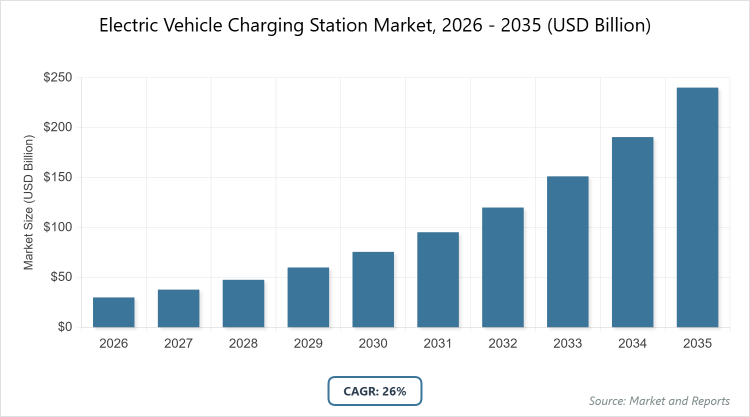
According to MarketnReports, the global Electric Vehicle Charging Station market size was estimated at USD 30 billion in 2025 and is expected to reach USD 300 billion by 2035, growing at a CAGR of 26% from 2026 to 2035. Electric Vehicle Charging Station Market is driven by the increasing adoption of electric vehicles and supportive government policies for sustainable transportation.
What are the Key Insights into the Electric Vehicle Charging Station Market?
- The global electric vehicle charging station market was valued at USD 30 billion in 2025 and is projected to reach USD 300 billion by 2035.
- The market is anticipated to grow at a CAGR of 26% during the forecast period from 2026 to 2035.
- The market is driven by surging EV adoption, government incentives, and advancements in fast-charging technology.
- In the charger type segment, DC charging dominates with a 60% share due to its ability to provide rapid charging, essential for long-distance travel and commercial fleets.
- In the application segment, public charging holds the largest share at 55% because of widespread infrastructure investments in urban areas to support mass EV usage.
- In the level segment, Level 3 (DC fast charging) leads with 50% market share owing to its high-power output that minimizes downtime for users.
- In the connector segment, CCS (Combined Charging System) dominates with 45% share as it supports both AC and DC charging, offering versatility across vehicle models.
- Asia Pacific dominates the global market with a 60% share, driven by massive EV sales in China and extensive government-backed infrastructure rollouts.
What is the Overview of the Electric Vehicle Charging Station Industry?
The electric vehicle charging station industry encompasses the infrastructure essential for powering electric vehicles, including hardware, software, and services that enable efficient energy transfer from the grid to EVs. Market definition refers to stations equipped with connectors and chargers that supply electricity to battery electric vehicles (BEVs) and plug-in hybrid electric vehicles (PHEVs), categorized by charging speed, location, and technology. This market plays a pivotal role in supporting the global shift toward electrification, addressing range anxiety, and integrating renewable energy sources into transportation ecosystems. It involves a network of public, private, and residential setups designed to meet diverse user needs, from slow overnight charging to ultra-fast highway stops, while fostering interoperability through standardized protocols.
What are the Dynamics Shaping the Electric Vehicle Charging Station Market?
Growth Drivers
The primary growth drivers include the exponential rise in electric vehicle sales worldwide, fueled by stringent emission regulations and consumer demand for eco-friendly mobility. Governments are offering subsidies, tax rebates, and mandates for charging infrastructure deployment, accelerating market expansion. Technological advancements, such as ultra-fast chargers and vehicle-to-grid integration, enhance efficiency and user convenience, attracting investments from utilities and automakers. Additionally, the declining cost of batteries and renewable energy integration reduces operational expenses, making charging stations more viable for widespread adoption.
Restraints
High initial installation costs for fast-charging infrastructure, particularly in remote or underdeveloped areas, pose significant restraints. Grid capacity limitations in certain regions lead to potential overloads during peak usage, requiring costly upgrades. Interoperability issues among different charger standards and connectors create confusion for users and slow standardization efforts. Moreover, supply chain disruptions for critical components like semiconductors can delay projects and increase prices.
Opportunities
Emerging opportunities lie in the expansion of wireless charging technology, which eliminates the need for physical connectors and enhances user experience in residential and fleet applications. Partnerships between energy companies and real estate developers for integrated smart city projects offer new revenue streams. The rise of electric fleets in logistics and public transport opens avenues for dedicated high-capacity stations. Furthermore, leveraging AI for predictive maintenance and dynamic pricing can optimize operations and attract more users.
Challenges
Key challenges include ensuring reliable power supply in areas with unstable grids, which can lead to downtime and user dissatisfaction. Cybersecurity threats to connected charging networks pose risks of data breaches and system hacks. Vandalism and maintenance issues in public stations increase operational costs. Additionally, achieving equitable access in rural versus urban areas remains a hurdle, potentially hindering overall market penetration.
Electric Vehicle Charging Station Market: Report Scope
| Report Attributes | Report Details |
| Report Name | Electric Vehicle Charging Station Market |
| Market Size 2025 | USD 30 Billion |
| Market Forecast 2035 | USD 300 Billion |
| Growth Rate | CAGR of 26% |
| Report Pages | 220 |
| Key Companies Covered | ABB, ChargePoint, Tesla, Schneider Electric, Siemens, Blink Charging, EVgo, and Others |
| Segments Covered | By Charger Type, By Application, By Level, By Connector, and By Region |
| Regions Covered | North America, Europe, Asia Pacific (APAC), Latin America, and The Middle East and Africa (MEA) |
| Base Year | 2025 |
| Historical Year | 2020 - 2024 |
| Forecast Year | 2026 - 2035 |
| Customization Scope | Avail customized purchase options to meet your exact research needs. |
The Electric Vehicle Charging Station market is segmented by charger type, application, level, connector, and region.
Based on Charger Type Segment. The DC charging subsegment is the most dominant, holding 60% market share, as it enables quick recharges crucial for commercial and long-haul operations, driving market growth by reducing EV downtime and encouraging broader adoption; the AC charging subsegment is the second most dominant at 30%, valued for its cost-effectiveness in residential settings, supporting market expansion through accessible home-based solutions that complement public infrastructure.
Based on Application Segment. The public subsegment dominates with 55% share, driven by government investments in urban networks that alleviate range anxiety and boost EV sales; the commercial subsegment follows as second dominant at 25%, aiding market growth via fleet electrification in businesses, which demands reliable on-site charging to optimize logistics and reduce fuel costs.
Based on Level Segment. Level 3 dominates at 50%, owing to its high-speed capabilities that cater to highway and fleet needs, propelling market momentum by enabling seamless long-distance travel; Level 2 is second dominant with 35% share, contributing through widespread use in workplaces and homes, where it provides efficient overnight charging to sustain daily EV usage.
Based on Connector Segment. CCS dominates with 45% share because of its universal compatibility across major automakers, fostering market interoperability and user confidence; CHAdeMO is second dominant at 20%, supporting growth in Asian markets by offering fast DC options that integrate with legacy systems and emerging standards.
What are the Recent Developments in the Electric Vehicle Charging Station Market?
- In January 2025, Tesla expanded its Supercharger network by opening access to non-Tesla EVs in additional regions, adding over 5,000 new ports globally to enhance interoperability and boost utilization rates.
- In March 2025, Shell and Volkswagen partnered to deploy 2,500 fast-charging stations across Europe, focusing on high-traffic corridors to support cross-border EV travel and accelerate infrastructure growth.
- In April 2025, ChargePoint raised USD 500 million in funding, enabling the company to expand its network by 20,000 stations in North America, emphasizing smart charging features for improved energy management.
- In May 2025, the European Union implemented the Alternative Fuels Infrastructure Regulation, mandating one million public charging points by the end of the year, driving rapid deployment and standardization efforts.
- In October 2025, India allocated INR 20 billion for charging infrastructure under the PM E-DRIVE scheme, targeting urban centers and highways to support the country's EV adoption goals.
What is the Regional Analysis of the Electric Vehicle Charging Station Market?
Asia Pacific to dominate the global market.
Asia Pacific leads the market, driven by China's dominance as the world's largest EV producer and consumer, with extensive government subsidies and over 3 million charging points installed, fostering rapid urbanization and fleet electrification.
North America shows strong growth, with the United States as the key country, supported by federal incentives like the paused but partially resumed NEVI program, adding thousands of fast chargers along highways to address infrastructure gaps.
Europe maintains robust expansion, led by Germany's aggressive targets under the AFIR, which mandates high-power stations every 60 km, integrating renewable energy and promoting cross-border networks.
Latin America experiences emerging growth, with Brazil at the forefront through investments in public-private partnerships for urban charging hubs, though grid limitations pose challenges.
The Middle East and Africa see gradual progress, dominated by the UAE's initiatives in Dubai for luxury EV infrastructure, aligning with sustainability goals and tourism.
Who are the Key Players in the Electric Vehicle Charging Station Market?
- ABB. ABB focuses on innovative DC fast chargers and digital solutions, partnering with utilities for grid-integrated systems to enhance reliability and expand in emerging markets.
- ChargePoint. ChargePoint emphasizes cloud-based networks and roaming partnerships, investing in AI-driven analytics to optimize station performance and user experience across commercial and public sectors.
- Tesla. Tesla advances its Supercharger ecosystem with V4 hardware for ultra-fast charging, opening networks to rivals while integrating solar and battery storage for sustainable operations.
- Schneider Electric. Schneider Electric prioritizes smart energy management and IoT-enabled chargers, collaborating with real estate firms for residential and workplace installations to drive efficiency.
- Siemens. Siemens develops modular charging solutions with high-voltage capabilities, focusing on fleet applications and renewable integration to support industrial electrification.
- Blink Charging. Blink Charging expands through acquisitions and municipal contracts, offering flexible pricing models and app-based services to capture urban and parking lot segments.
- EVgo. EVgo targets high-utilization sites with 350kW chargers, partnering with automakers for seamless access and emphasizing uptime through proactive maintenance strategies.
What are the Current Trends in the Electric Vehicle Charging Station Market?
- Rise of ultra-fast charging technology enabling 350kW+ speeds for quicker sessions.
- Integration of smart grids and AI for dynamic load management and predictive maintenance.
- Expansion of wireless charging systems for convenience in residential and fleet use.
- Growth in sustainable stations powered by solar and renewable energy sources.
- Increased focus on cybersecurity to protect connected networks from threats.
- Adoption of vehicle-to-grid (V2G) capabilities for energy storage and grid stability.
- Proliferation of subscription-based models for unlimited charging access.
- Emphasis on equitable rural and urban infrastructure to bridge access gaps.
What Market Segments and Subsegments are Covered in the Electric Vehicle Charging Station Report?
By Charger Type
- AC Charging
- DC Charging
- Inductive Charging
- Level 1
- Level 2
- Level 3
- Fast Charger
- Slow Charger
- Wireless Charger
- Portable Charger
- Others
By Application
- Residential
- Commercial
- Public
- Private
- Fleet
- Highway
- Parking
- Workplace
- Shopping Centers
- Hotels
- Others
By Level
- Level 1
- Level 2
- Level 3
- Others
By Connector
- J1772
- CCS1
- CCS2
- CHAdeMO
- Tesla
- GB/T
- Mennekes
- Type 2
- Type 1
- NACS
- Others
By Region
- North America
- U.S.
- Canada
- Europe
- UK
- Germany
- France
- Rest of Europe
- Asia Pacific
- China
- India
- Japan
- Rest of Asia Pacific
- Latin America
- Brazil
- Mexico
- Rest of Latin America
- Middle East & Africa
- UAE
- South Africa
- Rest of Middle East & Africa
Frequently Asked Questions
Electric Vehicle Charging Stations are infrastructure points equipped with connectors and power supply systems designed to recharge electric vehicles, including BEVs and PHEVs, using AC or DC electricity from the grid.
Key factors include rising EV adoption, government incentives, technological advancements in fast charging, and integration with renewable energy, alongside expanding fleet electrification and smart grid developments.
The market is projected to grow from approximately USD 36 billion in 2026 to USD 300 billion by 2035.
The CAGR is expected to be 26% over the forecast period.
Asia Pacific will contribute notably, driven by high EV penetration in China and India.
Major players include ABB, ChargePoint, Tesla, Schneider Electric, Siemens, Blink Charging, and EVgo.
The report provides comprehensive analysis, including market size, trends, segmentation, regional insights, key players, and forecasts from 2026 to 2035.
Stages include component manufacturing, system assembly, installation and deployment, operation and maintenance, and end-user services like billing and network management.
Trends are shifting toward ultra-fast and wireless charging, while consumers prefer seamless apps, sustainable energy sources, and affordable subscription models.
Regulations like EU's AFIR and emission standards drive infrastructure mandates, while environmental factors emphasize renewable integration and carbon reduction goals.