
Electric Bike Market Size, Share and Trends 2026 to 2035
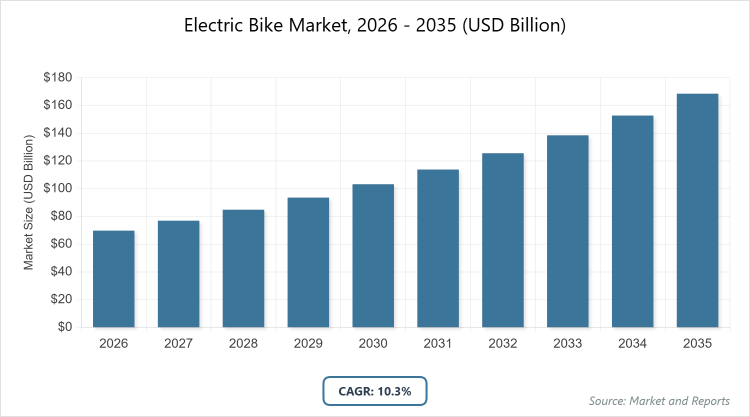
According to MarketnReports, the global Electric Bike market size was estimated at USD 69.73 billion in 2025 and is expected to reach USD 185.2 billion by 2035, growing at a CAGR of 10.3% from 2026 to 2035. Electric Bike Market is driven by increasing consumer preference for sustainable mobility solutions, urbanization, and government incentives promoting clean transportation.
What are the Key Insights?
- The global Electric Bike market size was estimated at USD 69.73 billion in 2025 and is expected to reach USD 185.2 billion by 2035.
- The market is projected to grow at a CAGR of 10.3% from 2026 to 2035.
- The market is driven by rising demand for eco-friendly transportation, advancements in battery technology, and supportive government policies.
- The chain drive segment dominated with a revenue share of 88.90% in 2024 due to its reliability, cost-effectiveness, and efficient power transmission.
- The lithium-ion battery segment dominated with a revenue share of 82.87% in 2024 owing to its superior energy density, lightweight design, and longer lifecycle.
- The personal end use segment dominated with a revenue share of 86.07% in 2024 because of consumer preference for convenient and sustainable commuting options.
- Asia Pacific dominated with a revenue share of 58.84% in 2024 attributed to its strong manufacturing base, high population density, and government subsidies.
What is the Industry Overview?
The Electric Bike market encompasses the industry focused on electric bicycles, which are pedal-assisted or throttle-powered bikes equipped with electric motors and rechargeable batteries to enhance propulsion and ease of use. Market definition refers to bicycles integrated with electric components that provide assistance up to certain speeds, typically categorized by drive mechanisms, battery types, and end uses, serving as an eco-friendly alternative to traditional vehicles for short-distance travel. This market addresses the growing need for sustainable urban mobility, combining human pedaling with electric power to reduce effort, extend range, and promote environmental benefits in densely populated areas.
What are the Market Dynamics?
Growth Drivers
The growth of the Electric Bike market is propelled by increasing consumer inclination toward sustainable and efficient transportation options amid rising environmental concerns and fuel costs. Government initiatives worldwide, including subsidies, tax incentives, and infrastructure developments like dedicated bike lanes, significantly boost adoption by making e-bikes more accessible and appealing. Technological advancements in battery efficiency, such as longer-lasting lithium-ion cells and faster charging capabilities, enhance user experience and range, further driving market expansion. Urbanization and traffic congestion in major cities encourage the shift to compact, agile e-bikes for daily commuting, while the commercial sector’s embrace for last-mile deliveries amplifies demand through cost savings and reduced emissions.
Restraints
High initial costs pose a major restraint in the Electric Bike market, as premium components like advanced batteries and motors elevate prices, limiting accessibility in price-sensitive developing regions. Inadequate charging infrastructure in many areas hinders widespread adoption, creating range anxiety for users and slowing penetration in rural or less urbanized locales. Limited awareness and cultural preferences for traditional vehicles or public transport in certain markets further impede growth, particularly where education on e-bike benefits is lacking. Additionally, the heavier weight and shorter lifespan of some battery types, like lead-acid, add to maintenance concerns and environmental drawbacks, restraining overall market progress.
Opportunities
Opportunities in the Electric Bike market abound with the expansion of commercial applications, such as e-commerce-driven last-mile logistics, where e-bikes offer efficient, low-emission alternatives to vans in congested urban settings. Advancements in belt drive technology present growth potential by providing durable, low-maintenance options that appeal to premium users seeking quieter and cleaner rides. Emerging markets in developing regions offer untapped potential through affordable entry-level models using cost-effective batteries, supported by decreasing production costs and battery recycling initiatives. Partnerships between manufacturers and tech firms for integrating smart features like IoT connectivity and app-based navigation can create new revenue streams and enhance product differentiation.
Challenges
The Electric Bike market faces challenges from regulatory inconsistencies across regions, where varying speed limits, helmet requirements, and classification rules complicate manufacturing and sales strategies. Environmental concerns surrounding battery disposal and recycling, especially for lead-acid types, pose sustainability hurdles that could attract stricter regulations and increase operational costs. Infrastructure gaps, such as insufficient bike paths and charging stations, challenge user safety and convenience, particularly in high-traffic areas. Moreover, competition from other electric mobility options like scooters and cars intensifies, requiring continuous innovation to maintain market share amid fluctuating raw material prices for batteries and motors.
Electric Bike Market: Report Scope
| Report Attributes | Report Details |
| Report Name | Electric Bike Market |
| Market Size 2025 | USD 69.73 Billion |
| Market Forecast 2035 | USD 185.2 Billion |
| Growth Rate | CAGR of 10.3% |
| Report Pages | 216 |
| Key Companies Covered | Giant Manufacturing Co. Ltd., Yadea Group Holdings Ltd., Pedego Electric Bikes, Merida Industry Co. Ltd., Trek Bicycle Corporation, and Others |
| Segments Covered | By Drive, By Battery, By End Use, and By Region |
| Regions Covered | North America, Europe, Asia Pacific (APAC), Latin America, and The Middle East and Africa (MEA) |
| Base Year | 2025 |
| Historical Year | 2020 – 2024 |
| Forecast Year | 2026 – 2035 |
| Customization Scope | Avail customized purchase options to meet your exact research needs. |
What is the Market Segmentation?
- The Electric Bike market is segmented by drive, battery, end use, and region.
Based on Drive Segment, the chain drive emerged as the most dominant subsegment with a revenue share of 88.90%, primarily due to its proven reliability, cost-effectiveness, and efficient power transmission suited for diverse terrains and everyday commuting, which drives the market by enabling broader accessibility and compatibility with existing bike designs; the belt drive is the second most dominant, expected to grow at the fastest CAGR, owing to its durability, minimal maintenance needs, and quieter operation that appeals to urban and premium users, contributing to market growth through enhanced user comfort and integration with advanced motor systems.
Based on Battery Segment, the lithium-ion battery is the most dominant subsegment with a revenue share of 82.87%, attributed to its superior energy density, lightweight construction, and extended lifecycle that provide longer ranges and faster charging, propelling the market forward by meeting demands for high-performance and eco-friendly options; the lead-acid battery ranks as the second most dominant, favored in entry-level models for its low cost and availability, though its heavier weight and shorter lifespan limit growth, yet it supports market expansion in price-sensitive regions by offering affordable entry points.
Based on End Use Segment, the personal end use is the most dominant subsegment with a revenue share of 86.07%, driven by consumer preferences for convenient, cost-effective, and environmentally friendly transport for commuting, fitness, and recreation, which accelerates market growth through widespread individual adoption and technological enhancements like long-range batteries; the commercial end use is the second most dominant, experiencing the fastest CAGR, due to its application in last-mile delivery and logistics amid e-commerce booms, aiding market propulsion by addressing urban congestion and emission reduction needs with specialized cargo models.
What are the Recent Developments?
- In December 2024, Segway unveiled two new e-bike models, the Xafari and Xyber, featuring futuristic designs, integrated smart technology, full-suspension systems, and long-range capabilities, aimed at expanding into the U.S. market through a dealer network with launches planned for Q1 2025.
- In April 2024, Pedego launched the Fat Tire Trike e-bike, designed with a low-step frame and three tires for enhanced stability and comfort, incorporating PEDALSENSE software for torque assist, throttle drive, and cruise control, customizable for leisure and commuting purposes to cater to diverse user needs.
What is the Regional Analysis?
- Asia Pacific to dominate the global market.
Asia Pacific: This region holds the largest market share due to its robust manufacturing ecosystem, cost-effective production, and high population density in urban areas, where e-bikes address congestion and pollution issues effectively; China dominates within Asia Pacific, driven by strong government policies promoting electric vehicles, extensive supply chains, affordable pricing, and rapid urban adoption of high-tech models integrated with advanced batteries and connectivity features, fostering innovation and export growth.
Europe: Europe is the fastest-growing region, supported by stringent eco-friendly transportation policies, expanding cycling infrastructure, and high disposable incomes that encourage sustainable living; Germany leads in Europe with its mature cycling culture, consumer demand for high-performance e-bikes, and innovations in cargo models for urban delivery, bolstered by favorable government incentives and urbanization trends that prioritize premium, lightweight designs for commuting and leisure.
North America: North America exhibits steady growth fueled by rising environmental consciousness, government incentives like subsidies and tax credits, and increasing adoption for urban commuting and recreation; the U.S. dominates this region, propelled by interest in micro-mobility solutions, escalating fuel costs, and demand for alternatives in congested cities, with states like California and New York leading through supportive policies, though challenges like high costs and limited awareness persist.
Latin America: Latin America shows emerging potential with growing urbanization and environmental awareness, where e-bikes serve as affordable transport options in traffic-heavy cities; Brazil stands out as the dominating country, driven by e-commerce expansion necessitating last-mile solutions, government efforts to reduce emissions, and increasing infrastructure for cycling, promoting adoption of entry-level models suited to diverse terrains.
Middle East and Africa: The Middle East and Africa region is gradually expanding, influenced by urban development and sustainability initiatives in select countries; the UAE dominates, supported by investments in smart cities, tourism-driven recreational use, and policies encouraging clean mobility, with e-bikes gaining traction for short-distance travel in hot climates through durable, battery-efficient designs.
Who are the Key Market Players?
Giant Manufacturing Co. Ltd.: As a leading global bicycle and e-bike manufacturer, Giant focuses on sustainability through innovative designs and technological advancements, with production facilities across Asia, Europe, and the U.S.; its strategies include expanding product portfolios for urban commuters and fitness enthusiasts, pursuing geographic growth, and forming partnerships to enhance brand visibility and integrate advanced features like efficient motors and batteries.
Yadea Group Holdings Ltd.: Yadea specializes in electric two-wheelers, including e-bikes, mopeds, and scooters, catering to eco-friendly demands with a presence in over 100 countries; its strategies involve building extensive distribution networks with over 4,000 distributors and 40,000 retailers, launching new models to improve accessibility, and leveraging mergers and acquisitions to strengthen market position and technological capabilities.
Pedego Electric Bikes: Pedego emphasizes user-friendly e-bikes with features like torque assist and customizable designs for leisure and commuting; strategies include product innovation, such as the introduction of specialized models like the Fat Tire Trike, expanding dealer networks in key markets like the U.S., and focusing on customer education to build brand loyalty and address awareness gaps.
Merida Industry Co. Ltd.: Merida produces a range of e-bikes targeting performance and urban use, with a commitment to quality and sustainability; its strategies encompass R&D investments in lightweight materials and connectivity, strategic alliances with technology firms, and market expansion through new launches and competitive pricing to capture shares in growing regions.
Trek Bicycle Corporation: Trek offers high-performance e-bikes for personal and recreational use, integrating advanced batteries and motors; strategies involve sustainability initiatives, product diversification, and partnerships for IoT features, alongside geographic expansion and marketing campaigns to enhance awareness and drive adoption in premium segments.
What are the Market Trends?
- Advancements in battery technologies, such as lithium-ion and emerging Lithium-Iron Phosphate (LFP) for improved safety and durability.
- Innovations in motor systems, including mid-drive motors for better weight distribution and torque efficiency.
- Integration of connectivity features like app-based monitoring, GPS navigation, and IoT-enabled diagnostics.
- Development of lightweight materials and aerodynamic designs using carbon fiber and modular components to enhance efficiency.
- Growing adoption in commercial sectors for last-mile delivery and logistics driven by e-commerce expansion.
- Shift toward sustainable mobility supported by government incentives and infrastructure developments.
- Rise in premium and urban-focused models with high-tech integrations in developed markets.
- Increasing focus on battery recycling and cost reductions to address environmental and affordability concerns.
What are the Market Segments and their Subsegments Covered in the Report?
By Drive
- Chain Drive
- Belt Drive
By Battery
- Lead Acid
- Lithium Ion
- Others
By End Use
- Personal
- Commercial
By Region
- North America
- U.S.
- Canada
- Europe
- UK
- Germany
- France
- Rest of Europe
- Asia Pacific
- China
- India
- Japan
- Rest of Asia Pacific
- Latin America
- Brazil
- Mexico
- Rest of Latin America
- Middle East & Africa
- UAE
- South Africa
- Rest of Middle East & Africa
Frequently Asked Questions
Electric bikes, also known as e-bikes, are bicycles equipped with an electric motor and battery that provide assisted propulsion, combining human pedaling with electric power for easier riding, extended range, and eco-friendly transportation.
Key factors include government incentives for sustainable transport, advancements in battery and motor technologies, urbanization driving demand for efficient commuting, rising fuel costs, and expanding commercial applications in logistics.
The Electric Bike market is projected to grow from approximately USD 69.73 billion in 2025 to USD 185.2 billion by 2035.
The CAGR value is expected to be 10.3% during 2026-2035.
Asia Pacific will contribute notably, driven by its manufacturing strength, population density, and supportive policies.
Major players include Giant Manufacturing Co. Ltd., Yadea Group Holdings Ltd., Pedego Electric Bikes, Merida Industry Co. Ltd., and Trek Bicycle Corporation.
The report provides comprehensive analysis including market size, forecasts, segmentation, trends, drivers, restraints, regional insights, key players, and strategic recommendations.
The value chain includes raw material sourcing (batteries, motors), manufacturing and assembly, distribution through networks of dealers and retailers, marketing and sales, and after-sales services like maintenance and recycling.
Trends are shifting toward smart connectivity, lightweight designs, and sustainable batteries, while consumers prefer eco-friendly, convenient options for urban mobility and recreation.
Regulatory factors include government subsidies, emission reduction policies, and infrastructure mandates; environmental factors involve battery recycling requirements and awareness of fossil fuel impacts promoting clean alternatives.