
E-commerce Logistics Market Size, Share and Trends 2026 to 2035
According to MarketnReports, the global E-commerce Logistics market size was estimated at USD 524.20 billion in 2025 and is expected to reach USD 3307.04 billion by 2035, growing at a CAGR of 20.22% from 2026 to 2035. E-commerce Logistics Market is driven by reduced shipping costs and the adoption of automation in warehouses.
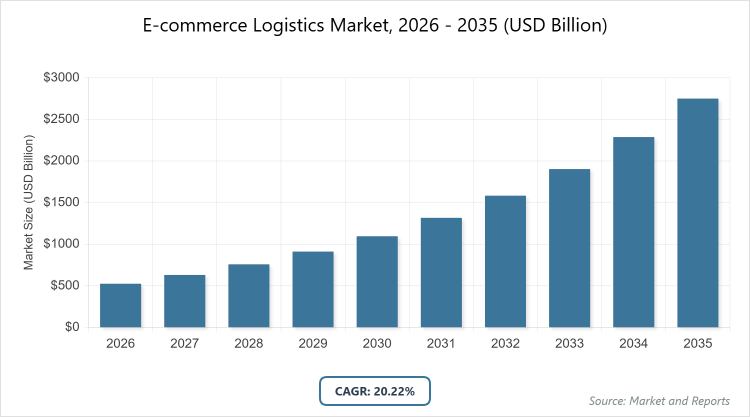
What are the Key Insights for E-commerce Logistics Market?
- The global E-commerce Logistics market size was valued at USD 524.20 billion in 2025 and is projected to reach USD 3307.04 billion by 2035.
- The market is expected to exhibit a CAGR of 20.22% during the forecast period from 2026 to 2035.
- The market is driven by reduced shipping costs and the implementation of automation in warehouses.
- Dominated subsegment in Service Type: Transportation (49%), as it plays a critical role in facilitating last-mile deliveries and cross-border shipments through various modes like road and air.
- Dominated subsegment in Operational Area: Domestic (66%), due to the surge in online shopping frequency, rising consumer spending power, and the demand for instant delivery of everyday goods.
- Dominated subsegment in Logistics Type: Forward Logistics (64%), owing to its essential function in order fulfillment and ensuring seamless delivery from suppliers to customers.
- Dominated region: Asia Pacific (42.11%), driven by rapid internet penetration, expanding online retail activities, and significant infrastructure investments in countries like China and India.
What is the Industry Overview of E-commerce Logistics Market?
E-commerce logistics encompasses a broad range of services including warehousing, transportation, and packaging solutions designed to manage, move, store, and facilitate the smooth flow of goods within the online retail sector. This market definition highlights its role in supporting the e-commerce ecosystem by ensuring efficient supply chain operations from order placement to final delivery. The industry has evolved significantly with the boom in online shopping, where consumer expectations for fast, reliable, and cost-effective delivery have pushed companies to innovate through technologies like automated warehouses, real-time tracking, and data analytics.
Omnichannel retailing has added complexity, requiring seamless integration between digital and physical channels. As digital commerce accelerates, brands are adopting advanced logistics practices to enhance customer satisfaction, reduce operational costs, and gain a competitive advantage. Cross-border e-commerce has also surged, fueled by global demand for diverse products, further expanding the market’s scope. The COVID-19 pandemic catalyzed changes, boosting online shopping, contactless deliveries, and a focus on warehouse automation and sustainability, transforming the landscape into a more resilient and tech-driven sector.
What are the Market Dynamics in E-commerce Logistics?
Growth Drivers
Reduced shipping costs significantly propel the e-commerce logistics market by enabling economies of scale as shipping volumes increase, allowing providers to negotiate better carrier rates and optimize operations. Advanced technologies like AI, machine learning, and big data analytics enhance route optimization, demand prediction, and inventory management, leading to lower fuel use, fewer delays, and reduced labor expenses. Consolidation centers and hub-and-spoke models centralize distribution, cutting transportation costs while speeding up deliveries. Automation in warehouses, including AGVs and robotic arms, boosts efficiency, minimizes errors, and improves worker safety, contributing to overall cost savings and market expansion. Localized warehouses and micro-fulfillment centers near customers shorten travel distances, enabling faster and cheaper shipments, which further drives growth in this competitive sector.
Restraints
High logistics costs in emerging economies such as India, China, and Brazil, compared to developed nations, pose a major restraint, exacerbated by infrastructural inefficiencies, high cash-on-delivery shares, and elevated return rates. This shifts providers toward surface transit, increasing delivery times and costs. Inadequate air and surface infrastructure leads to operational inefficiencies, prolonged transit periods, and higher returns, negatively impacting market development and hindering the ability to meet consumer demands for quick and affordable services.
Opportunities
The expansion of e-commerce in regions like Asia Pacific presents substantial opportunities, with India’s sector growing due to preferences for home delivery and China’s market projected at USD 62.51 billion in 2025, supported by infrastructure investments in railways, highways, and airports. Digitization and technology adoption by SMEs, along with North America’s dominance through companies like Amazon, offer avenues for growth. Europe’s focus on flexible deliveries and warehouse expansions, valued at USD 122.14 billion in 2025, and emerging markets in South America and MEA through mobile adoption and sustainability initiatives, create prospects for partnerships and innovative solutions to address infrastructure challenges.
Challenges
Poor infrastructure in developing regions increases costs and delays, while high return rates complicate reverse logistics. Cost pressures from competitive pricing and the need for rapid adaptations to safety protocols and sustainability demands further challenge market players, requiring ongoing investments in technology and operations to maintain efficiency.
E-commerce Logistics Market: Report Scope
| Report Attributes | Report Details |
| Report Name | E-commerce Logistics Market |
| Market Size 2025 | USD 524.20 Billion |
| Market Forecast 2035 | USD 3307.04 Billion |
| Growth Rate | CAGR of 20.22% |
| Report Pages | 220 |
| Key Companies Covered | FedEx Corporation, DHL International GmbH, Aramex International, XPO Logistics Plc., United Parcel Service, Inc., and Others |
| Segments Covered | By Service Type, By Operational Area, By Logistics Type, and By Region |
| Regions Covered | North America, Europe, Asia Pacific (APAC), Latin America, and The Middle East and Africa (MEA) |
| Base Year | 2025 |
| Historical Year | 2020 – 2024 |
| Forecast Year | 2026 – 2035 |
| Customization Scope | Avail customized purchase options to meet your exact research needs. |
What is the Market Segmentation of E-commerce Logistics?
The E-commerce Logistics market is segmented by Service Type, Operational Area, Logistics Type, and region.
Based on Service Type Segment, the Transportation subsegment is the most dominant, holding 49% share, followed by Warehousing as the second most dominant. Transportation’s dominance stems from its pivotal role in the supply chain, enabling efficient last-mile deliveries via road for direct access to households and air for speedy cross-border shipments to meet consumer demands for quick fulfillment; this drives the market by reducing delivery times and enhancing customer satisfaction, while Warehousing supports growth through technological advancements like robotics that improve operational efficiency and enable flexible inventory management closer to customers.
Based on Operational Area Segment, the Domestic subsegment is the most dominant with 66% share, followed by International as the second most dominant. Domestic’s leading position is driven by increased online shopping frequency, consumer spending power, and e-commerce platforms’ discounts encouraging frequent purchases of essentials like groceries and medicines; this propels market expansion by pressuring retailers to offer instant deliveries, whereas International grows rapidly due to easy access to foreign brands via platforms like Amazon and Alibaba, boosting cross-border shipments and overall market volume.
Based on Logistics Type Segment, the Forward Logistics subsegment is the most dominant at 64% share, followed by Backward Logistics as the second most dominant. Forward Logistics dominates because it ensures effective order fulfillment and downstream delivery from suppliers to customers, forming the backbone of e-commerce operations; this drives the market by facilitating seamless transactions and customer loyalty, while Backward Logistics, handling returns and exchanges, grows fastest due to rising return rates and the need for optimized reverse supply chains, enhancing inventory recovery and customer trust.
What are the Recent Developments in E-commerce Logistics Market?
- February 2024: The Indian government announced strategies to allocate funds for strengthening UPI infrastructure and promoting digital payments, expected to accelerate online shopping and benefit e-commerce logistics by increasing transaction volumes.
- January 2024: UPS launched micro-hubs in major U.S. cities to enable same-day deliveries, managing high order volumes and reducing turnaround times in urban areas through micro-fulfillment centers.
- November 2022: CEVA Logistics extended a multi-year contract with ASOS to handle warehousing, e-commerce fulfillment, and inbound/outbound services.
- October 2022: Aramex PJSC acquired USA Shipping, LLC, to strengthen its cross-border express business and drive revenue growth.
- September 2022: DHL acquired a major stake in Dutch e-commerce specialist Monta to serve small and mid-sized webshops in online sales and fulfillment, consolidating its logistics operations.
- February 2021: CEVA Logistics expanded in Southeast Asia with a new warehouse in Vietnam and a head office in Thailand to support distribution and storage needs across industries.
What is the Regional Analysis for E-commerce Logistics Market?
- Asia Pacific to dominate the global market
Asia Pacific: This region leads with a valuation of USD 223.46 billion in 2025, driven by surging internet penetration, growing consumer spending, and diverse e-commerce options. China dominates as the key country, projected at USD 62.51 billion in 2025, fueled by massive online retail growth and infrastructure enhancements in highways, railways, and airports. India follows closely at USD 54.45 billion, benefiting from a shift to home deliveries and digital payment adoption, while Japan reaches USD 22.87 billion through technological integrations and SME digitization, collectively propelling the region due to middle-class demand for foreign products and efficient supply chains.
North America: Valued at USD 132.49 billion in 2025 with a CAGR of 18.58%, this region thrives on the presence of e-commerce giants. The U.S. dominates, anticipated at USD 110.82 billion in 2025, driven by companies like Amazon’s investments in fulfillment and delivery centers to handle soaring demands, emphasizing last-mile solutions and contactless services post-pandemic, which enhance market efficiency and consumer expectations for rapid deliveries.
Europe: Set to reach USD 122.14 billion in 2025, Europe grows through consumer demands for flexible and short delivery times. Germany leads at USD 22.15 billion, supported by advanced logistics investments and warehouse expansions for optimized inventory. The U.K. follows at USD 16.17 billion, focusing on distribution networks to reduce transit times, while France at USD 12.40 billion benefits from omnichannel strategies, driving overall regional development amid rising online shopping.
South America: Projected at USD 29.60 billion in 2025, this region expands via online retail and mobile adoption, addressing infrastructure challenges with last-mile and cross-border solutions. Brazil emerges as dominant, leveraging partnerships and digital platforms for cost-efficient logistics, while sustainability initiatives shape competitiveness in the market.
Middle East & Africa: Growing rapidly through fast deliveries in Gulf states and mobile-first approaches in Africa, the UAE leads at USD 1.67 billion in 2025, driven by advanced infrastructure and e-commerce hubs, fostering partnerships for enhanced supply chain efficiency and market penetration.
Who are the Key Market Players in E-commerce Logistics?
- FedEx Corporation: FedEx employs strategies focused on global expansion and technological integration, such as investing in air and ground networks for faster cross-border deliveries, adopting AI for route optimization, and partnering with e-commerce platforms to enhance last-mile services, thereby strengthening its position in handling high-volume shipments.
- DHL International GmbH: DHL’s strategies include acquisitions like the stake in Monta for small business fulfillment, emphasizing sustainability through green logistics initiatives, and leveraging data analytics for predictive maintenance and demand forecasting to improve efficiency in warehousing and transportation.
- Aramex International: Aramex pursues growth through acquisitions such as USA Shipping to bolster cross-border express services, focusing on regional expansions in MEA and Asia, and implementing digital platforms for real-time tracking to cater to SMEs and reduce delivery costs.
- XPO Logistics Plc.: XPO emphasizes automation in warehouses and transportation hubs, strategic partnerships for e-fulfillment, and investments in robotics to optimize supply chains, driving cost reductions and faster processing times for e-commerce clients.
- United Parcel Service, Inc.: UPS strategies involve launching micro-hubs for same-day urban deliveries, expanding fulfillment centers, and adopting IoT for real-time monitoring, aiming to manage high order volumes and enhance customer satisfaction in competitive markets.
- Gati Limited: Gati focuses on domestic expansions in India, integrating advanced tracking systems, and partnering with e-commerce firms for last-mile solutions, capitalizing on the region’s growing online retail to improve delivery speeds and reduce returns.
- Kenco Group, Inc.: Kenco’s approaches include warehouse automation and omnichannel fulfillment services, strategic alliances for inventory management, and emphasis on reverse logistics to handle returns efficiently, supporting e-commerce growth through scalable operations.
What are the Market Trends in E-commerce Logistics?
- Increasing adoption of automation and robotics in warehouses to enhance efficiency and reduce labor costs.
- Shift toward sustainable practices, including green packaging and electric vehicles for deliveries.
- Growth in cross-border e-commerce, driven by consumer demand for international products and improved global supply chains.
- Emphasis on last-mile delivery innovations, such as micro-fulfillment centers and drone usage.
- Integration of AI and big data for predictive analytics and optimized route planning.
- Rising focus on reverse logistics to manage high return rates effectively.
- Expansion of contactless and same-day delivery options post-pandemic.
What Market Segments and Subsegments are Covered in the Report?
By Service Type
- Transportation
- Warehousing
- Others
By Operational Area
- Domestic
- International
By Logistics Type
- Forward Logistics
- Backward Logistics
By Region
- North America
- U.S.
- Canada
- Europe
- UK
- Germany
- France
- Rest of Europe
- Asia Pacific
- China
- India
- Japan
- Rest of Asia Pacific
- Latin America
- Brazil
- Mexico
- Rest of Latin America
- Middle East & Africa
- UAE
- South Africa
- Rest of Middle East & Africa
Chapter 1. Preface
1.1 Report Description and Scope1.2 Research Scope1.3 Research Methodology1.3.1 Market Research Type1.3.2 Market Research MethodologyChapter 2. Executive Summary
2.1 Global E-commerce Logistics Market, (2026 - 2035) (USD Billion)2.2 Global E-commerce Logistics Market: SnapshotChapter 3. Global E-commerce Logistics Market - Industry Analysis
3.1 E-commerce Logistics Market: Market Dynamics3.2 Market Drivers3.2.1 The e-commerce logistics market is driven by reduced shipping costs through economies of scale, AI-driven optimization, automation, hub-and-spoke distribution models, and localized warehouses that enable faster, cheaper, and more efficient deliveries.3.3 Market Restraints3.3.1 The e-commerce logistics market is restrained by high logistics costs in emerging economies, poor infrastructure, high return and cash-on-delivery rates, reliance on slower surface transport, and inefficiencies that increase delivery times and operational expenses.3.4 Market Opportunities3.4.1 The e-commerce logistics market offers strong opportunities through rapid e-commerce growth in Asia Pacific, infrastructure investments, SME digitization, warehouse expansion in Europe, tech-driven dominance in North America, and emerging market adoption in South America and MEA supported by mobile and sustainability initiatives.3.5 Market Challenges3.5.1 The e-commerce logistics market faces challenges from poor infrastructure, high return rates, pricing pressure, and the need for rapid adaptation to safety and sustainability requirements, driving up costs and operational complexity.3.6 Porter’s Five Forces Analysis3.7 Market Attractiveness Analysis3.7.1 Market Attractiveness Analysis By Service Type3.7.2 Market Attractiveness Analysis By Operational Area3.7.3 Market Attractiveness Analysis By Logistics TypeChapter 4. Global E-commerce Logistics Market- Competitive Landscape
4.1 Company Market Share Analysis4.1.1 Global E-commerce Logistics Market: Company Market Share, 20254.2 Strategic Development4.2.1 Acquisitions & mergers4.2.2 New Product launches4.2.3 Agreements, partnerships, collaborations, and joint ventures4.2.4 Research and development and regional expansion4.3 Price Trend AnalysisChapter 5. Global E-commerce Logistics Market - Service Type Analysis
5.1 Global E-commerce Logistics Market Overview: Service Type5.1.1 Global E-commerce Logistics Market share, By Service Type, 2025 and 20355.2 Transportation5.2.1 Global E-commerce Logistics Market by Transportation, 2026 - 2035 (USD Billion)5.3 Warehousing5.3.1 Global E-commerce Logistics Market by Warehousing, 2026 - 2035 (USD Billion)5.4 Others5.4.1 Global E-commerce Logistics Market by Others, 2026 - 2035 (USD Billion)Chapter 6. Global E-commerce Logistics Market - Operational Area Analysis
6.1 Global E-commerce Logistics Market Overview: Operational Area6.1.1 Global E-commerce Logistics Market Share, By Operational Area, 2025 and 20356.2 Domestic6.2.1 Global E-commerce Logistics Market by Domestic, 2026 - 2035 (USD Billion)6.3 International6.3.1 Global E-commerce Logistics Market by International, 2026 - 2035 (USD Billion)Chapter 7. Global E-commerce Logistics Market - Logistics Type Analysis
7.1 Global E-commerce Logistics Market Overview: Logistics Type7.1.1 Global E-commerce Logistics Market Share, By Logistics Type, 2025 and 20357.2 Forward Logistics7.2.1 Global E-commerce Logistics Market by Forward Logistics, 2026 - 2035 (USD Billion)7.3 Backward Logistics7.3.1 Global E-commerce Logistics Market by Backward Logistics, 2026 - 2035 (USD Billion)Chapter 8. E-commerce Logistics Market - Regional Analysis
8.1 Global E-commerce Logistics Market Regional Overview8.2 Global E-commerce Logistics Market Share, by Region, 2025 & 2035 (USD Billion)8.3 North America8.3.1 North America E-commerce Logistics Market, 2026 - 2035 (USD Billion)8.3.1.1 North America E-commerce Logistics Market, by Country, 2026 - 2035 (USD Billion)8.3.2 North America E-commerce Logistics Market, by Service Type, 2026 - 20358.3.2.1 North America E-commerce Logistics Market, by Service Type, 2026 - 2035 (USD Billion)8.3.3 North America E-commerce Logistics Market, by Operational Area, 2026 - 20358.3.3.1 North America E-commerce Logistics Market, by Operational Area, 2026 - 2035 (USD Billion)8.3.4 North America E-commerce Logistics Market, by Logistics Type, 2026 - 20358.3.4.1 North America E-commerce Logistics Market, by Logistics Type, 2026 - 2035 (USD Billion)8.4 Europe8.4.1 Europe E-commerce Logistics Market, 2026 - 2035 (USD Billion)8.4.1.1 Europe E-commerce Logistics Market, by Country, 2026 - 2035 (USD Billion)8.4.2 Europe E-commerce Logistics Market, by Service Type, 2026 - 20358.4.2.1 Europe E-commerce Logistics Market, by Service Type, 2026 - 2035 (USD Billion)8.4.3 Europe E-commerce Logistics Market, by Operational Area, 2026 - 20358.4.3.1 Europe E-commerce Logistics Market, by Operational Area, 2026 - 2035 (USD Billion)8.4.4 Europe E-commerce Logistics Market, by Logistics Type, 2026 - 20358.4.4.1 Europe E-commerce Logistics Market, by Logistics Type, 2026 - 2035 (USD Billion)8.5 Asia Pacific8.5.1 Asia Pacific E-commerce Logistics Market, 2026 - 2035 (USD Billion)8.5.1.1 Asia Pacific E-commerce Logistics Market, by Country, 2026 - 2035 (USD Billion)8.5.2 Asia Pacific E-commerce Logistics Market, by Service Type, 2026 - 20358.5.2.1 Asia Pacific E-commerce Logistics Market, by Service Type, 2026 - 2035 (USD Billion)8.5.3 Asia Pacific E-commerce Logistics Market, by Operational Area, 2026 - 20358.5.3.1 Asia Pacific E-commerce Logistics Market, by Operational Area, 2026 - 2035 (USD Billion)8.5.4 Asia Pacific E-commerce Logistics Market, by Logistics Type, 2026 - 20358.5.4.1 Asia Pacific E-commerce Logistics Market, by Logistics Type, 2026 - 2035 (USD Billion)8.6 Latin America8.6.1 Latin America E-commerce Logistics Market, 2026 - 2035 (USD Billion)8.6.1.1 Latin America E-commerce Logistics Market, by Country, 2026 - 2035 (USD Billion)8.6.2 Latin America E-commerce Logistics Market, by Service Type, 2026 - 20358.6.2.1 Latin America E-commerce Logistics Market, by Service Type, 2026 - 2035 (USD Billion)8.6.3 Latin America E-commerce Logistics Market, by Operational Area, 2026 - 20358.6.3.1 Latin America E-commerce Logistics Market, by Operational Area, 2026 - 2035 (USD Billion)8.6.4 Latin America E-commerce Logistics Market, by Logistics Type, 2026 - 20358.6.4.1 Latin America E-commerce Logistics Market, by Logistics Type, 2026 - 2035 (USD Billion)8.7 The Middle-East and Africa8.7.1 The Middle-East and Africa E-commerce Logistics Market, 2026 - 2035 (USD Billion)8.7.1.1 The Middle-East and Africa E-commerce Logistics Market, by Country, 2026 - 2035 (USD Billion)8.7.2 The Middle-East and Africa E-commerce Logistics Market, by Service Type, 2026 - 20358.7.2.1 The Middle-East and Africa E-commerce Logistics Market, by Service Type, 2026 - 2035 (USD Billion)8.7.3 The Middle-East and Africa E-commerce Logistics Market, by Operational Area, 2026 - 20358.7.3.1 The Middle-East and Africa E-commerce Logistics Market, by Operational Area, 2026 - 2035 (USD Billion)8.7.4 The Middle-East and Africa E-commerce Logistics Market, by Logistics Type, 2026 - 20358.7.4.1 The Middle-East and Africa E-commerce Logistics Market, by Logistics Type, 2026 - 2035 (USD Billion)Chapter 9. Company Profiles
9.1 FedEx Corporation9.1.1 Overview9.1.2 Financials9.1.3 Product Portfolio9.1.4 Business Strategy9.1.5 Recent Developments9.2 DHL International GmbH9.2.1 Overview9.2.2 Financials9.2.3 Product Portfolio9.2.4 Business Strategy9.2.5 Recent Developments9.3 Aramex International9.3.1 Overview9.3.2 Financials9.3.3 Product Portfolio9.3.4 Business Strategy9.3.5 Recent Developments9.4 XPO Logistics Plc.9.4.1 Overview9.4.2 Financials9.4.3 Product Portfolio9.4.4 Business Strategy9.4.5 Recent Developments9.5 United Parcel Service Inc.9.5.1 Overview9.5.2 Financials9.5.3 Product Portfolio9.5.4 Business Strategy9.5.5 Recent Developments
Frequently Asked Questions
E-commerce logistics refers to the services involved in managing, storing, transporting, and delivering goods for online retail, including warehousing, packaging, and fulfillment to ensure efficient supply chain operations.
Key factors include reduced shipping costs, automation adoption, rising internet penetration, cross-border trade expansion, and consumer demand for faster deliveries.
The market is projected to grow from USD 524.20 billion in 2025 to USD 3307.04 billion by 2035.
The CAGR is expected to be 20.22% during 2026-2035.
Asia Pacific will contribute notably, holding a 42.11% share, driven by rapid e-commerce growth in China and India.
Major players include FedEx Corporation, DHL International GmbH, Aramex International, XPO Logistics Plc., and United Parcel Service, Inc.
The report provides in-depth analysis of market size, trends, segmentation, regional insights, key players, and forecasts from 2026 to 2035.
Stages include procurement of goods, warehousing and inventory management, transportation and distribution, last-mile delivery, and reverse logistics for returns.
Trends are shifting toward sustainability, automation, and same-day deliveries, while consumers prefer faster, contactless options and flexible return policies.
Factors include infrastructure regulations in emerging markets, safety protocols post-pandemic, and environmental pressures for eco-friendly practices like reduced emissions.