
E-Cigarette Market Size, Share and Trends 2026 to 2035
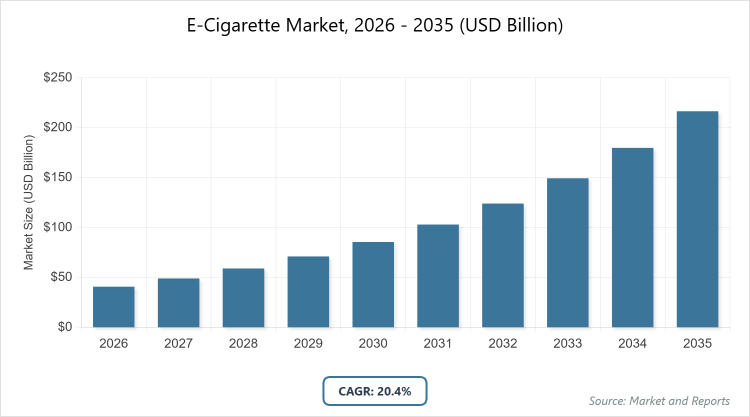
According to MarketnReports, the global E-Cigarette market size was estimated at USD 40.71 billion in 2025 and is expected to reach USD 260.59 billion by 2035, growing at a CAGR of 20.4% from 2026 to 2035. Increasing consumer preference for alternatives to traditional smoking and rising awareness of harm reduction.
What are the Key Insights of the E-Cigarette Market?
- The E-Cigarette market was valued at USD 40.71 billion in 2025 and is projected to reach USD 260.59 billion by 2035.
- The E-Cigarette market is expected to grow at a CAGR of 20.4% during the forecast period 2026-2035.
- The E-Cigarette market is driven by growing health consciousness, flavor innovations, and the shift towards smoke-free alternatives.
- Disposable dominates the product segment with a 50% share, due to its convenience, affordability, and appeal to new users seeking hassle-free options.
- Tobacco dominates the flavor segment with a 40% share, as it mimics traditional smoking experiences, attracting smokers transitioning from cigarettes.
- Online dominates the distribution channel segment with a 45% share, driven by ease of access, discreet purchasing, and wide product variety.
- North America dominates the regional segment with a 41% share, attributed to high adoption rates, established brands, and supportive harm-reduction policies.
What is the E-Cigarette Market?
Industry Overview
The E-Cigarette market involves battery-powered devices that heat a liquid solution to produce an inhalable aerosol, offering an alternative to traditional tobacco smoking with options for nicotine delivery and flavor customization. Market definition includes various product types such as disposables, rechargeables, and pod systems, along with e-liquids and accessories, catering to consumers seeking reduced-harm options, cessation aids, or recreational use while navigating regulatory landscapes focused on health and youth protection.
What are the Market Dynamics in the E-Cigarette Market?
Growth Drivers
The E-Cigarette market is expanding due to heightened awareness of the health risks associated with traditional tobacco smoking, prompting consumers to seek alternatives perceived as less harmful. Innovations in product design, such as customizable nicotine levels and diverse flavors, enhance user experience and attract a broader demographic, including young adults and former smokers. Additionally, supportive government initiatives in some regions promoting smoking cessation, coupled with aggressive marketing strategies by key players, further accelerate adoption and market penetration.
Restraints
Regulatory restrictions, including flavor bans and age verification requirements, pose significant barriers to market growth by limiting product availability and increasing operational costs for manufacturers. Public health concerns over long-term effects and youth vaping epidemics lead to negative perceptions and stricter controls, deterring potential users. Moreover, high taxation on e-cigarettes in various jurisdictions reduces affordability and competitiveness against traditional tobacco products.
Opportunities
Emerging markets in Asia-Pacific and Latin America present untapped potential due to rising disposable incomes and shifting consumer preferences towards modern alternatives. Advancements in technology, like smart devices with app integration for usage tracking, open avenues for premium offerings. Furthermore, the integration of sustainable materials and nicotine-free options aligns with growing environmental consciousness and health trends, creating niches for innovation.
Challenges
Navigating diverse and evolving regulatory environments across regions demands substantial compliance efforts, potentially delaying product launches. Counterfeit products undermine brand trust and safety standards, complicating market integrity. Additionally, ongoing debates about addiction risks and insufficient long-term research hinder widespread acceptance and investor confidence.
E-Cigarette Market: Report Scope
| Report Attributes | Report Details |
| Report Name | E-Cigarette Market |
| Market Size 2025 | USD 40.71 Billion |
| Market Forecast 2035 | USD 260.59 Billion |
| Growth Rate | CAGR of 20.4% |
| Report Pages | 220 |
| Key Companies Covered |
JUUL Labs, British American Tobacco, Philip Morris International, Altria Group, Imperial Brands, and Others |
| Segments Covered | By Product, By Flavor, By Distribution Channel, and By Region |
| Regions Covered | North America, Europe, Asia Pacific (APAC), Latin America, and The Middle East and Africa (MEA) |
| Base Year | 2025 |
| Historical Year | 2020 – 2024 |
| Forecast Year | 2026 – 2035 |
| Customization Scope | Avail customized purchase options to meet your exact research needs. |
What is the Market Segmentation of the E-Cigarette Market?
The E-Cigarette market is segmented by product, flavor, distribution channel, and region.
Based on Product Segment, disposable is the most dominant, holding a 50% share, followed by rechargeable at 30%. Disposable’s dominance is due to its user-friendly design requiring no maintenance or refills, driving the market by appealing to beginners and occasional users who prioritize convenience and portability.
Based on Flavor Segment, tobacco is the most dominant with a 40% share, followed by fruit at 25%. Tobacco leads as it provides a familiar taste for transitioning smokers, propelling market growth by facilitating cessation efforts and maintaining user satisfaction through authentic simulation.
Based on Distribution Channel Segment, online is the most dominant with a 45% share, followed by specialty stores at 30%. Online dominates owing to its broad accessibility and privacy in purchasing, fueling market expansion by enabling global reach and personalized recommendations via digital platforms.
What are the Recent Developments in the E-Cigarette Market?
- In 2025, Philip Morris International expanded its IQOS portfolio with a new heat-not-burn device featuring enhanced battery life and flavor consistency, targeting adult smokers in Europe.
- JUUL Labs received FDA authorization in late 2025 for its next-generation pod system with improved age-verification technology, aiming to reduce youth access.
- British American Tobacco launched Vuse Alto Plus in 2025, incorporating smart connectivity for usage tracking, appealing to tech-savvy consumers.
- Altria Group acquired a minority stake in a biotech firm in 2025 to develop nicotine alternatives, focusing on reduced-risk products.
What is the Regional Analysis of the E-Cigarette Market?
- North America is expected to dominate the global market.
North America holds the largest share at 41%, with the United States as the dominating country due to widespread adoption, strong retail presence, and policies supporting harm reduction, driving innovation in flavored and disposable products.
Asia Pacific is the fastest-growing region, led by China through massive manufacturing capabilities, rising youth population, and easing regulations in some areas, fostering export-led growth.
Europe maintains a significant share, with the United Kingdom dominating via progressive vaping policies and high cessation rates, emphasizing premium and compliant devices.
Latin America exhibits emerging potential, dominated by Brazil with increasing urban demand and retail expansions, supported by awareness campaigns.
The Middle East and Africa show gradual progress, with South Africa leading through growing acceptance and distribution networks for imported brands.
Who are the Key Market Players in the E-Cigarette Market?
- JUUL Labs focuses on compliance-driven innovations, such as app-locked devices, and partnerships for adult-only marketing to regain market share.
- British American Tobacco emphasizes diversification with Vuse, investing in R&D for reduced-risk products and global expansions.
- Philip Morris International pursues heat-not-burn technologies via IQOS, prioritizing scientific validation and regulatory approvals.
- Altria Group leverages NJOY for disposable segments, focusing on U.S. FDA compliance and acquisitions for portfolio enhancement.
- Imperial Brands drives growth through blu, highlighting flavor variety and sustainability initiatives.
What are the Market Trends in the E-Cigarette Market?
- Rise in smart vapes with screens and app integration for personalized experiences.
- Shift towards nicotine pouches and alternatives amid flavor bans.
- Growth in disposable devices despite regulatory pressures.
- Emphasis on sustainability with eco-friendly materials.
- Increasing focus on youth prevention through tech features.
What Market Segments and Subsegments are Covered in the E-Cigarette Report?
By Product
- Disposable
- Rechargeable
- Pod Systems
- Modular Devices
- Vape Pens
- Cigalikes
- Heat-Not-Burn
- Next-Generation Devices
- Refillable
- Closed Systems
- Others
By Flavor
- Tobacco
- Menthol
- Fruit
- Dessert
- Beverage
- Mint
- Candy
- Botanical
- Sweet
- Mixed
- Others
By Distribution Channel
- Online
- Offline
- Specialty Stores
- Supermarkets
- Convenience Stores
- Tobacconists
- Pharmacies
- E-commerce Websites
- Company Websites
- Retail Outlets
- Others
By Region
- North America
- U.S.
- Canada
- Europe
- UK
- Germany
- France
- Rest of Europe
- Asia Pacific
- China
- India
- Japan
- Rest of Asia Pacific
- Latin America
- Brazil
- Mexico
- Rest of Latin America
- Middle East & Africa
- UAE
- South Africa
- Rest of Middle East & Africa
Chapter 1. Preface
Chapter 2. Executive Summary
Chapter 3. Global E-Cigarette Market - Industry Analysis
Chapter 4. Global E-Cigarette Market- Competitive Landscape
Chapter 5. Global E-Cigarette Market - Product Analysis
Chapter 6. Global E-Cigarette Market - Flavor Analysis
Chapter 7. Global E-Cigarette Market - Distribution Channel Analysis
Chapter 8. E-Cigarette Market - Regional Analysis
Chapter 9. Company Profiles
Frequently Asked Questions
E-cigarettes are electronic devices that heat a liquid to produce an aerosol for inhalation, often containing nicotine and flavors as an alternative to smoking.
Factors include regulatory changes, health awareness, flavor innovations, and youth prevention measures.
The market is projected to grow from USD 48.18 billion in 2026 to USD 260.59 billion by 2035.
The expected CAGR is 20.4% from 2026 to 2035.
North America will contribute notably, driven by high adoption and innovation.
Major players include JUUL Labs, British American Tobacco, Philip Morris International, Altria Group, and Imperial Brands.
The report offers analysis of size, trends, segments, regions, players, and forecasts.
Stages include raw material sourcing, manufacturing, distribution, retail, and consumer usage.
Trends focus on tech integration and sustainability, with preferences shifting to customizable, low-nicotine options.
Flavor bans and age restrictions impact growth, while sustainability demands drive eco-friendly innovations.