
E-Bike Sharing Market Size, Share and Trends 2026 to 2035
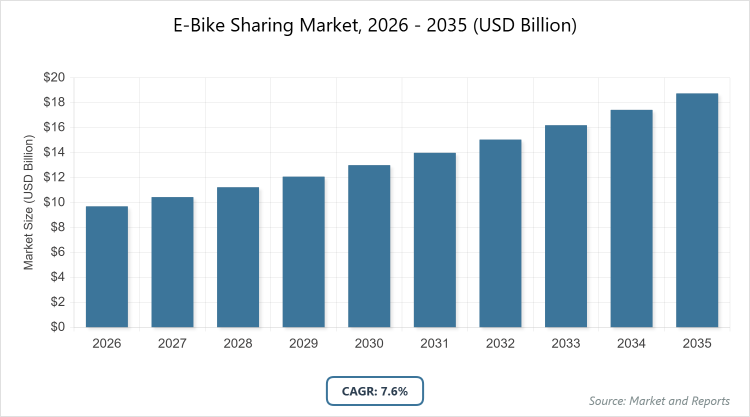
According to MarketnReports, the global E-Bike Sharing market size was estimated at USD 9.7 billion in 2025 and is expected to reach USD 20.1 billion by 2035, growing at a CAGR of 7.6% from 2026 to 2035. The E-Bike Sharing Market is driven by urbanization, sustainability initiatives, and advancements in smart mobility technologies.
What are the Key Insights into E-Bike Sharing?
- The global E-Bike Sharing market was valued at USD 9.7 billion in 2025 and is projected to reach USD 20.1 billion by 2035.
- The market is expected to grow at a CAGR of 7.6% during the forecast period from 2026 to 2035.
- The market is driven by rising urban congestion, environmental awareness, government incentives for green mobility, and technological integrations like IoT and AI.
- In the type segment, dockless e-bikes dominate with a 61% share due to their flexibility and ease of use without fixed stations, appealing to urban users for spontaneous rides.
- In the application segment, urban mobility dominates with a 50% share as it addresses last-mile connectivity in cities, reducing reliance on cars and public transit delays.
- In the end-user segment, individuals dominate with a 70% share owing to personal commuting needs and app-based convenience for daily travel.
- Asia Pacific dominates the regional market with a 45% share, driven by dense urban populations in China and India, government subsidies, and extensive sharing networks.
What is the Industry Overview of E-Bike Sharing?
The E-Bike Sharing market involves shared electric bicycle systems that provide on-demand, short-term rental access via mobile apps or stations, promoting eco-friendly urban transportation by integrating battery-powered bikes with GPS tracking, payment systems, and fleet management for seamless user experience. Market definition includes both docked and dockless models that offer pedal-assist or throttle propulsion, catering to commuters, tourists, and delivery services while addressing challenges in battery life, infrastructure, regulatory compliance, and vandalism in a sector focused on reducing carbon emissions and traffic congestion.
What are the Market Dynamics of E-Bike Sharing?
Growth Drivers
The E-Bike Sharing market is fueled by accelerating urbanization and the need for sustainable last-mile solutions, where e-bikes offer low-emission alternatives to cars, reducing traffic congestion and pollution in densely populated cities. Government policies promoting green transportation, such as subsidies for e-bike infrastructure and integration with public transit systems, drive widespread adoption. Technological advancements in battery life, GPS tracking, and AI-powered fleet management enhance user experience and operational efficiency, attracting investments from venture capital. Rising health consciousness and post-pandemic preferences for outdoor, contactless mobility further boost demand, while partnerships with ride-hailing services expand market reach.
Restraints
High initial capital for fleet deployment, charging infrastructure, and maintenance poses barriers for operators in emerging markets, where vandalism and theft increase operational costs. Regulatory inconsistencies across cities, including licensing requirements and zoning for docking stations, hinder expansion and standardization. Battery limitations in cold weather or hilly terrains reduce reliability, while data privacy concerns from app-based tracking deter users in regulated regions. Economic downturns and competition from e-scooters or personal e-bikes fragment market share, slowing growth in saturated urban areas.
Opportunities
Opportunities arise from integration with smart city initiatives, where e-bike sharing can link with IoT for real-time availability and predictive maintenance, enhancing urban mobility ecosystems. Expansion into suburban and rural areas with long-range batteries opens untapped markets, while corporate wellness programs promote e-bike subscriptions for employee commutes. Advancements in solar-powered charging and recyclable materials align with sustainability goals, attracting eco-focused investors. Partnerships with delivery services for cargo e-bikes capitalize on e-commerce growth, and government grants for green infrastructure in developing regions provide entry points.
Challenges
Challenges include battery supply chain vulnerabilities, with shortages of lithium and rare earths increasing costs and delaying fleet expansions. Urban space constraints for docking stations lead to clutter complaints and regulatory pushback, while cybersecurity risks in app platforms threaten user data and system integrity. User education on safe riding and maintenance is needed to reduce accidents and damage rates. Economic disparities limit accessibility in low-income areas, and competition from private e-bike ownership requires innovative pricing models to retain users.
E-Bike Sharing Market: Report Scope
| Report Attributes | Report Details |
| Report Name | E-Bike Sharing Market |
| Market Size 2025 | USD 9.7 Billion |
| Market Forecast 2035 | USD 20.1 Billion |
| Growth Rate | CAGR of 7.6% |
| Report Pages | 220 |
| Key Companies Covered | Lime, Bird, Bolt, Dott, JUMP (Uber), Lyft, Nextbike, Ofo, Spin, and Others |
| Segments Covered | By Type, By Application, By End-User, and By Region |
| Regions Covered | North America, Europe, Asia Pacific (APAC), Latin America, and The Middle East and Africa (MEA) |
| Base Year | 2025 |
| Historical Year | 2020 – 2024 |
| Forecast Year | 2026 – 2035 |
| Customization Scope | Avail customized purchase options to meet your exact research needs. |
What is the Market Segmentation of E-Bike Sharing?
The E-Bike Sharing market is segmented by type, application, end-user, and region.
By Type. Dockless e-bikes are the most dominant subsegment, holding approximately 61% market share, due to their convenience without fixed stations, allowing users to park anywhere, which suits dense urban environments. This dominance drives the market by lowering infrastructure costs for operators and increasing accessibility, boosting ridership in dynamic cities. Docked e-bikes rank as the second most dominant, with around 30% share, providing secure parking and charging, propelling growth through integration with public transit hubs for reliable commuting options.
By Application. Urban mobility emerges as the most dominant subsegment, capturing about 50% share, primarily because it solves last-mile connectivity issues in congested cities. This leads to market growth by reducing carbon emissions and traffic, aligning with sustainable urban planning. Tourism & leisure follows as the second most dominant, with roughly 20% share, offering eco-friendly exploration, driving the market via seasonal demand in tourist hotspots.
By End-User. Individuals represent the most dominant subsegment at about 70% share, driven by daily commuting and personal convenience. This dominance accelerates market expansion through app-based ease and affordability for urban dwellers. Governments & municipalities rank second most dominant, holding around 15% share, using sharing for public transport supplements, contributing to growth via smart city integrations.
What are the Recent Developments in E-Bike Sharing?
- In January 2025, Forest and Bird established a partnership to enhance accessible and affordable e-bike services, aiming to promote cleaner cities and reduce car usage.
- In April 2025, Minneapolis launched a year-round shared e-bike and scooter program operated by Lime and Spin for residents and tourists.
- In February 2025, Wicklow County Council collaborated with MOBY to re-launch and expand its public e-bike sharing scheme starting in March 2025.
- In August 2024, bike-sharing programs expanded rapidly across Canada, with notable growth in Montreal, Toronto, Calgary, and Vancouver.
- In April 2024, MTC and Lyft launched an expansion of the Bay Wheels bike-sharing program into the East Bay.
What is the Regional Analysis of E-Bike Sharing?
- Asia Pacific to dominate the global market.
Asia Pacific holds the largest share at approximately 45%, with China as the dominating country, due to dense urban populations, government subsidies for green transport, and extensive networks like Mobike and Hellobike. This region’s growth is fueled by rapid urbanization, air pollution concerns, and investments in smart cities, positioning it as a leader in dockless systems. High smartphone penetration enables seamless app-based access. India’s push for electric mobility through the FAME scheme accelerates adoption in metros. Southeast Asian nations like Singapore integrate with public transit for multi-modal travel. Environmental regulations reduce reliance on fossil fuels. Strong local manufacturing lowers fleet costs.
North America follows with steady growth, driven by tech integration and sustainability focus, where the United States dominates through companies like Lime and Lyft. The region’s expansion benefits from urban planning initiatives and post-pandemic outdoor preferences, supported by venture funding. Canadian cities like Toronto emphasize winter-resilient models. Government grants for green infrastructure in California boost charging networks. The focus on campus and corporate programs drives B2B growth. Collaborations with ride-hailing apps enhance user convenience.
Europe exhibits strong performance with emphasis on eco-mobility, led by the Netherlands through its cycling culture and firms like Dott. The region’s growth is aided by EU green deal policies and bike-friendly infrastructure in cities like Paris and London. Germany’s emphasis on sustainable transport integrates e-bikes with trains. The UK’s post-Brexit green recovery funds public schemes. Multilingual apps support diverse users in Spain and Italy. Circular economy initiatives recycle batteries, reducing waste.
Latin America shows moderate advancement, dominated by Mexico’s urban expansions and Brazil’s tourism sectors, supported by foreign investments, though limited by infrastructure gaps. Mexico City’s Ecobici system expands with solar docking. Brazil’s Rio focuses on leisure in tourist areas. Government subsidies in Colombia are promoted in low-income neighborhoods. However, theft rates require advanced tracking. Emerging partnerships with delivery firms boost cargo applications.
The Middle East and Africa remain emerging, with the United Arab Emirates leading through smart city projects in Dubai, constrained by climate but promising via tourism applications. Saudi Arabia’s NEOM invests in futuristic mobility. South Africa’s Cape Town adopts for eco-tourism. Technology transfers from European firms build local expertise. However, high temperatures affect battery performance. Investments in shaded charging address environmental challenges.
What are the Key Market Players in E-Bike Sharing?
- Lime. Lime focuses on urban e-bike fleets with app integration and solar-powered charging, expanding through partnerships for sustainable mobility.
- Bird. Bird emphasizes dockless models with AI fleet management, investing in safety features like geofencing to comply with regulations.
- Bolt. Bolt offers integrated e-bike and scooter sharing, strategizing on European market growth with affordable pricing.
- Dott. Dott prioritizes eco-friendly operations with electric fleets, pursuing city contracts for integrated public transport.
- JUMP (Uber). JUMP leverages Uber’s platform for seamless rides, focusing on data analytics for demand prediction.
- Lyft. Lyft integrates e-bikes with ride-hailing, expanding U.S. networks through acquisitions.
- Nextbike. Nextbike targets docked systems in Europe, emphasizing partnerships with public transit.
- Ofo. Ofo focuses on Asian markets with low-cost dockless bikes, recovering through restructuring.
- Spin. Spin invests in safety tech like AI cameras, targeting campus and corporate campuses.
What are the Market Trends in E-Bike Sharing?
- Increasing integration with public transit apps for seamless multi-modal travel.
- Adoption of AI for predictive maintenance and fleet optimization.
- Rise of solar-powered charging stations for sustainability.
- Expansion of cargo e-bikes for last-mile delivery.
- Focus on safety features like geofencing and helmet locks.
- Growth in subscription models for frequent users.
What Market Segments and Subsegments are Covered in the E-Bike Sharing Report?
By Type
- Docked E-Bikes
- Dockless E-Bikes
- Hybrid Models
- Pedal-Assist E-Bikes
- Throttle-Assist E-Bikes
- Cargo E-Bikes
- Folding E-Bikes
- Mountain E-Bikes
- Urban E-Bikes
- Shared Fleet Management Systems
- Others
By Application
- Urban Mobility
- Tourism & Leisure
- Commercial Delivery
- Campus Transportation
- Short-Term Rental
- Long-Term Subscription
- Event Management
- Corporate Commute
- Public Transport Integration
- Recreational Use
- Others
By End-User
- Individuals
- Tourists
- Corporates
- Governments & Municipalities
- Universities & Campuses
- Delivery Companies
- Hospitality Sector
- Event Organizers
- Transportation Authorities
- Fleet Operators
- Others
By Region
-
- North America
- U.S.
- Canada
- Europe
- UK
- Germany
- France
- Rest of Europe
- Asia Pacific
- China
- India
- Japan
- Rest of Asia Pacific
- Latin America
- Brazil
- Mexico
- Rest of Latin America
- Middle East & Africa
- UAE
- South Africa
- Rest of Middle East & Africa
- North America
Frequently Asked Questions
E-Bike Sharing refers to on-demand rental systems providing electric bicycles for short-term use via apps or stations, promoting sustainable urban transportation.
Key factors include urbanization, environmental regulations, tech integrations, and government incentives for green mobility.
The market is projected to grow from USD 9.7 billion in 2025 to USD 20.1 billion by 2035.
The CAGR is expected to be 7.6%.
Asia Pacific will contribute notably, holding around 45% share due to urban density and government support.
Major players include Lime, Bird, Bolt, Dott, and JUMP (Uber).
The report provides detailed analysis of size, trends, segments, regional outlook, key players, and forecasts.
Stages include bike manufacturing, fleet assembly, app development, infrastructure setup, operations, maintenance, and user acquisition.
Trends evolve toward AI optimization and cargo models, with preferences for sustainable, convenient urban transport.
Regulations on urban mobility and environmental policies promoting low-emission transport influence infrastructure and adoption.