
Drug Delivery in Cancer Market Size, Share and Trends 2026 to 2035
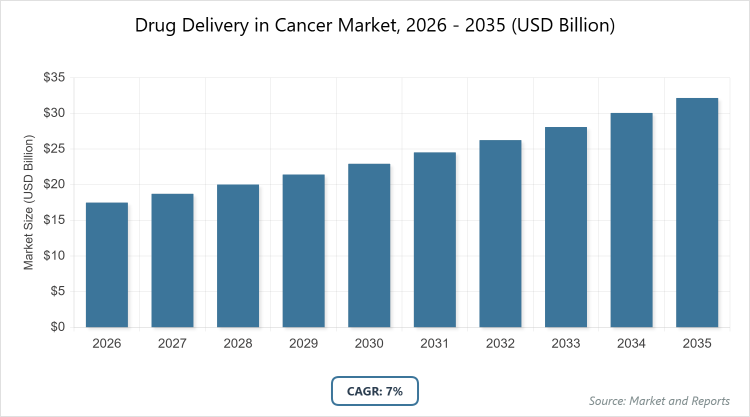
According to MarketnReports, the global Drug Delivery in Cancer market size was estimated at USD 17.5 billion in 2025 and is expected to reach USD 34 billion by 2035, growing at a CAGR of 7% from 2026 to 2035. Drug Delivery in Cancer Market is driven by the rising prevalence of cancer globally coupled with advancements in targeted drug delivery technologies.
What are the Key Insights in the Drug Delivery in Cancer Market?
- The global Drug Delivery in Cancer market was valued at USD 17.5 billion in 2025 and is projected to reach USD 34 billion by 2035.
- The market is expected to grow at a CAGR of 7% from 2026 to 2035.
- The market is primarily driven by escalating cancer incidence, technological advancements in targeted therapies, and increasing demand for precision medicine.
- Nanoparticles dominate the product type segment due to their ability to provide precise targeting, enhanced bioavailability, and reduced toxicity to healthy tissues. Injectable route dominates due to rapid and effective delivery for drugs with poor oral bioavailability. Hospitals dominate the end-user segment as primary providers of comprehensive cancer care and advanced administration. Breast cancer dominates the application segment owing to its high prevalence and advancements in personalized delivery systems.
- North America dominates the regional segment due to advanced healthcare infrastructure, strong R&D, and high adoption of innovative technologies.
What is the Industry Overview of the Drug Delivery in Cancer Market?
The Drug Delivery in Cancer market encompasses advanced technologies and systems designed to administer anticancer drugs more effectively, improving therapeutic outcomes while minimizing side effects. This market focuses on innovative mechanisms such as targeted delivery to cancer cells, controlled release, and enhanced bioavailability to overcome challenges like drug resistance, poor solubility, and toxicity to healthy tissues. It includes various delivery platforms that enable precise drug localization at tumor sites, supporting the shift toward precision oncology and personalized medicine in cancer treatment.
What are the Market Dynamics of the Drug Delivery in Cancer Market?
Growth Drivers
The market experiences strong growth due to the escalating global incidence of cancer, which necessitates more effective and targeted treatment options. Advancements in nanotechnology, such as nanoparticles and liposomes, improve drug solubility, stability, and targeted delivery, reducing systemic toxicity. The rise of personalized medicine allows tailoring therapies to specific cancer types and patient profiles, boosting efficacy. Increasing clinical trials, product approvals, and collaborative research partnerships further accelerate innovation and market expansion.
Restraints
High development and commercialization costs for advanced delivery systems pose a significant barrier, requiring substantial investment in R&D and manufacturing. Complex and stringent regulatory approval processes demand rigorous testing and long-term clinical trials, delaying product launches. Potential unforeseen adverse effects and pricing pressures in a competitive landscape also limit profitability and adoption rates.
Opportunities
Technological progress in nanoparticles, monoclonal antibodies, and conjugates offers enhanced efficacy and safety, opening avenues for new therapies. Growing emphasis on precision oncology and personalized treatments creates demand for specialized delivery systems. Integration of AI and data analytics in research, along with expanding biologics and biosimilars markets, presents significant growth potential. Rising cancer prevalence in emerging economies, supported by increasing healthcare expenditure, further expands market reach.
Challenges
High development costs combined with regulatory hurdles remain major challenges, slowing innovation timelines. Intense competition among players leads to pricing pressures and market saturation risks. Ensuring long-term safety through extensive trials and addressing potential adverse effects continue to pose ongoing difficulties.
Drug Delivery in Cancer Market: Report Scope
| Report Attributes | Report Details |
| Report Name | Drug Delivery in Cancer Market |
| Market Size 2025 | USD 17.5 Billion |
| Market Forecast 2035 | USD 34 Billion |
| Growth Rate | CAGR of 7% |
| Report Pages | 218 |
| Key Companies Covered | Pfizer Inc., Johnson & Johnson, F. Hoffmann-La Roche Ltd, Novartis AG, Bristol-Myers Squibb Company, and Others |
| Segments Covered | By Product Type, By Route of Administration, By Application, By End-User, and By Region |
| Regions Covered | North America, Europe, Asia Pacific (APAC), Latin America, and The Middle East and Africa (MEA) |
| Base Year | 2025 |
| Historical Year | 2020 – 2024 |
| Forecast Year | 2026 – 2035 |
| Customization Scope | Avail customized purchase options to meet your exact research needs. |
How is the Drug Delivery in Cancer Market Segmented?
The Drug Delivery in Cancer market is segmented by product type, route of administration, application, end-user, and region.
Based on Product Type Segment, Nanoparticles dominate as the leading segment due to their transformative ability to penetrate biological barriers, achieve precise tumor targeting, enhance drug solubility and stability, and minimize off-target toxicity. Monoclonal Antibodies rank as the second most dominant, widely used for binding to specific cancer cell antigens and delivering cytotoxic payloads effectively, driving market growth through improved therapeutic precision and expanded applications in various cancer types.
Based on Route of Administration Segment, Injectable dominates due to its effectiveness in delivering drugs with poor oral bioavailability, enabling rapid systemic distribution and high bioavailability, particularly suitable for advanced formulations like liposomes and nanoparticles. Oral ranks second, gaining traction through advanced formulations that overcome first-pass metabolism challenges, offering patient convenience and supporting controlled release for long-term management.
Based on Application Segment, Breast Cancer dominates owing to its high global prevalence, advances in targeted delivery systems that improve survival rates and reduce side effects, and strong focus on personalized approaches. Lung Cancer is the second most dominant, driven by high incidence rates, need for effective lung tissue penetration, and innovations like inhalable nanoparticles and liposomal formulations that address treatment resistance.
Based on End-User Segment, Hospitals dominate as the primary setting for administering advanced delivery systems, offering comprehensive care, specialized equipment, and expertise in managing complex cancer treatments. Cancer Research Institutes rank second, playing a crucial role in development, testing, and clinical trials that drive innovation and new product adoption.
What are the Recent Developments in the Drug Delivery in Cancer Market?
- Surge in clinical trials and regulatory approvals for novel drug delivery systems, including advanced nanoparticles and conjugates, accelerating market entry of targeted therapies.
- Increased collaborations, partnerships, mergers, and acquisitions among pharmaceutical companies to enhance R&D capabilities and speed up innovation in cancer drug delivery technologies.
- Development and approval of antibody-drug conjugates (ADCs) for clinical use, providing highly targeted delivery of cytotoxic agents to cancer cells while sparing healthy tissues.
- Growing integration of nanotechnology in cancer treatments, improving drug penetration, bioavailability, and overall therapeutic efficacy through innovative delivery platforms.
How Does the Drug Delivery in Cancer Market Vary by Region?
- North America to dominate the global market.
North America holds a leading position driven by high cancer prevalence, advanced healthcare infrastructure, robust R&D investments, and supportive regulatory frameworks that facilitate rapid adoption of innovative delivery systems. The United States leads as the key contributor through extensive clinical trials, product approvals, and favorable reimbursement policies.
Europe represents a significant market with strong emphasis on research, innovation, and collaborative initiatives across countries like Germany, France, and the United Kingdom, supported by government funding and demand for personalized medicine solutions.
Asia Pacific exhibits the fastest growth due to rising cancer incidence, improving healthcare infrastructure, increasing government initiatives, and expanding access to advanced treatments in countries such as China, Japan, and India.
Latin America shows steady growth supported by increasing healthcare expenditure and awareness, though limited by infrastructure challenges in many areas.
Middle East & Africa experiences gradual expansion driven by rising cancer cases and investments in healthcare modernization, with potential for future acceleration through international partnerships.
Who are the Key Market Players in the Drug Delivery in Cancer Market?
- Pfizer Inc. focuses on R&D investments, strategic partnerships, and product innovations in targeted delivery systems to enhance cancer treatment efficacy.
- Johnson & Johnson emphasizes acquisitions, collaborations, and development of advanced nanotechnology-based platforms for improved drug targeting and patient outcomes.
- F. Hoffmann-La Roche Ltd prioritizes monoclonal antibodies and conjugates, with strong clinical trial pipelines and global market expansion strategies.
- Novartis AG invests in precision medicine, partnerships for novel delivery technologies, and commercialization of innovative oncology solutions.
- Bristol-Myers Squibb Company concentrates on immunotherapy integration with delivery systems, R&D collaborations, and market penetration through new approvals.
What are the Market Trends in the Drug Delivery in Cancer Market?
- Increasing shift toward precision medicine and targeted therapies for better patient-specific outcomes.
- Rapid innovations in nanotechnology-based systems for enhanced tumor penetration and reduced side effects.
- Growing adoption of biologics and biosimilars requiring specialized delivery mechanisms.
- Integration of artificial intelligence and data analytics to optimize drug delivery research and development.
- Rising preference for outpatient and home-based care models supported by advanced delivery technologies.
What Market Segments and their Subsegments Covered in the Report?
By Product Type
- Nanoparticles
- Liposomes
- Monoclonal Antibodies
- Conjugates
- Others
By Route of Administration
- Oral
- Injectable
- Transdermal
- Others
By Application
- Breast Cancer
- Lung Cancer
- Prostate Cancer
- Colorectal Cancer
- Others
By End-User
- Hospitals
- Cancer Research Institutes
- Specialty Clinics
- Others
By Region
- North America
- U.S.
- Canada
- Europe
- UK
- Germany
- France
- Rest of Europe
- Asia Pacific
- China
- India
- Japan
- Rest of Asia Pacific
- Latin America
- Brazil
- Mexico
- Rest of Latin America
- Middle East & Africa
- UAE
- South Africa
- Rest of Middle East & Africa
Chapter 1. Preface
1.1 Report Description and Scope1.2 Research Scope1.3 Research Methodology1.3.1 Market Research Type1.3.2 Market Research MethodologyChapter 2. Executive Summary
2.1 Global Drug Delivery in Cancer Market, (2026 - 2035) (USD Billion)2.2 Global Drug Delivery in Cancer Market: SnapshotChapter 3. Global Drug Delivery in Cancer Market - Industry Analysis
3.1 Drug Delivery in Cancer Market: Market Dynamics3.2 Market Drivers3.2.1 The market is driven by rising global cancer incidence, advances in nanotechnology-based drug delivery, growth of personalized medicine, and increasing clinical trials, approvals, and research collaborations.3.3 Market Restraints3.3.1 High R&D and commercialization costs, stringent regulatory approvals, long clinical timelines, potential adverse effects, and pricing pressures limit market growth.3.4 Market Opportunities3.4.1 The market offers opportunities through innovations in nanoparticles and biologics, growth in precision oncology, AI-driven research integration, and rising healthcare investment in emerging economies.3.5 Market Challenges3.5.1 Key challenges include high development costs, regulatory complexity, intense competition, pricing pressure, and the need for long-term safety validation.3.6 Porter’s Five Forces Analysis3.7 Market Attractiveness Analysis3.7.1 Market Attractiveness Analysis By Product Type3.7.2 Market Attractiveness Analysis By Application3.7.3 Market Attractiveness Analysis By Route of Administration3.7.4 Market Attractiveness Analysis By End-UserChapter 4. Global Drug Delivery in Cancer Market- Competitive Landscape
4.1 Company Market Share Analysis4.1.1 Global Drug Delivery in Cancer Market: Company Market Share, 20254.2 Strategic Development4.2.1 Acquisitions & mergers4.2.2 New Product launches4.2.3 Agreements, partnerships, collaborations, and joint ventures4.2.4 Research and development and regional expansion4.3 Price Trend AnalysisChapter 5. Global Drug Delivery in Cancer Market - Product Type Analysis
5.1 Global Drug Delivery in Cancer Market Overview: Product Type5.1.1 Global Drug Delivery in Cancer Market share, By Product Type, 2025 and 20355.2 Nanoparticles5.2.1 Global Drug Delivery in Cancer Market by Nanoparticles, 2026 - 2035 (USD Billion)5.3 Liposomes5.3.1 Global Drug Delivery in Cancer Market by Liposomes, 2026 - 2035 (USD Billion)5.4 Monoclonal Antibodies5.4.1 Global Drug Delivery in Cancer Market by Monoclonal Antibodies, 2026 - 2035 (USD Billion)5.5 Conjugates5.5.1 Global Drug Delivery in Cancer Market by Conjugates, 2026 - 2035 (USD Billion)5.6 Others5.6.1 Global Drug Delivery in Cancer Market by Others, 2026 - 2035 (USD Billion)Chapter 6. Global Drug Delivery in Cancer Market - Application Analysis
6.1 Global Drug Delivery in Cancer Market Overview: Application6.1.1 Global Drug Delivery in Cancer Market Share, By Application, 2025 and 20356.2 Breast Cancer6.2.1 Global Drug Delivery in Cancer Market by Breast Cancer, 2026 - 2035 (USD Billion)6.3 Lung Cancer6.3.1 Global Drug Delivery in Cancer Market by Lung Cancer, 2026 - 2035 (USD Billion)6.4 Prostate Cancer6.4.1 Global Drug Delivery in Cancer Market by Prostate Cancer, 2026 - 2035 (USD Billion)6.5 Colorectal Cancer6.5.1 Global Drug Delivery in Cancer Market by Colorectal Cancer, 2026 - 2035 (USD Billion)6.6 Others6.6.1 Global Drug Delivery in Cancer Market by Others, 2026 - 2035 (USD Billion)Chapter 7. Global Drug Delivery in Cancer Market - Route of Administration Analysis
7.1 Global Drug Delivery in Cancer Market Overview: Route of Administration7.1.1 Global Drug Delivery in Cancer Market Share, By Route of Administration, 2025 and 20357.2 Oral7.2.1 Global Drug Delivery in Cancer Market by Oral, 2026 - 2035 (USD Billion)7.3 Injectable7.3.1 Global Drug Delivery in Cancer Market by Injectable, 2026 - 2035 (USD Billion)7.4 Transdermal7.4.1 Global Drug Delivery in Cancer Market by Transdermal, 2026 - 2035 (USD Billion)7.5 Others7.5.1 Global Drug Delivery in Cancer Market by Others, 2026 - 2035 (USD Billion)Chapter 8. Global Drug Delivery in Cancer Market - End-User Analysis
8.1 Global Drug Delivery in Cancer Market Overview: End-User8.1.1 Global Drug Delivery in Cancer Market Share, By End-User, 2025 and 20358.2 Hospitals8.2.1 Global Drug Delivery in Cancer Market by Hospitals, 2026 - 2035 (USD Billion)8.3 Cancer Research Institutes8.3.1 Global Drug Delivery in Cancer Market by Cancer Research Institutes, 2026 - 2035 (USD Billion)8.4 Specialty Clinics8.4.1 Global Drug Delivery in Cancer Market by Specialty Clinics, 2026 - 2035 (USD Billion)8.5 Others8.5.1 Global Drug Delivery in Cancer Market by Others, 2026 - 2035 (USD Billion)Chapter 9. Drug Delivery in Cancer Market - Regional Analysis
9.1 Global Drug Delivery in Cancer Market Regional Overview9.2 Global Drug Delivery in Cancer Market Share, by Region, 2025 & 2035 (USD Billion)9.3 North America9.3.1 North America Drug Delivery in Cancer Market, 2026 - 2035 (USD Billion)9.3.1.1 North America Drug Delivery in Cancer Market, by Country, 2026 - 2035 (USD Billion)9.3.2 North America Drug Delivery in Cancer Market, by Product Type, 2026 - 20359.3.2.1 North America Drug Delivery in Cancer Market, by Product Type, 2026 - 2035 (USD Billion)9.3.3 North America Drug Delivery in Cancer Market, by Application, 2026 - 20359.3.3.1 North America Drug Delivery in Cancer Market, by Application, 2026 - 2035 (USD Billion)9.3.4 North America Drug Delivery in Cancer Market, by Route of Administration, 2026 - 20359.3.4.1 North America Drug Delivery in Cancer Market, by Route of Administration, 2026 - 2035 (USD Billion)9.3.5 North America Drug Delivery in Cancer Market, by End-User, 2026 - 20359.3.5.1 North America Drug Delivery in Cancer Market, by End-User, 2026 - 2035 (USD Billion)9.4 Europe9.4.1 Europe Drug Delivery in Cancer Market, 2026 - 2035 (USD Billion)9.4.1.1 Europe Drug Delivery in Cancer Market, by Country, 2026 - 2035 (USD Billion)9.4.2 Europe Drug Delivery in Cancer Market, by Product Type, 2026 - 20359.4.2.1 Europe Drug Delivery in Cancer Market, by Product Type, 2026 - 2035 (USD Billion)9.4.3 Europe Drug Delivery in Cancer Market, by Application, 2026 - 20359.4.3.1 Europe Drug Delivery in Cancer Market, by Application, 2026 - 2035 (USD Billion)9.4.4 Europe Drug Delivery in Cancer Market, by Route of Administration, 2026 - 20359.4.4.1 Europe Drug Delivery in Cancer Market, by Route of Administration, 2026 - 2035 (USD Billion)9.4.5 Europe Drug Delivery in Cancer Market, by End-User, 2026 - 20359.4.5.1 Europe Drug Delivery in Cancer Market, by End-User, 2026 - 2035 (USD Billion)9.5 Asia Pacific9.5.1 Asia Pacific Drug Delivery in Cancer Market, 2026 - 2035 (USD Billion)9.5.1.1 Asia Pacific Drug Delivery in Cancer Market, by Country, 2026 - 2035 (USD Billion)9.5.2 Asia Pacific Drug Delivery in Cancer Market, by Product Type, 2026 - 20359.5.2.1 Asia Pacific Drug Delivery in Cancer Market, by Product Type, 2026 - 2035 (USD Billion)9.5.3 Asia Pacific Drug Delivery in Cancer Market, by Application, 2026 - 20359.5.3.1 Asia Pacific Drug Delivery in Cancer Market, by Application, 2026 - 2035 (USD Billion)9.5.4 Asia Pacific Drug Delivery in Cancer Market, by Route of Administration, 2026 - 20359.5.4.1 Asia Pacific Drug Delivery in Cancer Market, by Route of Administration, 2026 - 2035 (USD Billion)9.5.5 Asia Pacific Drug Delivery in Cancer Market, by End-User, 2026 - 20359.5.5.1 Asia Pacific Drug Delivery in Cancer Market, by End-User, 2026 - 2035 (USD Billion)9.6 Latin America9.6.1 Latin America Drug Delivery in Cancer Market, 2026 - 2035 (USD Billion)9.6.1.1 Latin America Drug Delivery in Cancer Market, by Country, 2026 - 2035 (USD Billion)9.6.2 Latin America Drug Delivery in Cancer Market, by Product Type, 2026 - 20359.6.2.1 Latin America Drug Delivery in Cancer Market, by Product Type, 2026 - 2035 (USD Billion)9.6.3 Latin America Drug Delivery in Cancer Market, by Application, 2026 - 20359.6.3.1 Latin America Drug Delivery in Cancer Market, by Application, 2026 - 2035 (USD Billion)9.6.4 Latin America Drug Delivery in Cancer Market, by Route of Administration, 2026 - 20359.6.4.1 Latin America Drug Delivery in Cancer Market, by Route of Administration, 2026 - 2035 (USD Billion)9.6.5 Latin America Drug Delivery in Cancer Market, by End-User, 2026 - 20359.6.5.1 Latin America Drug Delivery in Cancer Market, by End-User, 2026 - 2035 (USD Billion)9.7 The Middle-East and Africa9.7.1 The Middle-East and Africa Drug Delivery in Cancer Market, 2026 - 2035 (USD Billion)9.7.1.1 The Middle-East and Africa Drug Delivery in Cancer Market, by Country, 2026 - 2035 (USD Billion)9.7.2 The Middle-East and Africa Drug Delivery in Cancer Market, by Product Type, 2026 - 20359.7.2.1 The Middle-East and Africa Drug Delivery in Cancer Market, by Product Type, 2026 - 2035 (USD Billion)9.7.3 The Middle-East and Africa Drug Delivery in Cancer Market, by Application, 2026 - 20359.7.3.1 The Middle-East and Africa Drug Delivery in Cancer Market, by Application, 2026 - 2035 (USD Billion)9.7.4 The Middle-East and Africa Drug Delivery in Cancer Market, by Route of Administration, 2026 - 20359.7.4.1 The Middle-East and Africa Drug Delivery in Cancer Market, by Route of Administration, 2026 - 2035 (USD Billion)9.7.5 The Middle-East and Africa Drug Delivery in Cancer Market, by End-User, 2026 - 20359.7.5.1 The Middle-East and Africa Drug Delivery in Cancer Market, by End-User, 2026 - 2035 (USD Billion)Chapter 10. Company Profiles
10.1 Pfizer Inc.10.1.1 Overview10.1.2 Financials10.1.3 Product Portfolio10.1.4 Business Strategy10.1.5 Recent Developments10.2 Johnson & Johnson10.2.1 Overview10.2.2 Financials10.2.3 Product Portfolio10.2.4 Business Strategy10.2.5 Recent Developments10.3 F. Hoffmann-La Roche Ltd10.3.1 Overview10.3.2 Financials10.3.3 Product Portfolio10.3.4 Business Strategy10.3.5 Recent Developments10.4 Novartis AG10.4.1 Overview10.4.2 Financials10.4.3 Product Portfolio10.4.4 Business Strategy10.4.5 Recent Developments10.5 Bristol-Myers Squibb Company10.5.1 Overview10.5.2 Financials10.5.3 Product Portfolio10.5.4 Business Strategy10.5.5 Recent Developments
Frequently Asked Questions
Drug Delivery in Cancer refers to advanced technologies and systems designed to administer anticancer drugs precisely to tumor sites, improving efficacy, reducing side effects, and overcoming limitations like poor bioavailability and drug resistance.
Key factors include rising cancer prevalence, advancements in nanotechnology and targeted therapies, increasing adoption of precision medicine, supportive regulatory environments, and growing R&D investments.
The market is projected to grow from USD 17.5 billion in 2025 to USD 34 billion by 2035, reflecting steady expansion throughout the forecast period.
The market is expected to grow at a CAGR of 7% from 2026 to 2035.
North America will contribute notably due to its advanced infrastructure and high adoption rates, while Asia Pacific will show the fastest growth.
Major players include Pfizer Inc., Johnson & Johnson, F. Hoffmann-La Roche Ltd, Novartis AG, and Bristol-Myers Squibb Company through innovation and strategic initiatives.
The report provides comprehensive analysis of market size, growth trends, segmentation, regional insights, key players, dynamics, and forecasts to guide strategic decisions.
The value chain includes raw material suppliers, R&D and manufacturing of delivery systems, clinical trials and regulatory approvals, distribution to end-users, and patient administration with ongoing monitoring.
Trends are evolving toward targeted and personalized therapies, nanotechnology integration, outpatient care preference, and AI-driven research for more effective and convenient treatments.
Stringent regulatory approvals requiring extensive testing, favorable reimbursement policies in developed regions, government initiatives in emerging markets, and environmental considerations in manufacturing sustainable delivery systems influence growth.