
Domain-Specific Language Models Market Size, Share and Trends 2026 to 2035
According to MarketnReports, the global Domain-Specific Language Models Market size was estimated at USD 5.9 billion in 2025 and is expected to reach USD 71.1 billion by 2035, growing at a CAGR of 28.3% from 2026 to 2035. Domain-Specific Language Models Market is driven by the need for specialized AI solutions in industries like healthcare and finance to enhance accuracy and compliance.
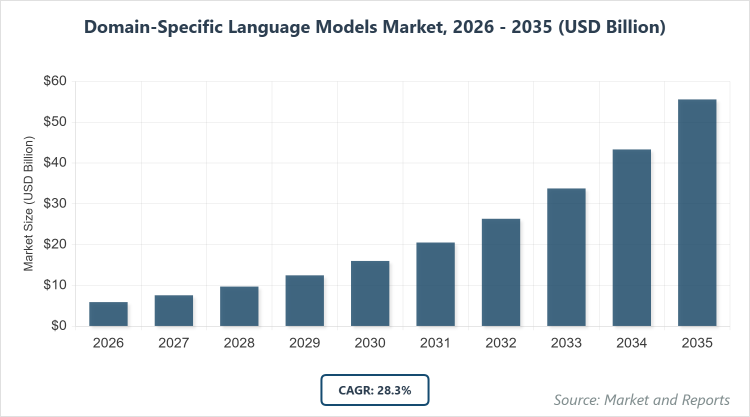
What are the Key Insights into the Domain-Specific Language Models Market?
- The global Domain-Specific Language Models Market was valued at USD 5.9 billion in 2025.
- The market is projected to grow at a CAGR of 28.3% from 2026 to 2035.
- The Domain-Specific Language Models Market is driven by increasing demand for industry-tailored AI, advancements in fine-tuning techniques, and regulatory compliance needs in sectors like healthcare and finance.
- Fine-Tuned Models dominate the Type segment with approximately 40% share because they offer customized accuracy by adapting pre-trained bases to specific domains, enabling efficient deployment without full retraining.
- Healthcare Diagnostics dominates the Application segment with around 30% share as it requires precise, compliant models for medical data analysis, reducing errors in general AI applications.
- Financial Institutions dominate the End-User segment with over 25% share since they handle sensitive data needing secure, domain-optimized models for fraud detection and analysis.
- North America dominates the global market with 35% share due to advanced AI infrastructure, high R&D investments, and strict regulations in the United States driving adoption in key sectors.
What is the Industry Overview of the Domain-Specific Language Models Market?
The Domain-Specific Language Models Market encompasses AI models trained or fine-tuned on specialized datasets for particular industries or fields, such as healthcare, finance, or legal, to deliver higher accuracy, relevance, and efficiency compared to general-purpose models by incorporating domain-specific terminology, regulations, and contexts. This market includes development, deployment, and integration of these models into applications for tasks like diagnostics, risk assessment, or contract analysis, addressing limitations of broad LLMs in precision and compliance. The market definition focuses on tailored NLP solutions that leverage transfer learning from base models to optimize performance in niche areas, driven by data privacy needs, regulatory requirements, and the push for AI-driven productivity in verticals, fostering innovation in customized intelligence systems.
What are the Market Dynamics of the Domain-Specific Language Models Market?
Growth Drivers
The Domain-Specific Language Models Market is propelled by the escalating need for precision in AI applications across regulated industries, where general models fall short in understanding specialized jargon and contexts, leading to investments in fine-tuning and domain adaptation to improve outcomes like diagnostic accuracy or financial forecasting. Advancements in transfer learning and efficient training methods reduce development costs, while the explosion of industry-specific data from IoT and digital transformation enables richer model training, supported by collaborations between AI firms and domain experts to create compliant, high-performance solutions that enhance operational efficiency and decision-making.
Restraints
High costs associated with curating domain-specific datasets and fine-tuning models, often requiring expert annotation and computational resources, limit accessibility for smaller enterprises and emerging markets. Data privacy concerns and regulatory hurdles in sharing sensitive information for training, along with potential biases in niche datasets, constrain scalability, while interoperability issues with existing systems and a shortage of skilled domain-AI specialists further impede widespread adoption.
Opportunities
Opportunities abound in integrating domain-specific models with edge computing for real-time applications in IoT-heavy sectors like manufacturing, alongside expansions into underserved areas such as legal tech and education through open-source frameworks. Partnerships for federated learning to train models without data centralization address privacy issues, while growing demand in developing regions for localized models in languages and contexts opens new markets, driven by AI ethics initiatives and funding for specialized AI research.
Challenges
Challenges involve mitigating hallucinations and ensuring reliability in high-stakes domains where errors can have severe consequences, compounded by the need for continuous updates to models amid evolving regulations and knowledge. Balancing model size for efficiency versus performance, addressing ethical concerns in biased training data, and navigating intellectual property issues in domain knowledge integration pose ongoing obstacles, requiring robust validation frameworks and interdisciplinary collaboration.
Domain-Specific Language Models Market: Report Scope
| Report Attributes | Report Details |
| Report Name | Domain-Specific Language Models Market |
| Market Size 2025 | USD 5.9 Billion |
| Market Forecast 2035 | USD 71.1 Billion |
| Growth Rate | CAGR of 28.3% |
| Report Pages | 220 |
| Key Companies Covered |
Google, Microsoft, OpenAI, IBM, Anthropic and Others. |
| Segments Covered | By Type, By Application, By End-User, and By Region. |
| Regions Covered | North America, Europe, Asia Pacific (APAC), Latin America, and The Middle East and Africa (MEA) |
| Base Year | 2025 |
| Historical Year | 2020 - 2024 |
| Forecast Year | 2026 - 2035 |
| Customization Scope | Avail customized purchase options to meet your exact research needs. |
What is the Market Segmentation of the Domain-Specific Language Models Market?
The Domain-Specific Language Models Market is segmented by Type, Application, End-User, and region.
By Type Segment, Fine-Tuned Models represent the most dominant segment while Pre-Trained Models stand as the second most dominant. Fine-Tuned Models lead due to their ability to leverage general pre-training while customizing for domain accuracy, driving market growth by offering cost-effective, high-precision solutions that accelerate adoption in specialized applications without extensive data requirements.
By Application Segment, Healthcare Diagnostics is the most dominant segment followed by Financial Analysis as the second most dominant. Healthcare Diagnostics dominates as it demands models compliant with medical standards for accurate analysis, propelling market expansion through improved patient outcomes and integration with health tech ecosystems.
By End-User Segment, Financial Institutions is the most dominant while Healthcare Providers constitute the second most dominant. Financial Institutions prevail owing to their need for secure, regulation-adherent models in risk and fraud tasks, supporting market growth by fostering trust in AI-driven financial services and encouraging investments in custom solutions.
What are the Recent Developments in the Domain-Specific Language Models Market?
- In 2025, Google Cloud launched enhanced domain-specific models for finance, integrating retrieval-augmented generation to improve accuracy in regulatory compliance tasks.
- Microsoft Azure expanded its healthcare-focused language models in early 2026, partnering with medical institutions for fine-tuning on anonymized data to enhance diagnostic support.
- OpenAI introduced customizable domain adapters for legal applications in late 2025, enabling faster fine-tuning and deployment for contract analysis.
- IBM Watson released updated models for manufacturing in 2026, incorporating federated learning to address data privacy in supply chain optimization.
What is the Regional Analysis of the Domain-Specific Language Models Market?
North America to dominate the global market
North America holds the leading position, primarily driven by the United States with its robust AI ecosystem, substantial R&D funding, and stringent data regulations fostering demand in finance and healthcare sectors.
Europe exhibits steady growth, led by Germany through EU-wide privacy laws like GDPR and initiatives for ethical AI, emphasizing models in automotive and legal domains.
Asia Pacific emerges as the fastest-growing region, spearheaded by China with rapid digitalization, government AI investments, and expanding tech industries requiring localized models.
Latin America shows promising development, with Brazil at the forefront via growing fintech adoption and partnerships for domain-specific AI in agriculture.
The Middle East and Africa are gradually advancing, led by the UAE through smart city projects and investments in oil & gas-optimized models, supported by international collaborations.
Who are the Key Market Players in the Domain-Specific Language Models Market?
Google focuses on cloud-based domain adaptations, leveraging Vertex AI for scalable fine-tuning in healthcare and finance to enhance enterprise adoption.
Microsoft emphasizes Azure integrations with domain datasets, pursuing partnerships for compliant models in legal and medical fields to drive Azure AI growth.
OpenAI adopts API-based customizations, investing in adapters for verticals like code development to accelerate developer ecosystems.
IBM prioritizes Watsonx for federated learning, targeting manufacturing and government with secure, on-premise solutions.
Anthropic pursues ethical domain models, collaborating on safety-focused adaptations for education and research applications.
What are the Market Trends in the Domain-Specific Language Models Market?
- Increasing adoption of RAG for enhanced accuracy in domain queries.
- Shift toward federated learning to maintain data privacy during training.
- Growth in open-source domain models for collaborative development.
- Expansion of multilingual capabilities for global market penetration.
- Focus on quantized models for efficient edge deployment.
- Integration with hybrid architectures for better generalization.
- Emphasis on ethical fine-tuning to reduce biases in specialized fields.
What Market Segments and their Subsegments are Covered in the Report?
By Type
- Pre-Trained Models
- Fine-Tuned Models
- Hybrid Models
- Multilingual Domain Models
- Retrieval-Augmented Generation (RAG) Models
- Quantized Models
- Edge-Deployed Models
- Federated Learning Models
- Custom-Built Models
- Open-Source Domain Models
- Others
By Application
- Healthcare Diagnostics
- Financial Analysis
- Legal Document Review
- Customer Service Automation
- Content Generation
- Code Development
- Supply Chain Optimization
- Marketing Personalization
- Research and Development
- Fraud Detection
- Others
By End-User
- Healthcare Providers
- Financial Institutions
- Legal Firms
- E-Commerce Companies
- Manufacturing Industries
- Government Agencies
- Educational Institutions
- Media and Entertainment
- IT and Software Companies
- Retail Sector
- Others
- North America
- U.S.
- Canada
- Europe
- UK
- Germany
- France
- Rest of Europe
- Asia Pacific
- China
- India
- Japan
- Rest of Asia Pacific
- Latin America
- Brazil
- Mexico
- Rest of Latin America
- Middle East & Africa
- UAE
- South Africa
- Rest of Middle East & Africa
Frequently Asked Questions
The Domain-Specific Language Models Market involves AI models tailored to specific industries for enhanced accuracy and compliance in tasks like diagnostics or analysis.
Key factors include AI advancements, regulatory needs, data availability, and demand for precision in vertical applications.
The market is expected to grow from approximately USD 5.9 billion in 2026 to USD 71.1 billion by 2035.
The CAGR is projected to be 28.3% during the forecast period.
North America will contribute notably, driven by innovation and regulations in the United States.
Major players include Google, Microsoft, OpenAI, IBM, and Anthropic.
The report provides detailed insights on size, segmentation, dynamics, trends, regions, players, and forecasts.
Stages include data curation, model training, fine-tuning, deployment, integration, and maintenance.
Trends favor privacy-focused training and edge deployment, while preferences shift to accurate, compliant models for industry tasks.
Factors include data privacy laws like GDPR and energy efficiency concerns in model training.