
Digital Transformation Consulting Market Size, Share and Forecast 2026 to 2035
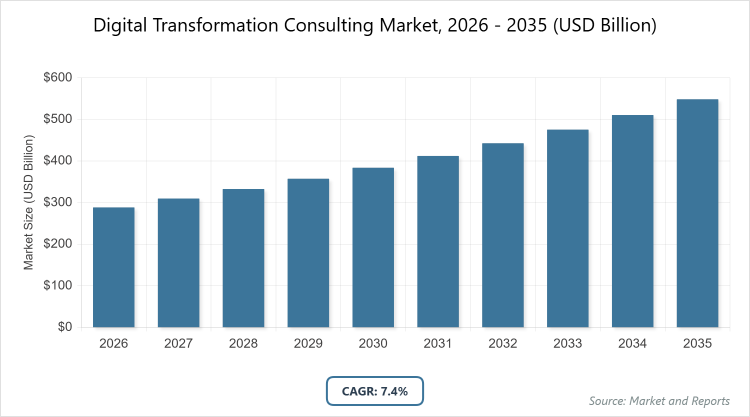
According to our latest research, the global digital transformation consulting market is projected to grow from USD 288.4 billion in 2026 to USD 548.29 billion by 2035, growing at a CAGR is estimated at 7.4% during 2026-2035. The Digital Transformation Consulting Market is primarily driven by the urgent need for “value orchestration,” where enterprises shift from isolated technology pilots to integrated, AI-native operating models that prioritize measurable ROI, operational agility, and hyper-personalized customer experiences.
What are the Key Insights into the Digital Transformation Consulting Market?
- Global market value projected to reach USD 548.29 billion by 2035 from USD 288.4 billion in 2026.
- Compound Annual Growth Rate (CAGR) estimated at 7.4% during 2026-2035.
- Implementation Consulting dominates the service type segment.
- Cloud-Based dominates the delivery model segment.
- Large Enterprises dominate the organization size segment.
- Financial Services dominates the industry vertical segment.
- North America dominates the regional market.
What is the Digital Transformation Consulting Market?
Industry Overview
The digital transformation consulting market involves professional services provided by specialized firms to help organizations integrate digital technologies into their operations, strategies, and business models to enhance efficiency, innovation, and competitiveness. This encompasses advising on the adoption of tools like cloud computing, artificial intelligence, data analytics, cybersecurity, and automation to streamline processes, improve customer experiences, and drive revenue growth. Consultants assess current systems, design tailored transformation roadmaps, implement solutions, and provide ongoing support, catering to various industries such as finance, healthcare, and manufacturing. The market addresses the need for businesses to adapt to rapid technological changes, navigate digital disruptions, and achieve sustainable growth in an increasingly connected world, often involving multidisciplinary expertise in IT, strategy, and change management.
What are the Market Dynamics in the Digital Transformation Consulting Market?
Growth Drivers
The digital transformation consulting market is driven by the escalating need for businesses to adopt advanced technologies like AI, cloud, and data analytics to remain competitive in a fast-evolving digital landscape, coupled with the push for operational efficiency and cost reduction through automation and process optimization. Increasing regulatory compliance requirements, such as data privacy laws, compel organizations to seek expert guidance, while the rise of remote work and e-commerce post-pandemic accelerates demand for digital infrastructure upgrades. Additionally, the focus on customer-centric strategies and personalized experiences fuels investments in transformation initiatives, supported by government incentives for digitalization in emerging economies.
Restraints
Restraints in the digital transformation consulting market stem from the high costs associated with consulting services and implementation, which can deter small and medium-sized enterprises with limited budgets, alongside the complexity of integrating new technologies with legacy systems that often leads to prolonged project timelines and resistance from employees. Rapid technological obsolescence requires constant upskilling, increasing overheads for consultants, while concerns over data security and potential cyber threats during transformations can cause hesitation among clients. Market fragmentation with numerous players also intensifies competition, potentially leading to price wars and reduced profit margins.
Opportunities
Opportunities abound in the digital transformation consulting market with the expansion into emerging technologies such as AI-driven analytics and sustainable digital solutions, allowing consultants to offer innovative services tailored to industry-specific needs like telehealth in healthcare or supply chain optimization in manufacturing. Growing demand in developing regions presents avenues for market penetration through localized strategies and partnerships, while the shift toward hybrid work models opens doors for consulting on remote collaboration tools. Leveraging data for predictive insights and focusing on cybersecurity enhancements can create niche expertise, fostering long-term client relationships and recurring revenue streams.
Challenges
Challenges in the digital transformation consulting market include navigating the rapidly changing technological environment that demands continuous adaptation and investment in R&D, compounded by the difficulty in measuring ROI on transformation projects which can lead to client dissatisfaction. Cultural resistance within organizations to change management poses hurdles in implementation, while stringent global regulations on data privacy and ethical AI use require compliance expertise that varies by region. Intense competition from in-house IT teams and low-cost providers further pressures margins, necessitating differentiation through specialized, value-added services.
Digital Transformation Consulting Market: Report Scope
| Report Attributes | Report Details |
| Report Name | Digital Transformation Consulting Market |
| Market Size 2025 | USD 288.4 Billion |
| Market Forecast 2035 | USD 548.29 Billion |
| Growth Rate | CAGR of 7.4% |
| Report Pages | 220 |
| Key Companies Covered | Accenture, Deloitte, IBM, Capgemini, PwC, Cognizant, Tata Consultancy Services, and Infosys |
| Segments Covered | By Service Type, By Delivery Model, By Organization Size, By Industry Vertical By Region |
| Regions Covered | North America, Europe, Asia Pacific (APAC), Latin America, The Middle East and Africa (MEA) |
| Base Year | 2025 |
| Historical Year | 2020 – 2024 |
| Forecast Year | 2026 – 2035 |
| Customization Scope | Avail customized purchase options to meet your exact research needs. |
What is the Market Segmentation Analysis for the Digital Transformation Consulting Market?
The digital transformation consulting market is segmented by service type, delivery model, organization size, industry vertical, and region.
By service type segment, Implementation Consulting emerges as the most dominant subsegment, followed by Managed Services as the second most dominant. Implementation Consulting leads due to its critical role in executing digital strategies, involving hands-on deployment of technologies like cloud migrations and AI integrations that directly translate plans into operational realities, appealing to organizations seeking tangible results; this dominance drives the market by ensuring successful adoption rates, reducing failure risks, and enabling scalable transformations that boost client confidence and encourage further investments in consulting services.
By delivery model segment, Cloud-Based stands out as the most dominant subsegment in the delivery model segment, with Hybrid as the second most dominant. Cloud-Based dominates owing to its flexibility, scalability, and cost-effectiveness, allowing rapid deployment of digital solutions without heavy upfront infrastructure investments, particularly favored by enterprises transitioning to remote and data-intensive operations; this leadership propels the market by facilitating faster time-to-value, enabling global accessibility, and integrating with emerging tech like AI, thereby attracting a broad client base and accelerating overall digital adoption.
By organization size segment, Large Enterprises are the most dominant subsegment in the organization size segment, followed by Small and Medium-Sized Enterprises (SMEs) as the second most dominant. Large Enterprises dominate because of their substantial budgets, complex operations, and strategic focus on comprehensive digital overhauls to maintain competitive edges in global markets, often involving multi-faceted transformations across departments; this position drives the market by generating high-value contracts, piloting advanced solutions, and setting industry benchmarks that influence smaller players to follow suit.
By industry vertical segment, Financial Services is the most dominant subsegment in the industry vertical segment, followed by Healthcare as the second most dominant. Financial Services leads due to stringent regulatory demands, the need for secure digital banking, fintech innovations, and data analytics for fraud detection and customer personalization, making it a high-priority sector for consulting investments; this dominance accelerates market dynamics by driving demand for specialized expertise, fostering technological integrations that enhance efficiency, and creating spillover effects to adjacent industries through best practices.
What are the Recent Developments in the Digital Transformation Consulting Market?
- In August 2025, Accenture announced a partnership with a leading fintech firm to develop advanced digital payment solutions, aiming to enhance transaction security and user experience through AI and blockchain integrations, marking a strategic move to capture the growing fintech consulting space.
- In September 2025, Deloitte launched a new initiative to integrate sustainability into its digital transformation consulting services, focusing on eco-friendly tech implementations like green cloud computing to appeal to environmentally conscious clients and align with global ESG standards.
- In July 2025, IBM unveiled a new AI-driven analytics platform to optimize supply chain operations, designed to help clients achieve real-time visibility and predictive capabilities, reinforcing its position in operational transformation consulting.
What is the Regional Analysis of the Digital Transformation Consulting Market?
- North America to dominate the market
North America holds the largest share in the digital transformation consulting market, characterized by advanced technological infrastructure, high adoption of AI and cloud services, and a concentration of innovative enterprises; the United States dominates this region with its tech hubs like Silicon Valley, robust venture capital for digital initiatives, and regulatory frameworks supporting data-driven transformations, driving growth through collaborations between consultants and industries like finance and tech to enhance competitiveness and efficiency.
Europe represents a mature market with strong emphasis on data privacy and sustainable practices, where Germany leads as the dominating country through its industrial strength in manufacturing, EU-funded digital projects, and focus on Industry 4.0, enabling consultants to provide specialized services in automation and cybersecurity that bolster economic resilience across the continent.
Asia Pacific is the fastest-growing region, propelled by rapid urbanization, digital economy expansions, and government policies promoting tech adoption; China dominates here with its massive investments in AI and 5G, state-backed initiatives like Digital Silk Road, and a burgeoning startup ecosystem that demands consulting for scalable transformations in e-commerce and manufacturing.
Latin America shows emerging potential with increasing digital inclusion and foreign investments, led by Brazil as the dominating country through its vibrant fintech sector, government programs for digital infrastructure, and consulting needs in agriculture and retail to address economic disparities and boost productivity.
The Middle East and Africa region is gaining momentum through oil diversification and smart city projects, with the United Arab Emirates dominating due to its visionary initiatives like Dubai’s Smart City, investments in AI and blockchain, and attraction of global consultants to support tourism, finance, and healthcare transformations.
Who are the Key Market Players and Their Strategies in the Digital Transformation Consulting Market?
- Accenture focuses on strategic partnerships and acquisitions to expand its digital capabilities, investing in AI and sustainability integrations to deliver end-to-end transformation solutions across industries.
- Deloitte emphasizes industry-specific expertise and data analytics, leveraging global networks for customized consulting and prioritizing ESG factors in transformations to build long-term client trust.
- IBM pursues innovation through AI and cloud platforms, forming alliances with tech vendors to offer hybrid solutions and focusing on supply chain optimizations for operational efficiency.
- Capgemini adopts a client-centric approach with agile methodologies, investing in R&D for emerging tech like quantum computing and expanding in Europe through regulatory compliance services.
- PwC utilizes advisory services combined with tech audits, emphasizing cybersecurity and risk management while partnering with startups to infuse innovative strategies into transformations.
- Cognizant concentrates on digital engineering and AI, employing nearshore delivery models for cost-effective implementations and targeting healthcare and finance for specialized growth.
- Tata Consultancy Services leverages its IT heritage for scalable solutions, focusing on Asia Pacific expansions and sustainability-driven transformations through global delivery centers.
- Infosys prioritizes acquisitions for capability enhancement, integrating AI ethics and automation to provide value-based consulting in emerging markets.
What are the Market Trends in the Digital Transformation Consulting Market?
- Increased integration of artificial intelligence and machine learning for predictive analytics and automation in business processes.
- Shift toward cloud-based and hybrid delivery models to enhance scalability and flexibility in digital implementations.
- Growing emphasis on customer experience transformation through personalized and data-driven strategies.
- Rise in cybersecurity consulting to address evolving threats and ensure data privacy compliance.
- Adoption of agile methodologies for faster project delivery and adaptability to market changes.
- Focus on sustainability and ESG factors in digital transformation initiatives.
- Expansion of services into emerging markets with tailored, localized digital strategies.
- Use of data analytics for informed decision-making and operational optimizations.
- Partnerships between consulting firms and tech providers for innovative solution ecosystems.
- Incorporation of advanced technologies like IoT and blockchain for industry-specific applications.
What Market Segments are Covered in the Digital Transformation Consulting Market Report?
By Service Type
- Strategy Consulting
- Implementation Consulting
- Managed Services
- Training and Education
- Outsourcing
By Delivery Model
- On-Premise
- Cloud-Based
- Hybrid
By Organization Size
- Small and Medium-Sized Enterprises (SMEs)
- Large Enterprises
By Industry Vertical
- Financial Services
- Healthcare
- Manufacturing
- Retail and Consumer Products
- Technology and Telecommunications
By Region
- North America
- U.S.
- Canada
- Europe
- UK
- Germany
- France
- Rest of Europe
- Asia Pacific
- China
- India
- Japan
- Rest of Asia Pacific
- Latin America
- Brazil
- Mexico
- Rest of Latin America
- Middle East & Africa
- UAE
- South Africa
- Rest of Middle East & Africa
Chapter 1. Preface
Chapter 2. Executive Summary
Chapter 3. Global Digital Transformation Consulting Market - Industry Analysis
Chapter 4. Global Digital Transformation Consulting Market- Competitive Landscape
Chapter 5. Global Digital Transformation Consulting Market - Service Type Analysis
Chapter 6. Global Digital Transformation Consulting Market - Delivery Model Analysis
Chapter 7. Global Digital Transformation Consulting Market - Organization Size Analysis
Chapter 8. Global Digital Transformation Consulting Market - Industry Vertical Analysis
Chapter 9. Digital Transformation Consulting Market - Regional Analysis
Chapter 10. Company Profiles
Frequently Asked Questions
Digital transformation consulting refers to advisory services that assist organizations in leveraging digital technologies to revamp their business models, processes, and customer interactions for improved efficiency and growth.
Key factors include the adoption of AI and cloud technologies, regulatory compliance needs, focus on operational efficiency, expansion in emerging markets, and emphasis on sustainability and cybersecurity.
The market is projected to grow from USD 288.4 billion in 2026 to USD 548.29 billion by 2035.
The CAGR is estimated at 7.4% during 2026-2035.
North America will contribute notably, holding the largest share due to advanced infrastructure and high technology adoption.
Major players include Accenture, Deloitte, IBM, Capgemini, PwC, Cognizant, Tata Consultancy Services, and Infosys.
The report offers comprehensive insights into market size, forecasts, segmentation, regional analysis, key players, trends, dynamics, and recent developments to inform strategic planning.
The value chain includes assessment and strategy development, technology selection and planning, implementation and integration, training and change management, and ongoing monitoring and optimization.
Trends are evolving toward AI integration, cloud adoption, and sustainability focus, with clients preferring agile, customized solutions that emphasize data security and customer-centric outcomes.
Regulatory factors involve compliance with data privacy laws like GDPR, while environmental factors include the push for sustainable tech practices to reduce carbon footprints in digital infrastructures.